

Master Korean Second-Hand Deals: How to Set the Perfect Meetup Time & Place on Karrot
Phase 1: Empathy & Story-Driven Opening
안녕하세요! This is your Daily Hangul editor and your personal Korean culture navigator!
Picture this: You finally found that limited-edition K-pop vinyl or a barely-used vintage jacket on Danggeun Market (Karrot). Your heart is racing, you send a polite offer, and the seller replies instantly: “네, 직거래 가능합니다! 어디서 뵐까요?” (Yes, in-person trade is possible! Where shall we meet?). Suddenly, cold sweat kicks in. How do you suggest a convenient spot without sounding demanding? What if you need to adjust the time around your busy schedule?
Navigating second-hand transactions (직거래, jik-georae) in Korea is practically an art form of polite negotiation, subtle consideration (배려, baeryeo), and community etiquette. Today, we’re unpacking authentic B2-level phrases and unspoken cultural rules so you can coordinate meetups smoothly, protect your privacy, and boost your Karrot “Manners Temperature” (매너온도) like a true local!
Phase 2: Top 3 Core Expressions in Depth
1. 혹시 중간 지점에서 뵐 수 있을까요? (Hoksi junggan jijeom-eseo boel su isseulkkayo?)
- Pronunciation: [Hok-shi joong-gahn jee-jeom-eh-suh boel soo ee-sseul-kka-yo?]
- Meaning: Literal: “By any chance, can we meet at the middle point?” | Nuance: “Would it be possible to meet halfway if it isn’t too inconvenient for you?”
- K-Culture Moment: Seen frequently in slice-of-life K-dramas when two characters living across the Han River try to find a neutral subway transfer station like Wangsimni or Express Bus Terminal.
- Editor’s Insight: Starting with 혹시 (by any chance) instantly softens the request, showing that you respect the seller’s schedule rather than demanding they travel to you.
- Situation Spectrum: Casual ⚠️ | Semi-formal ✅ | Formal ✅
- 🤔 Think About It: In your home country, do buyers usually travel all the way to the seller’s doorstep, or is meeting halfway standard practice?
2. 몇 번 출구 앞에서 뵈면 편하실까요? (Myeot beon chulgu ap-eseo boemyeon pyeonhasilkkayo?)
- Pronunciation: [Myut-beon chool-goo ahp-eh-suh boe-myeon pyun-hah-sheel-kka-yo?]
- Meaning: Literal: “In front of which exit would meeting be comfortable for you?” | Nuance: “Which subway exit works best for you?”
- K-Culture Moment: Korean subway stations are massive community hubs. Asking for the specific exit number shows top-tier spatial consideration.
- Editor’s Insight: Using the honorific verb form 뵈다 (boeda – humble form of ‘to meet’) combined with 편하시다 (to be comfortable) elevates your communication to natural, respectful B2 fluency.
- Situation Spectrum: Casual 🚫 | Semi-formal ✅ | Formal ✅
- 🤔 Think About It: Why is asking about the counterparty’s convenience prioritized before stating your own location preference in Korea?
3. 퇴근 후 7시쯤 거래 가능하신가요? (Twegeun hu ilgopsijjeum georae ganeunghasingayo?)
- Pronunciation: [Tway-geun hoo eel-gop-shee-jjeum guh-rae gah-neung-hah-sheen-gah-yo?]
- Meaning: Literal: “Is trading possible around 7 PM after work?” | Nuance: “Would around 7 PM after typical working hours suit you for the transaction?”
- K-Culture Moment: The evening rush hour trade! Between 6:30 PM and 8:00 PM near station gates is the golden hour for neighborhood trade meetups.
- Editor’s Insight: The particle ~쯤 (around/approximately) is vital; giving an exact time like 7시 정각 (7:00 sharp) can feel overly rigid for a casual community deal.
- Situation Spectrum: Casual ⚠️ | Semi-formal ✅ | Formal ✅
- 🤔 Think About It: How does attaching approximate time markers reflect the flexible yet busy rhythm of Korean city life?
Phase 3: Textbook Korean vs. Real Korean
Situation A: Asking for the Other Person’s Location Preference
- 📖 Textbook Korean: 어디서 만날까요? (Eodiseo mannalkkayo? – “Where shall we meet?”)
- 🗣️ Real Korean: 혹시 편하신 장소나 역 있으신가요? (Hoksi pyeonhasin jangsona yeok isseusingayo? – “Do you happen to have a preferred station or spot that’s convenient for you?”)
- 💡 Why the Difference? While the textbook version is grammatically correct, it can sound slightly blunt. Real Korean uses 편하신 (comfortable) to display active politeness.
Situation B: Setting an Evening Meeting Time
- 📖 Textbook Korean: 저녁 6시에 만납시다. (Jeonyeok yeoseotsie mannapsida. – “Let us meet at 6 in the evening.”)
- 🗣️ Real Korean: 퇴근하고 6시 반 이후로 시간 괜찮으실까요? (Twegeunhago yeoseot si ban ihuro sigan gwaenchanheusilkkayo? – “Would any time after 6:30 PM after work work well for you?”)
- 💡 Why the Difference? Suggesting an open range (~이후로, after…) allows the counterparty to check their commuting transit time without feeling cornered.
Phase 4: K-Culture Deep Dive & Non-Verbal Manners
4-1. Nunchi & Physical Etiquette During Direct Meetups
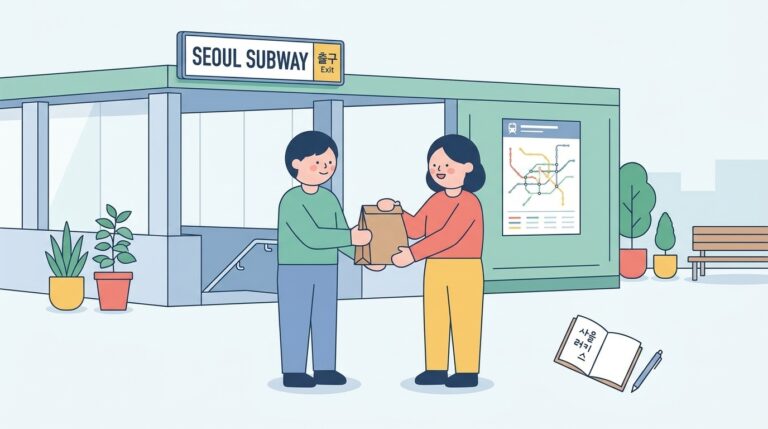
- The Discreet Paper Bag Rule: Most Korean sellers bring items in a clean shopping bag or poly-mailer rather than handing bare items. Bringing exact change or transferring via bank app/Toss right on the spot is appreciated.
- Two-Handed Exchange: Handing over items and checking the goods should always be done with both hands or supporting your right wrist with your left hand.
- Punctuality & Instant Chat: If you are running even 3 minutes late, message immediately: “도착 3분 전입니다!” (3 minutes away!). Korean buyers and sellers value swift, predictable communication.
4-2. Cultural Code: The Magic Password “당근이세요?”
When you spot someone lingering near Exit 3 holding a distinctive shopping bag while glancing at their phone, you don’t say “Hello, are you the seller?” You smile and ask softly: “혹시… 당근이세요?” (Excuse me… are you from Karrot?). It’s an endearing national greeting that instantly breaks the ice across all generations.
Phase 5: Real-Life Roleplay Scenario
Setting: Chat room on Karrot Market. You are purchasing a vintage camera from seller “Min-seo” (민서).
- You: 안녕하세요! 올리신 필름 카메라 아직 구매 가능한가요?
(Annyeonghaseyo! Ollisin pilleum kamera ajik gumae ganeunghangayo?)
[🎭 Polished greeting] “Hello! Is the film camera you posted still available for purchase?” - Min-seo: 네, 안녕하세요! 구매 가능하세요. 직거래 원하시나요?
(Ne, annyeonghaseyo! Gumae ganeunghaseyo. Jikgeorae wonhasingayo?)
[🎭 Prompt reply] “Yes, hello! It is available. Would you prefer an in-person trade?” - You: 네! 제가 합정역 근처에 사는데, 혹시 어느 역이 편하세요?
(Ne! Jega Hapjeong-yeok geuncheoe saneunde, hoksi eoneu yeogi pyeonhaseyo?)
[🎭 Sharing general area first] “Yes! I live near Hapjeong Station, which station would be convenient for you?” - Min-seo: 저도 2호선 라인이라 합정역 8번 출구 쪽 괜찮아요!
(Jeodo i-hoseon rain-ira Hapjeong-yeok pal-beon chulgu jjok gwaenchanh-ayo!)
[🎭 Agreeing on spot] “I’m on Line 2 as well, so near Hapjeong Station Exit 8 works great for me!” - You: 다행이네요! 평일 퇴근 후 7시쯤 시간 괜찮으실까요?
(Dahaeng-ineyo! Pyeong-il twegun hu ilgopsijjeum sigan gwaenchanheusilkkayo?)
[🎭 Suggesting time window] “What a relief! Would around 7 PM on a weekday after work work for you?” - Min-seo: 내일(수요일) 저녁 7시 합정역 8번 출구 개찰구 앞 어떠세요?
(Naeil(suyoil) jeonyeok ilgopsi Hapjeong-yeok pal-beon chulgu gaechalgu ap eotteoseyo?)
[🎭 Pinpointing specific fixture] “How about tomorrow (Wednesday) at 7 PM in front of the Exit 8 turnstiles at Hapjeong Station?” - You: 네, 좋습니다! 내일 출발할 때 다시 채팅 드릴게요.
(Ne, jotseumnida! Naeil chulbalhal ttae dasi chaeting deurilgeyo.)
[🎭 Confirming update habit] “Yes, sounds great! I’ll message you again when I head out tomorrow.” - Min-seo: 네, 내일 뵙겠습니다. 조심히 오세요!
(Ne, naeil boepgetseumnida. Josimhi oseyo!)
[🎭 Warm sign-off] “Great, see you tomorrow. Safe travels on your way!”
🔀 Interactive Branching Point
Min-seo unexpectedly messages 15 minutes before the meetup: “퇴근이 조금 늦어져서 15분 정도 늦을 것 같아요. 죄송합니다ㅠㅠ” (My work finished a bit late so I might be 15 mins late. So sorryㅠㅠ). How do you respond?
- Option A: 천천히 조심히 오세요! 근처 카페에 앉아있을게요. 도착하시면 채팅 주세요! (Cheoncheonhi josimhi oseyo! Geuncheo kape-e anja-isseulgeyo. Dochakhasimyeon chaeting juseyo!)
- 👉 Feedback (Best Choice): 🌟 100% Manner Rating! Reassures the seller, removes tension, and clearly states your waiting spot.
- Option B: 왜 늦으세요? 빨리 와주세요. (Wae neujeuseyo? Ppal-li wajuseyo.)
- 👉 Feedback (Bad Choice): 🚫 Very abrasive and confrontational. Destroys rapport instantly in a community market setting.
- Option C: 네. 그럼 역 앞에서 서서 기다릴게요. (Ne. Geureom yeok ap-eseo seoseo gidarilgeyo.)
- 👉 Feedback (Risky Choice): ⚠️ Grammatically fine, but “standing and waiting” can make the other person feel excessively guilty and pressured.
Phase 6: 10-Second Emotional Shadowing Drill
Practice matching natural pauses (/) and emotional tone:
[😊 Politeness & Warmth]
혹시 / 편하신 장소나 / 시간이 있으실까요?
(Hoksi / pyeonhasin jangsona / sigani isseusilkkayo?)[🤝 Considerate Coordination]
제가 그쪽으로 갈 테니 / 역 출구 번호만 / 알려주세요!
(Jega geujjogeuro gal teni / yeok chulgu beonhoman / allyojuseyo!)[👋 Cheerful Greeting on Meetup]
안녕하세요! / 혹시 / 당근마켓 판매자님 맞으실까요?
(Annyeonghaseyo! / Hoksi / Danggeun-maket panmaejanim majeusilkkayo?)
Phase 7: K-Culture Mini Dictionary
- 직거래 (Jik-georae) | In-person direct transaction. Preferred in Korea to verify item condition and avoid shipping fees.
- 네고 (Nego) | Short for ‘negotiation’ (price drop). Usually asked respectfully in advance (네고 가능한가요?), never bargained unexpectedly at the meetup.
- 매너온도 (Maeneo-ondo) | Karrot’s “Manners Temperature” starting at 36.5°C (human body temp). Respectful communication raises it above 40°C+!
- 쿨거래 (Kul-georae) | “Cool deal” – A smooth, rapid transaction with zero hesitation, no last-minute haggling, and punctual meetup.
Phase 8: Traveler’s Survival Kit
Top 3 Survival Phrases
- 개찰구 밖으로 안 나가고 거래 가능할까요? (Gaechalgu bakkeuro an nagago georae ganeunghalkkayo?)
Pro Tip: Useful when you want to trade across the subway fare gate without tapping out and paying extra transit fare! - 도착해서 3번 출구 기둥 옆에 서 있어요. (Dochakhaeseo sambeon chulgu gidung yeope seo isseoyo.)
Pro Tip: Pinpoint a landmark (column, ATM, convenience store) to spot each other instantly. - 상태 확인했습니다. 계좌로 바로 입금해 드릴게요! (Sangtae hwaginhaetseumnida. Gyejwaro baro ipgeumhae deurilgeyo!)
Pro Tip: Say this as you check the item and execute the bank transfer on your banking app.
Editor’s Travel Note
When pinning a meetup location, use the Naver Map location share feature rather than just typing a vague building name. If you are meeting in public apartments, designate the security booth (경비실 앞, gyeongbisil ap) or main entrance gate (정문 차단기 앞, jeongmun chadangi ap).
Phase 9: “One Step Deeper” (Cultural Reflection)
In many global metropolitan areas, meeting an unknown stranger for second-hand deals can feel intimidating, often requiring designated police station parking lots. In contrast, Korea’s hyper-localized second-hand culture flourishes on street corners, subway station turnstiles, and apartment playgrounds. This reflects Korea’s deep sense of Jeong (정) and shared civic neighborhood trust (이웃사촌). Treating trade partners with polite honorifics isn’t just about formality—it’s about affirming mutual respect within a close-knit urban community.
💬 Your Turn: Have you ever tried trading second-hand items abroad? What location would feel safest and most convenient for you in your city? Share in the comments below!
Phase 10: FAQ & Common Mistakes
Q: Is it rude to ask for a discount when meeting in person?
A: Yes, absolutely. Last-minute haggling in person (현장 네고) is considered one of the worst etiquette breaches in Korea. Any price adjustment must be agreed upon beforehand in chat.
Q: What if I don’t speak enough Korean to explain where I’m standing?
A: Send a quick photo of your exact surroundings via the chat app alongside the text: “여기 앞에 있어요!” (I am in front of here!). Visual cues work wonders.
Q: Can I bring cash instead of mobile bank transfer?
A: Yes, but make sure to prepare the exact amount. Asking a private seller for change on the street creates unnecessary awkwardness.
🚨 Common Mistakes Alert
| Mistake | Why it hurts communication | Correct Action |
|---|---|---|
| Demanding the seller come to your house | Feels intrusive and inconsiderate | Propose a public halfway point (중간 지점) |
| Using casual talk (반말) because it’s casual chat | Lowers your trade trust score instantly | Always stick to polite 해요체 / 하십시오체 |
| Arriving late without sending a chat notice | Major penalty on seller evaluation | Send ETA when you are 5–10 minutes away |
Phase 11: Action Missions
- 🥉 Bronze Mission (Solo Practice): Read out loud the phrase “몇 번 출구 앞에서 뵈면 편하실까요?” 5 times with a polite, smiling tone.
- 🥈 Silver Mission (Social Share): Leave a comment below translating your favorite subway station meetup spot into Korean!
- 🥇 Gold Mission (Real Life): Open Karrot or Bungaejangter, find an item you want, and initiate a meetup chat using the formulas learned today.
- 🎮 K-Culture Mission: Look out for a second-hand meetup scene in modern Korean variety shows (like Hangout with Yoo) and spot how they greet each other with “당근이세요?”.
Phase 12: Interactive Quiz Challenge
1. Situation Judgement
You want to propose meeting at Gangnam Station, but you want to check if the seller agrees politely. Which sentence is best?
– (A) 강남역으로 오세요. (Gangnamyeog-euro oseyo.)
– (B) 강남역 쪽에서 뵙는 건 괜찮으실까요? (Gangnamyeok jjok-eseo boemneun geon gwaenchanheusilkkayo?)
– (C) 강남역에서 만납시다. (Gangnamyeog-eseo mannapsida.)
2. Fill in the Blank
Complete the respectful phrase asking for the exit number:
“합정역 몇 번 ( _____ ) 앞에서 뵐까요?”
3. True / False Culture Check
True or False: In Korean Karrot trading, it is considered polite and normal to ask for a 5,000 KRW discount on the spot while inspecting the item in person.
👉 Click to Reveal Answers & Explanations!
- Answer: (B) — 강남역 쪽에서 뵙는 건 괜찮으실까요? is gentle, uses respectful verb 뵙다, and asks for their consent.
- Answer: 출구 (Chulgu – Exit) — 합정역 몇 번 출구 앞에서 뵐까요? (In front of which exit of Hapjeong Station shall we meet?).
- Answer: False — On-site haggling (현장 네고) is considered rude and hurts your manners rating! All negotiations should happen beforehand.







