

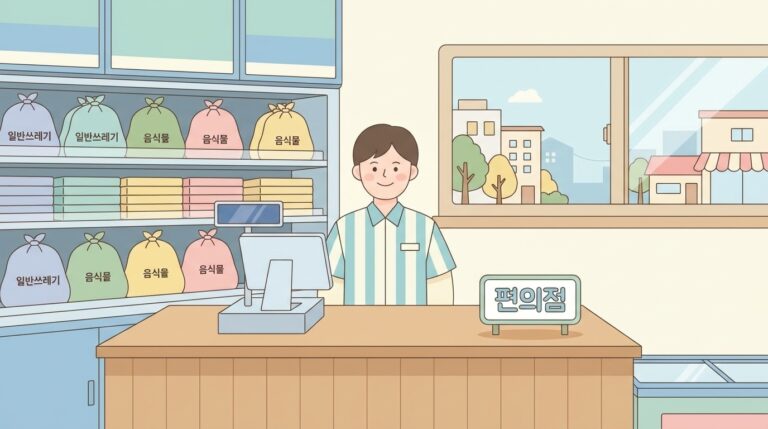
Phase 1: Empathy (Story-based Opening)
안녕하세요! 매일한글 에디터입니다. (Hello! This is your Daily Hangul editor.)
Picture this: You just moved into a cozy Airbnb in Hongdae or a stylish studio in Gangnam. You spent your first weekend binge-watching K-dramas with delicious late-night chimaek (fried chicken and beer) and delivery tteokbokki. But Monday morning arrives, and reality hits—a mountain of takeout containers, snack wrappers, and tissues sits in your corner.
You confidently grab your trash, walk downstairs, and suddenly notice colorful bags neatly stacked outside, each bearing official district stamps. You head to the nearest convenience store, freeze in front of the cashier, and wonder: How on earth do I ask for an official trash bag in Korean without accidentally getting a grocery bag?
If you have ever felt overwhelmed by Korea’s strict waste sorting rules, don’t worry! You are definitely not alone. Mastering the phrase to buy regular trash bags (종량제 봉투) is an essential milestone for every expat, student, and traveler in Korea. In this guide, tailored specifically for A2 elementary learners, we’ll turn that awkward convenience store encounter into a smooth, 10-second interaction you can nail every single time.
Phase 2: Core 3 Expressions
1. 일반 쓰레기 봉투 주세요 (Il-ban sseu-re-gi bong-tu ju-se-yo)
- Pronunciation: [Il-ban sseu-re-gi bong-tu ju-se-yo] (Sounds like: Eel-bahn ssoo-reh-gee bong-too joo-seh-yo)
- Meaning: “Please give me a regular waste bag.”
- K-Culture Moment: You will hear this in almost every K-drama slice-of-life scene when a character moves out into their first one-room apartment and visits the corner GS25 or CU.
- Editor’s Insight: In Korea, “일반 쓰레기” (general waste) refers to anything that is non-recyclable and non-food waste. Saying “봉투 주세요” alone might get you a normal shopping plastic bag, so adding “일반 쓰레기” is the magic keyword.
- Situation Spectrum: Casual (⚠️ 일반 쓰레기 봉투 줘) / Semi-formal (✅ 일반 쓰레기 봉투 주세요) / Formal (✅ 일반 쓰레기 종량제 봉투 부탁드립니다)
- 🤔 Think About It: In many Western countries, any plastic bag works for garbage. Why do you think Korea requires standardized, government-issued bags for non-recyclables?
2. 10리터짜리 한 장 주세요 (Sim-ni-teo-jja-ri han jang ju-se-yo)
- Pronunciation: [Sim-ni-teo-jja-ri han jang ju-se-yo] (Sounds like: Sheem-nee-tuh-jjah-ree hahn jahng joo-seh-yo)
- Meaning: “Please give me one 10-liter bag.”
- K-Culture Moment: When ordering at the counter, cashiers will immediately ask, “몇 리터로 드릴까요?” (What size would you like?). Responding with the exact volume makes you sound like a 5-year resident!
- Editor’s Insight: For solo living (자취 – jachwi), 10L or 20L is the sweet spot. 10L is pronounced 십 리터 (sim-ni-teo) due to Korean nasalization rules where ‘ㅂ’ meets ‘ㄹ/ㄴ’.
- Situation Spectrum: Casual (⚠️ 10리터 하나 줘) / Semi-formal (✅ 10리터짜리 한 장 주세요) / Formal (✅ 10리터 규격으로 1매 부탁드립니다)
- 🤔 Think About It: Notice the counter word “장” (jang) used for flat items like paper and plastic sheets. How does using specific counters change the rhythm of Korean speech?
3. 이 동네 봉투 맞아요? (I dong-ne bong-tu ma-ja-yo?)
- Pronunciation: [I dong-ne bong-tu ma-ja-yo?] (Sounds like: Ee dong-neh bong-too mah-jah-yoh?)
- Meaning: “Is this the valid bag for this neighborhood/district?”
- K-Culture Moment: Often asked by locals who live near district borders (e.g., between Mapo-gu and Seodaemun-gu) to avoid getting a bag that municipal sanitation workers won’t collect.
- Editor’s Insight: Seoul is divided into 25 districts (구 – gu). A Mapo-gu bag cannot be collected if disposed of in Gangnam-gu! It is always wise to double-check.
- Situation Spectrum: Casual (⚠️ 여기 봉투 맞아?) / Semi-formal (✅ 이 동네 봉투 맞아요?) / Formal (✅ 해당 구역 종량제 봉투가 맞습니까?)
- 🤔 Think About It: How does localized municipal waste management reflect the concept of local community responsibility (지역 공동체) in modern Korea?
Phase 3: Textbook Korean vs Real-life Korean
Situation 1: Asking if they sell trash bags
- 📖 교과서 한국어 (Textbook): “종량제 봉투를 이곳에서 판매하고 계십니까?” (Do you sell volume-rate waste disposal bags here?)
- 🗣️ 진짜 한국어 (Real-life): “일반 쓰레기 봉투 있어요?” (Do you have regular trash bags?)
- 💡 Why the difference? Textbook phrases sound like a formal business inquiry from the 1990s. In real life, simple verb endings like ~있어요? (Do you have~?) are standard, polite, and natural.
Situation 2: Buying just one piece
- 📖 교과서 한국어 (Textbook): “십 리터 용량의 규격 봉투 한 장을 주십시오.” (Please give me one standardized bag of ten liters capacity.)
- 🗣️ 진짜 한국어 (Real-life): “10리터 한 장만 주세요!” (Just one 10-liter bag, please!)
- 💡 Why the difference? Real Koreans value brevity (빠름 빠름 culture) at convenience store counters. Adding ~만 (only/just) clarifies that you don’t need a whole 10-pack bundle.
Phase 4: K-Culture Deep Dive & Non-verbal Manners
4-1. 눈치 (Nunchi) & Counter Etiquette
- Eye Contact & Position: Trash bags are usually stored folded inside drawers directly beneath the cash register or hung on hooks behind the clerk. When you ask, make brief polite eye contact and slightly nod.
- Two-Hand Manner (두 손 예절): When handing over your credit card or T-money card, and when receiving the folded white/blue trash bag, use both hands (or touch your right elbow with your left hand). This shows respect and creates instant goodwill.
- Cash or Card: In the past, government trash bags required cash, but today, almost all convenience stores accept credit cards, mobile pay, and transportation cards without issue.
4-2. Cultural Code: The Art of “종량제” (Volume-Rate System)
Introduced nationally in 1995, Korea’s Jongnyangje system revolutionized environmental habits. By paying for official waste bags, residents directly pay for the volume of trash they generate, turning Korea into one of the world’s top recycling nations. If you watch modern K-dramas like My Liberation Notes or Reply 1988, community cleanliness and organized collection stations are central backdrops of daily Korean neighborhood life.
Phase 5: Real-Life Roleplay Scenario
Setting: A 7-Eleven in Yeonnam-dong, Mapo-gu, Seoul. 8:30 PM.
Characters: Alex (Foreign exchange student, A2) & Min-woo (Friendly Part-time Clerk, 20s).
- Turn 1 (Alex): 🎭 (Approaches the counter with a polite nod)
안녕하세요! 혹시 일반 쓰레기 봉투 있어요?
(An-nyeong-ha-se-yo! Hok-si il-ban sseu-re-gi bong-tu it-seo-yo?)
“Hello! By any chance, do you have regular trash bags?” - Turn 2 (Min-woo): 🎭 (Smiles and reaches under the counter)
네, 있어요! 몇 리터로 드릴까요?
(Ne, it-seo-yo! Myeot ni-teo-ro deu-ril-kka-yo?)
“Yes, we do! What size (liter) would you like?” - Turn 3 (Alex): 🎭 (Thinks for a second about his room size)
혼자 사는데, 10리터짜리 많이 써요?
(Hon-ja sa-neun-de, sim-ni-teo-jja-ri ma-ni sseo-yo?)
“I live alone; do people use the 10-liter one a lot?” - Turn 4 (Min-woo): 🎭 (Nods knowingly)
네, 자취하시면 10리터가 딱 좋아요. 20리터는 너무 커요.
(Ne, ja-chwi-ha-si-myeon sim-ni-teo-ga ttak jo-a-yo. I-sip-ni-teo-neun neo-mu keo-yo.)
“Yes, if you live alone, 10 liters is just right. 20 liters is too big.” - Turn 5 (Alex): 🎭 (Smiles with confidence)
그럼 10리터짜리 한 장 주세요!
(Geu-reom sim-ni-teo-jja-ri han jang ju-se-yo!)
“Then please give me one 10-liter bag!” - Turn 6 (Min-woo): 🎭 (Takes out a bag and unfolds it slightly to show the seal)
마포구 거 맞으시죠? 300원입니다.
(Ma-po-gu geo ma-jeu-si-jyo? Sam-baek-wo-nim-ni-da.)
“You need the Mapo-gu one, right? That will be 300 KRW.” - Turn 7 (Alex): 🎭 (Hands over the payment card with both hands)
네, 맞아요. 카드로 계산할게요.
(Ne, ma-ja-yo. Ka-deu-ro gye-san-hal-ge-yo.)
“Yes, that’s right. I’ll pay by card.” - Turn 8 (Min-woo): 🎭 (Hands over the card and receipt with two hands)
결제 되셨습니다. 안녕히 가세요!
(Gyeol-je doe-syeot-seum-ni-da. An-nyeong-hi ga-se-yo!)
“Payment complete. Have a great day!”
🔀 Interactive Decision Point
If the cashier asks: “몇 리터로 드릴까요?” (What size would you like?), how should you reply?
- Option A: “10리터 한 장 주세요.” (Please give me one 10-liter bag.)
👉 [Best Choice ⭐] Clear, polite, and specifies both quantity and size. Zero confusion! - Option B: “쓰레기 봉투요.” (Trash bag.)
👉 [Risk ⚠️] Cashier will stare at you and repeat: “몇 리터요…?” (How many liters…?). - Option C: “비닐봉지 주세요.” (Please give me a plastic shopping bag.)
👉 [Bad ❌] You will receive a regular 100-won shopping bag that cannot be used for trash disposal!
Phase 6: 10-Second Emotion Shadowing Drill
Practice matching the native speaker’s speed, pauses (/), and natural pitch:
[😊 Friendly & Inquiring]
저기요! / 일반 쓰레기 봉투 / 있어요?
(Jeo-gi-yo! / Il-ban sseu-re-gi bong-tu / it-seo-yo?)-
[💡 Clear & Decisive]
10리터짜리 / 한 장만 / 주세요!
(Sim-ni-teo-jja-ri / han jang-man / ju-se-yo!) -
[🤝 Polite & Inquiring]
여기 / 마포구 봉투 / 맞죠?
(Yeo-gi / Ma-po-gu bong-tu / mat-jyo?)
Phase 7: K-Culture Mini Dictionary
- 종량제 봉투 (Jong-nyang-je bong-tu) | Official Volume-Rate Waste Bag
- The official government-mandated trash bag. Regular trash put in standard grocery bags will be fined up to 1,000,000 KRW!
- 분리수거 (Bun-ri-su-geo) | Waste Separation / Recycling
- The national discipline of sorting paper, plastic, cans, glass, and vinyl before throwing them out.
- 음식물 쓰레기 (Eum-sik-mul sseu-re-gi) | Food Waste
- Dedicated yellow/orange bags or electronic RFID bin categories strictly for organic food remnants.
- 자취 (Ja-chwi) | Living independently / Solo Living
- A beloved rite of passage for university students and young workers setting up their first solo home.
Phase 8: Traveler’s Survival Kit
Top 3 Survival Phrases
- 이거 일반 쓰레기예요? (I-geo il-ban sseu-re-gi-ye-yo?) — “Is this general trash?”
- Pro Tip: Ask this to your host or friends when unsure if an item counts as recyclable.
- 음식물 봉투도 있어요? (Eum-sik-mul bong-tu-do it-seo-yo?) — “Do you have food waste bags too?”
- Pro Tip: Useful when you need the small 1L or 2L food waste bags for home cooking.
- 영수증 버려주세요. (Yeong-su-jeung beo-ryeo-ju-se-yo.) — “Please throw away the receipt.”
- Pro Tip: After buying your single trash bag, hand back the paper receipt neatly.
🧳 Editor’s Travel Note
- Install the Naver Map Application to search for nearby 편의점 (convenience stores) or 동사무소 (Community Service Centers) when you need to find large item disposal stickers (대형폐기물 스티커).
Phase 9: One Step Deeper (Reflection)
In Korean culture, handling trash responsibly is viewed as a direct reflection of personal character (인성 – Inseong) and civic courtesy (배려 – Baeryeo). The colored trash bag is not just a container; it is a shared social contract ensuring clean streets for neighbors and sanitation workers alike.
💬 Your Turn: How does waste disposal work in your home country? Have you ever had a funny or confusing moment trying to sort trash abroad? Drop your story in the comments below!
Phase 10: FAQ & Common Mistakes
Q: Can I buy trash bags in Gangnam and use them in Mapo?
A: No! Each district (구 – Gu) has its own waste management contract. Garbage collectors will leave behind bags with stamps from different districts.
Q: What is the most practical bag size for a single traveler or student?
A: 10 Liters (10L). 20L takes too long to fill up and will cause odors, while 5L fills up too fast.
Q: Can I buy trash bags at large supermarkets (E-Mart, Homeplus)?
A: Yes! At hypermarket checkouts, ask for a 재사용 종량제 봉투 (reusable waste bag), which serves as your shopping bag and can later be disposed of as regular garbage.
🚨 Common Mistakes Warning Board
- Mistake: Asking for 비닐봉투 (Bi-nil-bong-tu) at checkout.
- Correct Action: Ask specifically for 일반 쓰레기 봉투 to get official garbage bags.
- Mistake: Throwing chicken bones or fruit pits into 음식물 쓰레기 (Food Waste).
- Correct Action: Hard bones, eggshells, and fruit stones belong in 일반 쓰레기 (General Waste)!
- Mistake: Throwing full plastic drink cups into general bins.
- Correct Action: Empty the liquid into the sink, rinse the cup, and place it in the plastic recycling bin.
Phase 11: Action Mission & Community Challenge
- 🥉 Bronze Mission (Solo Practice): Stand in front of your mirror and practice saying: “사장님, 일반 쓰레기 봉투 10리터짜리 한 장 주세요!” 3 times smoothly.
- 🥈 Silver Mission (Social Sharing): Take a picture of your district’s trash bag (or recycling corner) and post a story tagging @DailyHangul with the caption: “오늘 분리수거 완료! 🗑️”
- 🥇 Gold Mission (Real Action): Walk into a local convenience store, successfully purchase a 10L general trash bag using only Korean, and pay using two-handed etiquette!
- 🎮 K-Culture Spotting Mission: Spot an official trash bag in a K-drama apartment hallway (e.g., Hospital Playlist or Business Proposal) and notice its color!
Phase 12: Interactive Quiz Challenge
Quiz 1. Situation Judgment
You need to throw away dirty paper tissues and snack wrappers in your Mapo-gu studio. Which bag should you buy at the convenience store?
* A) 마포구 음식물 쓰레기 봉투 (Mapo-gu Food Waste Bag)
* B) 마포구 일반 쓰레기 종량제 봉투 (Mapo-gu General Waste Standard Bag)
* C) 투명 비닐 쇼핑백 (Transparent Plastic Shopping Bag)
👉 Click to reveal Answer & Explanation
Correct Answer: B
Explanation: Dirty tissues and wrappers are non-recyclable general waste (일반 쓰레기), and they must be put in the official district standard bag (종량제 봉투).
Quiz 2. Fill-in-the-Blank
Complete the sentence to politely ask for a 10-liter bag:
“10리터짜리 _____ _____ 주세요!” (Please give me one 10-liter bag!)
👉 Click to reveal Answer & Explanation
Correct Answer: 한 장 (han jang)
Explanation: “한 장” is the counter for one flat sheet/bag. The complete natural sentence is: “10리터짜리 한 장 주세요!”
Quiz 3. True or False
“A standard general trash bag bought in Jongno-gu can be thrown out in an alley in Itaewon (Yongsan-gu).” (True / False)
👉 Click to reveal Answer & Explanation
Correct Answer: False (X)
Explanation: Korean trash collection is strictly district-based. Bags from Jongno-gu are invalid in Yongsan-gu and will incur an illegal dumping fine!







