

Don’t Open the Window! How to Talk About Fine Dust in Korea (A1 Guide)
Phase 1: Empathy & Storytelling Opening
안녕하세요! 매일한글 에디터입니다. (Hello! I’m your Daily Hangul editor!)
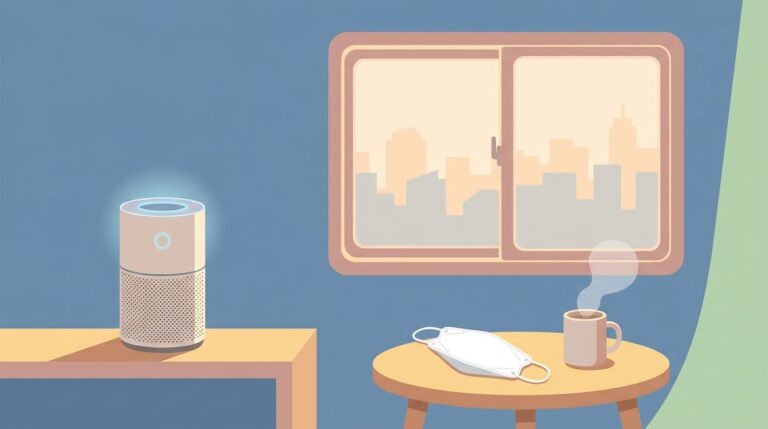
Picture this: You wake up in a cozy Airbnb in Hongdae or an apartment in Seoul. The morning sunlight feels gentle, and you feel like letting in some fresh morning breeze. You walk over to the window, unlock the latch, and push it wide open. Suddenly, your Korean roommate or host gasps from across the room: “No, no! Don’t open it! Today is bad!”
You look outside—the sky looks a little foggy, but wait, that’s not morning mist. That is 미세먼지 (misemeonji – fine dust)! In Korea, opening the window without checking the daily air quality forecast is a major rookie mistake.
If you’ve ever felt frozen in place, wondering why someone is stopping you from doing regular household ventilation, or if you didn’t know how to ask “Should we keep the windows shut today?”, you’re in the right spot. This lesson is created from real student mishaps and will give you the exact, friendly words to survive fine dust season like a seasoned local.
Phase 2: 3 Core Expressions Deep-Dive
1. 환기하지 마세요 (Hwan-gi-ha-ji ma-se-yo)
- Pronunciation: [Hwan-gi-ha-ji ma-se-yo] (Sounds like: Hwan-gee-hah-jee mah-say-yoh)
- Meaning: Literal: “Please do not ventilate.” → Natural: “Please don’t open the windows / Don’t air out the room.”
- K-Culture Moment: You’ll hear this in K-dramas whenever a mom rushes across the living room with an air purifier remote in hand during spring season.
- Editor’s Insight: While English speakers naturally say “Don’t open the window”, Koreans frequently use the noun 환기 (ventilation/airing out) as a verb (환기하다). Saying 환기하지 마세요 sounds polite, gentle, and practical.
- Situation Spectrum: Casual (⚠️ 환기하지 마), Semi-formal (✅ 환기하지 마세요), Formal (✅ 환기하지 마십시오)
- 🤔 Think About It: In English, we focus on the object (“window”), but in Korean, we often focus on the action’s purpose (“airing out”). How does this change the way you observe your surroundings?
2. 미세먼지 심해요 (Mi-se-meon-ji sim-hae-yo)
- Pronunciation: [Mi-se-meon-ji shim-hae-yo] (Sounds like: Mee-say-mun-jee seem-hay-yoh)
- Meaning: Literal: “Fine dust is severe.” → Natural: “The fine dust is really bad today.”
- K-Culture Moment: Idol vloggers opening their curtains before rehearsal, checking an air app, and saying this with a sigh before putting on a black KF94 mask.
- Editor’s Insight: 심하다 (to be severe/bad) is an indispensable A1 descriptive word. You can use it for fine dust (미세먼지 심해요), traffic (차 막힘이 심해요), or bad colds (감기가 심해요).
- Situation Spectrum: Casual (⚠️ 미세먼지 심해), Semi-formal (✅ 미세먼지 심해요), Formal (✅ 미세먼지가 심합니다)
- 🤔 Think About It: Notice how Koreans use words expressing intensity (심하다) rather than just “dirty” (더럽다) when describing air. It treats air quality as an atmospheric condition rather than simple dirt.
3. 창문 닫을게요 (Chang-mun da-deul-ge-yo)
- Pronunciation: [Chang-mun da-deul-ge-yo] (Sounds like: Chahng-moon dah-deul-gay-yoh)
- Meaning: Literal: “I will close the window.” → Natural: “I’ll close the window (for us).”
- K-Culture Moment: When office workers sit near a cafe terrace window and someone gets chilly or notices yellow dust settling on the table.
- Editor’s Insight: The ending ~을게요 (~eul-ge-yo) signals a helpful promise or considerate intention toward the listener. It’s much warmer than a flat statement.
- Situation Spectrum: Casual (⚠️ 창문 닫을게), Semi-formal (✅ 창문 닫을게요), Formal (✅ 창문을 닫겠습니다)
- 🤔 Think About It: By adding -(으)ㄹ게요, you show that your action is meant to create harmony in shared space.
Phase 3: Textbook Korean vs. Real Korean
Situation 1: Telling a friend not to open the window
- 📖 Textbook Korean: 창문을 열지 마십시오. (Chang-mu-neul yeol-ji ma-sip-si-o. – Do not open the window.)
- 🗣️ Real Korean: 오늘 미세먼지 심해요, 환기하지 마세요! (O-neul mi-se-meon-ji sim-hae-yo, hwan-gi-ha-ji ma-se-yo! – Fine dust is bad today, let’s not open the windows!)
- 💡 Why is it different?: Real Korean starts with the shared reason (미세먼지 심해요) before the request so it sounds considerate rather than bossy.
Situation 2: Asking if we should turn on the air purifier
- 📖 Textbook Korean: 공기청정기를 가동하십시오. (Gong-gi-cheong-jeong-gi-reul ga-dong-ha-sip-si-o. – Operate the air cleaner.)
- 🗣️ Real Korean: 공기청정기 틀까요? (Gong-gi-cheong-jeong-gi teul-kka-yo? – Shall I turn on the air purifier?)
- 💡 Why is it different?: In daily life, machines like TVs, fans, and purifiers are “turned on” using the casual verb 틀다 (teul-da) instead of mechanical words like 가동하다.
Phase 4: K-Culture Deep Dive & Non-Verbal Manners
4-1. Nunchi (눈치) & Body Language
When someone tells you 환기하지 마세요, do not argue or leave the window cracked open. The polite reaction is a quick nod (아, 네! 몰랐어요 – “Ah, yes! I didn’t know”) while promptly pulling the window shut. In Korean shared spaces (offices, study cafes, guesthouses), checking the communal air purifier’s LED light color (Blue = Good, Green = Moderate, Yellow = Bad, Red = Danger) before touching a window shows incredible 눈치 (nunchi – quick social awareness).
4-2. Cultural Code: The Yellow Dust Season & KF94 Mask Habit
Long before the global pandemic, Koreans were masters of mask-wearing due to springtime 황사 (Hwang-sa – Yellow Dust) and industrial 미세먼지. You’ll see weather apps pinned to the home screens of almost every Korean phone. Sharing air quality forecasts in morning group chats is a genuine Korean act of care (정, Jeong).
Phase 5: Real-Life Roleplay Scenario
Setting: You are chilling in the living room of your shared guesthouse in Mapo-gu. Your Korean housemate, Min-ji (민지), is brewing tea in the kitchen.
- Turn 1 (You): 오늘 날씨 좋아요! 창문 열까요?
(O-neul nal-ssi jo-a-yo! Chang-mun yeol-kka-yo? / The weather looks nice today! Shall I open the window?)
🎭 [Smiling brightly while touching the window handle] -
Turn 2 (Min-ji): 앗, 잠깐만요! 오늘 미세먼지 심해요.
(At, jam-kkan-man-yo! O-neul mi-se-meon-ji sim-hae-yo. / Ah, wait a second! The fine dust is really bad today.)
🎭 [Eyes wide, waving one hand gently] -
Turn 3 (You): 진짜요? 밖이 맑아 보여요.
(Jin-jja-yo? Bak-gi mal-ga bo-yeo-yo. / Really? It looks clear outside.)
🎭 [Tilting your head in confusion] -
Turn 4 (Min-ji): 하늘이 뿌연 편이에요. 오늘 환기하지 마세요.
(Ha-neu-ri ppu-yeon pyeon-i-e-yo. O-neul hwan-gi-ha-ji ma-se-yo. / The sky is quite hazy. Please don’t ventilate today.)
🎭 [Showing her phone screen displaying a red air icon] -
Turn 5 (You): 아, 그렇군요. 창문 닫을게요!
(A, geu-reot-gun-yo. Chang-mun da-deul-ge-yo! / Ah, I see. I will close the window!)
🎭 [Pulling the handle firmly shut] -
Turn 6 (Min-ji): 고마워요. 대신 공기청정기 틀게요.
(Go-ma-wo-yo. Dae-sin gong-gi-cheong-jeong-gi teul-ge-yo. / Thank you. I will turn on the air purifier instead.)
🎭 [Pressing the power button on the purifier] -
Turn 7 (You): 마스크도 써야 해요?
(Ma-seu-keu-do sseo-ya hae-yo? / Should I also wear a mask outside?)
🎭 [Pointing toward your jacket pocket] -
Turn 8 (Min-ji): 네, KF94 마스크 꼭 쓰세요!
(Ne, KF-gu-sip-sa ma-seu-keu kkok sseu-se-yo! / Yes, definitely wear a KF94 mask!)
🎭 [Nodding warmly and handing you a sealed mask]
🔀 Interactive Choice Point
Min-ji looks worried about the air outside. How do you respond after closing the window?
- Option A: “괜찮아요! 저 감기 안 걸려요!” (Gwaen-chan-a-yo! Jeo gam-gi an geol-lyeo-yo! – It’s okay! I don’t catch colds!)
- Option B: “알려줘서 고마워요. 창문 꼭 닫아 둘게요.” (Al-lyeo-jwo-seo go-ma-wo-yo. Chang-mun kkok da-da dul-ge-yo. – Thanks for letting me know. I’ll keep the window shut tightly.)
- Option C: “창문 조금만 열면 안 돼요?” (Chang-mun jo-geum-man yeol-myeon an dwae-yo? – Can’t we open the window just a little bit?)
Feedback:
* Option A [Risk]: Fine dust isn’t a cold virus; it affects lungs and eyes directly. This sounds like you didn’t understand the hazard.
* Option B [Best]: Polite, appreciative, and reassures your host that you care about indoor air quality.
* Option C [Bad]: Stubbornly asking to open it after being warned can seem inconsiderate of others sharing the indoor air.
Phase 6: 10-Second Emotional Shadowing Drill
Practice saying these with natural rhythm and emotion! Pause slightly at the / marks.
- [😮 Surprised & Understanding]
아, / 오늘 미세먼지 / 심해요?
(Ah, / o-neul mi-se-meon-ji / sim-hae-yo?)
“Ah, is the fine dust bad today?” -
[🤝 Polite & Cooperative]
네, / 환기하지 않을게요! / 창문 닫을게요.
(Ne, / hwan-gi-ha-ji an-eul-ge-yo! / Chang-mun da-deul-ge-yo.)
“Yes, I won’t open it to ventilate! I’ll close the window.” -
[😷 Caring & Thoughtful]
나갈 때 / 마스크 / 꼭 쓰세요!
(Na-gal ttae / ma-seu-keu / kkok sseu-se-yo!)
“Make sure to wear a mask when you go out!”
Phase 7: K-Culture Mini Dictionary
- 미세먼지 (Mi-se-meon-ji) | Fine Dust / PM10 & PM2.5 particulate matter. The staple topic of Korean morning weather chats.
- 환기 (Hwan-gi) | Ventilation / Airing out a room. A daily hygiene habit in Korea, except on high-dust days.
- 공기청정기 (Gong-gi-cheong-jeong-gi) | Air Purifier. A standard home appliance found in almost every Korean household, office, and classroom.
- 마스크 (Ma-seu-keu) | Face Mask (specifically KF80, KF94 certified). Essential outdoor gear during yellow dust alerts.
Phase 8: Traveler’s Survival Kit
Top 3 Survival Phrases
- 창문 닫아 주세요. (Chang-mun da-da ju-se-yo.) – “Please close the window.”
Pro Tip: Use this on buses or in cafes if someone leaves a window cracked on a dusty day. - 오늘 공기 어때요? (O-neul gong-gi eo-ttae-yo?) – “How is the air quality today?”
Pro Tip: Great small talk phrase with your Airbnb host or hotel front desk. - KF94 마스크 있어요? (KF-gu-sip-sa ma-seu-keu i-sseo-yo?) – “Do you have KF94 masks?”
Pro Tip: Say this at any convenience store (CU, GS25, 7-Eleven) or pharmacy (약국).
Editor’s Travel Note
Before heading out for a day of sightseeing in Seoul or Busan, don’t rely solely on visual clarity. Check real-time air stats by installing the AirVisual Air Quality Forecast App or checking Naver Weather. If the index shows “나쁨” (Bad – Orange) or “매우 나쁨” (Very Bad – Red), grab a mask from the nearest convenience store before hopping on the subway.
Phase 9: Thinking Deeper (Cultural Reflection)
In Western countries, opening windows for “fresh air” is considered universally healthy. However, in modern Korea, air is treated as an environmental condition that must be actively managed to protect the community. Telling someone 환기하지 마세요 is not an infringement on your freedom; it is an expression of communal care (우리, Uri culture). When you close the window, you are silently telling everyone in the room: “I value our collective health.”
💬 Your Turn: In your home country, how do people react to weather alerts? Have you ever had to keep windows shut because of air pollution or pollen? Share your story in the comments below!
Phase 10: FAQ & Common Mistakes
Q: Can I use “환기하지 마세요” when talking to someone older or in authority?
A: Yes! The -(으)세요 ending is polite and standard for polite daily requests. If you want to be extra formal to a professor or executive, you can say “오늘 미세먼지가 심해서 환기를 안 하시는 것이 좋겠습니다” (It might be best not to ventilate today as fine dust is severe).
Q: What is the difference between 황사 (Hwang-sa) and 미세먼지 (Misemeonji)?
A: 황사 (Yellow Dust) refers to natural mineral sand blown from the deserts of Mongolia and Northern China during spring. 미세먼지 (Fine Dust) refers to micro particulate pollution that can occur in any season.
Q: If I can’t ventilate, how do Koreans keep indoor air fresh?
A: Koreans rely on 공기청정기 (air purifiers) on high filter mode, run kitchen range hoods when cooking, and avoid burning indoor scented candles during high fine dust alerts.
🚨 Common Mistakes Warning Board
- Mistake: Saying “창문 열지마” directly to strangers or elders.
Correction: Always add ~세요 (창문 열지 마세요 / 환기하지 마세요) to avoid sounding rude. - Mistake: Confusing 공기 (air) with 날씨 (weather).
Correction: Clear blue skies can still have bad air! Don’t say 날씨가 나빠요 (weather is bad) when you mean 공기가 안 좋아요 (the air is not good). - Mistake: Using 끄다 (to turn off) when you meant 닫다 (to close window).
Correction: Windows are opened/closed (열다/닫다), while electronic air purifiers are turned on/off (틀다/끄다).
Phase 11: Action Missions
- 🥉 Bronze Mission (Solo): Stand in front of your bedroom window, point outside, and say “오늘 미세먼지 심해요, 환기하지 마세요!” out loud 3 times.
- 🥈 Silver Mission (Social): Open your weather app, find the air quality index for Seoul, take a screenshot, and post it to your study story with the caption: 미세먼지 조심하세요! (Be careful of fine dust!)
- 🥇 Gold Mission (Real Life): When you walk into a Korean cafe or your accommodation, locate the air purifier (공기청정기) and check if its LED status light is blue, green, or red.
🎮 K-Culture Mission: Watch any Korean daily vlog (브이로그) featuring morning routines. Listen carefully for the moment they check the weather app and speak the word 미세먼지!
Phase 12: Interactive Quiz Challenge
Q1. You are staying in an Airbnb. Your host says: “오늘 미세먼지 심해요. 환기하지 마세요.” What should you do?
A) Open all windows wide to let fresh air in
B) Keep the windows closed and turn on the air purifier
C) Go out for a marathon without a mask
🔍 Click to Reveal Answer & Explanation
Answer: B
Explanation: “환기하지 마세요” means “Please don’t ventilate / open windows.” Keeping windows shut and running the air purifier is the correct local etiquette.
Q2. Fill in the blank:
오늘 미세먼지 심해요. 창문 ________. (I will close the window.)
A) 열게요 (yeol-ge-yo)
B) 닫을게요 (da-deul-ge-yo)
C) 먹을게요 (meog-eul-ge-yo)
🔍 Click to Reveal Answer & Explanation
Answer: B (닫을게요)
Explanation: “닫다” means to close. Adding “-을게요” makes it “I will close it (for us).” “열게요” means I will open it, and “먹을게요” means I will eat.
Q3. True or False:
“If the morning sky looks sunny in Seoul, it always means the fine dust level is safe.”
🔍 Click to Reveal Answer & Explanation
Answer: FALSE
Explanation: Fine dust (미세먼지) consists of microscopic particles that can be at hazardous levels even under sunny skies. Always check the daily air quality index!







