

Phase 1: Empathy (Story-Driven Opening)
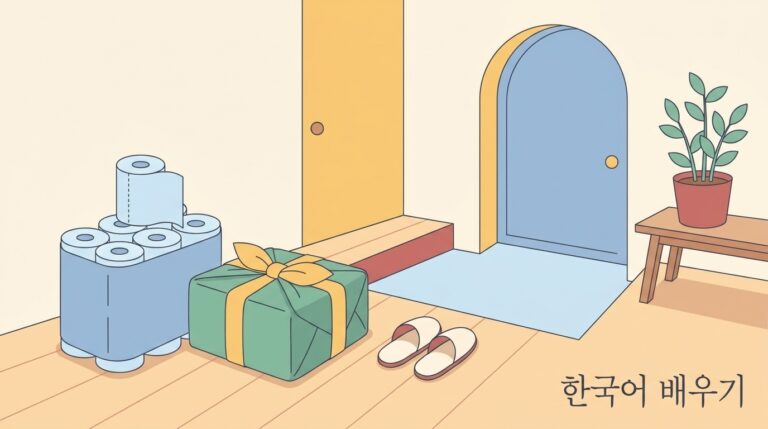
안녕하세요! I’m your Daily Hangul editor. Have you ever watched a K-Drama where someone walks into a friend’s brand-new studio apartment carrying a giant package of toilet paper or a massive bottle of laundry detergent? If you thought, “Wait… are they giving toilet paper as a housewarming gift?!”, you are definitely not alone!
Visiting a Korean friend’s new home for a jipdeuri (집들이, housewarming party) is an exciting milestone in any friendship. But for beginners, it comes with a bundle of panic: What should I bring? What do I say when the door opens? Is it rude if I hand over a gift with one hand?
Don’t worry! Based on hundreds of real questions from beginner Korean learners and feedback from our Daily Hangul community, this guide gives you the exact phrases, cultural insider tips, and non-verbal etiquette you need. By the end of this 5-minute read, you’ll walk into any Korean home with total confidence and warm Korean manners!
Phase 2: 3 Core Expressions in Detail
1. 집들이 선물이에요. (Jipdeuri seonmul-ieyo.)
- Pronunciation: [Jip-deu-ri seon-mul-ee-ye-yo] (Sounds like “Jeep-due-ree sun-mool-ee-ye-yo”)
- Meaning: Literal: “It is a housewarming gift.” / Actual nuance: “Here’s a little housewarming gift for you!”
- K-Culture Moment: Seen in almost every cozy slice-of-life K-drama when characters ring the doorbell and hand over wrapped gifts with a smile.
- Editor’s Insight: Jip means house, and deuri comes from inviting people in. Adding seonmul (gift) makes your intention instantly clear, polite, and sweet.
- Situation Spectrum: Casual ✅ | Semi-formal ✅ | Formal ⚠️
- 🤔 Think About It: In your culture, do you announce what a gift is for right as you hand it over, or do you wait for the host to unwrap it later?
2. 초대해 주셔서 감사해요. (Chodaehae jusyeoseo gamsahaeyo.)
- Pronunciation: [Cho-dae-hae ju-syeo-seo gam-sa-hae-yo] (Think: “Cho-day-hay joo-shuh-saw gahm-sah-hay-yo”)
- Meaning: Literal: “Because you invited me, I am thankful.” / Actual nuance: “Thank you so much for having me over!”
- K-Culture Moment: The polite golden greeting spoken at the front entrance (hyeon-gwan) right after slipping off your shoes.
- Editor’s Insight: Koreans love showing gratitude early. Saying this before even sitting down shows great manners (ye-ui).
- Situation Spectrum: Casual ⚠️ (use ‘초대해 줘서 고마워’ for close friends) | Semi-formal ✅ | Formal ✅
- 🤔 Think About It: Why does Korean grammar connect the reason (“inviting me”) directly with the thank-you using -seoseo?
3. 새 집 축하해요! (Sae jip chukahaeyo!)
- Pronunciation: [Sae jip chu-ka-hae-yo] (Think: “Say jeep choo-kah-hay-yo!”)
- Meaning: Literal: “New house congratulate!” / Actual nuance: “Congratulations on your new place!”
- K-Culture Moment: Cheerful shout over a table full of delicious delivery fried chicken and tteokbokki at a friend’s house party.
- Editor’s Insight: Sae means ‘new’, jip means ‘house/home’. Short, punchy, and impossible to forget!
- Situation Spectrum: Casual ✅ | Semi-formal ✅ | Formal ⚠️
- 🤔 Think About It: Do you usually congratulate the person or the house itself in your native language?
Phase 3: Textbook Korean vs. Real Korean
Situation 1: Handing over the gift at the door
- 📖 교과서 한국어 (Textbook): 이것은 당신을 위해 준비한 선물입니다. (Igeoseun dangsineul wihae junbihan seonmul-imnida. – This is a gift prepared for you.)
- 🗣️ 진짜 한국어 (Real-life): 이거 작은 집들이 선물이에요! (Igeo jageun jipdeuri seonmul-ieyo! – Here’s a little housewarming gift!)
- 💡 왜 다를까? Koreans rarely say dangsin (you) in casual spoken Korean. Adding jageun (“small/humble”) shows Korean modesty even if the gift is huge!
Situation 2: Praising their new home
- 📖 교과서 한국어 (Textbook): 귀하의 집이 매우 아름답습니다. (Gwihaui jibi maeu areumdapseumnida. – Your home is very beautiful.)
- 🗣️ 진짜 한국어 (Real-life): 와, 집 진짜 아늑하고 좋아요! (Wa, jip jinjja aneukhago joayo! – Wow, your home is so cozy and nice!)
- 💡 왜 다를까? Real conversations love conversational softeners like jinjja (really) and adjectives like aneukhada (cozy) over stiff dictionary terms.
Phase 4: K-Culture Deep Dive & Non-Verbal Manners
4-1. 눈치 (Nunchi) & Front Door Etiquette
- The Two-Hand Rule: Always hand over your housewarming gift using both hands (or support your right forearm with your left hand). It immediately communicates deep respect.
- The Shoe Line Discipline: When stepping into the hyeogwan (entryway), take off your shoes without stepping barefoot onto the dirty tile. Turn your shoes around so they point toward the exit—a classic Korean politeness move!
4-2. The Secret Meaning of Toilet Paper & Detergent
Why do Koreans bring rolling toilet paper and bubbly detergent to a housewarming?
* 🧻 Toilet Paper (두루마리 휴지): It unrolls smoothly without catching, symbolizing that all your plans, wealth, and health will unroll just as smoothly (sul-sul pul-li-da)!
* 🫧 Laundry Detergent (세제): The bubbling lather (geopum) represents wealth and fortune bubbling up quickly in the new home.
Phase 5: Real Roleplay Scenario
Setting: You arrive at your Korean friend Minji’s new apartment in Mapo-gu, holding a gift bag with fancy hand soap and a roll cake.
- Turn 1 (Minji): 어서 와요! 찾기 어렵지 않았어요? (Eoseo wayo! Chatgi eoryeopji anasseoyo?)
🎭 [Opens the door wide with a bright smile]
(“Welcome! Did you have trouble finding the place?”) - Turn 2 (You): 네, 쉽게 찾았어요! 초대해 주셔서 감사해요. (Ne, swipge chajasseoyo! Chodaehae jusyeoseo gamsahaeyo.)
🎭 [Taking off shoes neatly and bowing slightly]
(“No, found it easily! Thank you for inviting me.”) - Turn 3 (You): 새 집 이사 축하해요! 이거 집들이 선물이에요. (Sae jip isa chukahaeyo! Igeo jipdeuri seonmul-ieyo.)
🎭 [Handing the gift bag with both hands]
(“Congrats on the new place! Here is a housewarming gift.”) - Turn 4 (Minji): 어머, 뭘 이런 걸 사 왔어요! 그냥 와도 되는데. (Eomeo, mwol ireon geol sa wasseoyo! Geunyang wado doeneunde.)
🎭 [Playfully waving hands in modest gratitude]
(“Oh my, you didn’t have to buy anything! You could have just come empty-handed!”) - Turn 5 (You): 마음에 들었으면 좋겠어요. (Maeume deureosseumyeon jokess-eoyo.)
🎭 [Smiling warmly]
(“I hope you like it!”) - Turn 6 (Minji): 고마워요, 정말 잘 쓸게요! 들어와요. (Gomawoyo, jeongmal jal sseulgeyo! Deureowayo.)
🎭 [Accepts with both hands and guides you into the living room]
(“Thank you, I’ll put it to great use! Come on in.”) - Turn 7 (You): 와, 집 진짜 깔끔하고 예뻐요! (Wa, jip jinjja kkalkkeumhago yeppeoyo!)
🎭 [Looking around the bright living room]
(“Wow, the house is so clean and pretty!”) - Turn 8 (Minji): 고마워요! 편하게 앉아요. 맛있는 거 시켜 먹어요! (Gomawoyo! Pyeonhage anjayo. Masinneun geo sikyeo meogeoyo!)
🎭 [Pulls out a seat cushion]
(“Thanks! Make yourself comfortable. Let’s order something delicious!”)
🔀 Interactive Choice Point
Minji says: “뭘 이런 걸 사 왔어요! 그냥 와도 되는데!” (You shouldn’t have brought anything!) What is your best response?
* A. “네, 다음에는 빈손으로 올게요.” (Okay, next time I’ll come empty-handed.) -> ⚠️ Risk: Too literal! Minji is showing polite Korean humbleness.
* B. “작은 거니까 부담 갖지 마세요!” (It’s just a small token, please don’t feel burdened!) -> 🏆 Best: Warm, thoughtful, and natural!
* C. “얼마 안 비싸요.” (It wasn’t very expensive.) -> 🚫 Bad: Talking about the price ruins the aesthetic mood.
Phase 6: 10-Second Emotion Shadowing Drill
Read these out loud with rhythm! The / mark indicates a natural 0.5-second breath pause.
[😊 Bright & Grateful]
초대해 주셔서 / 감사해요!
(Cho-dae-hae ju-syeo-seo / gam-sa-hae-yo!)-
[🎉 Cheerful & Excited]
새 집 축하해요! / 이거 집들이 선물이에요!
(Sae jip chu-ka-hae-yo! / I-geo jip-deu-ri seon-mul-i-e-yo!) -
[✨ Impressed & Heartfelt]
와, / 집이 진짜 아늑해요!
(Wa, / jip-i jin-jja a-neuk-hae-yo!)
Phase 7: K-Culture Mini Dictionary
- 집들이 (Jipdeuri): Housewarming gathering. A compound of jip (home) and deul-i (entering/welcoming).
- 두루마리 휴지 (Durumari Hyuji): Roll toilet paper. The classic Korean symbol of unrolling good fortune without snags.
- 세제 (Seje): Detergent. Associated with bubbly prosperity and rapid wealth generation.
- 번창 (Beonchang): Flourishing/Prosperity. Often wished to someone starting a new home or business venture.
Phase 8: Traveler’s Survival Kit
Top 3 Survival Phrases
- 🎁 포장해 주세요. (Pojanghae juseyo.) – “Please gift-wrap this for me.” (Pro Tip: Say this at department store gift counters or bakery shops!)
- 🏠 집들이 선물 추천해 주세요. (Jipdeuri seonmul chucheonhae juseyo.) – “Please recommend a good housewarming gift.”
- 🧻 휴지 어디에 있어요? (Hyuji eodie isseoyo?) – “Where is the toilet paper / tissue section?”
Editor’s Travel Note
When heading to a friend’s new studio in Korea, finding the right building entrance can be tricky due to complex alleyways. We recommend using the KakaoMap app download for easy navigation to pinpoint building entrance numbers. Also, bakeries like Paris Baguette or Olive Young stores near subway stations are the easiest spots to grab upscale room diffusers, hand washes, or roll cakes with standard T-money / credit card tap payments!
Phase 9: One Step Deeper
In Korean culture, visiting someone’s home isn’t just about sharing food—it is an exchange of Jeong (정, deep emotional bond and affection). By offering something practical like paper towels or body wash, Koreans express a collective wish: “May your daily life in this space be smooth and comfortable.” It reflects a community-oriented mindset where mutual support is woven into everyday items.
💬 Your Turn: What is the traditional or most common housewarming gift in your country? Let us know in the comments below!
Phase 10: FAQ & Common Mistakes
Q: Is it considered rude to bring toilet paper if the host has a high-end luxury apartment?
A: Not rude at all culturally, but if you want to elevate it, go for premium 3-ply unbleached bamboo tissue, a chic designer room diffuser, or a famous bakery roll cake!
Q: Should I give the gift right away at the door or wait?
A: In Korea, it’s standard etiquette to hand over the housewarming gift right after greeting each other at the hyeon-gwan (entryway) before moving into the living room.
Q: Do Korean hosts unwrap gifts in front of guests?
A: Traditionally, hosts may set the gift aside modestly to avoid seeming greedy, or open it with enthusiastic appreciation. Follow their lead and don’t feel offended if they wait until later!
🚨 Common Mistakes TOP 3
- ❌ Handing gifts with one hand. -> Correct: Always use two hands to pass the gift bag.
- ❌ Stepping onto the raised wooden floor with shoes on. -> Correct: Step out of your shoes on the lower tiled area before stepping up.
- ❌ Coming completely empty-handed. -> Correct: Even a simple drink set (like vitamin drinks from a convenience store) shows polite consideration.
Phase 11: Action Mission & Engagement
- 🥉 Bronze Mission: Practice saying “초대해 주셔서 감사해요!” 3 times looking in the mirror.
- 🥈 Silver Mission: Share this post on your Instagram Story and tag a friend you want to invite over for K-food!
- 🥇 Gold Mission: Next time you visit a Korean acquaintance or class tutor, use the two-hand handoff technique with a beverage!
- 🎮 K-Culture Mission: Watch an episode of a Korean variety show (like I Live Alone / 나 혼자 산다) and spot what guests bring when visiting a member’s new home!
Phase 12: Interactive Quiz Challenge
Q1. Situational: You just arrived at Minho’s new apartment. Which phrase should you say first?
– A) 이거 얼마예요? (How much is this?)
– B) 초대해 주셔서 감사해요! (Thank you for inviting me!)
– C) 안녕히 가세요! (Goodbye!)
👉 Click to view Answer & Explanation
Answer: B
Explanation: “초대해 주셔서 감사해요!” is the polite greeting thanking the host for welcoming you into their home.
Q2. Fill-in-the-blank: Complete the phrase: “새 집 [ ___ ]해요!” (Congratulations on your new home!)
– A) 미안 (Mian)
– B) 축하 (Chuka)
– C) 싫어 (Sireo)
👉 Click to view Answer & Explanation
Answer: B (축하)
Explanation: 축하해요 (Chukahaeyo) means “Congratulations!”.
Q3. True or False: Giving toilet paper as a housewarming gift in Korea is considered an insult.
– [ ] True
– [ ] False
👉 Click to view Answer & Explanation
Answer: False
Explanation: Toilet paper represents smooth success and fortune unrolling in the new home, making it one of the most classic traditional housewarming gifts in Korea!







