

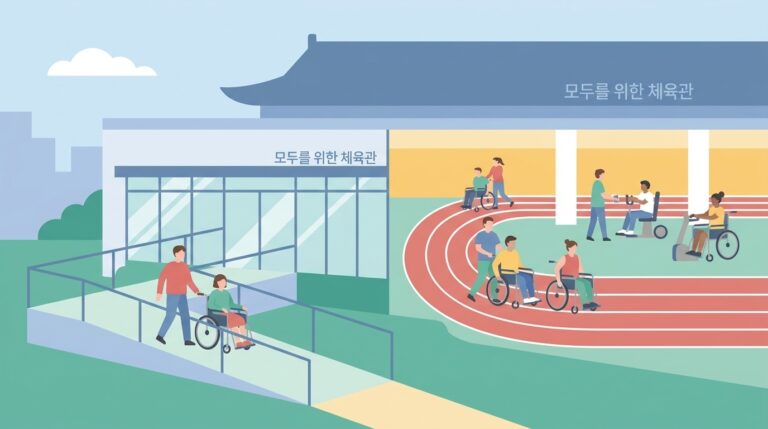
Phase 1: Empathy (Story-Driven Opening)
안녕하세요! 매일한글 에디터입니다. (Hello! This is your Daily Hangul editor.)
Imagine watching an inspiring K-drama like Extraordinary Attorney Woo or an insightful documentary on the legacy of the 2018 PyeongChang Winter Paralympics. You hear civic leaders, para-athletes, and community planners vigorously debating how public spaces in Seoul must evolve. Then, during a high-level discussion with your Korean colleagues or graduate peers, someone asks your perspective on municipal sports policies. You want to articulate the urgency of barrier-free sports infrastructure, but you find yourself caught between basic textbook vocabulary and the nuanced, policy-level discourse native speakers use. Discussing 장애인 체육 시설 확충과 접근성 개선 (expanding sports facilities for people with disabilities and enhancing accessibility) requires more than just translating “sports for the disabled”; it involves nuanced sociopolitical concepts such as universal design, institutional inclusion, and civic dignity.
Mastering C2-level Korean in this domain allows you to transition effortlessly from casual supporter to articulate advocate or policy analyst. Based on real-world feedback from advanced learners navigating public policy forums and NGO seminars in Korea, this comprehensive guide provides the idiomatic, socio-cultural, and linguistic tools necessary to engage in high-level civic debates with authentic native resonance.
Phase 2: Core Expressions Deep Dive
1. 문턱을 낮추다 (Munteogeul natchuda)
- Pronunciation: [Moon-teog-eul nat-choo-da] (Think of moon + tug, then not-chew-da)
- Literal Meaning: To lower the threshold.
- Actual Nuance: To drastically eliminate institutional, physical, or psychological barriers so everyone can participate equally.
- K-Culture Moment: Frequently featured in social-impact documentaries and public campaign speeches advocating for inclusive community sports clubs (생활체육 클럽).
- Editor’s Insight: While originally referring to physical thresholds in traditional Korean architecture (hanok), it is now standard C2 rhetoric for institutional deregulation and universal accessibility.
- Situation Spectrum: Casual: ⚠️ | Semi-formal: ✅ | Formal: ✅
- 🤔 Think About It: How does the spatial metaphor of a traditional architectural “threshold” (문턱) reflect Korean society’s collective journey toward civil accessibility?
2. 배리어 프리(Barrier-Free) 인프라를 구축하다 (Baerieo-peuri inpeurareul guchukhada)
- Pronunciation: [Bae-ri-eo peu-ri in-peu-ra-reul goo-chook-ha-da]
- Literal Meaning: To construct barrier-free infrastructure.
- Actual Nuance: To systematically implement universal design standards in sports venues so that persons of all physical abilities can navigate facilities autonomously.
- K-Culture Moment: Highlighted during press conferences for the nationwide rollout of Bandabi Sports Centers (반다비 체육센터), the Paralympic legacy initiative in Korea.
- Editor’s Insight: “Barrier-free” is treated as an official policy loanword in Korea, often paired with active, state-building verbs like 구축하다 (to construct/establish) rather than merely 만들다 (to make).
- Situation Spectrum: Casual: 🚫 | Semi-formal: ✅ | Formal: ✅
- 🤔 Think About It: Why do modern Korean policy discussions blend Anglo-international terms like “Barrier-Free” with Sino-Korean administrative verbs like “구축(構築)”?
3. 체감 복지를 실현하다 (Chegam bokjireul silhyeonhada)
- Pronunciation: [Chae-gam bok-ji-reul sil-hyeon-ha-da]
- Literal Meaning: To realize tangible welfare.
- Actual Nuance: To deliver perceptible, practical social support directly felt by citizens in daily life, rather than abstract numbers on paper.
- K-Culture Moment: Used by civic organizers, athletes, and municipal leaders on news panels analyzing local district accessibility scorecards.
- Editor’s Insight: The root 체감 (體感) literally means “body-feeling” or direct somatic perception. It distinguishes empty bureaucratic promises from real, lived convenience.
- Situation Spectrum: Casual: 🚫 | Semi-formal: ✅ | Formal: ✅
- 🤔 Think About It: What does the preference for 체감 (bodily perception) reveal about the standard for policy accountability in contemporary Korean discourse?
Phase 3: Textbook Korean vs. Real Korean
Situation 1: Calling for Facility Upgrades
- 📖 교과서 한국어 (Textbook): 장애인이 운동할 수 있는 장소를 더 많이 만들어야 합니다. (We must make more places where disabled people can exercise.)
- 🗣️ 진짜 한국어 (Authentic C2): 장애인 생활체육의 저변 확대를 위해 맞춤형 체육 시설 확충이 시급합니다. (To broaden the grassroots base of adaptive sports, expanding customized athletic facilities is of paramount urgency.)
- 💡 왜 다를까? (Why the difference?): Native discourse relies on sophisticated Sino-Korean constructs (저변 확대 – broadening grassroots foundations; 시급하다 – to be urgent) rather than descriptive relative clauses, conveying civic gravity and rhetorical authority.
Situation 2: Emphasizing Universal Mobility
- 📖 교과서 한국어 (Textbook): 누구나 휠체어를 타고 편하게 체육관에 들어갈 수 있어야 합니다. (Everyone should be able to enter the gym comfortably in a wheelchair.)
- 🗣️ 진짜 한국어 (Authentic C2): 이동 약자의 접근성을 원천적으로 보장하는 유니버설 디자인 도입이 선행되어야 합니다. (The pre-emptive introduction of universal design that fundamentally guarantees accessibility for mobility-vulnerable groups must take precedence.)
- 💡 왜 다를까? (Why the difference?): In policy dialogues, native speakers replace specific mechanical descriptions with inclusive sociological umbrella terms like 이동 약자 (mobility-vulnerable individuals) and procedural terms like 선행되다 (to take precedence).
Phase 4: K-Culture Deep Dive & Non-Verbal Manners
4-1. 눈치 (Nunchi) & Non-Verbal Etiquette
When debating sports accessibility in Korea, non-verbal cues carry enormous ethical weight:
* Dignified Eye Contact & Attentive Nodding: Maintain measured, respectful eye contact (정중한 시선 처리). Overly dramatic head nodding can appear condescending or dismissive when discussing structural social disparities.
* Inclusive Terminology Awareness: Avoid outdated, colloquial shorthand. Always use 장애인 (persons with disabilities) or 장애인 선수 (para-athletes), paired with deliberate, respectful hand gestures rather than pointing.
4-2. Cultural Code Analysis: The Legacy of Bandabi Sports Centers
Following the 2018 PyeongChang Winter Paralympics, South Korea inaugurated the Bandabi Sports Center project—a nationwide blueprint building over 150 integrated sports hubs across local municipalities. These centers pair specialized adaptive sports equipment with open community wellness spaces. In Korean public discourse, public sports infrastructure is not viewed merely as recreation; it is an index of civil maturity and human rights progress.
Phase 5: Real-World Roleplay Scenario
- Setting: A civic advisory committee meeting at Seoul City Hall regarding the renovation of a metropolitan sports complex.
- Characters:
- 박 위원장 (Park Wiwonjang): Head of the Sports Policy Committee.
- 학습자 (You): Guest Policy Advisor on Universal Infrastructure.
Dialogue (8-Turn):
1. 박 위원장: 🎭 (진지한 표정으로 안건 서류를 넘기며) 이번 종합운동장 리모델링 안건에서 장애인 접근성 개선이 핵심 쟁점입니다. 자문위원님의 견해는 어떠십니까?
(Ibeon jonghab-undongjang rimodelling angeoneseo jang-aein jeopgeunseong gaeseoni haeksim jaengjeom-imnida. Jamun-wiwon-nim-ui gyeonhae-neun eotteosibnikka?)
“In this sports complex remodeling agenda, improving accessibility for individuals with disabilities is the focal point. What is your perspective, Advisor?”
2. You: 🎭 (자료를 짚으며 단호하고 차분한 어조로) 단순한 편의시설 보수를 넘어, 진정한 배리어 프리 인프라를 구축해야 합니다.
(Dansunhan pyeon-uisiseol bosureul neomeo, jinjeonghan baerieo-peuri inpeurareul guchukhaeya hamnida.)
“Going beyond basic facility repairs, we must establish genuine barrier-free infrastructure.”
3. 박 위원장: 🎭 (고개를 끄덕이며 메모를 적는다) 배리어 프리 체육관 구축에 공감합니다. 구체적으로 어떤 시설 보완이 우선입니까?
(Baerieo-peuri che-yukkwan guchuk-e gonggamhamnida. Guchejeok-euro eotteon siseol bowani useon-imnikka?)
“I agree with establishing a barrier-free gymnasium. Specifically, which facility enhancements should take priority?”
4. You: 🎭 (시각 자료를 가리키며) 휠체어 리프트나 경사로뿐 아니라, 시각·청각 장애인을 위한 감각 안내 시스템이 선행되어야 합니다.
(Hwilchee-eo ripeuteuna gyeongsaroppun anira, sigak-cheonggak jang-aeineul wihan gamgak annae siseutemi seonhaengdoe-eoya hamnida.)
“Not only wheelchair lifts and ramps, but sensory guidance systems for visually and hearing-impaired citizens must take precedence.”
5. 박 위원장: 🎭 (예산안을 살피며 살짝 난색을 표한다) 취지는 좋으나, 한정된 예산으로 인해 시설 확충 속도 조절이 필요하다는 의견도 있습니다.
(Chwijineun joeuna, hanjeongdoen yesan-euro inhye siseol hwakchung sokdo jojeori piryohadaneun uigyeondo itseumnida.)
“The intent is commendable, but some suggest adjusting the pace of facility expansion due to budget constraints.”
6. You: 🎭 (진정성 있는 눈빛으로 설득하며) 체육 시설은 단순한 여가가 아니라 기본권이므로, 문턱을 낮추는 체감 복지 실현에 과감히 투자해야 합니다.
(Che-yuk siseoreun dansunhan yeogaga anira gibon-gwon-imeuro, munteogeul natchuneun chegam bokji silhyeon-e gwagamhi tuja-haeya hamnida.)
“Sports facilities are not merely leisure but a fundamental right; we must invest boldly in delivering tangible welfare that lowers all thresholds.”
7. 박 위원장: 🎭 (결의에 찬 미소를 지으며) 옳으신 말씀입니다. 이동 약자의 기본권을 보장하는 종합 대책으로 수정 반영하겠습니다.
(Orheusin malsseum-imnida. Idong yakja-ui gibon-gwoneul bojanghaneun jonghap daechaek-euro sujeong banyeonghagetseumnida.)
“You are absolutely right. I will revise the proposal into a comprehensive measure guaranteeing the fundamental rights of mobility-vulnerable citizens.”
8. You: 🎭 (정중하게 상체를 숙여 목례하며) 공공성과 포용성을 담아낸 위원장님의 결단에 깊이 감사드립니다.
(Gonggongseonggwa poyongseongeul damanaen wiwonjang-nim-ui gyeoldane gipi gamsadeurimnida.)
“I deeply appreciate your decisive resolution embracing public value and inclusivity.”
🔀 Interactive Decision Point
How would you address an objection regarding local budget allocation?
* Option A: “돈이 없으면 공사를 미루면 됩니다.” (If there is no money, we can postpone the construction.)
– Feedback (Bad): Dismissive and unconstructive. Shows a lack of professional civic nuance.
* Option B: “장애인 전용 체육관 하나만 짓고 일반 시설은 그대로 둡시다.” (Let’s build just one exclusive disabled center and leave other facilities unchanged.)
– Feedback (Risk): Contradicts the principles of integrated universal design and social inclusion.
* Option C (Best): “단계적 로드맵을 구축하여 기존 공공 체육시설의 유니버설 리모델링부터 순차적으로 전환하는 방안을 제안합니다.” (I propose establishing a phased roadmap to systematically transition existing public sports facilities through universal remodeling.)
– Feedback (Best): Demonstrates strategic problem-solving and institutional mastery.
Phase 6: 10-Second Emotion Shadowing Drill
[🏛️ 단호하고 정책적인 어조]
장애인 체육 시설 확충은 / 시혜적 복지가 아니라 / 마땅히 보장되어야 할 기본권입니다.
(Jang-aein che-yuk siseol hwakchung-eun / sihyejeok bokjiga anira / mattanghi bojangdoe-eoya hal gibon-gwon-imnida.)-
[💡 진정성 있고 설득력 있게]
생활체육의 문턱을 낮출 때 / 비로소 모든 시민이 / 체감 복지의 혜택을 누릴 수 있습니다.
(Saenghwalcheyug-ui munteogeul natchul ttae / biroso modeun simini / chegam bokji-ui hye-taegeul nuril su itseumnida.) -
[🤝 포용적이고 미래지향적인 톤]
유니버설 디자인 기반의 체육 인프라는 / 사회적 통합을 견인하는 핵심 동력이 됩니다.
(Yunibeoseol dijain giban-ui che-yuk inpeura-neun / sahoejeok tonghab-eul gyeon-inhaneun haeksim dongryeog-i doemnida.)
Phase 7: K-Culture Mini Dictionary
- 반다비 체육센터 (Bandabi 체육센터, Bandabi Che-yukkwan)
- Meaning: Integrated public sports centers named after the 2018 PyeongChang Paralympic mascot, engineered for universal accessibility.
- Usage: Standard reference when discussing municipal para-sports investments.
- 이동 약자 (Idong Yakja, 移動 弱者)
- Meaning: Persons with limited mobility, encompassing disabled individuals, seniors, pregnant women, and young children.
- Usage: Preferred institutional standard replacing exclusionary terminology in urban planning.
- 생활체육 (Saenghwal Che-yuk, 生活體育)
- Meaning: Community/grassroots sports practiced for daily health and wellness rather than elite competition.
- Usage: Essential term when discussing public park facilities and local community sports policies.
- 저변 확대 (Jeobyeon Hwakdae, 底邊 擴大)
- Meaning: Expanding the grassroots foundation or base of participation.
- Usage: High-frequency socio-economic idiom used across Korean sports, culture, and business.
Phase 8: Traveler’s & Resident’s Survival Kit
Top 3 Real-World Survival Expressions
- 이 체육관에 휠체어 전용 경사로나 리프트가 완비되어 있나요?
(I che-yukkwan-e hwilchee-eo jeonyong gyeongsarona ripeuteuga wanbidoeeo innayo?)
Pro Tip: Perfect when verifying accessibility protocols at municipal or regional stadiums. - 장애인 체육 프로그램 수강을 위한 온라인 사전 접수 절차를 알려주세요.
(Jang-aein che-yuk peurogeuraem sugang-eul wihan onrain sajeon jeopsu jeolchareul allyeojuseyo.)
Pro Tip: Use this at community center help desks (주민센터) to register for adaptive wellness classes. - 장애인 전용 샤워실 및 락커룸 동선이 배리어 프리 기준으로 설계되었습니까?
(Jang-aein jeonyong syaweosil mit rakkeorum dongseoni baerieo-peuri gijun-euro seolgyedoeeotseumnikka?)
Pro Tip: High-level vocabulary (동선 – foot-traffic movement line) essential for facility audits.
Editor’s Travel & Living Note
When navigating athletic complexes across South Korea, download the 국립특수교육원 장애인 체육 정보 포털 및 서울스마트맵 배리어프리 지도 앱 다운로드 to discover real-time barrier-free public gyms, accessible transit routes, and adapted swimming pools.
Phase 9: A Step Deeper (한 발 더 깊이)
In Korean society, the language surrounding welfare has shifted from 시혜 (sihye – benevolent charity) to 권리 (gwonri – structural civil rights). When you speak about expanding sports facilities through the lens of 보편적 복지 (universal welfare) rather than exceptional aid, you tap directly into the collective ethical trajectory of modern Korea. True sports accessibility does not segregate spaces; it redefines public architecture so that communal health belongs to all.
💬 Your Turn: In your home country, how are sports facilities adapted for athletes with disabilities? Share your thoughts below in advanced Korean!
Phase 10: FAQ & Common Mistakes
Q: What is the exact difference between 장애인 시설 and 배리어 프리 시설?
A: While 장애인 시설 focuses specifically on dedicated amenities for individuals with disabilities, 배리어 프리 시설 (Barrier-Free facilities) or 유니버설 디자인 applies an inclusive architecture standard intended for the seamless movement of all citizens, including seniors and parents with strollers.
Q: Is it considered overly formal to use terms like 시급하다 in verbal conversations?
A: In civic debates, committee discussions, and university policy seminars, terms like 시급하다 (urgent) and 선행되다 (precede) demonstrate intellectual eloquence. In casual locker-room chats, however, you would use natural phrases like 빨리 늘려야 해요.
Q: How do native Koreans refer to Para-athletes respectfully?
A: Always refer to them as 장애인 국가대표 선수 (National Para-athlete) or 패럴림픽 선수 (Paralympian), avoiding patronizing expressions that overemphasize pity.
🚨 Common Mistakes Warning Board
- Mistake: Using 장애자 instead of 장애인.
- Correction: 장애자 is an outdated, pejorative term. Always use 장애인 (Disabled person / Person with disabilities).
- Mistake: Saying 일반인 (ordinary person) in contrast to disabled individuals.
- Correction: Use 비장애인 (Non-disabled person) to avoid framing disability as an abnormality.
- Mistake: Confusing 특수 체육 and 생활 체육.
- Correction: 특수 체육 refers to specialized/therapeutic physical education, whereas 장애인 생활체육 refers to community-based adaptive sports for everyday health.
Phase 11: Action Missions
- 🥉 Bronze Mission (Self Practice): Record yourself delivering the Phase 6 Shadowing Drill sentences, focusing on maintaining steady breathing and authoritative intonation.
- 🥈 Silver Mission (Social Sharing): Write a 3-sentence Korean comment on a sports news article or YouTube documentary using 문턱을 낮추다 and 저변 확대.
- 🥇 Gold Mission (Real-World Application): In your next Korean language exchange, mock interview, or academic debate, lead a discussion on how urban public facilities can adopt universal design principles.
- 🎮 K-Culture Mission: Search for news clips on 반다비 체육센터 개관식 (Bandabi Sports Center Opening Ceremonies) and note how government officials and athletes use the term 체감 복지.
Phase 12: Interactive Quiz Challenge
1. Situation Assessment
During an official municipal forum, someone remarks: “장애인만 쓰는 체육관을 따로 멀리 짓는 것이 효율적입니다.” (Building separate gyms far away only for disabled individuals is efficient.) How should you critically refute this in C2 Korean?
👉 정답 및 해설 보기 (Click to view answer & explanation)
정답: “체육 인프라는 격리가 아닌 사회적 통합을 목표로 해야 하며, 비장애인과 장애인이 함께 어우러지는 유니버설 배리어 프리 복합 시설 구축이 바람직합니다.”
(Sports infrastructure should aim for social integration rather than segregation; establishing universal barrier-free multi-complexes where non-disabled and disabled citizens interact is desirable.)
2. Fill-in-the-Blank
공공 체육 시설의 이용 (________)을/를 낮춰 모든 시민의 접근권을 보장해야 한다.
(We must lower the public sports facility usage threshold to guarantee accessibility rights for all citizens.)
👉 정답 및 해설 보기 (Click to view answer & explanation)
정답: 문턱 (Munteok – threshold)
3. True / False Cultural Quiz
In modern Korean public policy, the term 비장애인 is preferred over 정상인 or 일반인 when referring to individuals without disabilities. (True / False)
👉 정답 및 해설 보기 (Click to view answer & explanation)
정답: True (참). Using 정상인 (normal person) implies that persons with disabilities are “abnormal.” Modern inclusive Korean standardizes 비장애인 (non-disabled individual).







