

Mastering Korean Data Privacy & Analytics: A C1 Guide to Professional Fluency
Phase 1: Empathy & Immersion
안녕하세요! 매일한글 에디터입니다. (Hello! I’m your Daily Hangul editor.)
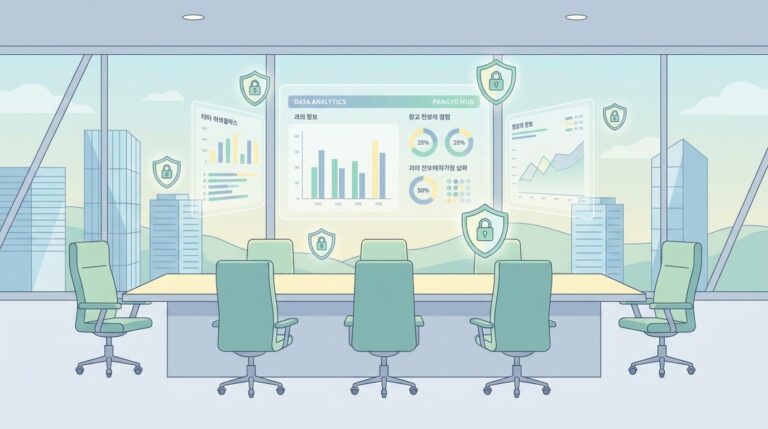
Imagine this scenario: You are sitting in a sleek glass conference room in Pangyo Techno Valley—Korea’s Silicon Valley. Your team has just built a groundbreaking predictive model utilizing customer transaction logs. The dashboard looks immaculate, the metrics are soaring, and everyone is nodding along. Suddenly, the Lead Compliance Officer clears their throat, adjusts their glasses, and asks: “이 데이터 세트에서 비식별화 조치 및 가명정보 처리는 개인정보보호법 가이드라인에 맞춰 제대로 검증되었나요?” (Have the de-identification measures and pseudonymous data processing in this dataset been verified according to the Personal Information Protection Act guidelines?)
Silence falls over the room. You understand the technical concept of data privacy, but articulate debate at an executive C1 Korean level—balancing legal nuances, ethical responsibility, and technical statistical vocabulary—feels like an uphill battle. In Korea’s hyper-digitized corporate ecosystem, data ethics and privacy compliance are not merely backend checklists; they are critical boardroom discussion topics. Based on real-world feedback from foreign data scientists and analysts working in top Korean tech giants, this comprehensive guide will equip you with the precise register, strategic diplomatic tones, and high-level terminology needed to navigate data privacy discussions flawlessly.
Phase 2: Core Expressions Deep Dive
1. 가명정보 결합 및 비식별화 (한글)
- Pronunciation: [Gamyeong-jeongbo gyeolhap mit bi-sikbyeolhwa] (Sound analogy: Gah-myeong jung-boh gyeol-hahp meet bee-sheek-byeol-hwah)
- Meaning: Pseudonymous data combination and de-identification / anonymization.
- K-Culture Moment: Seen frequently in Korean tech thrillers and corporate dramas like Start-Up or Search: WWW when data analytics firms undergo regulatory audits before rolling out AI algorithms.
- Editor’s Insight: Under Korea’s updated Personal Information Protection Act (개인정보보호법), “가명정보” (pseudonymous information) can be utilized for statistics, scientific research, and public interest archiving without explicit re-consent, provided strict “비식별화” (de-identification) protocols are enforced. Using this phrase demonstrates sharp legal-technical literacy.
- Situation Spectrum: Casual 🚫 | Semi-formal ⚠️ | Formal ✅
- 🤔 Think About It: How does your home country’s regulatory framework (e.g., GDPR, CCPA) distinguish between anonymized and pseudonymous data compared to Korea’s strict institutional third-party combination agency system?
2. 정보 주체의 사전 동의 철회 (한글)
- Pronunciation: [Jeongbo juche-ui sajeon dong-ui cheolhoe] (Sound analogy: Jung-boh joo-cheh-eui sah-jeon dong-eui chul-hweh)
- Meaning: Revocation/withdrawal of data subject’s prior consent.
- K-Culture Moment: A classic scene in modern office K-dramas where a consumer privacy advocacy group confronts a conglomerate for tracking digital footprints without allowing accessible opt-outs.
- Editor’s Insight: “정보 주체” (data subject) places the individual human being at the center of ownership, rather than merely calling them “사용자” (user) or “고객” (customer). Combining this with “사전 동의 철회” signals an advanced mastery of regulatory data compliance.
- Situation Spectrum: Casual 🚫 | Semi-formal ⚠️ | Formal ✅
- 🤔 Think About It: Notice the respect embedded in referring to a user as an autonomous legal entity (정보 주체). Does the vocabulary in your native language emphasize user utility or legal agency?
3. 데이터 오남용 및 유출 리스크를 선제적으로 차단하다 (한글)
- Pronunciation: [De-iteo onamyong mit yuchul riseukeu-reul seonje-jeogeuro chadanhada] (Sound analogy: Day-ee-tuh oh-nahm-yong meet yoo-chool ree-seu-keu-reul sun-jeh-juhk-eu-roh chah-dahn-hah-dah)
- Meaning: Preemptively block data misuse, abuse, and leakage risks.
- K-Culture Moment: An assertive statement made by a Chief Information Security Officer (CISO) during an executive crisis meeting or high-stakes pitch.
- Editor’s Insight: “선제적으로” (preemptively/proactively) is a prized corporate keyword in Korean business strategy. It transforms a defensive statement into an executive-level action plan.
- Situation Spectrum: Casual 🚫 | Semi-formal ✅ | Formal ✅
- 🤔 Think About It: Why does Korean corporate communication place heavy stylistic value on four-character derived Sino-Korean verbs like “오남용” (misuse and abuse) and “선제적” (preemptive) in high-stakes governance?
Phase 3: Textbook Korean vs. Real-World Korean
Situation 1: Expressing that customer data needs stricter masking before analysis
- 📖 교과서 한국어: 고객 데이터를 분석하기 전에 이름을 가려야 합니다. (We must hide names before analyzing customer data.)
- 🗣️ 진짜 한국어: 통계 모델링에 투입하기 전에 식별자 정보를 마스킹하고 민감정보 필드를 전면 비식별화해야 합니다. (Before feeding into statistical modeling, we must mask identifier details and completely de-identify sensitive data fields.)
- 💡 왜 다를까? In professional C1 environments, colloquial terms like “이름을 가리다” (hide names) are replaced by technical precision words like “식별자 마스킹” (identifier masking) and “민감정보 비식별화” (sensitive data de-identification).
Situation 2: Asking if legal compliance approved the feature
- 📖 교과서 한국어: 법무팀이 이 기능을 써도 된다고 했습니까? (Did the legal team say we can use this feature?)
- 🗣️ 진짜 한국어: 해당 파이프라인의 개인정보 처리방침 위배 여부에 대해 법무 컴플라이언스 측 컨펌을 득했나요? (Have we obtained confirmation from legal compliance regarding potential violations of the privacy policy in this pipeline?)
- 💡 왜 다를까? High-level corporate Korean frequently uses formal administrative terminology such as “컨펌을 득하다” (obtain confirmation/approval) and “처리방침 위배 여부” (compliance status against processing policy).
Phase 4: K-Culture Deep Dive & Non-Verbal Nuance
4-1. 눈치 (Nunchi) & Non-Verbal Manners in Korean Data Audits
When presenting statistical findings where privacy edge cases exist, Korean executive etiquette dictates that you never dismiss privacy concerns as “mere statistical anomalies.” Maintain an upright posture, keep two hands visible on the conference table (or resting calmly on your tablet/laptop), and acknowledge potential regulatory implications before presenting commercial yields. When an executive raises a compliance question, gently nodding while jotting it down in your notebook signals utmost institutional prudence and Nunchi.
4-2. The Korean Digital Paradox: Hyper-Convenience vs. Ultra-Strict PIPA
South Korea is renowned for lightning-fast digital ecosystems—from one-click KakaoPay authentication to ultra-personalized Coupang logistics algorithms. However, behind this seamless interface lies one of the world’s most stringent regulatory frameworks: the Personal Information Protection Commission (개인정보보호위원회 – PIPC). Korean consumers demand hyper-convenience while fiercely protecting their privacy right (사생활 침해 방지). In business meetings, referencing the PIPC’s official enforcement precedents immediately positions you as an insider who understands the delicate balance between rapid data innovation and institutional compliance.
Phase 5: Real-World Roleplay Scenario
- Setting: A strategy room at a Pangyo fintech enterprise.
- Characters:
- 팀장 박성훈 (Team Lead Park): A sharp, risk-averse Data Analytics Director.
- Alex (You): Senior Data Scientist proposing an aggregate user behavior model.
- Turn 1 (박성훈): 알렉스 님, 이번에 구축한 고객 행동 예측 모델의 표본 추출 과정에서 개인정보 침해 소지는 완전히 배제된 건가요?
(Alex-nim, in the sampling process of this customer behavior predictive model, have potential personal data infringements been completely eliminated?)
🎭 행동 지문: 태블릿 PC의 화면을 넘기며 날카롭게 안경 너머로 쳐다본다. - Turn 2 (You): 네, 팀장님. 데이터 수집 단계부터 원본 식별자를 전면 제거하고, 난수화된 가명 식별키를 부여하여 결합을 진행했습니다.
(Yes, Team Lead. From the data ingestion stage, we removed all original identifiers and conducted the combination using randomized pseudonymous keys.)
🎭 행동 지문: 차분한 표정으로 데이터 아키텍처 다이어그램을 프로젝터에 띄운다. - Turn 3 (박성훈): 만약 다른 외부 공개 데이터셋과 교차 결합되었을 때 재식별화(Re-identification)될 가능성은 얼마나 됩니까?
(What is the probability of re-identification if cross-combined with external public datasets?)
🎭 행동 지문: 턱을 괴고 분석 대시보드의 파라미터를 유심히 점검한다. - Turn 4 (You): k-익명성과 l-다양성 지수를 각각 최고 수준으로 보정했기 때문에 재식별화 리스크는 통계적으로 제로에 수렴합니다.
(Because we calibrated both k-anonymity and l-diversity indices to the highest threshold, the statistical risk of re-identification converges to zero.)
🎭 행동 지문: 신뢰감 있는 목소리로 화면의 프라이버시 평가 지표를 가리킨다. - Turn 5 (박성훈): 다행이네요. 그렇다면 마케팅 활용 목적에 대한 이용 약관 동의율 및 거부권 보장 프로세스는 확인하셨나요?
(That is a relief. Then, have you verified the opt-in rate for marketing terms and the mechanism ensuring the right to object?)
🎭 행동 지문: 만족스러운 듯 고개를 끄덕이며 펜을 집어 든다. - Turn 6 (You): 물론입니다. 옵트인(Opt-in) 기본 설정을 준수했으며, 언제든 마이데이터 포털에서 사전 동의 철회가 가능하도록 구현했습니다.
(Of course. We complied with opt-in defaults and implemented immediate consent withdrawal via the MyData portal.)
🎭 행동 지문: 백서의 컴플라이언스 체크리스트 페이지를 펼쳐 건넨다. - Turn 7 (박성훈): 완벽하군요. 법무팀 최종 검토서만 첨부되면 다음 주 임원 회의에서 바로 릴리즈 승인을 요청하겠습니다.
(Flawless. Once the legal team’s final review is attached, I will request release approval at next week’s executive meeting.)
🎭 행동 지문: 서류에 서명하며 엷은 미소를 짓는다. - Turn 8 (You): 감사합니다. 법무팀 컴플라이언스 최종 승인본을 수령하는 즉시 공유해 드리겠습니다.
(Thank you. I will share the legal compliance sign-off document as soon as it is received.)
🎭 행동 지문: 정중하게 목례하며 회의 자료를 정리한다.
🔀 Interactive Decision Fork
When Team Lead Park asks about cross-dataset re-identification risk in Turn 3, how should you respond?
* Option A: “재식별화 가능성은 거의 없으니까 일단 배포하고 나중에 문제 생기면 고치죠.” (Best / Bad / Risk: Bad — In Korean corporate governance, taking a reactive stance on data privacy will immediately lose trust and halt project approval.)
* Option B: “k-익명성과 l-다양성 알고리즘을 적용하여 외부 데이터와 결합하더라도 개인 식별이 불가능하도록 안전장치를 마련했습니다.” (Best / Bad / Risk: Best — Demonstrates strong statistical knowledge, rigorous preventive compliance, and executive composure.)
* Option C: “법무팀에서 알아서 할 문제라 데이터 사이언스 팀에서는 신경 쓰지 않았습니다.” (Best / Bad / Risk: Risk — Demonstrates dangerous departmental silo mentality and neglect of shared privacy responsibility.)
Phase 6: 10-Second Emotional Shadowing Drill
Master the cadence, pauses (/), and corporate executive emotion markers:
[🧐 신중하고 확신에 찬 목소리로]
“본 데이터 파이프라인은 / 개인정보보호법 가이드라인에 의거하여 / 완벽하게 비식별화 처리를 완료했습니다.”
(Bon de-iteo paipeu-rain-eun / gaein-jeongbo-boho-beop ga-i-deu-rain-e uigeo-hayeo / wanbyeok-hage bi-sikbyeolhwa cheori-reul wanryo-haetseumnida.)-
[🛡️ 단호하고 전문성 있게]
“민감정보 유출 리스크를 방지하기 위해 / 식별자 필드에 대한 / 단방향 암호화를 적용해야 합니다.”
(Mingam-jeongbo yuchul riseukeu-reul bangji-hagi wihae / sikbyeolja pil-deu-e daehan / danbanghyang amhohwa-reul jeok-yong-haeya hamnida.) -
[🤝 정중하면서도 전략적인 어조로]
“정보 주체의 자기결정권을 존중하면서도 / 데이터의 통계적 효용 가치를 / 극대화하는 방안을 모색하겠습니다.”
(Jeongbo juche-ui jagi-gyeoljeong-gwon-eul jonjung-hamyeonseo-do / de-iteo-ui tonggye-jeok hyoyong gachi-reul / geukdaehwa-haneun bangan-eul mosek-hagetseumnida.)
Phase 7: K-Culture Mini Dictionary (Core 4 Keywords)
- 가명정보 (Gamyeong-jeongbo) | Pseudonymous Data
- Data that cannot identify a specific individual without supplementary information. Vital under Korea’s 3 Privacy Acts (데이터 3법).
- 재식별화 (Jae-sikbyeolhwa) | Re-identification
- The risk of reconstructing personal identity by linking anonymized data with external auxiliary sets.
- 마이데이터 (MyData) | MyData Initiative / Data Sovereignty Framework
- South Korea’s nationwide framework empowering citizens to manage, transfer, and monetize their own personal records across finance, healthcare, and telecommunications.
- 개인정보 침해신고 (Gaein-jeongbo Chimhae-singo) | Personal Privacy Infringement Report
- Formal regulatory report filed to the PIPC or KISA regarding illegal data harvesting or unauthorized profiling.
Phase 8: Traveler & Tech Professional Survival Kit
Top 3 Survival Expressions
- 개인정보 수집 동의서에 필수 항목만 체크해도 되나요?
- [Gaein-jeongbo sujip dong-uiseo-e pilsu hangmok-man chekeu-haedo doenayo?]
- Pro Tip: In apps or offline forms, differentiate between [필수] (Mandatory) and [선택] (Optional). You only need to check mandatory items to use the service without consenting to marketing spam.
- 제 개인정보 처리 현황 및 열람 청구를 요청합니다.
- [Je gaein-jeongbo cheori hyeonhwang mit yeollam cheong-gu-reul yocheong-hamnida.]
- Pro Tip: The legal phrase used when formally demanding a company to reveal what personal metrics they hold about you.
- 마케팅 목적의 제3자 정보 제공 동의를 철회하고 싶습니다.
- [Maketing mokjeok-ui jesanja jeongbo jegong dong-ui-reul cheolhoe-hago sipseumnida.]
- Pro Tip: Instantly stops customer service agents or apps from transferring your contact logs to affiliated advertisers.
Editor’s Travel & Expat Note
When settling in Korea, download the official 개인정보 포털 (Privacy Portal) via the 개인정보보호위원회 공식 웹사이트. This tool allows residents and foreign registration card (ARC) holders to track all website identity authentications and sweep inactive accounts effortlessly.
Phase 9: A Step Deeper (한 발 더 깊이)
In Western data privacy philosophy, data rights are predominantly viewed through individual privacy and anti-surveillance frameworks. In South Korea, data privacy operates at the intersection of high-density social trust, hyper-speed infrastructure, and strict state-led regulatory standardization. Korea’s rapid digitalization was fueled by national resident identifiers, making the subsequent transition to decentralized “가명정보” (pseudonymization) a massive sociotechnical endeavor.
When foreign data engineers converse with Korean counterparts, acknowledging this historical context creates profound mutual respect. It proves you understand that Korean data governance isn’t just about avoiding fines—it is about honoring collective social contracts in an interconnected nation.
💬 Your Turn: How does your home country’s approach to data privacy balance commercial big data analytics with individual data sovereignty? Share your perspective in the comments below!
Phase 10: FAQ & Common Pitfalls
Q: Can companies in Korea process user behavioral logs without consent if data is aggregated?
A: Only if the data is processed into “가명정보” (pseudonymous data) for statistical purposes, scientific research, or public record-keeping in accordance with Article 28-2 of the PIPA, while strictly adhering to safety measures that prevent re-identification.
Q: What is the difference between 익명정보 (Anonymized Data) and 가명정보 (Pseudonymous Data)?
A: 익명정보 cannot be re-identified even when combined with all available additional data (outside PIPA scope). 가명정보 can be restored with supplementary keys and thus remains strictly regulated under PIPA safeguards.
Q: If a customer demands account deletion, does the company have to delete analytics logs immediately?
A: Yes, under the right to erasure (삭제권), primary identifying data must be deleted. However, statistical aggregated summaries where individuals cannot be identified can generally be retained for reporting.
🚨 Common Mistakes Warning Board
- Mistake: Confusing “동의 철회” (Consent withdrawal) with “회원 탈퇴” (Account deletion).
- Correct Action: State clearly whether you are revoking optional data processing permissions (동의 철회) or completely deleting the service account (회원 탈퇴).
- Mistake: Using casual words like “데이터 지우다” in legal compliance audits.
- Correct Action: Use “데이터 파기 (Data destruction)” or “영구 삭제 (Permanent deletion)”.
- Mistake: Assuming “선택 동의” (Optional consent) is required to use Korean digital platforms.
- Correct Action: Uncheck all non-mandatory items to protect your personal privacy when signing up for services.
Phase 11: Action Mission & Engagement
- 🥉 Bronze Mission (Solo Shadowing): Read the Phase 6 shadowing drill out loud three times, focusing on natural pauses at
/. - 🥈 Silver Mission (Social Exploration): Open your favorite Korean mobile app (KakaoTalk, Baemin, or Naver), go to 설정 (Settings) > 개인정보 처리방침 (Privacy Policy), and locate the words “가명정보” and “제3자 제공 동의”.
- 🥇 Gold Mission (Real-world Challenge): Draft a 3-sentence Korean email requesting de-identification validation for a mock dataset using the C1 vocabulary learned today.
- 🎮 K-Culture Mission: Watch an episode of tech/office dramas (e.g., Start-Up or Agency) and note down how characters handle confidential user data and legal contracts!
Phase 12: Interactive Quiz Challenge
1. [Situational Judgment] You are leading a data science meeting in Seoul and an executive asks how to comply with Korean privacy laws while training an AI model. Which phrase is most accurate and professional?
* A) 데이터 대충 섞어서 쓰면 법무팀도 모를 겁니다.
* B) 원본 데이터에서 개인식별자를 비식별화 처리하고 가명정보 결합 절차를 준수하겠습니다.
* C) 그냥 미국 서버로 데이터를 보내서 규제를 피합시다.
2. [Fill-in-the-Blank] 통계 분석 시 특정 개인을 알아볼 수 없도록 식별자를 안전하게 변환하는 조치를 “______ 조치”라고 합니다.
3. [True / False] In South Korea, users do not have the right to revoke their prior consent once given for data analytics. (O / X)
🔍 Click here to reveal Answers & Detailed Explanations
- Answer: B
- Explanation: Option B demonstrates full compliance with PIPA’s pseudonymous data frameworks using advanced terminology.
- Answer: 비식별화 (De-identification)
- Explanation: “비식별화 조치” is the standard legal and technical term for anonymizing/de-identifying identifiers.
- Answer: X (False)
- Explanation: Under Korean PIPA, data subjects have an explicit right to withdraw prior consent (사전 동의 철회권) at any time.
- Explanation: Under Korean PIPA, data subjects have an explicit right to withdraw prior consent (사전 동의 철회권) at any time.







