

Master Korean Supermarket Savings: How to Use Discount Coupons Like a Local
Phase 1: Empathy (Story-Driven Opening)
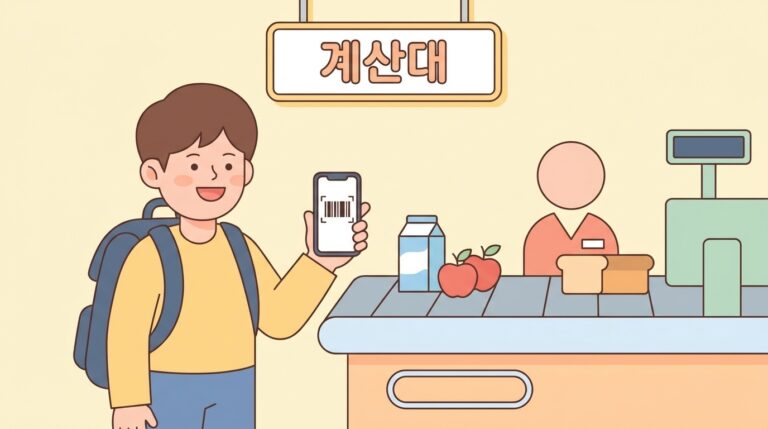
안녕하세요! (Hello!) I’m your Daily Hangul editor and your personal cultural navigator. Picture this: You’re standing inside a bustling Korean supermarket like E-Mart or Homeplus. Your cart is packed with your favorite Shin Ramyun, marinated bulgogi, and strawberry milk. You excitedly pull out a 3,000 KRW discount barcode coupon on your phone that you received from a travel promo or downloaded via an app. But as the cashier swiftly beeps your items and says “봉투 필요하세요?” (Do you need a bag?), your mind goes completely blank. You freeze, nervously point your phone screen at the cashier, and wonder: How do I politely say ‘Can I use this coupon?’ without creating a long line behind me?
If you have ever felt that sudden burst of social panic at a Korean checkout counter, you are definitely not alone! Many of our beginner learners tell us that shopping counters trigger the highest anxiety because Korean cashiers work with lightning speed (ppalli-ppalli culture). In this lesson, we will break down simple A2-level phrases so you can confidently claim discounts, save your travel budget, and shop just like a savvy Seoul local.
Phase 2: Top 3 Essential Expressions Deep Dive
1. 쿠폰 쓸 수 있어요? (Kupon sseul su isseoyo?)
- Pronunciation: Koo-pon seul soo ee-ssuh-yo? (Sounds like “coo-pon” + “sir” without the ‘r’ + “sue” + “ee-saw-yo”)
- Meaning: Literal: “Can [I] use coupon?” / Natural Nuance: “Can I use this coupon?”
- K-Culture Moment: Seen frequently in K-Dramas like Weightlifting Fairy Kim Bok-joo when college students look for every possible discount at marts or snack bars.
- Editor’s Insight: The verb 쓰다 (sseuda) means ‘to use’, and -(으)ㄹ 수 있어요 (-(eu)l su isseoyo) is the essential A2 pattern for ‘can do’. It is polite, direct, and universally understood.
- Situation Spectrum: Casual: ⚠️ (쿠폰 써도 돼?) | Semi-formal/Everyday: ✅ (쿠폰 쓸 수 있어요?) | Formal: ✅ (쿠폰 사용 가능한가요?)
- 🤔 Think About It: In English, we often ask “Do you accept this?” whereas Koreans focus on the action “Can I use this?” Notice how the subject ‘I’ is naturally omitted!
2. 이거 할인돼요? (Igeo harindwaeyo?)
- Pronunciation: Ee-guh ha-rin-dwae-yo? (Think of “Ee-gear” without the ‘r’, “ha-rin”, and “dway-yo”)
- Meaning: Literal: “Does this get discounted?” / Natural Nuance: “Is this eligible for a discount?”
- K-Culture Moment: When grocery shopping at night in Korean reality shows like I Live Alone, celebrities check yellow discount stickers (tteol-i) on fresh produce.
- Editor’s Insight: 할인 (harin) means ‘discount’ and 되다 (dweda) means ‘to become/to be done’. This phrase works wonders when checking if a promo applies to your specific item.
- Situation Spectrum: Casual: ⚠️ (이거 할인돼?) | Semi-formal/Everyday: ✅ (이거 할인돼요?) | Formal: ✅ (할인 적용이 되나요?)
- 🤔 Think About It: Koreans love turning nouns into passive verbal questions with 되다 (dweda). It sounds softer than demanding “Give me a discount!”
3. 바코드 찍어 주세요. (Bakodeu jjigeo juseyo.)
- Pronunciation: Bah-ko-deu jjee-guh joo-seh-yo. (“Bar-code” + “jjee” with a tense ‘jj’ + “guh” + “joo-say-yo”)
- Meaning: Literal: “Please scan the barcode.” / Natural Nuance: “Please scan this barcode (on my phone).”
- K-Culture Moment: In modern convenience store scenes (Backstreet Rookie), customers hold up digital membership barcodes on their smartphones.
- Editor’s Insight: 찍다 (jjikda) means to stamp, print, or scan. Paired with -아/어 주세요 (-a/eo juseyo), it becomes a polite request that gets cashiers to scan your phone screen instantly.
- Situation Spectrum: Casual: 🚫 (바코드 찍어줘) | Semi-formal/Everyday: ✅ (바코드 찍어 주세요) | Formal: ✅ (바코드 스캔 부탁드립니다)
- 🤔 Think About It: Notice how digital interactions in Korea still use physical tactile verbs like 찍다 (to stamp/imprint). Language preserves history!
Phase 3: Textbook Korean vs. Real-world Korean
- Situation 1: Asking if a mobile coupon works
- 📖 Textbook Korean: “제가 모바일 할인 쿠폰을 소지하고 있는데 사용 가능합니까?” (Jega mobail harin kuponeul sojihago inneunde sayong ganeunghamnigga? – I possess a mobile discount coupon; is usage possible?)
- 🗣️ Real-world Korean: “이 쿠폰도 돼요?” (I kupon-do dwaeyo? – Does this coupon work too?)
- 💡 Why the difference? Supermarket lines move fast! Native speakers replace stiff Sino-Korean words like 소지 (possession) and 사용 가능 (usage possibility) with the versatile verb 되다 (to work / to be okay).
- Situation 2: Showing a 1+1 or 2+1 promotion item
- 📖 Textbook Korean: “이 상품은 일 더하기 일 증정 행사 대상입니까?” (I sangpumeun il deohagi il jeungjeong haengsa daesang-imnikka?)
- 🗣️ Real-world Korean: “이거 원 플러스 원 맞아요?” (Igeo won peulleoseu won majayo? – Is this 1+1, right?)
- 💡 Why the difference? Koreans literally say “One Plus One” (원 플러스 원) in everyday speech rather than formal literary terms.
Phase 4: K-Culture Deep Dive & Non-Verbal Etiquette
4-1. Nunchi & Grocery Etiquette
- The Screen Brightness Rule: Before stepping up to the cash register, turn your smartphone brightness to maximum. Cashiers scan at high speed, and a dim screen slows down the entire line!
- Two-Handed Phone Presentation: Hold your phone with both hands or support your right wrist with your left hand when presenting your barcode. This shows subtle Korean politeness (ye-ui).
- Point at the Right Moment: Mention your coupon before you tap your credit card or cash. Once the payment processes, cashiers have to cancel the entire transaction to apply the discount!
4-2. Cultural Code: The Magic of “1+1” (One-Plus-One)
In Korea, promotions are deeply ingrained in the consumer mindset. Look out for tags labeled 1+1 (Buy 1 Get 1 Free) or 2+1 (Buy 2 Get 1 Free). If you bring only one item from a 1+1 display to the counter, a kind cashier will often point back and say “하나 더 가져오세요!” (Bring one more!). Korean retail culture prioritizes making sure you get your full promotional benefit!
Phase 5: Real-Life Roleplay Scenario
Setting: Supermarket Checkout Counter at Lotte Mart Seoul Station.
Characters: Cashier (Min-ji) & Shopper (Alex).
- Turn 1 (Cashier): 봉투 필요하세요? (Bongtu pil-yohaseyo? / 🎭 Pointing to plastic and paper bags / “Do you need a bag?”)
- Turn 2 (Shopper): 아니요, 괜찮아요. 장바구니 있어요. (Aniyo, gwaenchanayo. Jangbaguni isseoyo. / 🎭 Shaking head gently and showing reusable bag / “No, I’m okay. I have a grocery tote bag.”)
- Turn 3 (Shopper): 저기요, 쿠폰 쓸 수 있어요? (Jeogiyo, kupon sseul su isseoyo? / 🎭 Showing phone screen politely with both hands / “Excuse me, can I use a coupon?”)
- Turn 4 (Cashier): 네, 바코드 보여주세요. (Ne, bakodeu boyeojuseyo. / 🎭 Raising barcode scanner / “Yes, please show me the barcode.”)
- Turn 5 (Shopper): 여기 바코드 있어요. 찍어 주세요. (Yeogi bakodeu isseoyo. Jjigeo juseyo. / 🎭 Tilting screen toward the scanner / “Here is the barcode. Please scan it.”)
- Turn 6 (Cashier): [삑-] 네, 3천 원 할인되셨어요. ([Beep-] Ne, sam-cheon won harindoesyeosseoyo. / 🎭 Checking screen / “[Beep] Yes, 3,000 won has been discounted.”)
- Turn 7 (Shopper): 감사합니다! 카드로 계산할게요. (Gamsahamnida! Kadeuro gyesanhalgeyo. / 🎭 Tapping credit card on reader / “Thank you! I will pay by card.”)
- Turn 8 (Cashier): 영수증 드릴까요? (Yeongsujeung deurilkkayo? / 🎭 Holding printed receipt / “Would you like your receipt?”)
🔀 Interactive Choice Point
The cashier looks at your phone and says: “이 쿠폰은 3만 원 이상 살 때만 돼요.” (This coupon only works for purchases over 30,000 KRW.) Your total is currently 27,000 KRW. What do you do?
- Option A: Say “아, 그래요? 과자 하나 더 가져올게요!” (Oh really? I’ll bring one more snack!) and quickly grab a 3,000 KRW snack nearby.
- 👉 Feedback (Best Choice): Perfectly natural and clever! You meet the threshold and maximize your discount value without holding up the cashier.
- Option B: Loudly argue “그냥 깎아 주세요!” (Just discount it anyway!).
- 👉 Feedback (Bad Choice): POS systems in Korean marts are automated; the cashier cannot manually override digital promo thresholds. This will cause awkward tension.
- Option C: Say nothing, immediately snatch your phone back, and walk away in embarrassment.
- 👉 Feedback (Risk Choice): No need to panic! Simply saying “그러면 쿠폰 빼고 결제해 주세요” (Then please charge without the coupon) solves it smoothly in 2 seconds.
Phase 6: 10-Second Emotion Shadowing Drill
Practice matching the cadence and intonation of native speakers. Pause briefly at /.
[😊 Cheerful & Inquiring]저기요, / 이 쿠폰 / 쓸 수 있어요? (Jeogiyo, / i kupon / sseul su isseoyo?)[💡 Hopeful & Curious]이거 / 오늘 / 할인돼요? (Igeo / oneul / harindwaeyo?)[🤝 Polite & Clear]바코드 / 여기 있어요! / 찍어 주세요. (Bakodeu / yeogi isseoyo! / jjigeo juseyo.)[🥺 Slightly Disappointed but Polite]아, / 적용 안 돼요? / 알겠습니다. (Ah, / jeogyong an dwaeyo? / algetseumnida.)
Phase 7: K-Culture Mini Dictionary
- 할인 쿠폰 (Harin Kupon) | Discount Coupon | Used for physical paper vouchers, mobile barcodes, and app-based discount pop-ups in grocery stores.
- 원 플러스 원 (Won Peulleoseu Won) | 1+1 (Buy One Get One Free) | The holy grail of Korean retail promotions. Look for tags reading ‘1+1’ or ‘2+1’ across convenience stores and supermarkets.
- 장바구니 (Jangbaguni) | Reusable Grocery Tote Bag | Since Korean stores charge 50~100 KRW for disposable plastic/paper bags, bringing a 장바구니 saves money and looks eco-friendly.
- 영수증 (Yeongsujeung) | Receipt | Often asked at checkout: “영수증 버려드릴까요?” (Shall I throw away your receipt?). Answer “네, 버려주세요” (Yes, discard it) or “주세요” (Please give it to me).
Phase 8: Traveler’s Survival Kit
Top 3 Survival Phrases
- 한글: 이거 1+1 행사예요? (Igeo won-plus-won haengsa-yeyo?)
- Romanization: Ee-guh won-pleu-luh-seu-won hang-sah-yay-yo?
- Pro Tip: Ask this when you aren’t sure if two products from slightly different brands qualify for the combo promo.
- 한글: 포인트 적립은 안 해요. (Pointeu jeongnibeun an haeyo.)
- Romanization: Po-in-teu jung-neeb-eun an hay-yo.
- Pro Tip: Cashiers frequently ask “포인트 카드 있으세요?” (Do you have a membership card?). If you don’t have one, just use this phrase.
- 한글: 쿠폰 적용됐어요? (Kupon jeogyong-dwaesseoyo?)
- Romanization: Koo-pon jug-yong-dway-ssuh-yo?
- Pro Tip: Use this after payment if you want to double-check that the discount was properly deducted from the total.
Editor’s Travel Note
When shopping in Korea, download the Naver Map App to find mega-supermarkets (like E-Mart, Lotte Mart, Homeplus, and No Brand) nearby. Keep in mind that major Korean supermarkets have mandatory closure days (usually the 2nd and 4th Sunday of every month) due to domestic retail regulations. Always verify store opening status on map apps before heading out!
Phase 9: A Step Deeper (Reflection Question)
In Korea, grocery discounts and store loyalty programs are tightly integrated with KakaoTalk channels and smartphone apps. Asking for discounts isn’t viewed as stingy; rather, using coupons skillfully is admired as 알뜰하다 (altteulhada – frugal, sensible, and smart). This reflects Korea’s post-war cultural value of resourcefulness combined with high-tech efficiency.
💬 Your Turn: In your home country, do people feel shy using coupons at grocery counters, or is it celebrated as smart shopping? Share your thoughts in the comments below!
Phase 10: FAQ & Avoiding Misunderstandings
Q: Can I use coupons on items that are already on sale (e.g., 1+1 or yellow clearance stickers)?
A: Usually, Korean mart POS systems do not allow double discounts (jung-bok harin). However, general cash-voucher coupons (e.g., 5,000 KRW off total bill) often apply regardless. Ask: “중복 할인 돼요?” (Jungbok harin dwaeyo? – Does duplicate discount work?).
Q: Do tourist tax refunds work together with discount coupons?
A: Yes! At large marts (like Lotte Mart Seoul Station), you can use discount coupons first to lower the bill, and then present your passport for an immediate Tax Refund (hwangeup) on the remaining balance.
Q: How do I tell the cashier that my phone coupon won’t scan?
A: If the scanner struggles with your screen, simply say “화면 밝기 올려드릴게요” (I will turn up the brightness) or offer to read the 12-digit number underneath the barcode: “번호로 입력해 주시겠어요?” (Could you input the number?).
🚨 Common Mistakes Alert
- Mistake: Showing the coupon after tapping your credit card.
- Correct Action: Present your phone before payment begins while saying, “쿠폰 먼저 쓸게요” (I’ll use the coupon first).
- Mistake: Assuming all coupons work across all branch locations.
- Correct Action: Check the fine print at the bottom of the voucher for “일부 매장 제외” (Excluded at certain branches).
- Mistake: Forgetting to turn off night mode / low blue-light filters.
- Correct Action: Yellow night filters block laser scanners. Disable them for a second when showing barcodes.
Phase 11: Action Mission & Engagement
- 🥉 Bronze Mission (Solo Practice): Stand in front of your mirror with your phone. Say “쿠폰 쓸 수 있어요?” aloud 5 times with a bright smile.
- 🥈 Silver Mission (Social Share): Take a photo of an interesting Korean snack and post it on your Instagram Story with the caption: “이거 1+1 맞아요? #DailyHangul”
- 🥇 Gold Mission (Real-World Test): Walk into a Korean mart or convenience store (GS25/CU), show a digital promotional event banner on your phone, and ask the clerk: “이 쿠폰 쓸 수 있어요?”
- 🎮 K-Culture Mission: Watch any grocery scene in a Korean variety show (like Three Meals a Day or Omniscient Interfering View) and spot how often cast members look for “1+1” stickers!
Phase 12: Interactive Quiz Challenge
1. Situational Judgment: You want to ask the mart cashier if your mobile coupon is accepted. Which phrase is the most natural?
* A) 쿠폰 먹어요?
* B) 쿠폰 쓸 수 있어요?
* C) 쿠폰을 사세요!
2. Fill in the Blank: “이 상품 오늘 _______?” (Is this product discounted today?)
* A) 비싸요
* B) 없어요
* C) 할인돼요
3. True or False Culture Quiz: In Korea, saying “원 플러스 원 (1+1)” at a checkout counter is considered incorrect English and cashier staff won’t understand it.
* [True / False]
🔍 Click here to reveal Answers & Explanations!
- Answer: B) 쿠폰 쓸 수 있어요? (A is nonsensical using ‘eat’, and C means ‘Buy the coupon!’).
- Answer: C) 할인돼요 (할인되다 = to be discounted. A means expensive, B means not present).
- Answer: False! “1+1” (pronounced Won-Plus-Won) is standard Konglish embraced nationwide across every mart and convenience store in Korea!







