

Phase 1: Empathy & Story Opening
안녕하세요! (Hello!) I’m your Daily Hangul editor and your personal Korean culture navigator! 🙋♂️✨
Picture this: You are having the most amazing evening exploring the vibrant alleys of Hongdae or Bukchon Hanok Village. You just devoured delicious Tteokbokki, clicked a hundred photos, and suddenly… your head starts throbbing, or your stomach sends an urgent SOS. You reach for your phone, search for medicine, but the signs are all in Korean and you freeze in panic.
We have all seen this classic scene in K-Dramas where the protagonist rushes into a brightly lit neighborhood shop to buy a patch or soothing medicine for someone they care about. But in real life, being sick in a foreign country can be intimidating.
Don’t worry! You don’t need a medical degree in Korean. With just a few beginner-friendly magic phrases from our tested survival toolkit, you will confidently walk up to any local, locate the nearest pharmacy, and get the exact medicine you need in under two minutes! Let’s conquer this together!
Phase 2: Top 3 Essential Expressions Deep Dive
1. 약국 어디예요? (Yak-guk eo-di-ye-yo?)
- Pronunciation: [Yak-gook uh-dee-yay-yo?] (Sounds like “Yuck-gook” with a gentle upward inflection at the end!)
- Meaning: Literal: “Pharmacy where is?” / Actual: “Where is the pharmacy?”
- K-Culture Moment: Seen in countless slice-of-life dramas when a friend suddenly feels dizzy and asks a passerby on a street corner.
- Editor’s Insight: The word 약 (Yak) means “medicine” and 국 (Guk) means “station/office”. Combining them creates “Pharmacy”. 어디예요? is the ultimate life-saving question word for “Where is [place]?”.
- Situation Spectrum: Casual: ⚠️ (Use ‘약국 어디야?’ with close friends) | Semi-formal: ✅ | Formal: ✅
- 🤔 Think About It: Notice how Korean puts the location word first and the question ending at the very back. How does this compare to English starting with “Where”?
2. 머리가 아파요 (Meo-ri-ga a-pa-yo)
- Pronunciation: [Muh-ree-gah ah-pah-yo] (Think of “Memory” shortened to “Muh-ree” + “Ah-pa-yo” like sighing “Ah!” in pain)
- Meaning: Literal: “Head hurts” / Actual: “I have a headache.”
- K-Culture Moment: The iconic dramatic K-Drama mother holding her temples with both hands after her child says something shocking.
- Editor’s Insight: Simply swap the body part before -가 아파요 (hurts)! For example: 배가 아파요 (Bae-ga a-pa-yo) = “My stomach hurts.”
- Situation Spectrum: Casual: ⚠️ (to friends: 머리 아파) | Semi-formal: ✅ | Formal: ✅
- 🤔 Think About It: Instead of saying “I have a noun (headache)”, Korean describes the state: “The head is painful”. Isn’t that vivid?
3. 진통제 주세요 (Jin-tong-je ju-se-yo)
- Pronunciation: [Jeen-tong-jay joo-seh-yo]
- Meaning: Literal: “Painkiller give please” / Actual: “Please give me a painkiller / Tylenol.”
- K-Culture Moment: Walking into a pharmacy right before an important job interview or date to stop the pain quickly.
- Editor’s Insight: 주세요 (Ju-se-yo) is your golden word in Korea for anything you want to purchase or request nicely.
- Situation Spectrum: Casual: 🚫 | Semi-formal: ✅ | Formal: ✅
- 🤔 Think About It: Adding 주세요 instantly makes any noun polite and respectful in Korean shops!
Phase 3: Textbook Korean vs. Real Korean
- Situation 1: Asking where the pharmacy is located
- 📖 Textbook Korean: 약국이 어느 쪽에 위치해 있습니까? (Is the pharmacy located in which direction?)
- 🗣️ Real Korean: 저기요, 약국 어디예요? (Excuse me, where is the pharmacy?)
- 💡 Why is it different? Real Koreans value brevity and quick communication, especially when someone looks unwell.
- Situation 2: Asking for headache medicine
- 📖 Textbook Korean: 두통 치료 약제를 구비하고 계십니까? (Do you have headache therapeutic medication in stock?)
- 🗣️ Real Korean: 머리 아픈 약 있어요? / 타이레놀 있어요? (Do you have medicine for headache? / Do you have Tylenol?)
- 💡 Why is it different? A1 beginners don’t need complex medical jargon; simple descriptive phrases like “head hurting medicine” are completely natural!
Phase 4: K-Culture Deep Dive & Non-Verbal Manners
4-1. Nunchi (눈치) & Body Language
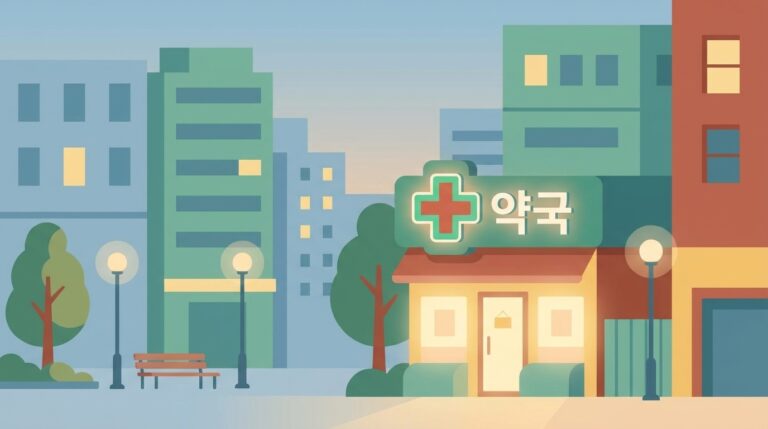
- Spotting the Sign: Look for the giant Korean character 약 (YAK) glowing in red or blue neon on storefronts. Most pharmacies in Korea do not look like huge grocery marts; they are cozy, specialized shops.
- Point and Explain: If words fail you, lightly place your hand on your forehead (for headache) or stomach (for stomachache) while saying “여기 아파요 (Yeo-gi a-pa-yo – It hurts here)”. Pharmacists will instantly understand your Nunchi signal.
- Receiving Items: When the pharmacist hands you the medicine box or card receipt, receive it using both hands (or one hand supporting your other wrist). It shows immediate warmth and gratitude.
4-2. The Convenience Store (편의점) Safety Net
Did you know? In Korea, if pharmacies are closed late at night or on holidays, you can buy basic emergency medicine (안전상비의약품) such as Tylenol, digestive pills (훼스탈), and pain relief patches (파스) at 24-hour convenience stores like CU, GS25, and 7-Eleven right behind the counter!
Phase 5: Real-Life Roleplay Scenario
- Setting: A cozy neighborhood pharmacy near Myeongdong subway station. Pharmacist Mr. Park is standing behind a clean glass counter.
Alex (Tourist): 저기요, 실례합니다.
(Jeo-gi-yo, sil-lye-ham-ni-da.)
“Excuse me, pardon me.”
🎭 Alex walks in carefully holding his forehead with a tired expression.
Pharmacist Park: 네, 어서 오세요. 어디 불편하세요?
(Ne, eo-seo o-se-yo. Eo-di bul-pyeon-ha-se-yo?)
“Yes, welcome. Where does it bother you / what’s wrong?”
🎭 Pharmacist smiles warmly and leans forward.
Alex: 머리가 너무 아파요.
(Meo-ri-ga neo-mu a-pa-yo.)
“My head hurts so much.”
Pharmacist Park: 열도 나요? 감기예요?
(Yeol-do na-yo? Gam-gi-ye-yo?)
“Do you have a fever too? Is it a cold?”
Alex: 아니요, 열은 없어요. 그냥 두통이에요.
(A-ni-yo, yeor-eun eop-seo-yo. Geu-nyang du-tong-i-e-yo.)
“No, no fever. Just a headache.”
Pharmacist Park: 아, 진통제 드릴게요. 하루에 두 번 드세요.
(A, jin-tong-je deu-ril-ge-yo. Ha-ru-e du beon deu-se-yo.)
“Ah, I’ll give you painkillers. Take it twice a day.”
🎭 Pharmacist hands over a small box and points to the instructions.
Alex: 얼마예요?
(Eol-ma-ye-yo?)
“How much is it?”
Pharmacist Park: 삼천 원이에요. 물 많이 드세요!
(Sam-cheon won-i-e-yo. Mul man-i deu-se-yo!)
“It’s 3,000 KRW. Drink lots of water!”
🔀 Interactive Choice Branch
What should Alex say after paying to leave a great impression?
- Option A: “감사합니다! (Gam-sa-ham-ni-da!)” + Bow slightly with two hands.
- Option B: “안녕! (An-nyeong!)” + Give a high-five.
- Option C: Say nothing and run out immediately.
-
Option Feedback:
- Option A (Best): 🌟 Perfect! Polite, natural, and warm. Pharmacists will smile and say “쾌차하세요 (Get well soon)!”
- Option B (Risk): ⚠️ ‘An-nyeong’ is informal slang only for close peers. Older pharmacists might find it rude!
- Option C (Bad): 🚫 While understandable if you’re in pain, a quick “감사합니다” makes Korean interactions super heartwarming.
Phase 6: 10-Second Emotion Shadowing Drill
Repeat these aloud with matching emotional intonation! Slash marks (/) indicate where to take a mini-breath.
[🥺 In pain & desperate]
저기요… / 약국 / 어디예요?
(Jeo-gi-yo… / yak-guk / eo-di-ye-yo?)-
[😣 Describing your symptom clearly]
머리가 / 너무 / 아파요.
(Meo-ri-ga / neo-mu / a-pa-yo.) -
[😊 Relieved & grateful]
진통제 / 주세요. / 감사합니다!
(Jin-tong-je / ju-se-yo. / Gam-sa-ham-ni-da!)
Phase 7: K-Culture Mini Dictionary
- 약국 (Yak-guk) | Pharmacy / Drugstore
Found on almost every major street and near subway stations with a glowing “약” sign. - 약사 (Yak-sa) | Pharmacist
The certified healthcare professional wearing a clean white gown inside the store. - 소화제 (So-hwa-je) | Digestive medicine
Essential for when you indulge in too much Korean K-BBQ, fried chicken, or spicy food! - 파스 (Pa-seu) | Pain relief patch
The famous topical menthol patch Koreans stick on sore muscles or legs after 20,000 steps of shopping.
Phase 8: Survival Kit for Travelers
TOP 3 Survival Phrases
- 약국 어디예요? (Where is the pharmacy?) — Pro Tip: Show the written text to any subway staff if you are in a rush.
- 소화제 주세요. (Please give me digestive medicine.) — Pro Tip: Say this when your stomach feels heavy after spicy K-Food.
- 물 좀 주세요. (Please give me some water.) — Pro Tip: Most pharmacies have a complimentary hot/cold water dispenser near the entrance to take your medicine immediately.
Editor’s Travel Note
- Install the [Naver Map Navigation App] on your phone before your trip. Typing
약국in the search bar immediately highlights all open pharmacies nearby with real-time hours! - Credit cards and Apple Pay (at supported terminals) are widely accepted even for a 3,000 KRW box of band-aids.
Phase 9: “A Step Deeper” — Cultural Reflection
In Korea, neighborhood pharmacies are more than just commercial stores; they are cozy community touchpoints. When elderly neighbors or students drop by looking exhausted, it is traditional for pharmacists to offer a small bottle of warm energy drink (like Ssanghwa-tang or Bacchus). This reflects Korea’s Jeong (정)—an unspoken bond of collective affection and care for one another’s well-being.
💬 Your Turn: How are pharmacies viewed in your home country? Are they quick impersonal supermarkets or friendly neighborhood spots? Let us know in the comments below!
Phase 10: FAQ & Common Mistakes
Q: Can I buy antibiotics over the counter at a Korean pharmacy?
A: No. In Korea, antibiotics and strong prescription drugs strictly require an official doctor’s prescription from a clinic (의원/병원). Over-the-counter medicines (진통제, 소화제, 감기약) do not require a prescription.
Q: How do I say I have a cold in Korean?
A: You can simply say “감기 걸렸어요 (Gam-gi geol-lyeo-sseo-yo)” which translates to “I caught a cold”.
Q: What if all pharmacies nearby are closed on Sunday?
A: Head to the nearest convenience store (CU, GS25, 7-Eleven) and ask the cashier for “상비약 (Sang-bi-yak)” or point to Tylenol behind the counter.
🚨 Common Mistakes TOP 3
- Mistake: Pronouncing 약국 as “Yak-gook-oo” with extra vowels.
➡️ Correct Action: Keep the ending crisp: “Yak-guk”. - Mistake: Asking “Do you have pharmacy?” instead of “Where is the pharmacy?”.
➡️ Correct Action: Always remember [Place] + 어디예요?. - Mistake: Forgetting to mention your specific pain point.
➡️ Correct Action: Even saying just “머리 (head)” or “배 (stomach)” while looking sad helps the pharmacist select the right medicine instantly!
Phase 11: Action Mission & Engagement
- 🥉 Bronze Mission (Solo): Stand in front of the mirror, hold your forehead, and say “저기요, 머리가 아파요. 진통제 주세요!” 3 times smoothly.
- 🥈 Silver Mission (Social): Share this post with a friend traveling to Korea and test each other on how to say “Where is the pharmacy?”.
- 🥇 Gold Mission (Real Life): When watching your next K-Drama, spot the sign 약 in street scenes and shout out “약국이다! (It’s a pharmacy!)”.
🎮 K-Culture Mission: Search for a clip of BTS or your favorite K-Pop idol ordering food/drinks and notice how frequently they use the polite magic word 주세요 (Ju-se-yo)!
Phase 12: Interactive Quiz Challenge
Test your new skills! Click to reveal the correct answers:
1. Situation Check: You just walked into a pharmacy with an upset stomach after dinner. What should you say?
* A) 머리가 아파요.
* B) 배가 아파요. 소화제 주세요.
* C) 약국 어디예요?
👉 Click to view the answer & explanation!
Answer: B) 배가 아파요. 소화제 주세요.
Explanation: ‘배가 아파요’ means ‘my stomach hurts’, and ‘소화제’ is digestive medicine. (A is for headache, C is asking for directions).
2. Fill in the Blank:
“Excuse me, where is the pharmacy?” ➡️ “저기요, 약국 ______?”
👉 Click to view the answer & explanation!
Answer: 어디예요 (eo-di-ye-yo)
Explanation: ‘어디예요?’ means ‘Where is it?’.
3. True or False: In Korea, you can buy basic pain relief medicine at 24-hour convenience stores if pharmacies are closed.
👉 Click to view the answer & explanation!
Answer: True (O)
Explanation: 24-hour convenience stores carry designated emergency over-the-counter medicines (안전상비의약품) like basic painkillers and digestive tablets!







