

Mastering the Art of Korean Middle Management: Navigating Grievances and Leadership at a C2 Level
Phase 1: 공감 (Story Immersion Opening)
안녕하세요! 매일한글 에디터입니다. (Hello! This is your Daily Hangul editor.)
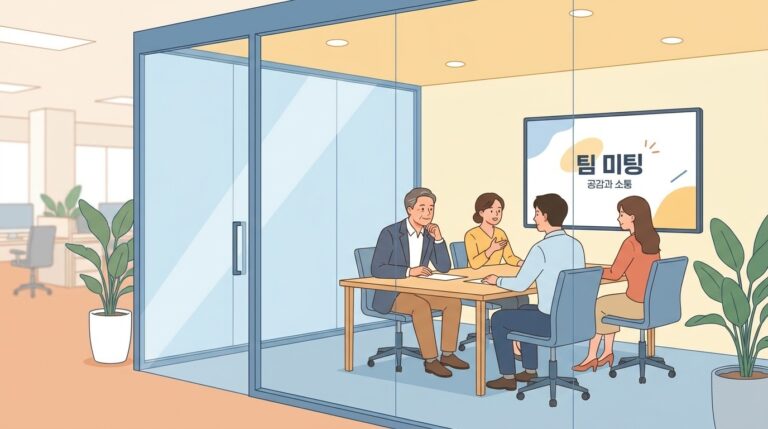
Picture this: You are sitting in a dimly lit glass meeting room at a bustling Gangnam tech firm. On your left is your senior director (bujangnim), demanding flawless Q3 KPI deliverables with uncompromising traditional rigor. On your right is your junior associate (sawon), an articulate Gen-Z hire who just sent an emotional message hinting at quiet quitting due to burnout. You, sitting in the middle as the team manager (timjangnim), are caught in the quintessential Korean corporate sandwich—the notorious kkindae (낀 세대) dilemma.
In high-stakes Korean corporate culture, middle management is not merely about project tracking; it is an intricate psychological dance of grievance mediation, strategic buffering, and emotional coaching. If you have ever felt your high-level Korean freeze up during intense one-on-one conflict resolutions, you are not alone. Many advanced C2 learners understand the grammar perfectly but stumble upon the sociolinguistic pragmatics required to defuse tensions without burning bridges. This masterclass is curated from years of executive coaching and insider corporate insights, designed to elevate your nuanced Korean to boardroom-level mastery.
Phase 2: 핵심 표현 3선 심층 분석 (Key Expressions Deep Dive)
1. 중간에서 조율하느라 고충이 많으시겠지만, 원만히 수습해 봅시다.
- Pronunciation: Jung-gan-eseo joyul-haneura gochungi maneusigettjiman, wonmanhi suseup-hae bopsida. (Sounds like: Joong-gahn-eh-suh jo-yool-ha-neu-rah go-choong-ee mahn-eu-shi-get-jee-mahn, won-mahn-hee soo-seup-hae bop-she-dah)
- Meaning: “I know it must be extremely challenging to coordinate in the middle, but let us settle this smoothly.”
- K-Culture Moment: Reminiscent of the legendary desk confrontations in tvN’s Misaeng (Incomplete Life), where Manager Oh mediates between executive pressure and the sales team’s exhaustion.
- Editor’s Insight: Gochung (고충) goes deeper than ‘difficulty’; it encapsulates internal agony and systemic grievances. Pairing it with Wonmanhi suseup (원만히 수습) signals mature, outcome-oriented executive diplomacy.
- Situation Spectrum: Casual 🚫 | Semi-formal ⚠️ | Formal ✅
- 🤔 Think About It: In Western management, accountability is often individual and direct. How does acknowledging the systemic burden of the “middle coordinator” (jung-gan) reflect Korean collective harmony?
2. 실무진의 애로사항을 충분히 수렴하여 상부에 설득력 있게 건의하겠습니다.
- Pronunciation: Silmujindului aerosa-hangeul chungbunhi suryeom-hayeo sangbue seoldeukryeok itge geon-uihagetseumnida. (Sounds like: Sheel-moo-jeen-eui eh-ro-sah-hahng-eul choong-boon-hee soo-ryum-hah-yuh sahng-boo-eh sul-deuk-ryuk eet-geh gun-eui-hah-get-seum-nee-dah)
- Meaning: “I will thoroughly synthesize the working-level staff’s operational pain points and persuasively petition upper management.”
- K-Culture Moment: The pivotal turning point in office dramas where an authentic leader shields their team from unrealistic C-suite directives.
- Editor’s Insight: Suryeom-hada (수렴하다) means actively converging diverse inputs into an organized consensus, proving you are not a passive messenger (tteut-jeon-dalja), but an empathetic advocate.
- Situation Spectrum: Casual 🚫 | Semi-formal ⚠️ | Formal ✅
- 🤔 Think About It: Notice how geon-ui (건의) replaces direct demands (yogu). How does soft-phrasing an upward appeal protect both your credibility and organizational face?
3. 감정적인 소모를 줄이고, 근본적인 업무 프로세스 개선에 초점을 맞춥시다.
- Pronunciation: Gamjeongjeokin somoreul jurigo, geunbonjeokin eomu peuroseseu gaeseone chojeomeul matchwopsida. (Sounds like: Gahm-jung-juck-een soh-moh-reul joo-ree-goh, geun-bon-juck-een um-moo pro-seh-seu geh-sun-eh choh-jum-eul maht-choop-she-dah)
- Meaning: “Let us minimize emotional depletion and pivot our focus toward reforming fundamental operational workflows.”
- K-Culture Moment: A calm HR or department director de-escalating interpersonal team friction in Search: WWW.
- Editor’s Insight: By labeling relational tension as gamjeongjeok somo (emotional burn/depletion), you de-personalize the conflict and steer the conversation objectively toward structural problem-solving.
- Situation Spectrum: Casual ⚠️ | Semi-formal ✅ | Formal ✅
- 🤔 Think About It: Why is reframing a personal conflict into an “operational process issue” such a crucial skill in high-context communication environments?
Phase 3: 교과서 한국어 vs 진짜 한국어 (Textbook vs. Real-World C2 Korean)
Situation 1: De-escalating an agitated junior colleague’s complaints about workload
- 📖 교과서 한국어: 당신의 불만을 이해합니다. 제가 부장님께 말해보겠습니다. (I understand your dissatisfaction. I will tell the department head.)
- 🗣️ 진짜 한국어: 현업에서 느끼는 현타와 과부하, 십분 공감합니다. 제가 완충재 역할을 맡아 조율해 볼 테니 조금만 믿고 지켜봐 주세요.
- 💡 왜 다를까? Textbook phrasing sounds cold, clinical, and blunt. The sophisticated native expression uses contemporary concepts like hyeonta (disillusionment), gwa-buha (overload), and the metaphor wanchungjae (buffer), establishing deep psychological safety.
Situation 2: Reporting a cross-departmental clash to your Executive Director
- 📖 교과서 한국어: 개발팀과 마케팅팀이 싸우고 있어서 일을 못 합니다. (The Dev and Marketing teams are fighting, so work cannot proceed.)
- 🗣️ 진짜 한국어: 양 부서 간의 R&R(역할과 책임) 불분명으로 인한 마찰이 누적된 상태입니다. 우선순위를 재설정하여 리소스를 재배분할 필요가 있습니다.
- 💡 왜 다를까? Advanced professional speech avoids simplistic words like ssawuda (fight) in favor of refined corporate terminology like machal nujeok (accumulated friction) and strategic resource allocation terms.
Phase 4: K-Culture 딥다이브 & 비언어적 매너 (Deep Dive & Non-Verbal Nuance)
4-1. 눈치(Nunchi) & Corporate Micro-Gestures
When handling grievances as a Korean manager, your physical posture is 70% of the message:
* The Tilt of Empathetic Attentiveness: When listening to a subordinate’s grievance, angle your torso roughly 15 degrees toward them rather than confronting them face-to-face over a desk. Nod slowly with subtle eye contact, avoiding intrusive staring.
* The Open-Palm Suggestion: When addressing upper management with counter-proposals, keep hands open and gestures low near the waistline. Never point or tap pens, as this indicates argumentative defiance.
4-2. Cultural Code: The Evolution of Gondae and the “Shielding Manager”
In modern South Korean business culture, traditional hierarchical authority (kkondae-ism) has faced fierce pushback from younger professionals. The contemporary ideal middle manager is known as a bangpae timjang (Shielding Team Lead)—someone who acts as a shock absorber against unreasonable top-down pressure while nurturing junior talent. Balancing this without alienating senior executives requires supreme linguistic dexterity.
Phase 5: 실전 롤플레이 시나리오 (Interactive Roleplay Scenario)
Setting: A quiet corner meeting room on the 14th floor of a Pangyo headquarters.
Characters:
* Manager Alex (You): C2 Korean speaker, Senior Operations Lead.
* Manager Min-ji (NPC): Brilliant but exasperated Product Owner contemplating resignation due to unfeasible sprint deadlines.
- Turn 1 (Min-ji): 🎭 (한숨을 깊게 내쉬며 서류를 내려놓는다) 팀장님, 솔직히 이번 프로젝트 일정은 도저히 맞출 수 없습니다. 경영진에서는 현실을 너무 모릅니다.
(Deeply sighing and placing documents down: Team Lead, honestly, this project schedule is utterly impossible to meet. Executive management is completely out of touch with reality.) - Turn 2 (You): 🎭 (따뜻한 눈빛으로 물 한 잔을 건네며) 민지 님이 혼자 짊어지신 부담감이 얼마나 막중했을지 충분히 짐작이 갑니다. 우선 일정 압박 요인부터 하나씩 짚어볼까요?
(Handing over a glass of water with warm eyes: I can fully fathom how crushing the burden you’ve shouldered alone must have been. Shall we pinpoint the schedule pressure points one by one first?) - Turn 3 (Min-ji): 🎭 (목소리가 떨리며) 지난주에도 매일 야근했는데, 추가 요구사항까지 내려왔어요. 밑의 팀원들도 한계에 도달했습니다.
(With a trembling voice: We worked overtime every single day last week, and now additional scope requirements have been pushed down. The team members are at their breaking point too.) - Turn 4 (You): 🎭 (고개를 끄덕이며 진지한 톤으로) 실무진의 피로도가 임계치에 다다랐다는 점, 제가 무겁게 받아들이고 있습니다. 팀원들의 소진을 방치할 수는 없죠.
(Nodding with a solemn tone: I take it very heavily that the team’s fatigue has reached its critical threshold. We cannot simply overlook team burnout.) - Turn 5 (Min-ji): 🎭 (약간 누그러졌지만 여전히 의구심을 품고) 하지만 상무님께 말씀드리면 또 ‘의지 문제’라고 일축하실 텐데요…
(Slightly softened but still doubtful: But if we bring this to the Managing Director, he will probably brush it off as a ‘matter of willpower’…) - Turn 6 (You): 🎭 (신뢰감 있는 미소와 단호한 어조로) 데이터 기반으로 설득해야죠. 기능별 개발 소요 시간을 시각화해서 제가 직접 상무님과 담판 짓겠습니다.
(With a confident smile and decisive tone: We must persuade using data. I will visualize the development hours per feature and negotiate with the Director personally.) - Turn 7 (Min-ji): 🎭 (안도의 한숨을 쉬며 허리를 편다) 팀장님께서 그렇게 앞장서 주신다면, 저희도 기능 우선순위 조율안을 다시 정리해 보겠습니다.
(Sighing in relief and sitting up: If you step up to bat for us like that, we will re-organize the feature priority roadmap.) - Turn 8 (You): 🎭 (손을 가볍게 모으며) 고마워요. 불합리한 압박은 제가 막아낼 테니, 민지 님은 팀의 안정과 품질에만 집중해 주세요.
(Lightly clasping hands together: Thank you. I will absorb the unreasonable pressure, so Min-ji, please focus strictly on team stability and delivery quality.)
🔀 인터랙티브 분기점 (Interactive Decision Fork)
At Turn 6, if you chose a different approach, how would the outcome shift?
* Option A (Best): “데이터 기반으로 설득해야죠. 제가 직접 상무님과 담판 짓겠습니다.” (Data-driven advocacy; protects psychological safety and builds unwavering loyalty.)
* Option B (Risk): “상무님 스타일 아시잖아요. 이번 한 번만 참고 주말에 조금 더 힘내봅시다.” (Result: Toxic positivity. High risk of immediate talent resignation.)
* Option C (Bad): “그럼 민지 님이 직접 상무님께 보고서 들고 가서 따져보실래요?” (Result: Complete abdication of managerial leadership. Total loss of team trust.)
Phase 6: 10초 감정 섀도잉 드릴 (Emotional Shadowing Drill)
Practice matching the micro-cadences and pitch variations indicated below:
[🛡️ 단호하고 든든하게 (Resolute and protective)]- “상부와의 조율은 / 제가 책임지고 담판 지을 테니, / 실무진은 걱정 말고 / 페이스 유지하세요.”
[🤝 따뜻하고 사려 깊게 (Warm and considerate)]- “단순한 업무 과중을 넘어 / 심리적 탈진 상태인 것 같아 / 마음이 매우 무겁습니다.”
[⚖️ 이성적이고 차분하게 (Objective and composed)]- “누구의 잘잘못을 가리기 전에, / 구조적인 병목 현상부터 / 객관적으로 짚어봅시다.”
Phase 7: K-Culture 미니 사전 (Mini Dictionary)
- 완충 작용 (Wanchung Jagyong) | Shock-absorption / Buffer capacity
- Usage: Refers to a middle manager absorbing structural or emotional friction between senior executives and juniors.
- 현타 (Hyeonta) | Reality check / Sudden disillusionment (Slang/Colloquialism)
- Usage: Used empathetically in 1-on-1s to validate an employee feeling meaningless burnout from tedious corporate tasks.
- 교착 상태 (Gyochaek Sangtae) | Deadlock / Impasse
- Usage: Professional term for describing stalled negotiations or project gridlocks between competing departments.
- 담판을 짓다 (Dampan-eul Jitda) | To settle final terms / Reach a definitive resolution
- Usage: Used when a manager steps into executive meetings to make a definitive negotiation on behalf of the squad.
Phase 8: 여행자 & 비즈니스 주재원을 위한 생존 키트 (Survival Kit)
Top 3 On-the-Fly Survival Expressions
- “잠시 머리 좀 식히고 10분 뒤에 다시 논의할까요?” (Jam-si meori jom sikigo sip-bun dwie dasi nonui-halkkayo?)
- Pro Tip: Perfect for de-escalating heated boardroom debates gracefully.
- “이 사안은 실무진 차원을 넘어섰으니 제가 핸들링하겠습니다.” (I sa-aneun silmujin cha-woneul neomeoseosseumiro jega haendeulling-hagetseumnida.)
- Pro Tip: Instantly protects overwhelmed team members while showcasing decisive ownership.
- “팀원들의 의견을 취합하여 명문화된 가이드라인을 전달드리겠습니다.” (Tim-wondului uigyeoneul chwihap-hayeo myeongmun-hwadoen gaideu-raineul jeondal-deurigetseumnida.)
- Pro Tip: Replaces verbal ambiguity with formalized, professional commitments.
Editor’s Pro Travel & Expat Note
If you are relocating to Pangyo, Teheran-ro, or Yeouido for leadership roles, ensure you install the official 네이버 지도 앱 다운로드 (Naver Map application) to seamlessly reserve private corporate conference rooms and tea lounges (hoeui-shil) for confidential one-on-ones.
Phase 9: “한 발 더 깊이” (Cultural Insights & Critical Thinking)
Korean corporate dynamics are deeply rooted in the Confucian matrix of relational hierarchy (yullryeo) merged with hyper-speed modernization. While modern corporate language increasingly embraces flat hierarchy (pyeongdeung munhwa), the implicit expectation for managers to act as paternal/maternal guardians (bomo) remains surprisingly resilient. True C2 Korean leadership mastery requires the art of honoring formal hierarchy (kyuk-sik) upwards while offering unconditional psychological safety (simri-jeok anjeong-gam) downwards.
💬 Your Turn: Have you ever experienced a management situation where direct Western-style feedback clashed with high-context Korean expectations? Share your leadership challenge below!
Phase 10: FAQ & 오해 방지 (FAQ & Common Mistakes)
Q: Can I use “화내지 마세요” (Don’t get angry) to calm down a frustrated junior team member?
A: Absolutely avoid this. “화내지 마세요” invalidates the employee’s genuine feelings and can sound condescending. Instead, validate their emotions first using: “충분히 답답하고 화가 날 만한 상황입니다” (It is completely understandable that you feel frustrated in this situation).
Q: How do I tell an executive that a deadline is impossible without sounding insubordinate?
A: Never say “못 합니다” (We can’t do it). Instead, frame it through resource constraints and trade-offs: “현재 가용 리소스로는 품질 저하가 불가피하여, 핵심 기능 우선 출시 후 순차 배포하는 방안을 제안드리고자 합니다” (Given current available resources, quality compromise is inevitable; hence we propose prioritizing core features first with phased rollouts).
Q: What is the most refined word to describe “burnout” in a formal report?
A: While beon-aut (번아웃) is widely understood, use 심신 소진 (physical and mental exhaustion) or 직무 탈진 (occupational burnout) in written reports to demonstrate elite executive diction.
🚨 흔한 실수 (Common Mistakes) Checklist
- ❌ Saying “김 부장님이 그렇게 시켰어” (Manager Kim ordered it that way — casts blame upward).
👉 Correct: “경영진의 전략적 방향성을 바탕으로 우선순위를 조율 중입니다.” - ❌ Saying “제 말이 맞죠?” (Am I right? — confrontational tone).
👉 Correct: “이 방향에 대해 다른 우려 사항이나 제언이 있으실까요?” - ❌ Saying “알아서 잘 처리해 봐” (Figure it out yourself — classic negligent leadership).
👉 Correct: “진행하면서 병목이 생기면 언제든 즉시 저에게 에스컬레이션해 주세요.”
Phase 11: 액션 미션 & 참여 유도 (Action Missions)
- 🥉 Bronze Mission (Self Practice): Record yourself delivering the Phase 6 Shadowing Drill sentences, focusing on keeping a warm, steady, and lower vocal register.
- 🥈 Silver Mission (Social Connection): Leave a comment below translating your own management motto into high-level C2 Korean.
- 🥇 Gold Mission (Real Application): Next time you face a workplace bottleneck, consciously replace casual frustration with the phrase: “업무 프로세스 상의 병목 현상을 진단해 봅시다.”
- 🎮 K-Culture Mission: Watch Episode 4 of the K-drama Misaeng or Agency and jot down 2 instances where a middle manager mediates an inter-departmental conflict.
Phase 12: 인터랙티브 퀴즈 챌린지 (Interactive Quiz Challenge)
1. Situational Judgment Quiz
Your senior director pushes down an unexpected 50% workload increase due in 48 hours. Your team is on the verge of revolt. What is the most culturally adept C2 response?
* (A) “이건 명백한 근로기준법 위반이니 노동청에 신고하겠습니다.”
* (B) “팀원들의 리소스 한계를 감안하여, 긴급도가 높은 항목부터 선별 집행하는 가이드라인을 수립하겠습니다.”
* (C) “부장님, 저희 팀 죽으라는 말씀이신가요?”
🔍 정답 및 해설 보기 (Click for Answer & Explanation)
- Correct Answer: (B)
- Explanation: (B) strategically acknowledges the crisis, avoids direct confrontation with senior leadership, and actively provides a structured prioritization solution. (A) and (C) are emotionally combative and destroy professional credibility.
2. Fill-in-the-Blank Quiz
Fill in the proper Korean business term for ‘absorbing friction and buffering conflict’:
“팀장님께서 상부의 압박 속에서도 훌륭한 (______ ) 역할을 해주신 덕분에 프로젝트를 무사히 마쳤습니다.”
🔍 정답 및 해설 보기 (Click for Answer & Explanation)
- Correct Answer: 완충재 (or 완충 작용)
- Explanation: Wanchungjae literally means ‘cushioning/shock-absorbing material’, metaphorically describing an exemplary protective leader.
3. True or False Cultural Nuance Quiz
True or False: In high-context Korean business culture, silence during an escalation meeting always means complete agreement with your management decision.
🔍 정답 및 해설 보기 (Click for Answer & Explanation)
- Correct Answer: False
- Explanation: In Korean corporate settings, silence from subordinates during conflict often indicates unspoken grievance, severe discomfort, or passive resistance (mu-eon-ui jeohang). A C2 manager must proactively uncover this through separate 1-on-1 conversations (myeon-dam).






