

Phase 1: Empathy & Story Immersion
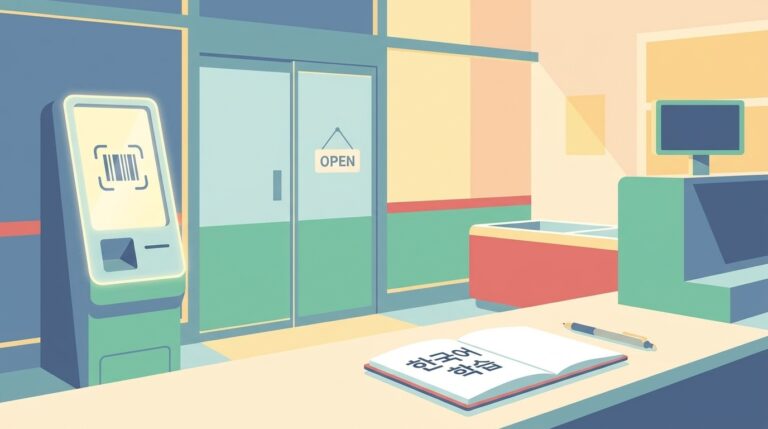
안녕하세요! It’s your Daily Hangul editor and cultural navigator. Picture this: It is 1:30 AM in a quiet alley of Yeonnam-dong. You just finished a late-night stroll after binge-watching K-dramas, craving a steaming cup of ramyeon and a pouch iced coffee. You walk up to a brightly lit convenience store, but the automatic sliding doors do not open. You peer inside: no cashier, glowing self-checkout kiosks, and an RFID scanner blinking at the door.
You might feel a sudden wave of panic: Do I need a Korean resident registration number? What if the door locks behind me? How do I scan barcode bundles properly without triggering an alarm?
Rest assured! Korea’s unmanned convenience stores (무인 편의점) are marvels of urban safety and smart retail. Navigating them smoothly is a true rite of passage that elevates your Korean competence to an authentic C1 level. Drawing from real feedback from our advanced learners, this guide covers everything from entry authentication and barcode nuances to handling self-service errors naturally.
Phase 2: 3 Core Expressions in Depth
1. 출입 인증을 위해 카드를 태그해 주세요 (Chur-ip in-jeung-eul wi-hae ka-deu-reul tae-geu-hae ju-se-yo)
- Pronunciation: [Chur-ip in-jeung-eul wi-hae ka-deu-reul tae-geu-hae joo-seh-yo] (Think of ‘tag’ sounding like the English game of tag, spoken softly)
- Meaning: Literal: “Please tag your card for entry authentication.” / Nuance: “Tap any credit/debit card or QR pass on the scanner to unlock the entrance.”
- K-Culture Moment: Heard across automated voice prompts in modern unmanned kiosks throughout Seoul’s residential districts.
- Editor’s Insight: ‘태그하다’ (to tag/tap) is standard everyday loan-word Korean for contactless RFID/NFC tapping. Notice that no money is deducted at the door—it verifies identity or operational intent.
- Situation Spectrum: Casual ⚠️ | Semi-formal ✅ | Formal ✅ (System Prompt / Store Signage)
- 🤔 Think About It: Why does a cashless entry system symbolize the high-trust social infrastructure of South Korea?
2. 바코드를 리더기에 찍고 결제 버튼을 눌러 주세요 (Ba-ko-deu-reul ri-deo-gi-e jjik-go gyeol-je beo-teun-eul nul-leo ju-se-yo)
- Pronunciation: [Bah-koh-deu-reul ree-duh-gee-eh jjeek-goh gyuhl-jeh buh-teun-eul nool-luh joo-seh-yo] (The ‘jjik’ sounds crisp like a camera shutter clicking)
- Meaning: Literal: “Scan the barcode on the reader and press the payment button.” / Nuance: “Self-checkout standard instruction.”
- K-Culture Moment: Displayed on self-kiosk touchscreens at automated GS25, CU, and E-Mart24 branches.
- Editor’s Insight: The verb ‘찍다’ originally means to stamp, imprint, or photograph, but in modern digital retail, it universally means ‘to scan a barcode’ or ‘to tap a transit card.’
- Situation Spectrum: Casual ✅ | Semi-formal ✅ | Formal ✅
- 🤔 Think About It: How did everyday action verbs like ‘찍다’ evolve to cover modern automated technology in Korean?
3. 바코드 인식이 잘 안 되는데 혹시 어떻게 해야 하나요? (Ba-ko-deu in-sig-i jal an doe-neun-de hok-si eo-tteoh-ge hae-ya ha-na-yo?)
- Pronunciation: [Bah-koh-deu in-sheeg-ee jal an dweh-neun-deh hohk-shee uh-ttuhk-keh hae-yah hah-nah-yoh?]
- Meaning: Literal: “Barcode recognition isn’t working well, what should I do by any chance?” / Nuance: “Excuse me, the barcode isn’t scanning—could you show me what to do?”
- K-Culture Moment: Used when asking a fellow late-night shopper or contacting store emergency support via the intercom.
- Editor’s Insight: The softener ‘혹시’ (by any chance) combined with ‘-는데’ creates an impeccably polite, non-confrontational C1-level inquiry.
- Situation Spectrum: Casual ⚠️ | Semi-formal ✅ | Formal ✅
- 🤔 Think About It: Why do Korean speakers prefer indirect contextual openers (
-는데) before asking for troubleshooting help?
Phase 3: Textbook Korean vs. Real Native Korean
Situation 1: Asking if a credit card is needed to open the door
- 📖 Textbook Korean: “이 문을 열기 위해서는 신용카드가 필요합니까?”
- 🗣️ Real Native Korean: “여기 들어가려면 카드 찍어야 돼요?”
- 💡 Why the difference?: Textbook Korean relies on formal Sino-Korean structures (
-기 위해서,필요합니까), while native speakers use fluid, spoken conditionals (-려면) with natural dynamic verbs (찍다).
Situation 2: Asking someone how to apply a ‘1+1’ promotional bundle at self-checkout
- 📖 Textbook Korean: “원 플러스 원 행사는 어떻게 처리해야 합니까?”
- 🗣️ Real Native Korean: “행사 상품 바코드 둘 다 찍어야 적용돼요?”
- 💡 Why the difference?: Natives pinpoint the specific operational question directly (whether both promotional items need individual barcode scans for system discount verification).
Phase 4: K-Culture Deep Dive & Non-Verbal Manners
4-1. Nunchi & Self-Checkout Etiquette
- Clean-as-you-go (뒷정리): If you use the hot water dispenser for cup ramyeon or the microwave, wipe spills immediately with paper towels provided beside the station.
- Sequential Bagging: Do not toss un-scanned items directly into personal bags. Keep all items on the scanning platform counter to maintain camera sightlines and avoid accidental alarms.
- Door Latch Awareness: When leaving, wait for the chime before pushing the exit button (
문열림/퇴실 버튼). Forcing the door can trigger security sirens.
4-2. Cultural Code: The High-Trust Society (CCTV & Security Tech)
Unmanned stores across Korea operate on a blend of community trust and omnidirectional smart surveillance (AI CCTV). Locals treat unmanned spaces with the same civic decorum as staffed stores. It is common to see unattended laptops and open store fridges respected completely, reflecting a deep societal commitment to shared public trust.
Phase 5: Real-Life Roleplay Scenario
- Setting: 2:00 AM at an unmanned convenience store near Hongdae. You and Min-woo (a friendly local shopper) are at the self-checkout kiosks.
- You: 저기요, 혹시 이 문 열 때 교통카드 찍어도 돼요? (Jeo-gi-yo, hok-si i mun yeol ttae gyo-tong-ka-deu jjik-eo-do dwae-yo?) 🎭 [Politely pointing toward the card reader at the entrance] (Excuse me, can I tap a transportation card to open this door?)
- Min-woo: 아, 티머니는 안 되고 신용카드나 카카오페이 QR 찍으셔야 열려요! (A, T-money-neun an doe-go sin-yong-ka-deu-na Ka-ka-o-pe-i QR jjik-eu-syeo-ya yeol-lyeo-yo!) 🎭 [Smiling warmly and showing his payment app] (Ah, T-money doesn’t work; you need to tap a credit card or Kakao Pay QR to unlock it!)
- You: 아하, 그렇군요! 신용카드 태그하니까 바로 열리네요. 감사합니다. (A-ha, geu-reoh-gun-yo! Sin-yong-ka-deu tae-geu-ha-ni-kka ba-ro yeol-li-ne-yo. Gam-sa-ham-ni-da.) 🎭 [Tapping credit card and stepping inside] (Aha, I see! Tapped my credit card and it opened right away. Thank you.)
- Min-woo: 다행이네요. 계산할 때 1+1 상품은 두 개 다 바코드 찍으셔야 할인돼요! (Da-haeng-i-ne-yo. Gye-san-hal ttae won-peul-leo-seu-won sang-pum-eun du gae da ba-ko-deu jjik-eu-syeo-ya hal-in-dwae-yo!) 🎭 [Pointing at the ramen shelf promo sign] (Glad that worked. For 1+1 items, make sure to scan both barcodes at checkout to get the discount!)
- You: 아, 두 개 다 찍어야 되는군요! 하나만 찍을 뻔했어요. (A, du gae da jjik-eo-ya doe-neun-gun-yo! Ha-na-man jjik-eul ppeon-haess-eo-yo.) 🎭 [Grabbing the second drink with relief] (Ah, I need to scan both! I was almost going to scan just one.)
- Min-woo: 네, 화면에 ‘행사 적용’ 뜨는지 확인하고 카드 꽂으시면 돼요. (Ne, hwa-myeon-e ‘haeng-sa jeog-yong’ tteu-neun-ji hwag-in-ha-go ka-deu kkot-eu-si-myeon dwae-yo.) 🎭 [Tapping his own kiosk screen] (Yes, just check if ‘Promotion Applied’ pops up on screen, then insert your card.)
- You: 영수증 출력 버튼 누르고 봉투 바코드도 따로 결제하는 거죠? (Yeong-su-jeung chul-ryeok beo-teun nu-reu-go bong-tu ba-ko-deu-do tta-ro gyeol-je-ha-neun geo-jyo?) 🎭 [Holding up a 100-won plastic bag] (I press print receipt, and scan the bag barcode separately too, right?)
- Min-woo: 맞아요, 완벽하시네요! 맛있게 드세요. (Maj-a-yo, wan-byeok-ha-si-ne-yo! Mas-it-ge deu-se-yo.) 🎭 [Giving a thumb-up and waving] (Exactly right, you’ve got it down! Enjoy your food.)
🔀 Interactive Decision Branch
What do you do if your payment is approved, but the receipt paper runs out and the door won’t unlock?
* Choice A: Force the glass door open using shoulder pressure.
* Feedback (Bad): 🚫 Will sound an alarm and alert local security.
* Choice B: Press the blue “퇴실 (Exit)” button next to the door frame.
* Feedback (Best): ✅ Standard unmanned store protocol. The door opens automatically via internal motion/button triggers.
* Choice C: Leave your purchases on the counter and climb over the partition.
* Feedback (Risk): ⚠️ Extreme risk of police dispatch under trespassing surveillance.
Phase 6: 10-Second Emotion Shadowing Drill
[😊 Confident & Inquiring]
신용카드 / 태그하면 / 바로 / 열리나요?
(Sin-yong-ka-deu / tae-geu-ha-myeon / ba-ro / yeol-li-na-yo?)[💡 Realizing & Grateful]
아 / 원 플러스 원은 / 바코드를 / 둘 다 찍어야 / 적용되는군요!
(A / won-peul-leo-seu-won-eun / ba-ko-deu-reul / dul da jjik-eo-ya / jeog-yong-doe-neun-gun-yo!)[🤝 Polite & Smooth]
결제 다 끝났는데 / 퇴실 버튼 / 누르면 되죠?
(Gyeol-je da kkeut-nass-neun-de / toe-sil beo-teun / nu-reu-myeon doe-jyo?)
Phase 7: K-Culture Mini Dictionary
- 무인 매장 (Mu-in Mae-jang): Unmanned / Automated store operating without on-site staff.
- 행사 상품 (Haeng-sa Sang-pum): Promotional merchandise (1+1, 2+1, discounts).
- IC칩 결제 (IC-chip Gyeol-je): Inserting a physical smartcard chip into a card reader slot.
- 퇴실 버튼 (Toe-sil Beo-teun): The designated wall/door button pressed to exit automated premises.
Phase 8: Traveler’s Survival Kit
Survival Phrases TOP 3
- 한글: 카드 꽂는 곳이 어디예요? (Ka-deu kkot-neun gos-i eo-di-ye-yo?)
- Pronunciation: [Kah-deu kkot-neun goh-shee uh-dee-yeh-yoh?]
- Pro Tip: Use when self-checkout kiosks have multiple card and scanner slots.
- 한글: 비닐봉투 바코드 찍어야 돼요? (Bi-nil-bong-tu ba-ko-deu jjik-eo-ya dwae-yo?)
- Pronunciation: [Bee-neel-bong-too bah-koh-deu jjeek-uh-yah dweh-yoh?]
- Pro Tip: In Korea, disposable plastic bags are legally charged (usually 100–200 KRW).
- 한글: 기계가 멈췄는데 관리자 연락처 있나요? (Gi-gye-ga meom-chwoss-neun-de gwan-ri-ja yeol-lak-cheo it-na-yo?)
- Pronunciation: [Gee-gyeh-gah muhm-chwos-neun-deh gwahn-ree-jah yuhl-lahk-chuh ees-nah-yoh?]
- Pro Tip: Kiosks feature emergency helpline numbers printed right near the screen.
Editor’s Travel Note
Download the Naver Map application to search for nearby 24-hour spots with the keyword 무인 편의점 (unmanned convenience store) or 무인 라면 (self-service ramen café). Ensure you have international credit cards with IC chips activated for seamless authentication.
Phase 9: “A Step Deeper” Humanities Reflection
Unmanned stores in Korea represent more than mere automation—they reflect the intersection of communal trust, digital infrastructure, and urban density. In a society where public spaces are preserved through mutual accountability, stepping into an unmanned shop gives you a window into how smart cities can function safely.
💬 Your Turn: Have you ever tried an automated kiosk in Korea? Share your favorite late-night convenience store snack in the comments below!
Phase 10: FAQ & Common Mistakes
Q: Do foreign credit cards work at entry scanners and self-checkout kiosks?
A: Yes! Most major international cards (Visa, Mastercard) work for entry authentication and checkout. Entry scanners do not charge fees; they only verify valid card details.
Q: What should I do if an item doesn’t scan a 1+1 promotional discount?
A: Ensure you brought both items to the kiosk and scanned both individual barcodes. The system will recognize the paired set and deduct the price of one item automatically.
Q: Can I buy alcohol or tobacco at unmanned stores?
A: By Korean law, age-restricted products in unmanned stores require Korean digital resident authentication (PASS app/mobile ID). Foreign passports are generally not supported by automated vending machines, so buy these during staffed daytime hours.
🚨 Common Mistakes TOP 3
- Mistake: Tapping T-money transit cards on the entry scanner.
- Correct Action: Use an IC credit card, Kakao Pay, or Naver Pay QR.
- Mistake: Scanning only one item during a 2+1 promotion.
- Correct Action: Bring all 3 items to the kiosk and scan all three barcodes sequentially.
- Mistake: Forgetting to scan the optional plastic bag.
- Correct Action: Scan the barcode printed directly on the plastic bag stand before payment.
Phase 11: Action Missions
- 🥉 Bronze Mission: Stand in front of a mirror and practice saying
바코드 찍고 결제할게요smoothly 5 times. - 🥈 Silver Mission: Next time you visit an automated store, take a picture of the self-checkout screen (without personal info) and label the buttons (
결제,영수증,퇴실) in Korean. - 🥇 Gold Mission: Successfully enter a Korean unmanned convenience store, scan a 1+1 drink promo, pay by card, and exit using the manual door button!
- 🎮 K-Culture Mission: Spot an unmanned store scene in a recent slice-of-life K-drama and note how the characters interact with the kiosk.
Phase 12: Interactive Quiz Challenge
1. Situation Judgment Quiz
You want to enter an unmanned convenience store at night, but your T-money card is rejected at the door. What is the correct solution?
* A) Kick the bottom of the door.
* B) Tap a valid credit/debit card on the entrance scanner.
* C) Wait outside until morning.
👉 View Answer & Explanation
Correct Answer: B
Explanation: Entrance scanners check for valid identity/financial cards (credit cards or mobile app authentication). Transportation cards like T-money are not valid entry verification tools.
2. Fill-in-the-Blank
“1+1 행사 상품은 바코드를 ___ ___ 찍어야 할인 적용이 됩니다.”
* Hint: Meaning “both / all two”
👉 View Answer & Explanation
Correct Answer: 둘 다 (dul da)
Explanation: In Korean self-checkout systems, both promotional items must be scanned so the POS system can calculate the 1+1 discount.
3. True or False Culture Quiz
Statement: Unmanned stores in Korea let foreign tourists buy beer and cigarettes anytime without special ID verification.
👉 View Answer & Explanation
Correct Answer: False (X)
Explanation: Korean regulations require automated biometric or domestic mobile ID authentication for age-restricted items, which foreign passports cannot bypass at kiosks.







