

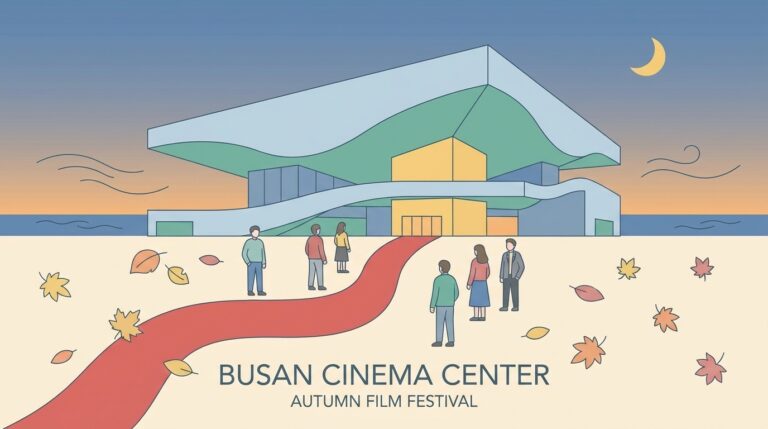
Attending the Busan International Film Festival (BIFF): Essential Korean Phrases & Festival Guide
Phase 1: Empathy & K-Culture Story Opening
안녕하세요! Welcome back to Daily Hangul! I’m your Korean culture navigator and best friend here to guide you through one of Korea’s most magical autumn experiences: The Busan International Film Festival (BIFF / 부산국제영화제).
Picture this: It is early October in Haeundae, Busan. The cool autumn sea breeze touches your cheeks, the massive outdoor screen at the Busan Cinema Center lights up under the night sky, and top K-drama stars are walking right past you on the red carpet. You want to ask where the ticket booth is, find out if the famous Guest Visit (GV) session is already sold out, or grab a late-night street food snack at BIFF Square. But suddenly, your mind goes blank, and textbook phrases like “Where is the cinema?” feel too stiff and robotic.
Don’t worry! Many beginner learners feel overwhelmed when visiting a bustling Korean festival. In this guide, tailored specifically for A2 learners, you will master natural, bite-sized expressions that will help you navigate ticket booths, spot famous actors, and enjoy Busan’s coastal festival vibes with total confidence.
Phase 2: Key Expressions Breakdown (Top 3)
1. 현장 예매 가능한가요? (Hyeonjang yemae ganeunghangayo?)
- Pronunciation: Hyeon-jang ye-mae ga-neung-han-ga-yo? (Sounds like: Hyun-jahng yeh-mae gah-neung-hahn-gah-yo? – emphasize “ye-mae” like “yeh-may”)
- Meaning: Literal: “Is on-site booking possible?” / Real Nuance: “Can I buy tickets in person here today?”
- K-Culture Moment: Asking staff at the Busan Cinema Center outdoor booth when online tickets are completely sold out.
- Editor’s Insight: Online tickets for BIFF sell out within seconds. Knowing this phrase lets you check for on-site cancellation tickets fast!
- Situation Spectrum: Casual: ⚠️ (현장 예매 돼?) / Semi-formal: ✅ (현장 예매 돼요?) / Formal: ✅ (현장 예매 가능한가요?)
- 🤔 Think About It: In English, we simply say “Can I get tickets here?” Why do you think Korean specifically distinguishes between ye-mae (advance reservation) and gu-mae (direct purchase)?
2. 혹시 GV 자리 남아 있어요? (Hoksi GV jari nama isseoyo?)
- Pronunciation: Hok-si GV ja-ri na-ma is-seo-yo? (Sounds like: Hoke-shee G-V jah-ree nah-mah ees-suh-yo?)
- Meaning: Literal: “By any chance, are there GV seats left?” / Real Nuance: “Are there any seats left for the Guest Visit talk?”
- K-Culture Moment: Checking if you can join the Q&A session with directors and K-drama actors right after the screening.
- Editor’s Insight: Adding 혹시 (hoksi – by any chance) at the start softens your question instantly, making you sound polite and natural.
- Situation Spectrum: Casual: ⚠️ / Semi-formal: ✅ / Formal: ✅
- 🤔 Think About It: Notice how softeners like 혹시 make requests less demanding in Korean social etiquette.
3. 사진 한 장만 찍어주실 수 있나요? (Sajin han jangman jjigeojusil su innayo?)
- Pronunciation: Sa-jin han jang-man jji-geo-ju-sil su in-na-yo? (Sounds like: Sah-jeen hahn jahng-mahn jjee-guh-joo-sheel soo een-nah-yo?)
- Meaning: Literal: “Could you take just one photo for me?” / Real Nuance: “Could you take a quick photo of me in front of the red carpet?”
- K-Culture Moment: Standing in front of the giant BIFF photo wall or Haeundae beach backdrop.
- Editor’s Insight: The particle ~만 (-man / only, just) indicates you won’t take too much of the other person’s time.
- Situation Spectrum: Casual: ⚠️ / Semi-formal: ✅ / Formal: ✅
- 🤔 Think About It: Why does specifying “just one photo” make people much more willing to help you on busy festival grounds?
Phase 3: Textbook Korean vs. Real Korean
- Situation 1: Asking if a movie session has open seats
- 📖 Textbook Korean: “그 영화의 좌석이 있습니까?” (Geu yeonghwaui jwaseogi isseumnikka?)
- 🗣️ Real Korean: “자리 아직 있어요?” (Jari ajik isseoyo?)
- 💡 Why is it different? While jwaseok (좌석) is formal “seat,” locals naturally use the native Korean word jari (자리) for casual ticketing inquiries.
- Situation 2: Expressing excitement about seeing an actor
- 📖 Textbook Korean: “유명한 배우가 매우 멋집니다.” (Yumyeonghan baeuga maeu meotjimnida.)
- 🗣️ Real Korean: “실물이 진짜 대박이에요!” (Silmuri jinjja daebagieyo!)
- 💡 Why is it different? Silmul (실물) means “in real life / in person.” Saying their real-life visual is daebak is how fans actually praise celebrities!
Phase 4: K-Culture Deep Dive & Mannerisms
4-1. Festival Nunchi & Etiquette
- Two-Handed Ticket Passing: When receiving festival badges, wristbands, or paper tickets from volunteers, use both hands or support your right wrist with your left hand.
- GV Etiquette (Guest Visit): When the microphone reaches you during the Q&A session, start with a quick bow and say, “영화 잘 봤습니다” (Yeonghwa jal bwasseumnida – I really enjoyed the movie) before your question.
4-2. Cultural Code: Busan’s Festival Chemistry
BIFF isn’t just about watching arthouse films; it’s a dynamic mix of cinema and Busan food culture. After screenings at Centum City, crowds flock to Haeundae Pocha (food tent stalls) or Nampo-dong BIFF Square for 씨앗호떡 (Ssiat Hotteok – seed-stuffed sweet pancakes) and 어묵 (Busan Fishcake) with warm broth. Film festival nights in Korea always end with delicious late-night snacks!
Phase 5: Real-Life Roleplay Scenario
- Location: BIFF Outdoor Ticketing Booth, Busan Cinema Center
- Character: Minji (Friendly BIFF Volunteer Staff)
- You: 실례합니다, 오늘 개막작 현장 예매 돼요?
(Silryehamnida, oneul gaemakjak hyeonjang yemae dwaeyo?)
“Excuse me, is on-site booking available for today’s opening film?” 🎭 (Approaching the booth with a polite nod) - Minji: 잠시만요… 아, 오늘 개막작은 전석 매진이에요!
(Jamsimanyo… Ah, oneul gaemakjageun jeonseok maejinieyo!)
“Just a moment… Ah, today’s opening film is completely sold out!” 🎭 (Checking the computer screen apologetically) - You: 아쉽네요! 혹시 내일 GV 영화는 자리 남아 있어요?
(Aswimneyo! Hoksi naeil GV yeonghwaneun jari nama isseoyo?)
“What a pity! By any chance, are there seats left for tomorrow’s GV film?” 🎭 (Tilting head with curious eyes) - Minji: 네! 내일 오후 2시 야외 상영작은 자리 조금 있어요.
(Ne! Naeil ohu dusi ya-oe sang-yeongjageun jari jogeum isseoyo.)
“Yes! There are a few seats left for tomorrow’s 2 PM outdoor screening.” 🎭 (Pointing at the screen with a smile) - You: 다행이다! 한 장 주세요.
(Dahaeng-ida! Han jang juseyo.)
“What a relief! Please give me one ticket.” 🎭 (Handing over payment card with both hands) - Minji: 네, 여기 티켓과 팸플릿입니다. 즐거운 축제 되세요!
(Ne, yeogi tiket-gwa paempleos-imnida. Jeulgeoun chukje doeseyo!)
“Here is your ticket and festival pamphlet. Enjoy the festival!” 🎭 (Handing tickets with two hands) - You: 감사합니다! 영화의전당 포토존이 어디예요?
(Gamsahamnida! Yeonghwaui jeondang photo-joni eodiyeyo?)
“Thank you! Where is the Cinema Center photo zone?” 🎭 (Looking around the plaza) - Minji: 저기 큰 전광판 바로 앞쪽이에요!
(Jeogi keun jeongwangpan baro apjjogieyo!)
“It is right in front of that big electronic billboard over there!” 🎭 (Gently gesturing with an open palm)
🔀 Interactive Choice Point
What should you say next to Minji after getting directions?
* A. “고마워, 갈게!” (Informal talk)
* B. “친절하게 알려주셔서 감사합니다!” (Polite gratitude)
* C. “사진 같이 찍어요!” (Asking the busy staff for a personal selfie)
- Feedback:
- Choice A (Bad): Using informal language (banmal) to staff is considered disrespectful.
- Choice B (Best!): “Chin-jeol-ha-ge al-lyeo-ju-syeo-seo gam-sa-ham-ni-da!” (Thank you for kindly explaining!) creates a heartwarming connection.
- Choice C (Risk): Volunteers are on duty and managing long lines; asking for personal photos might be burdensome.
Phase 6: 10-Second Emotion Shadowing Drill
- Drill 1:
[🥺 Disappointed but polite]
“아쉽네요… / 혹시 / 취소표 있어요?”
(Aswimneyo… / hoksi / chwisopyo isseoyo?)
“What a pity… / by any chance / are there canceled tickets?” -
Drill 2:
[✨ Excited and relieved]
“우와, / 현장 예매 / 성공했어요!”
(Uwa, / hyeonjang yemae / seonggonghaesseoyo!)
“Wow, / on-site booking / was a success!” -
Drill 3:
[📸 Cheerful and friendly]
“저기요, / 사진 한 장만 / 찍어주실 수 있나요?”
(Jeogiyo, / sajin han jangman / jjigeojusil su innayo?)
“Excuse me, / could you take / just one picture for me?”
Phase 7: K-Culture Mini Dictionary
- 개막작 (Gaemakjak) | Opening Film | The premiering feature film on the first night of the festival.
- GV (Guest Visit / 관객과의 대화) | Guest Visit Q&A | An interactive session where directors and actors talk directly with the audience after the film.
- 매진 (Maejin) | Sold Out | The dreaded red text on festival screens meaning zero tickets remaining.
- 영화의전당 (Yeonghwaui Jeondang) | Busan Cinema Center | The official main venue of BIFF famous for its massive LED cantilever roof.
Phase 8: Traveler’s Survival Kit
🧰 Survival Expressions TOP 3
- 자막 나와요? (Jamak nawayo?) – “Are there subtitles?” (Pro tip: Most BIFF foreign and Korean films offer English subtitles, but asking confirms your screen format!)
- 입장 언제부터예요? (Ipjang eonjebuteoyeyo?) – “When does admission start?”
- 포차 골목 어디로 가요? (Pocha golmok eodiro gayo?) – “How do I get to the street food tent alley?”
🗺️ Editor’s Travel Note
- Navigation: Download the Naver Map navigation app before heading to Centum City, as international map apps are less accurate in Korea.
- Public Transit: Take Busan Metro Line 2 to Centum City Station (센텀시티역) Exit 6 or 12 to reach the Busan Cinema Center within a 5-minute walk.
Phase 9: A Step Deeper (Reflection)
Attending a film festival in Korea reveals how deeply communal celebration is rooted in the culture. Rather than simply watching a movie in silence, fans gather around outdoor plazas, exchange ticket tips with total strangers, and share warm street food under the autumn sky. Film becomes a shared emotional journey (jeong / 정).
💬 Your Turn: Have you ever attended a film or cultural festival abroad? What is one phrase you wish you knew back then? Let us know in the comments below!
Phase 10: FAQ & Common Mistakes
Q: Can I buy BIFF tickets without speaking fluent Korean?
A: Yes! BIFF has English-speaking volunteers wearing badges marked “Language Support” near ticket booths, and basic phrases like 현장 예매 돼요? will get you through easily.
Q: Are all BIFF screenings held in one single theater?
A: No. Screenings take place across multiple venues including the Busan Cinema Center, CGV Centum City, and Lotte Cinema. Always check your venue name on the ticket!
Q: What is the weather like in Busan during BIFF?
A: October in Busan has pleasant sunny days, but coastal sea breezes make outdoor night screenings chilly. Always bring a light padded jacket or blanket.
🚨 Common Mistakes Warning Board
- Mistake: Asking for 표 있어요? without specifying the date or time.
- Correct Action: Specify clearly: “오늘 표 있어요?” (Do you have tickets today?) or “내일 표 있어요?” (Do you have tickets tomorrow?).
- Mistake: Confusing 예매 (advance booking) with 예약 (reservation for restaurants/hotels).
- Correct Action: For movie/concert tickets, use 예매 (yemae).
- Mistake: Leaving immediately when the movie credits roll during a GV screening.
- Correct Action: Stay in your seat! The director and cast usually enter right as the lights turn on.
Phase 11: Action Mission & Engagement
- 🥉 Bronze Mission: Practice saying “현장 예매 가능한가요?” out loud 3 times in front of your mirror.
- 🥈 Silver Mission: Write down your favorite Korean movie or actor in the comments using “저는 [Movie Title] 보고 싶어요!”.
- 🥇 Gold Mission: Spot a Korean film festival scene in a K-drama and identify whether the characters are attending a red carpet or a GV session.
Phase 12: Interactive Quiz Challenge
1. Situation Choice Quiz
You arrive at the Busan Cinema Center and want to ask if there are cancelation tickets for tonight’s sold-out outdoor movie. What do you say?
* A. 취소표 있어요? (Chwisopyo isseoyo?)
* B. 영화 언제 끝나요? (Yeonghwa eonje kkeutnayo?)
* C. 팝콘 주세요. (Papkon juseyo.)
2. Fill-in-the-Blank
“사진 한 ( )만 찍어주실 수 있나요?” (Could you take just one photo for me?)
* A. 개 (gae)
* B. 장 (jang)
* C. 병 (byeong)
3. True / False Cultural Fact
True or False: During the Busan International Film Festival, all outdoor movies are completely free without any ticket needed.
🔍 Click here to reveal Quiz Answers & Explanations!
- Answer: A. 취소표 있어요? means “Are there cancellation tickets?”. (B asks when the film ends; C orders popcorn).
- Answer: B (장 – jang). The Korean counter for flat objects like photos, paper, and tickets is 장 (jang).
- Answer: False. While some outdoor plaza events and greeting stages are free to the public, official outdoor screenings require reserved or on-site purchased tickets!







