

Surviving the Chuseok Family Gathering: How to Talk with Korean Cousins Like a Local
Phase 1: Empathy & Storytelling Opening
안녕하세요! 매일한글 에디터입니다! (Hello! This is your Daily Hangul editor!)
Imagine this: It is Chuseok (Korean Thanksgiving), and the living room is filled with the irresistible aroma of freshly fried jeon and sweet songpyeon. Your Korean relatives are gathered around the low wooden table. Suddenly, the front door opens, and in walk your cousins—the ones you haven’t seen since last year. You lock eyes. A wave of panic hits you: What do I call them? Should I bow formally or just wave? How do I start a conversation without sounding like a robotic textbook?
If you have ever felt frozen in a sea of Korean family dynamics, you are definitely not alone. Many intermediate learners master formal honorifics but struggle with the casual, affectionate middle ground used among family peers. In this guide, drawn from real-world learner feedback and authentic Korean holiday traditions, you will discover the exact phrases and cultural nuances needed to break the ice with cousins, avoid holiday small-talk traps, and build genuine bonds.
Phase 2: Top 3 Essential Expressions Deep Dive
1. 진짜 오랜만이다! 그동안 잘 지냈어? (Jinjja oraenmanida! Geudong-an jal jinaesseo?)
- Pronunciation: [Jeen-jja oh-raen-ma-nee-da! Geu-dong-ahn jahl jee-naess-eo?]
- Meaning: Literal: “It’s really been a long time! Have you spent time well meanwhile?” | Nuance: “Wow, it’s been forever! How have you been holding up?”
- K-Culture Moment: You hear this in every family K-drama reunion scene when same-age cousins drop their coats and greet each other warmly before the elders start asking questions.
- Editor’s Insight: Use this with cousins of a similar age. It immediately sets a friendly, peer-to-peer tone without being overly formal.
- Situation Spectrum: Casual (✅) | Semi-formal (⚠️ – add 요 (yo)) | Formal (🚫)
- 🤔 Think About It: In English, “How are you?” is often just a passing greeting. In Korean, asking 그동안 잘 지냈어? invites an actual update about the gap in time since you last met.
2. 요즘 뭐 하고 지내? 일은 할 만해? (Yojeum mwo hago jinae? Ireun hal manhae?)
- Pronunciation: [Yo-jeum mwo hah-goh jee-nae? Ee-reun hahl mahn-hae?]
- Meaning: Literal: “What are you doing these days? Is work bearable?” | Nuance: “What have you been up to lately? How’s work treating you?”
- K-Culture Moment: When escaping into a separate room or heading out to a cafe away from the adults, cousins ask this to check in on each other’s real stress levels.
- Editor’s Insight: The suffix -할 만해? (-hal manhae?) softens the question, showing empathy rather than prying into their career status.
- Situation Spectrum: Casual (✅) | Semi-formal (⚠️) | Formal (🚫)
- 🤔 Think About It: Notice how Korean questions about work often ask if something is “bearable/manageable” rather than “Are you successful?”, acknowledging shared daily hustle.
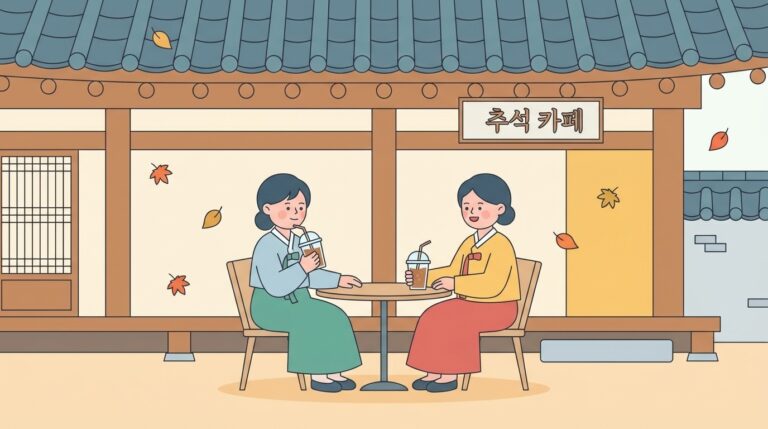
3. 우리 이따가 잠깐 나가서 카페 갈래? (Uri ittaga jamkkan nagaseo kape gallae?)
- Pronunciation: [Oo-ree ee-ttah-gah jahm-kkahn nah-gah-seoh kah-peh gahl-lae?]
- Meaning: Literal: “Shall we go out to a cafe for a little bit later?” | Nuance: “Hey, want to sneak out to a cafe together in a bit?”
- K-Culture Moment: The classic Chuseok Escape. Cousins team up to take a breather from heavy holiday duties and elder interrogation.
- Editor’s Insight: Asking someone to go to a cafe (카페 갈래?) is the universal Korean peace treaty and bonding invitation for people in their 20s and 30s.
- Situation Spectrum: Casual (✅) | Semi-formal (✅ – 카페 가실래요?) | Formal (⚠️)
- 🤔 Think About It: Escaping together creates an “us versus the nagging elders” alliance, turning awkward family duty into shared fun.
Phase 3: Textbook Korean vs. Real Korean
Situation 1: Greeting a cousin of similar age
- 📖 Textbook Korean: 안녕하십니까? 오랜만에 뵙겠습니다. (Annyeonghasimnikka? Oraenmane boepgetseumnida. – Hello. It is an honor to see you after a long time.)
- 🗣️ Real Korean: 어! 너 얼굴 진짜 좋아졌다! 어떻게 지냈어? (Eo! Neo eolgul jinjja joajyeotda! Eotteoke jinaesseo? – Oh! You look great! How have you been?)
- 💡 Why is it different?: Unless speaking to a much older relative, textbook hyper-formal language creates an unnatural emotional distance between cousins.
Situation 2: Empathizing with holiday stress
- 📖 Textbook Korean: 명절 준비가 참 힘드네요. (Myeongjeol junbiga cham himdeuneyo. – Holiday preparation is truly difficult.)
- 🗣️ Real Korean: 잔소리 듣느라 고생이 많다, 우리 좀만 버티자! (Jansori deunneura gosaengi manta, uri jomman beotija! – Hang in there through the nagging, let’s hold out a little longer!)
- 💡 Why is it different?: Real cousins bond through shared commiseration and playful solidarity against awkward questions from older relatives.
Phase 4: K-Culture Deep Dive & Non-Verbal Manners
4-1. Nunchi (눈치) & Gestures
- The Shared Wink/Nod: When an aunt begins asking about marriage or promotions, catch your cousin’s eye with a subtle, sympathetic nod. Don’t interrupt the elder, but signal solidarity.
- Two-Handed Beverage Pass: Even when pouring soda or iced tea for a slightly older cousin, using both hands or supporting your right forearm with your left hand displays warmth and respectful modern etiquette.
4-2. Cultural Code: The Cousin Alliance & Songpyeon Diplomacy
During Chuseok, making half-moon rice cakes (송편, songpyeon) is a collective family activity. Sitting side by side pinching dough is the ultimate icebreaker. Complementing your cousin’s rice cake shaping skills (“너 송편 진짜 예쁘게 빚는다!”) is the easiest natural bridge into a relaxed, heartwarming conversation.
Phase 5: Real-World Roleplay Scenario
Setting: The living room corner during Chuseok afternoon. You are sitting next to Min-woo (민우), a cousin who is roughly your age.
- 민우 (Min-woo): 🎭 (Sighs softly while glancing at the kitchen) 어휴, 삼촌들 또 취업 얘기 시작하셨네. (Phew, the uncles started talking about job hunting again.)
- You: 🎭 (Smiling sympathetically) 그러게. 명절마다 단골 주제인 것 같아. (Tell me about it. Seems like the usual holiday topic.)
- 민우 (Min-woo): 🎭 (Chuckles) 너는 요즘 어떻게 지내? 한국 생활 적응할 만해? (How about you these days? Is adapting to Korean life manageable?)
- You: 🎭 (Brightly) 응, 재미있어! 처음엔 낯설었는데 이제 좀 익숙해졌어. (Yeah, it’s fun! It felt unfamiliar at first, but I’m used to it now.)
- 민우 (Min-woo): 🎭 (Nods) 다행이다. 이따가 전 부치는 거 끝나면 바람 좀 쐴래? (That’s a relief. Want to get some fresh air after we finish frying jeon?)
- You: 🎭 (Excitedly) 좋아! 근처에 새로 생긴 예쁜 카페 있다던데 거기 가자. (Sounds great! I heard there’s a pretty new cafe nearby, let’s go there.)
- 민우 (Min-woo): 🎭 (Pulls out car keys slightly) 오, 좋아. 내가 커피 살게. (Oh, nice. Coffee is on me.)
- You: 🎭 (Waving hand politely) 아니야, 내가 살게! 저번에 도움 많이 받았잖아. (No way, I’ll treat! You helped me so much last time.)
🔀 Interactive Decision Point
An older cousin asks you: “한국 생활 안 힘들어? 다음엔 뭐 할 계획이야?” (Isn’t living in Korea tough? What are your next plans?)
- Option A: “힘들어서 그만두고 싶어요.” (I want to quit because it’s hard.)
- Option B: “조금 바쁘긴 한데 사촌들 덕분에 재밌게 잘 적응하고 있어요!” (It’s a bit busy, but thanks to my cousins, I’m adapting well and having fun!)
- Option C: “그건 제 개인적인 일이라 말씀드리기 어렵습니다.” (That is my personal matter, so it is difficult to say.)
Feedback:
* Option A (Risk): Too blunt; elders and cousins might become overly worried or give endless advice.
* Option B (Best): Perfect! Balances honest reality with upbeat politeness and credits family support.
* Option C (Bad): Far too defensive and formal for a cozy holiday family setting.
Phase 6: 10-Second Emotion Shadowing Drill
Practice matching rhythm and pitch with the natural emotional markers:
[😊 반갑고 신나게 / Warm & Cheerful]
진짜 / 오랜만이다! / 그동안 / 잘 지냈어? /
(Jinjja / oraenmanida! / Geudong-an / jal jinaesseo? /)-
[😮 공감하며 위로하듯 / Empathetic & Comforting]
명절 때마다 / 질문 받느라 / 진짜 피곤하겠다. /
(Myeongjeol ttaemada / jilmun banneura / jinjja pigonhagetda. /) -
[🤫 비밀스럽고 장난스럽게 / Playful & Whispering]
우리 / 이따가 / 어른들 몰래 / 아이스크림 먹으러 가자. /
(Uri / ittaga / eoreundeul mollae / aiseukeurim meogeureo gaja. /)
Phase 7: K-Culture Mini Dictionary
- 사촌 (Sachon – Cousin): Literally means “fourth degree of kinship”. Used to describe first cousins with whom you share grandparents.
- 명절 잔소리 (Myeongjeol Jansori – Holiday Nagging): Unsolicited life advice from well-meaning relatives regarding school grades, marriage, or employment.
- 송편 (Songpyeon – Half-Moon Rice Cake): Traditional Chuseok delicacy steamed over pine needles, stuffed with sesame, beans, or chestnuts.
- 눈치싸움 (Nunchi-ssaum – Subtle Mind Game/Timing): The social radar game played during holidays to decide who washes dishes or escapes to the store first.
Phase 8: Traveler’s Survival Kit
Top 3 Chuseok Survival Expressions
- 1. 송편 진짜 맛있어요! (Songpyeon jinjja masisseoyo! – This songpyeon is delicious!)
- Pro Tip: Complimenting the food instantly melts all tension across all generations.
- 2. 제가 도와드릴게요. (Jega dowadeurilgeyo. – Let me help you out.)
- Pro Tip: Offering to carry dishes shows high emotional intelligence (센스, sense).
- 3. 즐거운 추석 보내세요! (Jeulgeoun Chuseok bonaeseyo! – Have a joyful Chuseok!)
- Pro Tip: Use this polite greeting when parting ways with distant relatives.
Editor’s Travel Note
During the Chuseok holiday week, many independent stores close, while traffic peaks nationwide. Check transit schedules early through the official Korail reservation portal or use Naver Map transit route finder to find open 24-hour cafes and local emergency clinics.
Phase 9: Going Deeper (Cultural Reflection)
In traditional Korean culture, the boundary between family and individual identity is uniquely porous. Holidays like Chuseok highlight this collectivism (우리, Uri), where personal updates are seen as shared community matters. While young Koreans and foreigners alike can feel overwhelmed by inquisitive relatives, the informal camaraderie between cousins provides a warm cushion, turning intense collective traditions into lasting personal memories.
💬 Your Turn: What is the most awkward question relatives ask in your hometown during holidays, and how would you answer it in Korean? Share below in the comments!
Phase 10: FAQ & Common Mistakes
Q: Can I use 반말 (informal speech) immediately with my cousin?
A: If your cousin is the same age or younger, informal speech (반말) is common after exchanging quick greetings. If they are older, start with polite language (존댓말) until they invite you to speak comfortably (“말 편하게 해”).
Q: What should I call my older cousin?
A: Male cousins call older male cousins 형 (Hyeong) and older female cousins 누나 (Nuna). Female cousins call older male cousins 오빠 (Oppa) and older female cousins 언니 (Eonni).
Q: Is it rude to leave the living room to hang out with cousins?
A: Not at all! Once the ceremonial meals and initial greetings are finished, adults usually encourage cousins to hang out, grab boba, or visit cafes.
🚨 Common Mistakes Alert
- Calling all cousins by first name: Address older cousins by family titles (형/오빠/누나/언니) rather than just their given name.
- Bowing 90 degrees to younger cousins: Keep deep formal bows for grandparents; a friendly nod and wave is perfect for cousins.
- Isolating on your smartphone: Constantly looking at your phone during family dinner is seen as disengaged; keep your screen down and join the table banter.
Phase 11: Action Mission & Engagement
- 🥉 Bronze Mission: Stand in front of a mirror and practice saying “진짜 오랜만이다!” with a wide, natural smile.
- 🥈 Silver Mission: Text a Korean language buddy or classmate: “추석 잘 보내! 이따가 카페 갈래?”
- 🥇 Gold Mission: During your next real-life interaction with a Korean peer, smoothly transition from formal greetings to asking “요즘 일은 할 만해?”.
- 🎮 K-Culture Mission: Watch a Chuseok special episode of your favorite K-variety show (like Hangout with Yoo or I Live Alone) and spot at least two instances of cousin-style playful banter!
Phase 12: Interactive Quiz Challenge
1. Situation Judgment: Your cousin looks exhausted after answering questions about job hunting from elders. What is the most natural thing to say?
* A) “왜 취직 안 하셨어요?”
* B) “우리 바람 쐴 겸 아이스 아메리카노 마시러 갈래?”
* C) “저는 취직 잘 했습니다.”
2. Fill in the Blank: “우와, 1년 만이네! 그동안 ____ 지냈어?” (Wow, it’s been a year! How have you been spending time meanwhile?)
3. True or False: During Chuseok, it is customary to use strict, military-style formal speech (안녕하십니까) with cousins of your exact same age.
👉 Click here to reveal Answers & Explanations!
- Answer: B | Inviting them out for iced coffee provides thoughtful relief from family pressure.
- Answer: 잘 (jal) | The phrase 잘 지냈어? is the standard Korean expression for “Have you been doing well?”.
- Answer: False | Same-age cousins naturally speak in warm, informal Korean (반말) once the ice is broken!







