

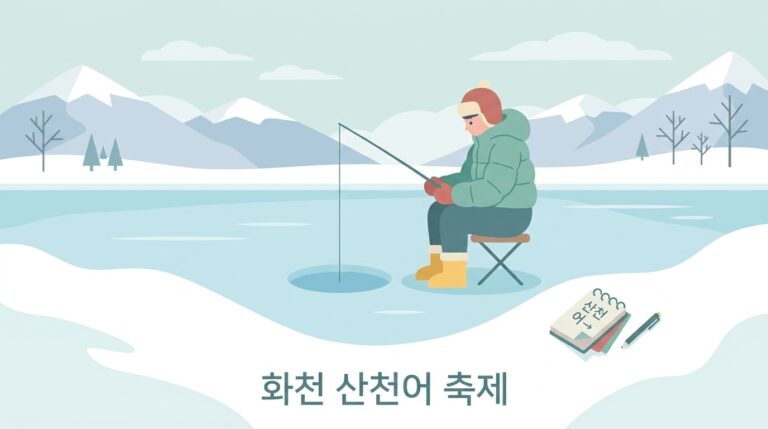
Conquering the Hwacheon Sancheoneo Ice Festival Like a Local
Phase 1: Empathy & K-Story Opening
안녕하세요! 매일한글 (Daily Hangul) editor here! Imagine standing on a crystalline sheet of 40-centimeter-thick ice on a frosty January morning in Gangwon-do, surrounded by thousands of joyful festival-goers bundled up in padded winter jackets. The smell of charcoal-grilled mountain trout (sancheoneo) drifts through the crisp sub-zero air. You drop your tiny translucent lure into a 20-centimeter drilled ice hole, peering down eagerly. Minutes turn into an hour, and your hands are freezing. Suddenly, the Korean uncle (ajusshi) next to you pulls up his third gleaming trout in ten minutes, cheering with his family, while your hook remains frustratingly empty.
You want to ask for his secret technique or ask the festival staff where the freshly released fish spots are, but your textbook phrases like “물고기를 어떻게 잡습니까?” (How does one catch fish?) feel stiff, robotic, and out of place in such a lively, boisterous Korean winter festival. Over the past decade, dozens of our intermediate learners have shared this exact frustration: freezing up linguistically right when communal warmth and camaraderie are unfolding all around them. Today’s guide breaks down the authentic, B2-level spoken phrases and cultural cues that will transform you from a bewildered tourist into a savvy ice-angler who can share hot fish cakes and fishing banter with friendly locals.
Phase 2: Deep Dive into Top 3 Essential Expressions
1. 입질이 전혀 안 와요 (I’m not getting any bites at all)
- Pronunciation: [Ip-jiri jeon-hyeo an wa-yo] (Sounds like “Ip-jeel-ee jun-hyuh ahn wah-yo”)
- Meaning: Literal: “A nibble is not coming at all.” / Nuance: Spoken frustration when fish are ignoring your bait completely.
- K-Culture Moment: Seen frequently on Korean variety shows like City Fisherman (도시어부) when cast members wait endlessly in freezing cold weather before turning to the camera with comedic despair.
- Editor’s Insight: 입질 (nibble/bite) comes from 입 (mouth) + 질 (repetitive action). Koreans use 입질이 오다 metaphorically in modern slang to describe when someone is showing initial interest in a dating prospect or an online sale item.
- Situation Spectrum: Casual: ✅ | Semi-formal: ✅ | Formal: ⚠️
- 🤔 Think About It: How does phrasing an action from the target’s perspective (the fish’s bite “coming”) reflect the observational nature of Korean conversational verbs?
2. 고패질을 어떻게 해야 잘 잡혀요? (How should I jig the rod to catch them well?)
- Pronunciation: [Go-pae-jireul eo-tteo-ke hae-ya jal ja-pyeo-yo?]
- Meaning: Literal: “How must I do rod-jigging so that they are caught well?” / Nuance: Asking a local angler or neighbor for their rhythmic jigging technique.
- K-Culture Moment: In outdoor winter vlogs and YouTube channels, creators approach experienced local elders to learn the subtle up-and-down wrist flick that triggers predatory trout reflexes.
- Editor’s Insight: 고패질 is the specialized term for moving a fishing rod up and down vertically to mimic live bait. Asking this specific word instantly signals that you understand ice fishing mechanics.
- Situation Spectrum: Casual: ⚠️ (with close friends use 반말) | Semi-formal: ✅ | Formal: ✅
- 🤔 Think About It: In your native language, do you have unique technical fishing jargon that builds instant rapport among hobbyists?
3. 이거 구이터에 맡기면 얼마나 걸려요? (How long does it take if I hand this over to the grill center?)
- Pronunciation: [I-geo gu-i-teo-e mat-gi-myeon eol-ma-na geol-lyeo-yo?]
- Meaning: Literal: “If I entrust this to the grilling area, how much time does it take?” / Nuance: Ordering your freshly caught catch to be salted and wood-fire roasted.
- K-Culture Moment: The climactic scene in Korean travel documentaries where steaming foil-wrapped trout are unwrapped at communal picnic tables with roasted sweet potatoes.
- Editor’s Insight: 구이터 combines 구이 (grilled food) and 터 (designated site/ground). Using the verb 맡기다 (to entrust/hand over) is standard etiquette at festival processing booths.
- Situation Spectrum: Casual: ⚠️ | Semi-formal: ✅ | Formal: ✅
- 🤔 Think About It: How does the word 터 reflect the Korean historical concept of communal, purpose-built gathering grounds?
Phase 3: Textbook Korean vs. Real Native Korean
- Situation 1: Asking if a fishing spot is already occupied
- 📖 교과서 한국어: 여기에 앉아도 괜찮습니까? (Is it okay if I sit here?)
- 🗣️ 진짜 한국어: 저기, 여기 자리 비어 있나요? 같이 낚싯대 드리워도 돼요? (Excuse me, is this spot open? Mind if I cast my line next to you?)
- 💡 Why the difference? Intermediate speakers should move away from robotic permission questions and use natural spatial phrasing (자리 비어 있나요?) coupled with expressive fishing verbs like 드리우다 (to cast down).
- Situation 2: Reacting to someone catching a big fish
- 📖 교과서 한국어: 축하합니다. 물고기가 아주 큽니다. (Congratulations. The fish is very large.)
- 🗣️ 진짜 한국어: 와, 대박! 손맛 제대로 보셨네요! (Wow, awesome! You really felt the thrilling tug!)
- 💡 Why the difference? Korean anglers prize 손맛 (the visceral tactile thrill felt through the fingers when a fish fights back). Complimenting someone’s 손맛 creates instant camaraderie.
Phase 4: K-Culture Deep Dive & Non-Verbal Etiquette
4-1. Ice Rink Nunchi & Spatial Etiquette
At the Hwacheon Ice Festival, thousands of pre-drilled holes (얼음 구멍) dot the frozen river. Never run aggressively across the ice, and avoid hovering directly over another angler’s shoulder without a warm greeting. If someone near you catches fish continuously while your basket is empty, observe their jigging cadence using discreet 눈치 (situational awareness). When receiving roasted trout or hot tea offered by neighboring festival-goers, accept with both hands, bow your head slightly, and say “감사히 잘 먹겠습니다!”.
4-2. The Cultural Phenomenon of Winter Festival Sanchoneo
산천어 (mountain trout) only thrive in first-grade pristine, oxygen-rich waters below 20°C. In Hwacheon, this festival transformed an isolated military border town into a globally celebrated winter wonderland. Beyond rod fishing, the festival is renowned for 맨손잡기 (bare-handed trout catching in freezing pool water while wearing t-shirts and shorts)—a test of youthful vigor (패기) that draws massive cheers and broadcast spotlights every year.
Phase 5: Interactive Role-play Scenario
- Setting: Hwacheon Stream Ice Fishing Zone 1, surrounded by crisp morning snow and steam rising from snack tents.
- Character: Mr. Park (박 반장님), a seasoned local ice-angler equipped with a wooden stool, specialized lures, and a steaming thermos of barley tea.
-
Turn 1 (You): (🎭 Rubbing your cold hands together and glancing politely at his brimming fish basket) 저기요, 실례지만 옆에 얼음 구멍 좀 써도 될까요? (Jeo-gi-yo, sil-lye-ji-man yeop-e eol-eum gu-meong jom sseo-do doel-kka-yo? / Excuse me, do you mind if I use the ice hole next to you?)
- Turn 2 (Mr. Park): (🎭 Smiling warmly and sliding his tackle box over) 아이고, 그럼요! 편하게 앉아요. 날이 꽤 쌀쌀하죠? (A-i-go, geu-reom-yo! Pyeon-ha-ge an-ja-yo. Nal-i kkwae ssal-ssal-ha-jyo? / Oh, of course! Make yourself comfortable. It’s quite chilly today, isn’t it?)
- Turn 3 (You): (🎭 Dropping your lure gently into the icy water) 네, 손이 꽁꽁 얼 것 같아요. 그런데 저는 입질이 전혀 안 오네요. (Ne, son-i kkong-kkong eol geot ga-ta-yo. Geu-reon-de jeo-neun ip-jiri jeon-hyeo an o-ne-yo. / Yes, my hands feel completely frozen. But I’m not getting any bites at all.)
- Turn 4 (Mr. Park): (🎭 Looking at your lure technique and nodding) 찌를 너무 가만히 두면 안 돼요. 바닥에서 20센티쯤 띄우고 살짝 흔들어봐요. (Jji-reul neo-mu ga-man-hi du-myeon an dwae-yo. Ba-dak-e-seo i-sip-sen-ti-jjeum ttwi-u-go sal-jjak heun-deul-eo-bwa-yo. / You shouldn’t leave the bobber still. Keep it about 20cm above the riverbed and twitch it gently.)
- Turn 5 (You): (🎭 Adjusting your line with a focused wrist flick) 아, 이렇게 고패질을 주기적으로 해줘야 산천어가 반응하는군요! (A, i-reoh-ge go-pae-jireul ju-gi-jeok-eu-ro hae-jwo-ya san-cheon-eo-ga ban-eung-ha-neun-gun-yo! / Ah, so trout only react when you jig the lure periodically like this!)
- Turn 6 (Mr. Park): (🎭 Suddenly pointing at your trembling rod tip) 어어! 낚싯대 끝 휘는 것 봐요! 지금 챔질해요! (Eo-eo! Nak-sit-dae kkeut hwi-neun geot bwa-yo! Ji-geum chaem-jil-hae-yo! / Look at the tip bending! Set the hook right now!)
- Turn 7 (You): (🎭 Pulling up firmly as a shimmering trout leaps onto the ice) 와, 잡았다! 손맛 제대로 봤어요! 도와주셔서 정말 감사합니다! (Wa, jab-at-da! Son-mat je-dae-ro bwat-eo-yo! Do-wa-ju-syeo-seo jeong-mal gam-sa-hap-ni-da! / Wow, I caught it! I really felt that thrilling tug! Thank you so much for your help!)
- Turn 8 (Mr. Park): (🎭 Laughing heartedly and patting your shoulder) 하하, 축하해요! 얼른 구이터 가져가서 노릇노릇하게 구워 드셔봐요! (Ha-ha, chuk-ha-hae-yo! Eol-leun gu-i-teo ga-jyeo-ga-seo no-reut-no-reut-ha-ge gu-wo deu-syeo-bwa-yo! / Haha, congratulations! Take it quickly to the grill center and taste it grilled golden brown!)
🔀 Interactive Choice Point
Mr. Park offers you a warm paper cup of hot barley tea from his thermos. How do you respond?
* Option A: “됐습니다. 제 보온병에 커피 있습니다.” (No thanks, I have coffee in my thermos.)
* Feedback (Bad): Grammatically polite but cold in tone. It needlessly cuts off communal Korean festival hospitality (정).
* Option B: “와, 따뜻한 보리차 정말 감사히 마시겠습니다! 몸이 사르르 녹네요.” (Two hands on the cup, taking a gentle sip)
* Feedback (Best): Shows impeccable etiquette, honors his kindness, and uses vivid sensory description (사르르 녹다).
* Option C: “산천어 잡으면 드릴 테니 차 한 잔 주세요.” (Give me tea and I will give you a fish if I catch one.)
* Feedback (Risk): Sounds overly transactional or presumptuous for an intermediate social interaction.
Phase 6: 10-Second Emotion Shadowing Drill
- Drill 1:
[🥶 덜덜 떨며 간절하게 / Freezing and earnest]
손이 / 꽁꽁 얼 것 같아요, / 입질이 / 전혀 안 오네요.
(Son-i / kkong-kkong eol geot ga-ta-yo, / ip-jiri / jeon-hyeo an o-ne-yo.) -
Drill 2:
[🤩 짜릿하고 환호하며 / Thrilled and cheering]
와, / 잡았다! / 손맛 / 제대로 봤어요!
(Wa, / jab-at-da! / Son-mat / je-dae-ro bwat-eo-yo!) -
Drill 3:
[😋 침 꼴깍 삼키며 기대감에 차서 / Anticipatory and mouthwatering]
노릇노릇하게 / 구워서 / 바로 먹으면 / 진짜 꿀맛이겠다!
(No-reut-no-reut-ha-ge / gu-wo-seo / ba-ro meog-eu-myeon / jin-jja kkul-mas-i-get-da!)
Phase 7: K-Culture Mini Dictionary
- 손맛 (Son-mat) | The exhilarating tactile sensation of catching a fish | Used in fishing contexts, but also metaphorically refers to a home cook’s distinct culinary touch (엄마의 손맛).
- 얼음구멍 (Eol-eum-gu-meong) | Pre-drilled ice fishing hole | Essential festival noun when searching for unclaimed spots across the designated river sectors.
- 챔질 (Chaem-jil) | Setting the hook / quick upward jerk of the rod | A vital fishing maneuver executed immediately when a bite is detected.
- 노릇노릇 (No-reut-no-reut) | Golden-brown crispiness (mimetic word) | Used universally to describe appetizingly roasted fish, pancakes (전), or grilled meat.
Phase 8: Traveler’s Survival Kit
Top 3 On-Site Survival Phrases
- 산천어 몇 마리까지 반출할 수 있어요? (San-cheon-eo myeot ma-ri-kka-ji ban-chul-hal su iss-eo-yo?)
- Pro Tip: Hwacheon enforces a strict bag limit (typically 3 fish per ticket holder) to protect environmental resources.
- 얼음 뜰채랑 낚싯의자 대여 되나요? (Eol-eum tteul-chae-rang nak-sit-ui-ja dae-yeo doe-na-yo?)
- Pro Tip: An ice skimmer (뜰채) is crucial to scoop out slush freezing over your hole every few minutes.
- 구이용 호일에 소금 넉넉히 뿌려주세요! (Gu-i-yong ho-il-e so-geum neong-neok-hi ppu-ryeo-ju-se-yo!)
- Pro Tip: Say this at the grill booth if you prefer seasoned, savory crispy skin on your trout.
Editor’s Travel Note
- Transportation: Shuttle buses run from Seoul (Dong Seoul Terminal) directly to Hwacheon Bus Terminal during the festival period. Booking your high-speed ITX train ticket via the 카카오T (Kakao T) 앱 다운로드 or checking schedules on the 코레일톡 (KorailTalk) 앱 다운로드 in advance is highly recommended.
- Festival Currency Voucher: Part of your admission fee is refunded in Hwacheon Love Gift Certificates (화천사랑상품권), which can be spent like cash on hot food stalls, local fruit, or equipment on-site.
Phase 9: A Step Deeper (한 발 더 깊이)
In Korean festival culture, sharing food and space is deeply rooted in 정 (Jeong)—the invisible bond of warmth and communal empathy. When freezing winds blow across the Hwacheon ice, social barriers melt away: complete strangers exchange tips, loan spare lures, and slice up hot roasted trout to hand to neighboring families on paper plates. Experiencing a regional Korean festival is not merely about fishing; it is about entering this collective warmth where mutual care turns sub-zero temperatures into a cozy memory.
💬 Your Turn: Have you ever attended a winter or harvest festival where strangers shared food and tips with you? How would you describe that feeling using your own cultural expressions? Share your thoughts below!
Phase 10: FAQ & Common Pitfalls
Q: Can I bring my own big fishing rod and live earthworms to the festival?
A: No. To protect river water quality and prevent snagging accidents, Hwacheon strictly bans live bait and large spinning rods. Only small plastic lure rods (릴찌낚싯대) and artificial jig heads are permitted.
Q: What should I do if my catch quota is zero after hours of trying?
A: Don’t panic! You can visit the festival fish transfer zones or ask friendly fishers with full coolers. Experienced locals often gift their surplus trout (나눔) so everyone gets to eat before leaving.
Q: What is the best time of day to catch trout?
A: Sancheoneo feed most actively during early morning opening (09:00 AM) and right after the festival stocking trucks release fresh batches into the water sectors.
🚨 Common Mistakes Alert
- ❌ Mistake 1: Standing too close to the hole edge with heavy metal boot spikes.
- 👉 Correct Action: Keep your stool centered on solid ice, and step cautiously around slushy margins.
- ❌ Mistake 2: Vigorous sweeping rod swings that hook neighboring clothes.
- 👉 Correct Action: Use compact wrist motions (고패질) within a 15-20 cm vertical range.
- ❌ Mistake 3: Discarding plastic warm packs (핫팩) inside empty ice holes.
- 👉 Correct Action: Always carry waste to the designated recycling drums at the sector exits.
Phase 11: Action Missions & K-Culture Discovery
- 🥉 Bronze Mission (Solo Practice): Practice the shadowing drill for “손맛 제대로 봤어요!” three times in the mirror with an energetic celebratory expression.
- 🥈 Silver Mission (Social Sharing): Share an Instagram story of your favorite Korean winter food using the mimetic keyword #노릇노릇 in the caption.
- 🥇 Gold Mission (Real Life Application): Attend a Korean food market or festival, order grilled fish or snacks, and say “노릇노릇하게 구워주셔서 정말 맛있어요!” to the vendor.
- 🎮 K-Culture Media Mission: Watch an episode of a Korean winter variety show (e.g., 1 Night 2 Days / 1박 2일) and spot when members use 입질 or 손맛 during outdoor fishing games.
Phase 12: Interactive Quiz Challenge
- Situational Judgment: You want to ask the grill master to roast your fresh trout well-done and crispy. Which expression is most natural?
- A) 물고기를 완전히 태워주세요.
- B) 노릇노릇하게 잘 구워주세요.
- C) 산천어 사망하게 해주세요.
- Fill in the Blank:
물고기가 미끼를 톡톡 건드릴 때 느끼는 찌릿한 촉감을 한국어로 “( )을/를 보다”라고 합니다. -
True / False Culture Check:
(T/F) Hwacheon Love Gift Certificates (화천사랑상품권) given at ticketing cannot be spent at festival street food stalls.
🔍 Click here to reveal Answers and Detailed Explanations!
- Answer: B (노릇노릇하게 잘 구워주세요.)
- Explanation: Option A means “burn it completely,” and Option C is nonsensical and bizarre. 노릇노릇 is the quintessential culinary adverb for appetizing, crispy grilling.
- Answer: 손맛 (Son-mat)
- Explanation: 손맛 refers specifically to the thrilling tactile resistance of a hooked fish transmitted to the hands.
- Answer: False (F)
- Explanation: The gift vouchers are designed specifically to stimulate local commerce and are widely accepted by festival food carts, grill centers, and nearby convenience stores!
- Explanation: The gift vouchers are designed specifically to stimulate local commerce and are widely accepted by festival food carts, grill centers, and nearby convenience stores!







