

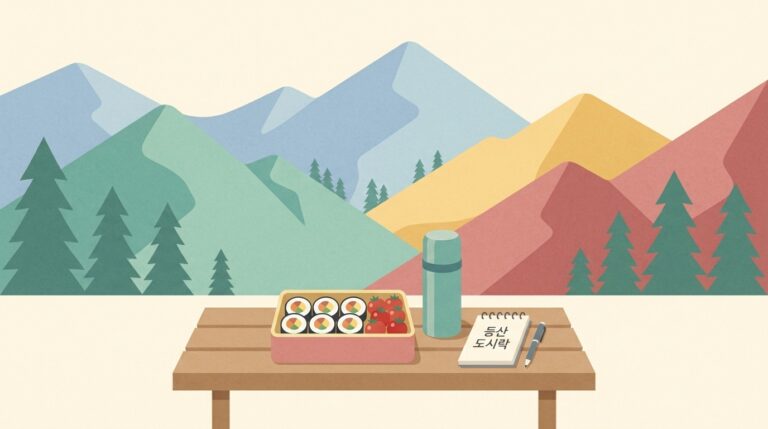
안녕하세요! 매일한글 에디터입니다. Have you ever hiked up a Korean mountain like Bukhansan or Seoraksan on a crisp autumn weekend, only to realize that the trail feels less like an isolated survival trek and more like an open-air banquet? You reach a scenic resting rock (쉼터) panting, your legs trembling, expecting people to sip plain water in silence—and instead, you’re greeted by colorful picnic mats spread out everywhere. Friendly hikers pull out insulated thermal flasks with steaming hot water for instant cup noodles, foil-wrapped kimbap, sliced cucumbers, and even seasoned boiled eggs. Before you know it, an energetic ajossi (middle-aged gentleman) wearing top-of-the-line neon Gore-Tex gear beams at you and offers a piece of dried persimmon: “당 떨어졌죠? 이거 하나 드셔보세요!” If your textbook Korean only taught you “저는 등산을 좋아합니다”, you might freeze up. This guide draws directly on real feedback from C1-level learners who wanted to navigate Korea’s vibrant trail food culture with nuanced, witty, and native-level fluency.
Phase 2: Core Expressions Deep Dive
1. 당 떨어지다 (Dang tteol-eo-ji-da)
- Pronunciation: [Dang tteol-eo-ji-da] (Sounds like “Dahng-tteol-o-jee-dah” — think ‘dang’ as in sweet, dropping fast like autumn leaves)
- Meaning: Literal: Blood sugar is dropping | Actual Nuance: To feel suddenly completely drained of physical or mental energy, desperately craving a quick sugar or carbohydrate fix on the trail.
- K-Culture Moment: Seen in variety shows like 2 Days & 1 Night (1박 2일) or outdoor dramas when cast members collapse on a steep incline, clutching energy bars.
- Editor’s Insight: At the C1 level, notice how this metabolic term has evolved into one of modern Korea’s favorite idioms for fatigue. On the trail, saying “저 지금 완전 당 떨어졌어요” (My sugar is totally crashing) instantly opens doors to shared chocolate and dried snacks.
- Situation Spectrum: Casual ✅ | Semi-formal ✅ | Formal ⚠️
- 🤔 Think About It: Why does Korean culture prioritize immediate caloric rescue (Dang) as a social bonding tool rather than an individual physical deficiency?
2. 가볍게 요기하다 (Ga-byeop-ge yo-gi-ha-da)
- Pronunciation: [Ga-byeop-ge yo-gi-ha-da] (Pronounce ‘yo-gi’ crisply like ‘yoh-gee’, not to be confused with ‘yeogi’ meaning here)
- Meaning: Literal: To lightly appease hunger | Actual Nuance: To grab a light, practical bite on the trail just enough to keep moving without feeling sluggish or bloated.
- K-Culture Moment: Veteran mountaineers in Korean vlogs or travel documentaries sitting on a ridge, saying “정상 가기 전에 여기서 가볍게 요기하고 가시죠.”
- Editor’s Insight: 요기(療飢) comes from Hanja meaning ‘to heal hunger.’ C1 speakers use this sophisticated, idiomatic expression instead of the generic 간단히 밥 먹다 to sound refined yet experienced.
- Situation Spectrum: Casual ✅ | Semi-formal ✅ | Formal ✅
- 🤔 Think About It: How does phrasing eating as “pacifying hunger” change the atmosphere compared to “eating a meal” during a challenging ascent?
3. 행동식을 챙기다 (Haeng-dong-sig-eul chaeng-gi-da)
- Pronunciation: [Haeng-dong-si-geul chaeng-gi-da] (Blend ‘sik’ and ‘eul’ naturally into ‘si-geul’)
- Meaning: Literal: To pack action food | Actual Nuance: To prepare high-calorie, portable trail snacks (nuts, jerky, chocolates, energy gels) specifically meant to be eaten on the move during physical activity.
- K-Culture Moment: In outdoor gear commercials and climbing YouTube channels, hikers emphasize packing lightweight 행동식 rather than heavy lunch boxes for technical trails.
- Editor’s Insight: While 간식 covers casual everyday snacks, 행동식 (行動食) is the technical, seasoned hiker’s term. Using it indicates you respect mountain safety and pacing.
- Situation Spectrum: Casual ✅ | Semi-formal ✅ | Formal ✅
- 🤔 Think About It: What does having specialized vocabulary for trail fuel tell you about Korea’s deep-rooted trekking infrastructure and outdoor enthusiasm?
Phase 3: Textbook Korean vs. Real Korean
Situation 1: Asking your hiking partner to take a snack break
- 📖 교과서 한국어: “우리 피곤하니까 잠깐 멈춰서 음식을 먹읍시다.” (Let us stop and eat food because we are tired.)
- 🗣️ 진짜 한국어: “슬슬 당 떨어지는데, 저기 쉼터에서 행동식 좀 까먹고 갈까요?” (Our energy is dropping; shall we unpack some trail snacks at that rest stop over there?)
- 💡 왜 다를까? Native hikers avoid rigid imperatives. Using 슬슬 (gradually) and the colloquial 까먹다 (to peel and eat / munch on) softens the suggestion and sounds natural.
Situation 2: Graciously sharing food with fellow trail companions
- 📖 교과서 한국어: “제가 도시락을 많이 가져왔으니 당신에게 나누어 주겠습니다.” (Since I brought a lot of lunch, I will distribute it to you.)
- 🗣️ 진짜 한국어: “손이 커서 넉넉하게 쌌는데, 부담 갖지 마시고 같이 드세요!” (My hands are big so I packed generously; please don’t feel burdened and enjoy together!)
- 💡 왜 다를까? Advanced Korean politeness uses humble self-deprecation (손이 크다 = habitually making/packing too much food) to eliminate any awkward indebtedness from the recipient.
Phase 4: K-Culture Deep Dive & Non-Verbal Trail Manners
4-1. 눈치 (Nunchi) & Trail Etiquette
In Korea, mountains are communal living rooms. When opening an insulated thermos for cup noodles (보온병 컵라면) or unwrapping kimbap on a public bench:
* Smell & Space Awareness: Keep your footprint compact. Never monopolize flat rest rocks (쉼터). If others approach, pull your lunch box slightly toward yourself to signal there is room to sit.
* The Reciprocal Offer: If someone offers you a cherry tomato or dried persimmon, it is customary to accept with both hands, bow slightly (15–30 degrees), and offer something from your pack in return—even a piece of candy or an energy gel.
4-2. Cultural Code: The Sacred “Mountain Summit Feast” (산상 만찬)
For Koreans, the culinary reward is as vital as reaching the peak. You will often see groups preparing multi-course mini-feasts: crunchy mountain cucumbers (오이) for crisp hydration, piping hot noodles, and occasionally a tiny ceremonial sip of 정상주 (summit celebration drink, though strictly regulated on national park trails nowadays for safety). Food on the mountain is not survival rations; it is a shared ritual of mutual endurance and celebration.
Phase 5: Real-World Roleplay Scenario
Setting: A shaded scenic pavilion near the ridge of Bukhansan. Cool autumn breeze rustling golden leaves.
Characters: 민우 (Min-woo), an experienced outdoor club leader in his 30s; You (Learner), hiking alongside him.
- 민우: “여기 경치 진짜 끝내주네요. 정상까지 딱 30분 남았는데, 여기서 가볍게 요기하고 갈까요?”
(Yeogi gyeongchi jinjja kkeutnaejuneyo. Jeongsangkkaji ttak samsipbun namatneunde, yeogiseo gabyeopge yogihago galkkayo?)
“The view here is incredible. We have just 30 minutes left to the peak; shall we grab a quick bite here?”
🎭 [Wipes sweat with a hiking towel and unbuckles his backpack straps.] -
You: “완전 찬성이에요! 마침 다리도 풀리고 슬슬 당 떨어지던 참이었어요.”
(Wanjeon chanseong-ieyo! Machim darido pulligo seulseul dang tteol-eojideon cham-ieosseoyo.)
“Totally agree! My legs were actually giving out and my energy was just crashing.”
*🎭 [Sits down on the wooden bench, letting out a relieved sigh.] -
민우: “제가 보온병에 뜨거운 물 담아왔거든요. 컵라면 하나 드실래요? 김밥도 넉넉해요.”
(Jega bo-onbyeong-e tteugeo-un mul dam-a-watgeodeunyo. Keomramyeon hana deusillaeyo? Gimbapdo neongneokhaeyo.)
“I brought hot water in my thermal flask. Would you like a cup of noodles? I have plenty of kimbap too.”
*🎭 [Pulls out a sleek 1-liter thermos and two cups of mini ramen.] -
You: “우와, 산에서 먹는 컵라면이라니 감동인데요! 그럼 전 행동식으로 챙겨온 견과류랑 과일 꺼낼게요.”
(Uwa, san-eseo meongneun keomramyeon-irani gamdong-indeyo! Geureom jeon haengdongsik-euro chaenggyeoon gyeongwaryurang gwail kkeonaelgeyo.)
“Wow, cup ramen on the mountain is a dream come true! Then I’ll unpack the nuts and fruit I brought as trail snacks.”
*🎭 [Opens your side pocket and places washed cherry tomatoes and energy bars on the mat.] -
민우: “오, 방울토마토 진짜 시원하네요! 갈증이 싹 가셔요. 역시 산행엔 상큼한 게 최고예요.”
(O, bang-ultomato jinjja si-wonhaneyo! Galjeung-i ssak gasyeoyo. Yeoksi sanhaeng-en sangkeumhan ge choego-yeyo.)
“Oh, these cherry tomatoes are so refreshing! My thirst vanished instantly. Fresh fruit really is the best for hiking.”
*🎭 [Pops a tomato into his mouth with an enthusiastic nod.] -
You: “국물까지 마시니까 속이 확 풀리네요. 남은 쓰레기는 제 배낭에 다 넣을 테니 저 주세요.”
(Gungmulkkaji masinikka sog-i hwak pullineyo. Nameun sseuregineun je baenang-e da neo-eul teni jeo juseyo.)
“Drinking the hot soup really revived my stomach. Please hand me all the leftover trash; I’ll carry it in my pack.”
*🎭 [Pulls out a sealable eco-trash bag and collects wrappers cleanly.] -
민우: “어휴, 뒷정리까지 완벽하시네요! 배도 든든하게 채웠으니 슬슬 정상을 향해 출발해 볼까요?”
(Eohyu, dwitjeongnikkaji wanbyeokhasineyyo! Baedo deundeunhage chaewosseuni seulseul jeongsang-eul hyanghae chulbalhae bolkkayo?)
“Whew, you even take care of clean-up perfectly! Now that our bellies are fueled up, shall we head for the peak?”
*🎭 [Stands up, adjusting backpack tension with a satisfied smile.] -
You: “네, 에너지 완충했습니다! 앞장서 주시면 씩씩하게 따라가겠습니다!”
(Ne, eneoji wanchunghaess-eumnida! Apjangseo jusimyeon ssikssikhage ttaragagess-eumnida!)
“Yes, battery fully recharged! Lead the way and I’ll follow right behind with energy!”
*🎭 [Ties boot laces firmly and stands up ready for the final ascent.]
🔀 Interactive Decision Branch
Your companion finishes the ramen, leaving some leftover spicy broth. What is the most appropriate C1 cultural action?
* Option A: Pour the soup into the bushes quietly so you don’t have to carry the extra weight.
* Option B: Seal the remaining soup in an airtight personal bottle/container or drink it up to carry back down.
* Option C: Leave the cup on the picnic table hoping the national park maintenance staff will dispose of it.
- Option A Feedback [Risk 🚫]: Severe trail etiquette breach! Discarding salty, oily soup in national parks harms mountain soil and wildlife ecology and can incur heavy fines.
- Option B Feedback [Best ✅]: Outstanding environmental awareness (흔적 남기지 않기 / Leave No Trace). Korean hikers always pack out all food waste and liquids.
- Option C Feedback [Bad 🚫]: Mountains in Korea follow the strict “take your own trash home” principle (되가져가기). Public bins are rarely available at trail pavilions.
Phase 6: 10-Second Emotion Shadowing Drill
- Sentence 1 [😫 Exhausted & Craving Sugar]:
“하, / 이제 진짜 / 당 떨어져서 / 한 발자국도 / 못 가겠어요!”
(Ha, / ije jinjja / dang tteol-eo-jyeoseo / han baljagukdo / mot gagess-eoyo!) -
Sentence 2 [😋 Delighted & Mouthwatering]:
“산 정상에서 / 먹는 보온병 컵라면은 / 그 어떤 미슐랭 요리보다 / 훨씬 끝내줘요!”
(San jeongsang-eseo / meongneun bo-onbyeong keomramyeoneun / geu eotteon misyullaeng yoriboda / hwolssin kkeutnaejwoyo!) -
Sentence 3 [🤝 Warm & Generously Offering]:
“손이 커서 / 좀 넉넉하게 쌌는데, / 부담 갖지 마시고 / 요기 좀 하고 가세요!”
(Soni keoseo / jom neongneokhage ssatneunde, / budam gatji masigo / yogi jom hago gaseyo!)
Phase 7: K-Culture Mini Dictionary
- 행동식 (Haeng-dong-sik) | High-energy Trail Fuel / Pocket Food
- Used specifically for calorie-dense snacks consumed during movement (chocolate, energy bars, beef jerky, mixed nuts).
- 보온병 (Bo-on-byeong) | Vacuum Thermal Flask
- An indispensable piece of Korean hiking gear. High-spec flasks keep boiling water hot for 8+ hours solely to cook instant noodles on ridges.
- 오이 (O-i) | Mountain Cucumber
- The quintessential Korean trail snack. Rich in moisture and minerals, seasoned hikers prefer carrying chilled, peeled whole cucumbers over heavy water bottles.
- 뒷정리 (Dwit-jeong-ri) | Tidying Up / Leave-No-Trace Clean-up
- The cultural value of cleaning your spot completely before leaving, taking all plastic wrappers, fruit peels, and trash back down in personal bags.
Phase 8: Traveler’s Survival Kit
- Survival Phrase 1: “남은 음식 쓰레기는 제가 챙겨 갈게요.” (I will pack out the leftover food waste.) — Pro Tip: Shows top-tier civic responsibility.
- Survival Phrase 2: “혹시 당 떨어지셨으면 초콜릿 하나 드실래요?” (Would you like a chocolate if you’re crashing on energy?) — Pro Tip: The single best icebreaker on Korean hiking trails.
-
Survival Phrase 3: “정상까지 가려면 얼마나 더 걸리나요?” (How much longer to reach the summit?) — Pro Tip: Expect cheerful answers like “Just 10 minutes left!” even if it’s 40 minutes.
-
Editor’s Travel Note: Before hitting popular peaks like Bukhansan, Gwanaksan, or Hallasan, prepare your trail food by visiting local convenience stores or traditional markets at the mountain base. To check trail conditions, bus connectivity, and exact rest stops, make sure to look up trail waypoints using the [Naver Map Navigation App Guide] on your smartphone.
Phase 9: Think Deeper (한 발 더 깊이)
In many Western outdoor cultures, hiking food is treated as individual functional fuel—lightweight freeze-dried packets or solitary protein bars eaten briskly. In Korea, however, the concept of 정 (Jeong) transforms trail food into a communal bridge. Packing extra kimbap, slicing apples into neat quarters to share with strangers on a ridge, and asking “식사하셨어요?” to passing hikers reflects an egalitarian warmth rooted in agrarian sharing traditions. On the mountain, status, age, and titles dissolve behind neon windbreakers, united by the simple joy of sharing warm food against a vast horizon.
💬 Your Turn: What is the traditional outdoor hiking snack in your home country, and how would you explain it to a Korean hiking club leader in Korean? Share your thoughts below!
Phase 10: FAQ & Common Mistakes
Q: Can I cook with portable gas stoves (버너) on Korean mountain summits?
A: No. In almost all South Korean National Parks, Provincial Parks, and city mountains, open flames and portable gas stoves are strictly prohibited due to wildfire prevention laws. Always use a high-performance thermal flask (보온병) with pre-boiled hot water.
Q: Is it rude to refuse food offered by an older Korean hiker?
A: A flat “No” can feel blunt. If you have dietary restrictions or are genuinely full, place your hand gently on your chest, smile, and say: “마음만으로도 정말 감사합니다. 제가 방금 밥을 든든히 먹고 와서요!” (Thank you so much for your kind heart; I just ate a hearty meal!).
Q: Can I throw biodegradable fruit peels (like banana peels or apple cores) into the mountain forest?
A: No. Fruit peels take months to decompose and alter local soil composition or attract wildlife unpredictably. The national standard rule is 100% pack-in, pack-out (되가져오기).
🚨 Common Mistakes Warning Board
- Mistake 1: Calling all trail snacks simply 밥 (rice/meal) instead of using nuanced terms like 행동식 (energy trail fuel) or 요기 (light hunger relief).
- Correct Action: Use “행동식 챙겨왔어요” when showing snacks, and “가볍게 요기하고 가요” for quick bites.
- Mistake 2: Leaving leftover ramen broth in pavilion corners.
- Correct Action: Carry an insulated liquid tumbler to pour leftover soup back into, or drink only what you can finish.
- Mistake 3: Not offering snacks back when accepting something from another hiker.
- Correct Action: Always reciprocate with any small candy, gum, or fruit you have in your pockets.
Phase 11: Action Mission & Engagement
- 🥉 Bronze Level: Stand in front of the mirror and practice saying Phase 6 Shadowing Sentence 1 with full dramatic exhaustion.
- 🥈 Silver Level: Next time you pack snacks for a walk, take a photo and post it on your socials with the caption: “오늘의 등산 행동식 준비 완료! #산행도시락 #당충전”.
- 🥇 Gold Level: During your next hike in Korea (or with Korean friends), offer a snack to someone using the phrase: “당 떨어지셨을 텐데 이거 드시고 힘내세요!”
🎮 K-Culture Challenge: Watch an episode of tvN’s Europe Outside Your Tent (텐트 밖은 유럽) or an outdoor hiking vlog. Spot whenever the cast members use the words 당 떨어지다 or 요기하다 and write down the timestamp!
Phase 12: Interactive Quiz Challenge
Question 1 (Situational Judgment):
You are trekking with a Korean hiking group. Everyone is panting on a steep staircase. What is the most natural, supportive C1 remark?
* A) 왜 이렇게 느리게 걷습니까?
* B) 다들 당 떨어지셨을 텐데, 저기 쉼터에서 초콜릿 먹으면서 요기 좀 하고 갈까요?
* C) 식사를 합시다. 배가 고픕니다.
Question 2 (Fill in the Blank):
“정상에서 컵라면 먹으려고 집에서 펄펄 끓는 물을 ( ________ )에 담아왔어요.”
Question 3 (True or False):
Throwing organic orange peels into the bushes on Bukhansan is encouraged because it acts as natural fertilizer.
🔍 Click here to reveal Answers & Detailed Explanations
- Q1 Answer: B — “다들 당 떨어지셨을 텐데…” combines empathy (당 떨어지다), respectful suggestion, and natural trail vocabulary (요기하다).
- Q2 Answer: 보온병 (Thermal Flask / Vacuum Bottle) — In Korea, portable stoves are banned, making a 보온병 essential for summit ramen.
- Q3 Answer: False — National parks strictly enforce zero-waste (흔적 남기지 않기). All fruit peels and organic food waste must be packed back home in your own trash bag.






