

Phase 1: Empathy & Immersion Opening
안녕하세요! Welcome back to Daily Hangul! As your trusted cultural navigator and editor, I’m thrilled to dive into one of the most dynamic sectors in modern Korean intellectual media today: the explosive boom of the Korean audiobook market and the transformative artistry of voice actors (성우).
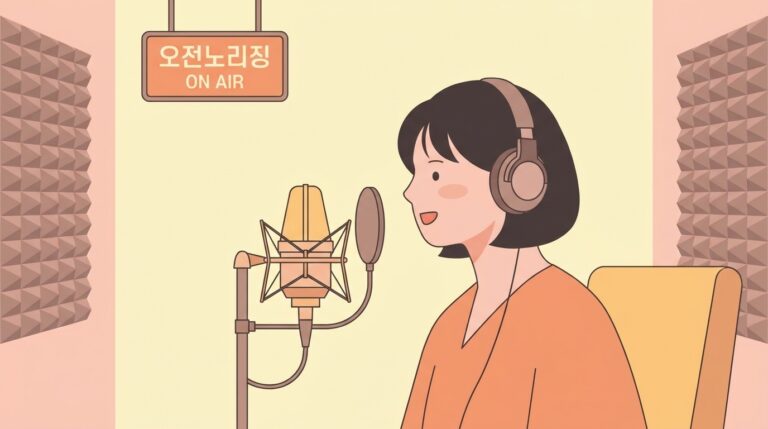
Imagine stepping into a high-end recording studio in Hapjeong, Seoul. The audio director sits behind a glowing console, meticulously listening to every breath. In the booth stands a veteran voice actor narrating a dense philosophical essay by a renowned Korean author. A subtle shift in vocal timbre—what Koreans describe as subtle moksori ton (목소리 톤) or yeoun (여운, lingering resonance)—transforms dry theoretical text into an intimate, evocative experience. Many advanced learners at the C2 level tell us: “I can read academic Korean and complex novels, but when discussing the subtle artistry, vocal cadence, and production nuances of Korean spoken literature, I lack the sophisticated industry vocabulary to express nuanced critique.”
Mastering this high-register terminology will allow you to critically dissect media trends, appreciate Korean voice drama fandoms, and engage in high-level intellectual dialogues with native media professionals.
Phase 2: Key Expressions In-Depth Analysis
1. 귀로 듣는 독서 (Gwi-ro deun-neun dok-seo)
- Pronunciation: [Gwi-ro deun-neun dok-seo] (Sounds like “gwee-ro deun-noon doke-suh”)
- Meaning: Literal: “Reading heard with the ears” | Actual: The immersive practice of audiobook consumption as a legitimate literary engagement.
- K-Culture Moment: Frequently headlined on premium audio platforms like Welaaa or Millie’s Library (밀리의 서재) marketing campaigns.
- Editor’s Insight: This phrase dignifies listening to books, elevating it from passive listening (cheong-chwi) to an active, intellectual act of literacy (dok-seo).
- Situation Spectrum: Casual ⚠️ | Semi-formal ✅ | Formal ✅
- 🤔 Think About It: How does your native language distinguish auditory text consumption from visual reading? In Korean, attaching dok-seo emphasizes cognitive depth.
2. 목소리에 생명력을 불어넣다 (Mok-so-ri-e saeng-myeong-nyeok-eul bul-eo-neot-da)
- Pronunciation: [Mok-so-ri-e saeng-myeong-nyeok-eul bul-eo-neot-da] (Sounds like “moak-so-ree-eh sang-myeong-nyuk-eul bool-uh-nuht-dah”)
- Meaning: Literal: “To breathe vitality into [the text] through one’s voice” | Actual: To bring a written manuscript vividly to life through nuanced voice acting.
- K-Culture Moment: Used by directors when praising voice actors who transform complex literary metaphors into tactile emotional experiences.
- Editor’s Insight: At the C2 level, using 불어넣다 (to breathe into / instill) demonstrates an evocative command of figurative language compared to basic verbs like 읽다 (to read).
- Situation Spectrum: Casual ⚠️ | Semi-formal ✅ | Formal ✅
- 🤔 Think About It: Why is voice acting in Korean culture considered an elevated dramatic art rather than mere voice-over narration?
3. 몰입감을 극대화하다 (Mor-ip-gam-eul geuk-dae-hwa-ha-da)
- Pronunciation: [Mo-rip-gam-eul geuk-dae-hwa-ha-da] (Sounds like “mo-reep-gahm-eul geuk-dae-hwah-hah-dah”)
- Meaning: Literal: “To maximize the sense of immersion” | Actual: To create an utterly captivating sensory and narrative atmosphere.
- K-Culture Moment: Found in cultural critique reviews praising multi-cast audio dramas featuring spatial sound effects (3D 입체 음향) and original scores.
- Editor’s Insight: 몰입감 (sense of immersion) combined with the Sino-Korean verb 극대화하다 (to maximize) is an essential collocation in media critique and publishing industry reports.
- Situation Spectrum: Casual ⚠️ | Semi-formal ✅ | Formal ✅
- 🤔 Think About It: How does Korean media critique prioritize listener absorption over mere plot delivery?
Phase 3: Textbook Korean vs. Real Native Korean
Scenario 1: Commenting on an Audiobook Narrator’s Expressive Range
- 📖 Textbook Korean: 이 성우는 감정을 잘 표현해서 듣기 좋습니다. (This voice actor expresses emotions well, so it is nice to listen to.)
- 🗣️ Real Native Korean (C2): 텍스트의 행간을 짚어내는 성우의 섬세한 완급 조절 덕분에 작품의 여운이 한층 깊어지네요.
- 💡 Why the Difference?: Advanced native speakers critique narration by referencing 행간 (reading between the lines) and 완급 조절 (pacing and modulation) rather than simple emotion words.
Scenario 2: Discussing the Audiobook Industry Shift
- 📖 Textbook Korean: 요즘 사람들이 오디오북을 많이 사서 시장이 커졌습니다. (These days people buy audiobooks a lot, so the market got bigger.)
- 🗣️ Real Native Korean (C2): 구독 경제와 결합한 오디오 콘텐츠 플랫폼의 약진이 출판 생태계의 패러다임을 재편하고 있어요.
- 💡 Why the Difference?: In professional or intellectual circles, referencing macro-trends (구독 경제 / subscription economy, 패러다임 재편 / paradigm shift) captures the full socio-economic reality.
Phase 4: K-Culture Deep Dive & Non-Verbal Studio Etiquette
4-1. Studio Nunchi & Professional Gestures
In Korean recording studios, non-verbal communication is paramount. Directors and voice actors avoid sudden vocal interjections while the red recording lamp (On-Air) is live. Feedback through the talkback mic begins with a gentle nod and an acknowledging phrase like “톤 너무 좋습니다, 이번엔 조금만 더 담백하게 가볼까요?” (The tone is great; shall we try a slightly more restrained take?). Observe how praise precedes constructive critique—a cornerstone of professional nunchi.
4-2. Cultural Code: The Rise of Audio Dramas (오디오 웹소설 & 드림캐스팅)
Korea has witnessed an extraordinary convergence of webtoons, web novels, and luxury audio productions. High-end audio dramas employ 20+ specialized voice actors with original soundtracks, triggering dedicated fandom cultures. Fandoms engage in 드림캐스팅 (dream-casting beloved voice actors for unreleased novel chapters), showcasing how oral interpretation has evolved into a powerhouse cultural medium.
Phase 5: Real-World Roleplay Scenario
Setting: A media production conference room in Mapo-gu, Seoul. You are discussing casting and acoustic direction for an upcoming philosophical essay audiobook with Audio Director Kang (강 PD).
- 강 PD: 이번 인문학 에세이 오디오북 기획안 보셨죠? 텍스트가 워낙 밀도 높아서 내레이터 선정이 관건일 것 같습니다.
- You: 네, 단순 낭독을 넘어서 텍스트의 행간을 입체적으로 살려낼 수 있는 베테랑 성우가 필요하다고 봅니다.
- 강 PD: 맞습니다. 자칫하면 지루해지기 쉬운 주제라, 목소리에 생명력을 불어넣는 완급 조절이 필수적이에요.
- You: 특히 클라이맥스 독백 구간에서는 배경음악을 절제하고 성우의 숨소리와 여운만으로 몰입감을 극대화하는 연출은 어떨까요?
- 강 PD: 오, 아주 탁월한 접근이네요! 3D 입체 음향 효과를 덧입히면 청자의 청각적 카타르시스가 배가되겠어요.
- You: 공감합니다. 귀로 듣는 독서의 묘미는 바로 그런 정교한 청각적 디테일에서 오니까요.
- 강 PD: 그럼 이번 주 안으로 최종 샘플 보이스를 청취하고 캐스팅을 확정 짓도록 하죠.
- You: 좋습니다. 원작자의 집필 의도가 청자에게 온전히 전달되도록 만전을 기하겠습니다.
🔀 Interactive Choice Point
- Choice A (Best): “원작의 서정적인 문체를 훼손하지 않도록, 담백하면서도 깊이 있는 보이스 톤을 우선순위로 두겠습니다.”
- Feedback: Excellent! Demonstrates high aesthetic discernment and nuanced industry vocabulary. (Best)
- Choice B (Risk): “그냥 목소리 유명한 성우 쓰면 많이 팔리지 않을까요?”
- Feedback: Too blunt and commercially simplistic; ignores the artistic nuance expected at this level. (Risk)
- Choice C (Bad): “아무나 책 빨리 읽는 사람으로 뽑아주세요.”
- Feedback: Inappropriate and dismissive of the voice acting profession. (Bad)
Phase 6: 10-Second Emotional Shadowing Drill
[🧐 Analytical & Intellectual]
“텍스트의 행간을 짚어내는 / 섬세한 완급 조절이 / 작품의 몰입감을 좌우합니다.”[✨ Expressive & Passionate]
“성우의 목소리는 / 활자에 머물던 문장에 / 생명력을 불어넣는 마법과도 같아요!”[🤝 Persuasive & Polished]
“귀로 듣는 독서가 대세로 자리 잡은 만큼, / 오디오 프로덕션의 퀄리티가 / 콘텐츠의 성패를 가릅니다.”
Phase 7: K-Culture Mini Dictionary
- 완급 조절 (Wan-geup jo-jeol) | Pacing modulation | Controlling tempo and intensity to maintain dramatic tension in narration or performance.
- 입체 음향 (Ip-che eum-hyang) | Spatial / 3D audio | Acoustic engineering that creates directional depth, widely used in modern Korean audiobooks.
- 오디오 도슨트 (O-di-o do-seun-teu) | Audio docent | An audio narration guide, increasingly popular in art exhibitions and literary walking tours.
- 귀명창 (Gwi-myeong-chang) | Discerning listener | Historically someone knowledgeable in pansori singing; today used to describe listeners with an exquisite ear for audio nuance.
Phase 8: Traveler & Culture-Seeker Survival Kit
Top 3 Survival Phrases for Cultural Book Cafes & Studios
- “이 오디오북 샘플을 청음해 볼 수 있는 공간이 마련되어 있나요?”
(Is there a listening station available where I can preview this audiobook sample?)- Pro Tip: Use 청음하다 (to listen critically/audiophile listening) rather than simple 듣다.
- “성우분의 낭독 톤이 원작 소설의 분위기와 완벽하게 부합하네요.”
(The narrator’s vocal tone matches the atmosphere of the original novel flawlessly.) - “오디오북 전용 팝업 부스나 청음 라운지 위치가 어디인가요?”
(Where is the dedicated audiobook pop-up booth or listening lounge located?)
Editor’s Travel Note
When exploring Seoul’s literary hubs like Paju Book City (파주출판도시) or Starfield Library in COEX, download the [Naver Map app on your device] to locate niche audiobook recording cafes. For seamless transport across cultural complexes, utilize the [T-Money Mobile transit card guide] to navigate the Gyeongui-Jungang line effortlessly.
Phase 9: Thinking Deeper
In traditional Korean culture, literature was never merely silent and visual; it was communal and oral. The Joseon-era jeon-gi-su (전기수)—professional street storytellers who recited vernacular novels with dramatic vocal flair—were the spiritual ancestors of today’s voice actors. The meteoric rise of audiobooks in contemporary Korea is not merely a byproduct of screen fatigue; it represents a deep cultural return to communal oral performance reimagined through digital streaming platforms.
💬 Your Turn: How does your home country’s audiobook culture treat the voice actor—as an invisible narrator, or as a co-creator of literary art? Share your thoughts below in Korean! (여러분의 생각을 댓글로 남겨주세요!)
Phase 10: Structured FAQ & Common Mistakes
Q: What is the linguistic difference between 낭독 (nang-dok) and 성우 연기 (seong-u yeon-gi)?
A: 낭독 refers to standard verbal reading with clear pronunciation and pace, whereas 성우 연기 encompasses complete character dramatization, breath control, emotional subtext, and vocal embodiment.
Q: Can I use the word 더빙 (dubbing) when talking about audiobooks?
A: It is preferable to use 낭독 (reading/narration), 녹음 (recording), or 오디오 드라마 제작 (audio drama production). 더빙 usually implies replacing foreign language dialogue in visual media like films or animation.
Q: How do native Koreans express that an audiobook narrator has a soothing, attractive voice?
A: Instead of just saying 목소리가 좋다, advanced speakers say “목소리 톤이 감미롭고 귀에 감긴다” (The tone is sweet and wraps pleasantly around the ear) or “보이스가 묵직하고 신뢰감을 준다” (The voice is resonant and instills trust).
🚨 Common Mistakes Alert
- Mistake: Using 듣는 책 in formal media analysis.
- Correction: Use refined terms like 오디오북 or 귀로 듣는 독서 콘텐츠.
- Mistake: Describing pacing as 속도가 빠르거나 느리다.
- Correction: Use 완급 조절이 탁월하다 (Pacing modulation is superb).
- Mistake: Calling spatial audio 좋은 소리.
- Correction: Use 입체 음향 설계 or 풍부한 사운드스케이프 (soundscape).
Phase 11: Action Missions
- 🥉 Bronze Mission: Record a 30-second voice memo reading a Korean poem using conscious 완급 조절 (pacing modulation) and dynamic breath control.
- 🥈 Silver Mission: Write a 2-sentence micro-review of an audio clip on Instagram or X using the expression “몰입감을 극대화하다” and tag
#DailyHangul. - 🥇 Gold Mission: Engage in a forum discussion on a Korean book platform (e.g., Millie’s Library or Welaaa) critiquing a voice actor’s interpretation using “텍스트의 행간을 짚어내다”.
- 🎮 K-Culture Media Mission: Watch an episode of a Korean behind-the-scenes recording session on YouTube (search term:
성우 오디오북 더빙 현장 비하인드) and note three professional idioms used by the director.
Phase 12: Interactive Quiz Challenge
1. Situation Judgment
Which sentence represents the most sophisticated C2-level critique of an audiobook narrator?
* A) 목소리가 커서 귀에 잘 들립니다.
* B) 성우 특유의 섬세한 완급 조절이 텍스트의 행간을 극적으로 살려냅니다.
* C) 책을 빨리 읽어줘서 시간이 절약됩니다.
2. Fill-in-the-Blank
오디오북 프로덕션팀은 청자의 청각적 ( )을/를 극대화하기 위해 3D 입체 음향 기술을 도입했다.
* (A) 소외감 (B) 피로감 (C) 몰입감
3. Cultural True/False
Joseon-era professional storytellers who orally performed literary works in market squares were called 전기수 (Jeon-gi-su). (True / False)
👉 Click here to reveal Answers & Explanations!
- Answer: B — Sentence B demonstrates high aesthetic and professional vocabulary (완급 조절, 행간을 살려내다).
- Answer: (C) 몰입감 — 몰입감을 극대화하다 (maximize the sense of immersion) is the correct industry collocation.
- Answer: True — Jeon-gi-su were historical professional readers who laid the foundation for modern Korean oral performance culture.







