

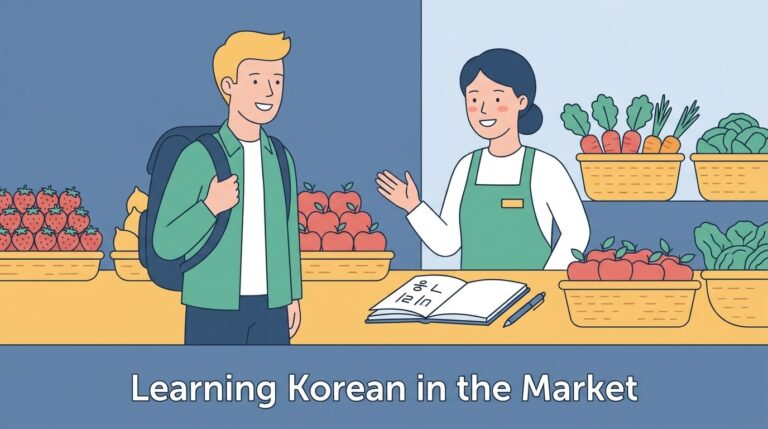
Phase 1: Empathy & Storytelling
안녕하세요! 매일한글 에디터입니다. (Hello! I’m your Daily Hangul editor.)
Imagine this: You step into the vibrant, bustling alleys of Gwangjang Market or Mangwon Market in Seoul. The air smells of freshly fried savory pancakes, and colorful wooden crates overflow with glistening strawberries, crisp apples, and vibrant greens. You make eye contact with a smiling market vendor (an Imo or Ajeossi). You want to pick out the best, freshest fruit just like local Koreans do, but your mind goes blank. How do you ask if something is fresh without sounding like an automated translation app? You might hesitate, wonder if it’s rude to ask, or end up pointing silently.
Don’t worry! This guide is crafted specifically for beginner learners based on real feedback from hundreds of travelers. By learning just a few warm, natural words centered around 싱싱해요 (It’s fresh), you will transform from a hesitant tourist into a charming market shopper who earns extra smiles (and maybe even free bonus treats!). Let’s dive into the lively world of traditional Korean markets together!
Phase 2: 3 Key Expressions Deep Dive
1. 이거 싱싱해요? (Igeo singsinghaeyo?)
- Pronunciation: ee-guh sing-sing-hae-yo? (Think of the English word sing repeated twice briskly: sing-sing!)
- Meaning: Literal: “Is this fresh?” | Real Nuance: A warm, friendly check with the vendor to ask, “Are these in season and fresh today?”
- K-Culture Moment: Seen in food variety shows like Three Meals a Day (삼시세끼) or travel vlogs when celebrities visit rural seaside or mountain markets.
- Editor’s Insight: The word 싱싱 (singsing) is an onomatopoeia/mimetic word describing vivid, energetic freshness—especially used for raw produce, fish, and fruits!
- Situation Spectrum: Casual ⚠️ | Semi-formal (Polite) ✅ | Formal 🚫
- 🤔 Think About It: In many Western supermarkets, produce is pre-packaged. In Korea, market vendors pride themselves on sourcing fresh goods every morning. How does asking directly build a personal connection with the seller?
2. 진짜 달아요! (Jinjja dara-yo!)
- Pronunciation: jin-jja da-ra-yo! (Jinjja rhymes with “ninja”, and dara-yo sounds like “da-ra-yo”)
- Meaning: Literal: “It’s really sweet!” | Real Nuance: Used when tasting a sample fruit or expressing delight at the quality: “Wow, this is super sweet and delicious!”
- K-Culture Moment: In K-Dramas, whenever an elder gives the main character a slice of melon or Korean pear, the polite and enthusiastic reaction is always “진짜 달아요!”
- Editor’s Insight: Korean fruit culture values sweetness highly. When you say this to a fruit stand owner, their face instantly lights up with pride.
- Situation Spectrum: Casual ⚠️ | Semi-formal (Polite) ✅ | Formal 🚫
- 🤔 Think About It: Complementing the product before buying is a universal sign of respect, but in Korea, expressing taste reactions with enthusiasm is part of market bonding (Jeong).
3. 덤 좀 주세요! (Deom jom juseyo!)
- Pronunciation: deom jom joo-seh-yo! (Deom rhymes with “hum”; jom sounds like “chome”)
- Meaning: Literal: “Please give me deom (free bonus/extra)!” | Real Nuance: A playful, affectionate request for an extra handful of vegetables or an extra fruit.
- K-Culture Moment: A classic scene in K-Dramas set in traditional towns (like When the Camellia Blooms) where lively neighborhood ladies barter with cute cheekiness.
- Editor’s Insight: Deom (덤) is the traditional Korean custom of giving an extra scoop for free out of affection. Always say it with a warm smile, never demand it sternly!
- Situation Spectrum: Casual ⚠️ | Semi-formal (Polite) ✅ | Formal 🚫
- 🤔 Think About It: Why does bargaining in Korea feel more like a friendly social game than a cold business transaction?
Phase 3: Textbook Korean vs. Real Korean
Situation 1: Asking if the fruit or fish is fresh
- 📖 교과서 한국어 (Textbook): “이 상품은 신선합니까?” (I sangpumeun sinseonhamnikka? – Is this merchandise fresh?)
- 🗣️ 진짜 한국어 (Real-life): “이거 오늘 들어왔어요? 싱싱해요?” (Igeo oneul deureowasseoyo? Singsinghaeyo? – Did this arrive today? Is it fresh?)
- 💡 왜 다를까? Textbook Korean often uses overly formal business terms (상품, 신선), whereas real market chatter relies on conversational words like 이거 (this) and 싱싱해요 (fresh).
Situation 2: Asking for a small discount or bonus
- 📖 교과서 한국어 (Textbook): “가격을 깎아 주실 수 있습니까?” (Gagyogeul kkakka jusil su itsseumnikka? – Can you discount the price?)
- 🗣️ 진짜 한국어 (Real-life): “이모, 조금만 깎아주세요~ 덤도 주세요!” (Imo, jogeumman kkakka-juseyo~ deomdo juseyo! – Auntie, please give a tiny discount~ throw in a bonus!)
- 💡 왜 다를까? Asking directly for a price cut can sound abrasive. Addressing the vendor affectionately as Imo (Auntie) and asking playfully keeps the mood warm and joyful.
Phase 4: K-Culture Deep Dive & Non-verbal Manners
4-1. Nunchi (눈치) & Body Language at the Market
- The Gentle Point & Two-Hand Rule: Never aggressively squeeze or poke soft fruits like strawberries or peaches. Instead, lightly point with an open hand. When paying or receiving goods, use both hands (or place your left hand under your right wrist) to show courtesy.
- Addressing Sellers: Don’t use Jeogiyo (Excuse me) cold-heartedly. Call female vendors Imo (이모 – Auntie) or Eomeoni (어머니 – Mother), and male vendors Sajangnim (사장님 – Boss). It instantly creates rapport.
4-2. Cultural Code: The Art of “Jeong” (정) in Traditional Markets
In modern supermarkets, everything is scanned by barcodes. But in traditional Korean markets (전통시장), transactions are about Jeong—warm emotional bonding. Vendors often give out Deom (덤, free bonus items) not because they have to, but because they like your energy and appreciation of their goods.
Phase 5: Real Roleplay Scenario
Setting: Mangwon Market on a sunny Saturday afternoon. You are standing in front of a colorful fruit stall run by a cheerful vendor, Imo-nim.
- Imo (Vendor): 어서 와요, 총각/아가씨! 오늘 딸기 진짜 좋아! (Eoseo wayo! Oneul ttalgi jinjja joa!) 🎭 [Smiles broadly and points at bright red strawberries] “Welcome! The strawberries are amazing today!”
- Learner: 안녕하세요! 이거 싱싱해요? (Annyeonghaseyo! Igeo singsinghaeyo?) 🎭 [Bows slightly with a polite smile] “Hello! Are these fresh?”
- Imo (Vendor): 그럼! 오늘 아침에 왔어. 하나 맛봐! (Geureom! Oneul achime wasseo. Hana matbwa!) 🎭 [Hands you a sample strawberry] “Of course! Arrived this morning. Taste one!”
- Learner: 와, 진짜 달아요! (Wa, jinjja dara-yo!) 🎭 [Eyes wide open in genuine delight] “Wow, it’s really sweet!”
- Imo (Vendor): 한 바구니에 오천 원이야. 줄까? (Han bagunie ocheon-won-iya. Julkka?) 🎭 [Lifts a basket] “Five thousand won per basket. Want one?”
- Learner: 네, 한 바구니 주세요! (Ne, han baguni juseyo!) 🎭 [Nods eagerly] “Yes, please give me one basket!”
- Imo (Vendor): 그래, 여기 있어! (Geurae, yeogi isseo!) 🎭 [Packs the basket into a bag] “Sure, here you go!”
- Learner: 감사합니다! 이모, 덤도 조금만 주세요~ (Gamsahamnida! Imo, deomdo jogeumman juseyo~) 🎭 [Hands cash with both hands, smiling cutely] “Thank you! Auntie, please throw in a tiny bonus too~”
🔀 Interactive Choice Point
What do you say when the vendor packs your bag?
* Option A: “더 주세요.” (Deo juseyo – Give me more.)
* Option B: “이모, 진짜 싱싱하고 맛있어요. 다음에 또 올게요!” (Imo, jinjja singsinghago masisseoyo. Daeume tto olgeyo!)
* Option C: “비싸요, 깎아줘요.” (Bissayo, kkakka-jwoyo – It’s expensive, cut the price.)
- Feedback:
- Option A (Bad): Too direct and demands without politeness or charm.
- Option B (Best! ⭐): Praises the produce, addresses her affectionately, and promises repeat business—she will almost certainly toss in extra fruits!
- Option C (Risk): Too blunt in informal tone (-jwoyo instead of -juseyo), which might sour the mood.
Phase 6: 10-Second Emotion Shadowing Drill
Practice reading these out loud with rhythm and emotion:
[😊 호기심 가득하고 밝게 / Curious & Bright]
이거 / 오늘 들어왔어요? / 싱싱해요?
(Igeo / oneul deureowasseoyo? / singsinghaeyo?)-
[😋 감탄하며 진심으로 / Full of Delight]
우와, / 설탕처럼 / 진짜 달아요!
(Uwa, / seoltang-cheoreom / jinjja dara-yo!) -
[🥺 애교 섞인 귀여운 톤 / Cute & Playful]
이모~ / 너무 맛있어요, / 덤 좀 주세요!
(Imo~ / neomu masisseoyo, / deom jom juseyo!)
Phase 7: K-Culture Mini Dictionary
- 싱싱하다 (Singsing-hada) | To be fresh/lively | Used exclusively for vibrant organic items like fresh fish, vegetables, and fruits.
- 덤 (Deom) | Extra bonus / freebie | A cornerstone of Korean market generosity where extra items are gifted without added cost.
- 이모 (Imo) | Aunt (Maternal) / Friendly vendor title | A warm, endearing title used to address middle-aged female market and restaurant staff.
- 바구니 (Baguni) | Basket | The standard measuring unit for produce in traditional open-air Korean markets (e.g., 한 바구니 = one basket).
Phase 8: Traveler’s Survival Kit
Top 3 Survival Phrases
- 이거 얼마예요? (Igeo eolmayeyo?) – How much is this? (Pro Tip: Point directly at the basket).
- 카드 돼요? (Kadeu dwaeyo?) – Do you take credit cards? (Pro Tip: Small vendors prefer cash or bank transfers).
- 현금 영수증은 괜찮아요. (Hyeongeum yeongsujeungeun gwaenchanayo.) – Cash receipt is okay to skip.
Editor’s Travel Note
- Cash is King in Traditional Markets: While modern marts take cards, having 1,000 KRW and 5,000 KRW bills ready makes traditional market shopping seamless and wins you larger portions.
- Navigation Guide: Search and find traditional markets nearby by checking the Naver Map App Download Page.
Phase 9: “One Step Deeper” (Reflective Note)
In a world dominated by touchscreens, self-checkout kiosks, and next-day delivery algorithms, Korean traditional markets preserve human warmth. When you say “싱싱해요?”, it is more than an inquiry about freshness; it is an invitation to converse. The market vendor is not an anonymous cashier, but a neighbor sharing their day’s harvest with you. Language in Korea is deeply relational—built to connect people, not just convey data.
💬 Your Turn: What is shopping at open markets like in your home country? Would you feel comfortable asking a vendor for a bonus item with a smile? Share your thoughts below!
Phase 10: FAQ & Common Mistakes
Q: Can I use “싱싱해요” for hot food like tteokbokki or soup?
A: No! 싱싱해요 is only for raw, living, or freshly harvested items (fruits, vegetables, seafood, raw meat). For cooked foods, use 따뜻해요 (It’s warm) or 갓 만들었어요? (Was it just made?).
Q: Is asking for “덤” (bonus) considered rude or greedy?
A: Not at all, provided you ask with a polite, playful tone (덤 좀 주세요~) after purchasing something. Demanding it aggressively or before agreeing to buy, however, is considered impolite.
Q: What if I don’t know the exact name of the fruit I want?
A: Simply use 이거 (this) while lightly gesturing: “이거 싱싱해요? 한 바구니 주세요!” (Is this fresh? One basket please!).
🚨 Common Mistakes Alert
- Touching soft fruits directly: ❌ Grabbing strawberries tightly. ➔ ✅ Look with your eyes and let the seller pack them.
- Using “신선해요” casually: While correct in writing, 싱싱해요 sounds 10x more natural in spoken market conversation.
- Speaking in flat monotone: Korean market conversations thrive on expressive intonation. Don’t be shy to show excitement!
Phase 11: Action Missions
- 🥉 Bronze Mission (Solo Practice): Say “이거 싱싱해요? 진짜 달아요!” aloud 5 times in front of the mirror with your biggest smile.
- 🥈 Silver Mission (Social Share): Next time you buy fruits or groceries, snap a photo and caption it: “오늘 과일 진짜 싱싱해요! 🍓”
- 🥇 Gold Mission (Real Life): Visit a local Korean grocery store or market in Korea, ask “이거 싱싱해요?”, and complete your purchase in 100% Korean!
- 🎮 K-Culture Mission: Watch any Korean food/travel reality show episode and spot when the cast compliments food freshness!
Phase 12: Interactive Quiz Challenge
Q1. Which item can you describe as “싱싱해요”?
* A) Freshly boiled Ramyeon
* B) Crisp morning strawberries at the market
* C) Steaming hot Tteokbokki
👉 Click to see the answer & explanation
Correct Answer: B
Explanation: 싱싱해요 is reserved for fresh, raw produce, seafood, and fruits. Cooked, hot dishes use expressions like 갓 만들었어요 or 따뜻해요.
Q2. Fill in the blank: You want to praise the extreme sweetness of a Korean pear.
* “우와, 이 배 _________!”
👉 Click to see the answer & explanation
Correct Answer: 진짜 달아요 (Jinjja dara-yo)
Explanation: “달아요” means “It is sweet”, and adding “진짜” emphasizes that it’s delicious and sugary sweet.
Q3. [True / False] Asking for “덤” (Deom) should only be done aggressively to get the lowest price.
👉 Click to see the answer & explanation
Correct Answer: False
Explanation: Deom is rooted in mutual warmth and affection (Jeong). It should always be requested playfully and politely with a smile!







