

Phase 1: Empathy & Storytelling
안녕하세요! 매일한글 에디터입니다. (Hello! I’m your Daily Hangul editor.)
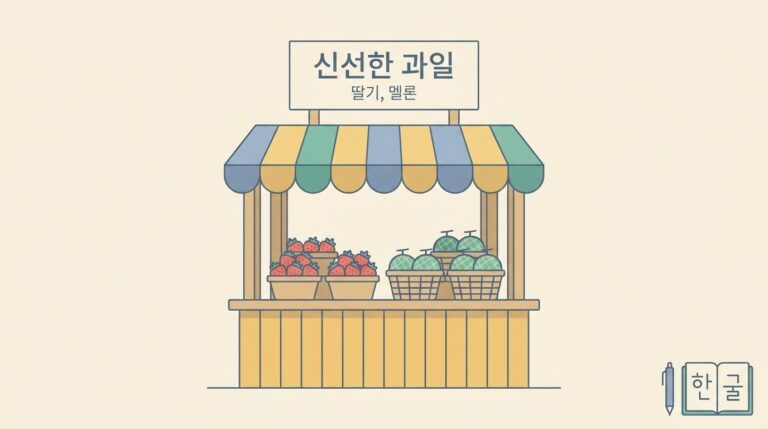
Imagine walking through a bustling Korean traditional market or the lively fresh produce aisle of a local mart in Seoul. The sweet, juicy aroma of strawberries (딸기), giant shiny Korean pears (배), and perfectly round golden melons (참외) surrounds you. You really want to buy some fruit, but you freeze. How do you ask if that box of peaches is ripe and sweet, or if it’s currently in season? You might hesitate, worried that touching the fruit carelessly might look rude, or wondering how to politely ask the friendly fruit vendor (아주머니 or 아저씨) for a recommendation.
Many of our beginner learners tell us: “I wanted to buy fruit so badly, but I ended up picking something sour because I was too shy to ask!” Don’t worry! Picking fresh, sweet fruit in Korea is not just a chore—it’s an interactive, heartwarming cultural experience. With just a few natural A2-level Korean phrases, you will gain the confidence to chat with fruit vendors, pick the juiciest seasonal treats, and maybe even get an extra piece of fruit as ‘서비스’ (free bonus)! Let’s jump right into your go-to guide.
Phase 2: Core Expressions Deep Dive
1. 이거 달아요? (Igeo darayo?)
- Pronunciation: [ee-guh dah-rah-yo?] (Sounds like “E-ger” + “da-ra-yo” with a gentle rising tone at the end)
- Meaning: Literal: “Is this sweet?” / Nuance: “Is this fruit sweet and good to eat right now?”
- K-Culture Moment: In K-Dramas, whenever a mom or a character visits a traditional market stall, they point at shiny shine muscat grapes or tangerines and warmly ask, “사장님, 이거 달아요?”
- Editor’s Insight: In Korean fruit culture, ‘sweetness’ (달콤함 / 당도) is the ultimate metric for good fruit! Asking this shows you care about quality, and it invites the seller to tell you about today’s batch.
- Situation Spectrum: Casual (친구): ⚠️ 이거 달아? | Semi-formal (상점/식당): ✅ 이거 달아요? | Formal: ✅ 이것은 단가요?
- 🤔 Think About It: In your home country, do shoppers ask vendors directly about fruit taste, or do people just squeeze and inspect on their own?
2. 요즘 무슨 과일이 제철이에요? (Yojeum museun gwa-iri jecheorieyo?)
- Pronunciation: [yo-jeum moo-seun gwa-ee-ree je-cheo-ree-eh-yo?]
- Meaning: Literal: “These days what fruit is in-season?” / Nuance: “What fruit is in peak season and tastiest right now?”
- K-Culture Moment: On Korean food and variety shows like Three Meals a Day (삼시세끼), cast members always highlight seasonal food (제철 음식) as nature’s best medicine and flavor.
- Editor’s Insight: Koreans take seasonal produce very seriously—spring is for strawberries, summer for watermelons and peaches, autumn for apples and pears, and winter for Jeju tangerines.
- Situation Spectrum: Casual: ⚠️ 요즘 무슨 과일이 제철이야? | Semi-formal: ✅ 요즘 무슨 과일이 제철이에요? | Formal: ✅ 요즘 어떤 과일이 제철입니까?
- 🤔 Think About It: Why do you think seasonal eating holds such a special place in traditional Korean well-being philosophy (신토불이 – local food for local health)?
3. 맛있는 걸로 골라 주세요. (Masinneun geollo golla juseyo.)
- Pronunciation: [mah-sheen-neun geol-lo gohl-lah joo-seh-yo]
- Meaning: Literal: “Please choose with a delicious one.” / Nuance: “Could you please pick out the best/tastiest one for me?”
- K-Culture Moment: When buying watermelons in summer, customers often trust the veteran shopkeeper’s trained eye rather than picking alone, saying this exact phrase with a big smile.
- Editor’s Insight: Handing the choice over to the vendor shows respect for their expertise. Most Korean fruit vendors feel proud when asked and will genuinely tap, sniff, and pick their absolute best piece for you!
- Situation Spectrum: Casual: ⚠️ 맛있는 걸로 골라줘 | Semi-formal: ✅ 맛있는 걸로 골라 주세요 | Formal: ✅ 맛있는 것으로 골라 주시겠어요?
- 🤔 Think About It: How does relying on a vendor’s recommendation foster a sense of community connection (Jeong / 정) compared to impersonal supermarket self-checkout?
Phase 3: Textbook Korean vs. Real Korean
Situation 1: Asking if a fruit is good
- 📖 Textbook Korean: 이 수박은 신선합니까? (Is this watermelon fresh? – Very robotic and stiff)
- 🗣️ Real Korean: 사장님, 이 수박 맛있어요? 달아요? (Boss, is this watermelon tasty? Is it sweet?)
- 💡 Why it’s different: Daily shoppers focus directly on taste (맛있다/달다) rather than formal freshness (신선하다), and addressing the seller as 사장님 (boss/owner) creates instant warmth.
Situation 2: Asking for a discount or bonus
- 📖 Textbook Korean: 가격을 깎아 주십시오. (Please reduce the price. – Sounds like a textbook demand)
- 🗣️ Real Korean: 조금만 깎아 주세요~ 서비스 있어요? (Could you give a little discount? Any bonus treats?)
- 💡 Why it’s different: Korean market shopping involves friendly banter and the playful culture of 서비스 (service/bonus fruit) rather than rigid contractual bargaining.
Phase 4: K-Culture Deep Dive & Non-Verbal Manners
4-1. 눈치 (Nunchi) & Fruit Shopping Etiquette
- Don’t Poke or Squeeze Fragile Fruit: Unlike some Western grocery styles where people press avocados or peaches, gently observing color and scent is preferred in Korea. Poking soft fruits like ripe persimmons (홍시) or peaches (복숭아) can bruise them and will make vendors upset.
- The Watermelon Thump (수박 두드리기): When buying whole watermelons, you’ll see locals knocking on them. A clear, ringing “tong-tong” (통통) sound indicates crisp, juicy ripeness, while a dull “thud-thud” means overripe.
- Two Hands for Payment: Always hand over cash or your card with both hands (or your right hand supported by your left elbow) to show polite respect.
4-2. The Joy of ‘Service’ (서비스) & Sliced Samples
In traditional markets (전통시장) and small neighborhood fruit shops (과일가게), vendors frequently offer bite-sized samples on toothpicks. If an ajumma offers you a slice of apple or melon, smile, say “감사합니다! (Gamsahamnida!)”, and taste it! If you buy a whole box of apples, don’t be surprised if she tosses in two extra tangerines as 서비스 (a free gift of goodwill).
Phase 5: Real Roleplay Scenario
Setting: Mangwon Market (망원시장) in Seoul. You are standing in front of a colorful fruit stall run by a cheerful vendor named Park Min-ho (사장님).
- You: 안녕하세요, 사장님! 요즘 무슨 과일이 제철이에요?
(Annyeonghaseyo, sajangnim! Yojeum museun gwa-iri jecheorieyo?)
Hello, boss! What fruit is in season these days?
🎭 [Smiling warmly while scanning the fruit crates] -
Sajangnim: 어서 와요! 요즘은 딸기랑 한라봉이 제일 달고 맛있어요!
(Eoseo wayo! Yojeumeun ttal-girang hallabong-i jeil dalgo masisseoyo!)
Welcome! These days strawberries and Hallabong citrus are the sweetest and tastiest!
🎭 [Points proudly at bright red strawberry baskets] -
You: 와, 딸기 진짜 싱싱해 보여요. 이거 많이 달아요?
(Wa, ttal-gi jinjja singsinghae boyeoyo. Igeo mani darayo?)
Wow, the strawberries look really fresh. Are these very sweet?
🎭 [Leaning in slightly to smell the sweet scent] -
Sajangnim: 그럼요! 오늘 아침에 농장에서 바로 가져온 거야. 하나 먹어봐요!
(Geureomyo! Oneul achime nongjang-eseo baro gajyeon geoya. Hana meogeobwayo!)
Of course! They came straight from the farm this morning. Try one!
🎭 [Hands you a fresh strawberry to taste] -
You: 음! 진짜 달고 맛있네요! 딸기 한 바구니 얼마예요?
(Eum! Jinjja dalgo masinneyo! Ttal-gi han baguni eolmayeyo?)
Mmm! It really is sweet and delicious! How much is one basket of strawberries?
🎭 [Nodding with a satisfied smile] -
Sajangnim: 한 바구니에 팔천 원이에요.
(Han bagunie palcheon-won-ieyo.)
It’s 8,000 won per basket.
🎭 [Holding up a sturdy plastic container] -
You: 제일 맛있는 걸로 골라 주세요!
(Jeil masinneun geollo golla juseyo!)
Please pick out the most delicious one for me!
🎭 [Handing over your card with both hands] -
Sajangnim: 알겠어요! 맛있게 먹어요, 귤도 두 개 서비스로 넣어줄게!
(Algesseoyo! Masikke meogeoyo, gyuldo du gae seobiseuro neoheojulge!)
Got it! Enjoy eating, and I’ll toss in two tangerines as a bonus!
🎭 [Packing the box neatly with a hearty laugh]
🔀 Interactive Choice Point
The vendor asks if you want a plastic bag for 100 won or if you have your own bag. How do you respond?
- Option A: 봉투에 넣어 주세요. (Bongtue neoheo juseyo. – Please put it in a bag.)
👉 Feedback [Best]: Simple, natural, and polite! The vendor will pack it up immediately for a small eco-fee. - Option B: 싫어요, 안 사요! (Sireoyo, an sayo! – I hate it, I won’t buy!)
👉 Feedback [Bad]: Too aggressive and rude for declining a shopping bag. - Option C: 제 가방에 담아 갈게요. (Je gabange dama galgeyo. – I’ll take it in my own bag.)
👉 Feedback [Best Eco]: Friendly and eco-conscious! Market sellers love reusable shoppers.
Phase 6: 10-Second Emotion Shadowing Drill
Practice matching the natural rhythm and intonation using pauses (/) and emotional cues:
[😊 Cheerful & Curious]
사장님, / 요즘 무슨 과일이 / 제일 달아요?
(Sajangnim, / yojeum museun gwa-iri / jeil darayo?)-
[😋 Delighted & Excited]
와! / 딸기가 / 진짜 싱싱하고 / 달콤해요!
(Wa! / Ttal-giga / jinjja singsinghago / dalkomhaeyo!) -
[🙏 Polite & Trusting]
제일 맛있는 걸로 / 하나만 / 골라 주세요~
(Jeil masinneun geollo / hanaman / golla juseyo~)
Phase 7: K-Culture Mini Dictionary
- 제철 (Jecheol) | Seasonal / In season
Used extensively in Korean grocery shopping and dining to indicate produce harvested at its absolute peak flavor and nutritional value. - 서비스 (Seobiseu) | Complimentary item / Bonus on the house
Derived from the English word ‘service’, it refers to free extra items, sides, or fruit given by kind store owners to show hospitality. - 당도 (Dangdo) | Sugar content / Brix level
You will often see signs in Korean supermarkets stating “고당도 과일” (High-sugar/High-sweetness fruit), guaranteeing superior sweetness. - 바가지 (Bagaji) | Overcharging / Rip-off
Literally meaning ‘gourd bowl’, “바가지를 쓰다” means being overcharged. Learning basic conversational phrases prevents any misunderstanding!
Phase 8: Traveler’s Survival Kit
Top 3 Survival Phrases
- 이거 얼마예요? (Igeo eolmayeyo?) – How much is this? (Your all-time essential grocery phrase).
- 카드 돼요? (Kadeu dwaeyo?) – Do you accept credit cards? (Pro Tip: While most market stalls accept cards, having cash ready at traditional stalls is appreciated and can earn you discounts!).
- 포장해 주세요. (Pojanghae juseyo.) – Please wrap/pack it up for take-out.
🧳 Editor’s Travel Note
- When heading to famous spots like Gwangjang Market or Mangwon Market, check navigation using the Naver Map app for smooth Korean transit navigation rather than international map apps for the most accurate walking directions and stall hours.
- If you stay at an Airbnb or hotel without a knife, look out for pre-cut fruit cups labeled “조각 과일” (Jogak gwa-il) at convenience stores like CU, GS25, or local supermarkets.
Phase 9: A Step Deeper (Reflection)
In Korean food culture, fruit is not just breakfast or a solo snack; it is the quintessential expression of affection (Jeong / 정). Whenever you visit a Korean household or finish a hearty meal at a gathering, the host will almost always peel and slice fresh fruit on a shared plate for everyone. Asking the fruit vendor for advice and exchanging kind words is the first step into this heartwarming communal culture.
💬 Your Turn: What is your all-time favorite fruit, and what seasonal fruit from Korea are you most excited to try? Drop your thoughts in the comments below!
Phase 10: FAQ & Common Mistakes
Q: Can I touch and squeeze fruits in Korean supermarkets to check for ripeness?
A: In general, it is better to avoid squeezing soft fruits. You can gently pick up boxed or hard fruits to check their aroma or inspect the color, but squeezing is considered impolite as it damages the produce.
Q: What is the best season to eat Korean strawberries (딸기)?
A: Korean strawberries are world-famous for their sweetness! Their peak season runs from December through early April.
Q: Is it okay to ask for a discount in Korean grocery stores?
A: In large department stores and major supermarkets (like E-Mart or Lotte Mart), prices are strictly fixed. In traditional markets (전통시장), asking playfully (“조금만 깎아 주세요~”) when buying in bulk is acceptable and fun!
🚨 Common Mistakes Alert!
- Saying “이것은 단 것입니까?” ❌ -> Say “이거 달아요?” ✅ (Keep it natural and conversational!)
- Assuming all markets are cash-only: Most modern traditional markets in Korea take cards, but keeping 5,000 ~ 10,000 KRW cash handy helps when buying smaller individual fruit baskets.
- Throwing fruit peels into general trash: Korea has strict waste recycling laws. Fruit peels (organic food waste) must be thrown into designated Food Waste bags (음식물 쓰레기).
Phase 11: Action Mission
- 🥉 Bronze Level: Say “이거 달아요?” out loud 5 times using our emotion shadowing rhythm.
- 🥈 Silver Level: Post a picture of your favorite fruit on Instagram/Threads and caption it: “요즘 딸기가 제철이에요! 🍓”
- 🥇 Gold Level: Visit a local Korean mart or your next travel market stall, greet the vendor with “안녕하세요!”, and ask “맛있는 걸로 골라 주세요!”
- 🎮 K-Culture Mission: Watch any modern K-Drama market scene and listen carefully for the words “사장님” and “얼마예요”!
Phase 12: Interactive Quiz Challenge
1. Situational Judgment: You want to ask the market vendor to select the ripest, most delicious melon for you. What do you say?
* A) 비싼 걸로 주세요. (Give me an expensive one.)
* B) 맛있는 걸로 골라 주세요. (Please pick a delicious one for me.)
* C) 아무거나 하나 주세요. (Give me just whatever.)
2. Fill in the Blank: “요즘 무슨 과일이 _________이에요?” (What fruit is in season these days?)
* Choice: (당도 / 제철 / 서비스)
3. True or False: In Korea, asking “이거 달아요?” is considered rude because you are questioning the seller’s honesty.
* (True / False)
🔍 Click here to reveal Answers & Explanations!
-
Answer: B) 맛있는 걸로 골라 주세요.
Explanation: Asking the vendor to pick a delicious one shows polite trust in their expertise. -
Answer: 제철 (Jecheol)
Explanation: “제철” means in-season produce at peak quality. -
Answer: False
Explanation: “이거 달아요?” is a completely standard, friendly question asked by Korean locals every day at fruit stands!







