

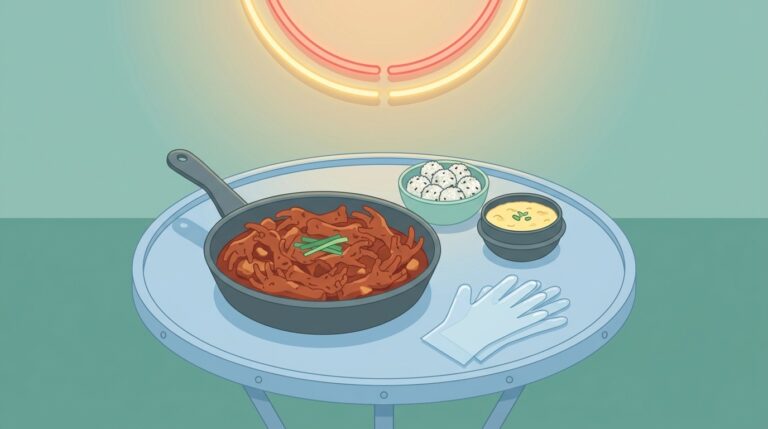
Mastering Late-Night Spicy Chicken Feet and Rice Balls Like a Seoul Insider
Phase 1: Empathy (Story-Driven Opening)
안녕하세요! 매일한글 에디터입니다. Have you ever watched a late-night K-drama scene where the main leads, overwhelmed by a terrible boss or a heartbreak, stumble into a dimly lit pocha (street cart) or a neon-lit snack bar to devour bright-red, steam-billowing chicken feet (dakbal)? You see them wearing thin plastic gloves, mashing seasoned rice into tight round balls, and sweating out their troubles with tears in their eyes.
Many intermediate Korean learners freeze when they finally sit in front of a real dakbal menu. Do you choose boneless (ppyeo-eopneun) or bone-in (tongppyeo)? How do you negotiate the spice level without offending the chef or setting your stomach on fire? How do you naturally order the quintessential sidekicks—steamed egg (gyeranjjim) and self-made tuna mayo rice balls (jumeokbap)? This guide is built directly on real feedback from expats and travelers who wanted to conquer Korea’s beloved yasik (late-night snack) culture with confidence, natural nuance, and zero awkwardness.
Phase 2: Core 3 Expressions Deep-Dive
1. 덜 맵게 해드릴까요, 아니면 보통으로 드릴까요? (Deol maepge hae-deurilkkayo, animyeon botong-euro deurilkkayo?)
- Pronunciation: [Deol maep-gae hae-deu-ril-kka-yo, ah-ni-myeon bo-tong-eu-ro deu-ril-kka-yo?] (Think of ‘deol’ like ‘dull’, ‘maep’ like the start of ‘maple’)
- Meaning: Literal: “Shall I make it less spicy, or give you the standard?” | Real Nuance: “How spicy would you like your chicken feet?”
- K-Culture Moment: A busy pocha auntie (Imo) holding a notepad, assessing your spice tolerance the moment you mention dakbal.
- Editor’s Insight: In Korea, ‘botong’ (regular) in a specialized spicy spot is often spicy enough to make beginners sweat. If your spice ceiling is Jalapeño level, always request 덜 맵게 (deol maepge – less spicy).
- Situation Spectrum: Casual: ⚠️ | Semi-formal: ✅ | Formal: 🚫
- 🤔 Think About It: Why do Korean late-night food joints focus so intensely on fine-tuning spice levels compared to Western diners?
2. 주먹밥 세트에 계란찜도 같이 나와요? (Jumeokbap seteue gyeranjjimdo gachi nawayo?)
- Pronunciation: [Joo-meok-bap seh-teu-eh gyeh-ran-jjim-doh gah-chee nah-wah-yo?]
- Meaning: Literal: “Does the steamed egg come together in the rice ball set?” | Real Nuance: “Does this combo include the steamed egg too?”
- K-Culture Moment: Planning your spice-defense strategy with friends before the red sauce hits the table.
- Editor’s Insight: Spicy chicken feet, savory rice balls, and soft steamed egg form the holy trinity of Korean spice survival. Checking set compositions shows you know how to eat like a local.
- Situation Spectrum: Casual: ⚠️ | Semi-formal: ✅ | Formal: ✅
- 🤔 Think About It: Notice how Koreans view side dishes (banchan or set additions) as functional palate cleansers rather than separate appetizers.
3. 뼈 없는 걸로 2인분 주시고, 비닐장갑 좀 더 주세요. (Ppyeo eopneun geollo i-inbun jusigo, binil-jang-gap jom deo juseyo.)
- Pronunciation: [Ppyeo eom-neun geol-roh ee-een-boon joo-she-go, bee-neel-jang-gap jom duh joo-seh-yo.]
- Meaning: Literal: “Please give us 2 servings of the boneless one, and give us some more plastic gloves.” | Real Nuance: “We’ll have two orders of boneless dakbal, and could we get extra disposable gloves?”
- K-Culture Moment: Prepping the table for group-making rice balls and handling food directly without messy utensils.
- Editor’s Insight: Ppyeo eopneun (boneless) is the beginner-friendly choice. Bone-in requires gnawing and high dexterity, whereas boneless allows you to wrap the meat directly around a rice ball.
- Situation Spectrum: Casual: ⚠️ | Semi-formal: ✅ | Formal: ✅
- 🤔 Think About It: In many Western cultures, using plastic gloves at a restaurant is rare, but in Korea, it is an efficient, community-embraced dining ritual.
Phase 3: Textbook Korean vs. Real Korean
Situation 1: Expressing that the food is extremely spicy but addictive
- 📖 Textbook Korean: 이 음식은 대단히 맵지만 맛이 좋습니다. (I eumsik-eun daedanhi maepjiman masi joseumnida.)
- 🗣️ Real Korean: 와, 이거 진짜 맛있게 매운데 콧물 나와요! (Wa, igeo jinjja mas-itge maeunde konmul nawayo!)
- 💡 Why is it different? Koreans distinguish between painful, bitter heat (geunyang maewun mat) and delicious, crave-worthy heat (mas-itge maewun mat). Mentioning your nose running (konmul) with a laugh is an authentic, relatable badge of honor at late-night tables.
Situation 2: Asking someone else to roll the rice balls
- 📖 Textbook Korean: 주먹밥을 동그랗게 만들어 주시겠습니까? (Jumeokbap-eul donggeurahge mandeureo jusigesseumnikka?)
- 🗣️ Real Korean: 장갑 낀 김에 주먹밥 좀 예쁘게 뭉쳐줘! (Jang-gap kkin gime jumeokbap jom yeppeuge mungcheojwo!)
- 💡 Why is it different? Mungchida (to ball up/clump together) is the natural culinary verb for shaping seasoned rice. Saying “since you already have the gloves on (kkin gime)” captures casual Korean dining camaraderie.
Phase 4: K-Culture Deep Dive & Non-Verbal Manners
4-1. Nunchi & Tabletop Manners
When the bowl of steaming rice topped with seaweed (gim), sesame oil, and mayo arrives, look at your tablemates. Whoever is wearing the single plastic glove traditionally makes bite-sized spheres for everyone, placing them neatly along the outer rim of the grill or platter. Do not start eating the rice directly with a spoon unless everyone agrees to make it bibimbap-style. Placing small rice balls in front of friends shows top-tier dining nunchi (social intuition).
4-2. The Healing Culture of ‘Iyeol-chiyeol’ and Yasik Stress Relief
In Korea, eating intensely spicy late-night food is not just a meal; it is therapeutic catharsis. Office workers gather at 10 PM to “sweat out stress” (seuteureseu-reul pulda). The rush of endorphins from capsaicin combined with cooling sips of soju or kulpi (sweet peach milk drink) creates a shared bonding experience celebrated across K-dramas from Weightlifting Fairy Kim Bok-joo to Hospital Playlist.
Phase 5: Real-World Roleplay Scenario
- Setting: A bustling, steam-filled late-night restaurant in Hongdae with round metal tables.
- Characters: You (Intermediate learner craving spicy food) and Imo (The energetic owner/server).
- You: 🎭 Raising hand slightly and making eye contact 저기요, 사장님! 여기 주문할게요. (Jeogiyo, sajangnim! Yeogi jumun-halgeyo.) — “Excuse me, owner! We’re ready to order here.”
- Imo: 🎭 Wiping the table with a smile and pulling out an order pad 네~ 뭐 드릴까요? 닭발은 뼈 있는 거? 없는 거? (Ne~ mwo deurilkkayo? Dakbal-eun ppyeo inneun geo? Eopneun geo?) — “Yes~ What can I get you? Bone-in or boneless chicken feet?”
- You: 🎭 Pointing at the menu firmly 무뼈 닭발 세트로 2인분 주세요. (Mubpyeo dakbal set-euro i-inbun juseyo.) — “Two servings of the boneless chicken feet set, please.”
- Imo: 🎭 Glancing up curiously 맵기는 어떻게 해줄까? 기본도 신라면보다 훨씬 매워요! (Maepgineun eotteoke hae-julkka? Gibondo Shin-ramyeonboda hwolssin maewoyo!) — “How spicy? Even our standard is way spicier than Shin Ramyun!”
- You: 🎭 Laughing nervously 그럼 신라면 맵기 정도로 덜 맵게 해주세요! (Geureom Shin-ramyeon maepgi jeongdoro deol maepge hae-juseyo!) — “Then please make it less spicy, around Shin Ramyun level!”
- Imo: 🎭 Nodding briskly 오케이, 덜 맵게! 주먹밥에 마요네즈 많이 넣어줄까? (Okei, deol maepge! Jumeokbap-e mayonejeu mani neoeo-julkka?) — “Got it, less spicy! Shall I add plenty of mayo to the rice balls?”
- You: 🎭 Smiling gratefully 네, 듬뿍 넣어주세요! 그리고 쿨피스 하나 추가할게요. (Ne, deumbppuk neoeo-juseyo! Geurigo Kulpiseu hana chugahalgeyo.) — “Yes, please add plenty! And I’d like to add one Coolpis drink too.”
- Imo: 🎭 Handing over plastic gloves 알겠어~ 장갑 끼고 주먹밥 먼저 만들고 있어! (Algesseo~ jang-gap kkigo jumeokbap meonjeo mandeulgo isseo!) — “Alright~ Put on the gloves and start making the rice balls first!”
🔀 Interactive Choice Point
The food arrives and your friend’s face turns bright red after one bite. What do you do?
* Option A: Ask the server: “사장님, 이거 너무 매운데 마요네즈나 치즈 디핑 좀 더 주실 수 있나요?” (Best: Polite, solves the heat issue naturally with standard Korean restaurant hospitality).
* Option B: Shout angrily: “사장님, 덜 맵게 해달라고 했는데 왜 이렇게 매워요? 환불해 주세요!” (Bad: Extremely rude and breaks cultural dining norms).
* Option C: Say nothing and leave all the food on the table (Risk: Wastes delicious food and misses out on extra side-dish rescues like egg soup).
Phase 6: 10-Second Emotional Shadowing Drill
- Drill 1: [🔥 맵지만 신나고 당당하게 / Spicy but excited]
- “와, / 진짜 맛있게 매운데 / 콧물 싹 돌아요!”
- (Wa, / jinjja mas-itge maeunde / konmul ssak dorayo!)
- Drill 2: [🥺 진지하게 매운맛 진정을 요청하며 / Earnest spice-rescue request]
- “사장님, / 계란찜이랑 쿨피스 / 얼른 하나만 더 주세요!”
- (Sajangnim, / gyeranjjim-irang kulpiseu / eolleun hanaman deo juseyo!)
Phase 7: K-Culture Mini Dictionary
- 무뼈 닭발 (Mubpyeo Dakbal): Boneless chicken feet. Easier to eat, stir-fried with smoky wok-char (bulmat).
- 주먹밥 (Jumeokbap): Hand-rolled rice balls mixed with seaweed flakes, sesame seeds, and pickled radish.
- 쿨피스 (Coolpis): A sweet, lactic peach beverage served ice-cold to instantly extinguish chili burning on your tongue.
- 맵찔이 (Maepjjiri): Slang for someone with zero spice tolerance. A playful self-deprecating term used among friends.
Phase 8: Survival Kit for Travelers
Top 3 Survival Phrases
- 비닐장갑 한 장만 더 주세요. (Binil-jang-gap han jangman deo juseyo.) — “Please give me one more plastic glove.” [Pro Tip: Essential when gloves tear while rolling rice].
- 마요네즈 따로 좀 주실 수 있어요? (Mayonejeu ttaro jom jusil su isseoyo?) — “Could I get mayonnaise on the side?”
- 남은 주먹밥 포장 되나요? (Nameun jumeokbap pojang doenayo?) — “Can I get the leftover rice balls packed to go?”
Editor’s Travel Note
When heading out for midnight snacks in Seoul, download and check the Naver Map app store listing to find late-night spots rated specifically for dakbal and pocha. Remember that most local midnight restaurants accept credit cards or T-Money, and late-night public buses run well past midnight across major hubs like Gangnam, Hongdae, and Jongno.
Phase 9: A Step Deeper (Reflection)
In Korean food culture, eating fiery yasik together is an act of vulnerability and stress release. Unlike formal dining where composure is paramount, sharing messy, sweat-inducing spicy chicken feet invites everyone to shed their corporate masks, roll up their sleeves, and connect on a raw human level.
💬 Your Turn: What is your ultimate comfort food when you need to blow off steam after a stressful day? Have you ever tested your limits with authentic Korean spice?
Phase 10: FAQ & Common Mistakes
Q: What is the difference between 통뼈 (tongppyeo) and 무뼈 (mubpyeo)?
A: Tongppyeo refers to whole chicken feet with bones intact, requiring you to chew around tiny knuckles. Mubpyeo is 100% boneless meat, making it faster and easier to pair with rice balls.
Q: Can I order non-spicy dakbal in Korea?
A: Dakbal sauce is pre-marinated with chili base, so “zero spice” rarely exists. However, asking for 순한맛 (sunhan-mat) or 덜 맵게 (deol maepge) reduces the extra chili powder added during cooking.
Q: Why do restaurants give only one plastic glove?
A: You keep your dominant hand clean inside the glove to shape rice balls or hold chicken feet, while your other bare hand freely grabs drinks, chopsticks, or your smartphone!
🚨 Common Mistakes Warning Board
- ❌ Mistake 1: Calling the whole chicken feet “chicken fingers” or “chicken legs”. -> Correct Action: Specify 뼈 있는 닭발 (ppyeo inneun dakbal) or 무뼈 닭발 (mubpyeo dakbal).
- ❌ Mistake 2: Eating the seasoned rice directly out of the big mixing bowl with chopsticks. -> Correct Action: Put on the plastic glove and shape bite-sized balls for the group first.
- ❌ Mistake 3: Saying “안 맵게 해주세요” expecting zero chili taste. -> Correct Action: Say “최대한 안 맵게 해주세요 (Please make it as mild as possible)” while ordering extra steamed egg.
Phase 11: Action Missions
- 🥉 Bronze Mission: Practice pronouncing “덜 맵게 해주시고 주먹밥 세트로 주세요” smoothly in under 4 seconds.
- 🥈 Silver Mission: Share your favorite Korean late-night food combo on Instagram with the hashtag
#매일한글야식챌린지. - 🥇 Gold Mission: Walk into a local Korean pocha or delivery app and order a boneless chicken feet set with custom spice adjustments.
- 🎮 K-Culture Mission: Spot how many times characters wear plastic gloves while eating late-night snacks in your favorite contemporary K-drama!
Phase 12: Interactive Quiz Challenge
- Situational Judgment: You cannot handle spicy food at all, but your friends want to visit a famous Dakbal restaurant. Which phrase should you say when ordering?
- A) 아주 맵게 불맛으로 주세요.
- B) 최대한 덜 맵게 해주시고 계란찜 추가해 주세요.
- C) 김치찌개 하나만 끓여 주세요.
- Fill-in-the-Blank: “장갑 끼고 _______ 좀 예쁘게 동글동글 뭉쳐줘!”
- (Hint: Hand-rolled rice ball)
- True / False Culture Quiz: In Korean late-night restaurants, wearing a plastic glove on only one hand is considered poor dining etiquette. (True / False)
🔍 Click to Reveal Answers and Explanations
- 1. Answer: B (Asking for the mildest possible preparation and adding steamed egg is the perfect B2-level cultural countermeasure).
- 2. Answer: 주먹밥 (Jumeokbap)
- 3. Answer: False (It is standard practice! One gloved hand shapes food while the bare hand holds utensils or drinks).







