

안녕하세요! 매일한글 에디터입니다.
Picture this: It is 1:45 AM on a crisp Friday night in Hongdae or Gangnam. The neon lights are still blazing, the streets are alive with the scent of grilled samgyeopsal, and you have just wrapped up an unforgettable night of noraebang with your local friends. But suddenly, the dreaded realization hits—the subways have stopped running. A wave of panic sets in: “Am I stranded? How much is a taxi going to cost with the midnight surcharge? How do I even hail one right now?”
If you have ever felt that late-night sinking feeling in Seoul, you are not alone. Many advanced learners and seasoned travelers feel confident navigating Seoul’s daytime transit, yet hit a wall when confronted with the late-night transit network known as the Owl Bus (올빼미 버스). Our advanced learners often share that while they can order food or conduct meetings in Korean, navigating real-time late-night bus stops and decoding rapid-fire transit jargon under time pressure feels intimidating.
Mastering Seoul’s nocturnal bus system does not just save you a 30,000 KRW taxi fare; it gives you the cultural autonomy to roam Korea’s 24-hour cityscapes effortlessly. Today’s C1-level masterclass bridges that gap with nuanced, authentic phrases, sharp socio-cultural insights, and practical strategies.
Phase 2: 핵심 표현 3선 심층 분석 (Top 3 Core Expressions)
1. 막차 끊겼는데 올빼미 버스 어디서 타요?
- Pronunciation: [Mak-cha kkeun-kyeot-neun-de ol-ppae-mi beo-seu eo-di-seo ta-yo?] (Sound analogy: Mak-cha rhymes with Gotcha, kkeunkyeot-neunde flows like kun-kyut-noon-day)
- Meaning: Literal: “The last transit was cut off, so where do I ride the Owl Bus?” | Nuanced: “Since the subways and daytime buses are done for the night, where is the nearest midnight N-bus stop?”
- K-Culture Moment: Common in modern K-Dramas like My Liberation Notes or Itaewon Class, where characters miss the last subway train (makcha) after overtime or late drinking and must coordinate their commute home.
- Editor’s Insight: 막차 (makcha) carries profound emotional weight in Korea—it represents the curfew of the urban workforce. Adding 끊기다 (to be cut/disconnected) highlights that the regular service has terminated.
- Situation Spectrum: Casual (✅ with 친구) | Semi-formal (✅ with 동료) | Formal (⚠️ use 어디서 탑승해야 하나요? with elders/officials)
- 🤔 Think About It: Why does Korean use the passive verb 끊기다 (to be cut off) rather than “I missed the bus”? It frames the event as an objective reality of the schedule rather than personal failure.
2. 이 버스 심야 할증 붙나요?
- Pronunciation: [I beo-seu sim-ya hal-jeung bun-na-yo?] (Sound analogy: Sim-ya rhymes with Kim-ya, hal-jeung sounds like hahl-joong)
- Meaning: Literal: “Does this bus attach a late-night surcharge?” | Nuanced: “Is there a midnight fare markup on this specific route?”
- K-Culture Moment: Heard among college students budgeting their late-night rides home after an energetic hoesik (company/group dinner).
- Editor’s Insight: Owl Buses operate on a flat late-night fare (currently around 2,500 KRW with a transportation card), which is slightly higher than daytime city buses but significantly cheaper than taxis. The verb 붙다 (to stick/attach) is the quintessential collocate for fees, surcharges (할증), and taxes.
- Situation Spectrum: Casual (✅) | Semi-formal (✅) | Formal (✅)
- 🤔 Think About It: In your native tongue, do fees “attach” (붙다) or do they “apply”? Notice how Korean often conceptualizes financial additions as physical attachments.
3. N번 버스 배차 간격이 어떻게 되나요?
- Pronunciation: [En-beon beo-seu bae-cha gan-gyeo-gi eo-tteo-ke doe-na-yo?] (Sound analogy: Bae-cha like Bay-cha, gan-gyeok like gahn-gyuck)
- Meaning: Literal: “What does the dispatch interval of the N-bus become?” | Nuanced: “How frequently does this N-line bus run?”
- K-Culture Moment: Essential when waiting at freezing outdoor bus stops along major hubs like Gangnam Station or Jongno 3-ga, checking if it is worth waiting 30 minutes or finding an alternative.
- Editor’s Insight: 배차 간격 (dispatch interval) is an advanced institutional transit term that native speakers use reflexively. Notice the honorific open-ended inquiry 어떻게 되나요? which sounds infinitely more refined than 몇 분이에요?.
- Situation Spectrum: Casual (⚠️ use 몇 분마다 와?) | Semi-formal (✅) | Formal (✅)
- 🤔 Think About It: Korean prefers asking how a situation “becomes” (어떻게 되나요?) rather than asking “what is it?” (무엇인가요?), embodying a dynamic, process-oriented worldview.
Phase 3: 교과서 한국어 vs 진짜 한국어 (Textbook vs. Real-World Korean)
Situation 1: Realizing the daytime transit has ended
- 📖 교과서 한국어: “지하철 운행이 종료되었습니다. 심야 버스를 이용하십시오.” (Subway operation has ended. Please use the late-night bus.)
- 🗣️ 진짜 한국어: “아, 지하철 막차 완전 끊겼다. N버스 몇 분 남았는지 앱으로 한번 찍어봐.” (Ah, the last subway is totally gone. Check the app to see how many minutes until the N-bus.)
- 💡 왜 다를까?: Native Korean speakers rarely use formal administrative terms like 운행 종료 in conversation. Instead, they default to vivid colloquial verbs like 끊기다 and compound phrases like 앱으로 찍어보다 (to scan/check via app).
Situation 2: Inquiring about route stops on board
- 📖 교과서 한국어: “기사님, 이 버스는 신촌역을 경유합니까?” (Driver, does this bus pass through Sinchon Station?)
- 🗣️ 진짜 한국어: “기사님, 혹시 이거 신촌 로터리 쪽도 지나가나요?” (Driver, by any chance, does this pass through the Sinchon Rotary area too?)
- 💡 왜 다를까?: While 경유하다 (to transit through) is grammatically flawless, actual passengers soften late-night inquiries using discourse markers like 혹시 (by any chance) and spatial colloquialisms like ~쪽도 지나가다 (pass by that direction).
Phase 4: K-Culture 딥다이브 & 비언어적 매너 (Deep Dive & Etiquette)
4-1. 눈치 (Nunchi) & Late-Night Transit Etiquette
- The Card-Tap Speed (카드 태그 템포): Owl Bus drivers operate on tight nighttime schedules. Have your physical climate card, T-money, or mobile NFC ready in your hand before boarding. Fumbling inside your backpack at 2:30 AM slows the schedule and tests collective patience.
- Volume Modulation: Unlike lively daytime buses, the Owl Bus is often a sanctuary for exhausted shift workers, hospital staff, and sleepy students. Keep smartphone videos on silent or use headphones; keep phone conversations under a whisper.
- Alighting Preparation: Ring the stop bell (하차 벨) early as the bus approaches your destination, and hold onto handrails firmly since late-night roads allow faster bus speeds.
4-2. Cultural Code: The ‘N’ Network Legacy
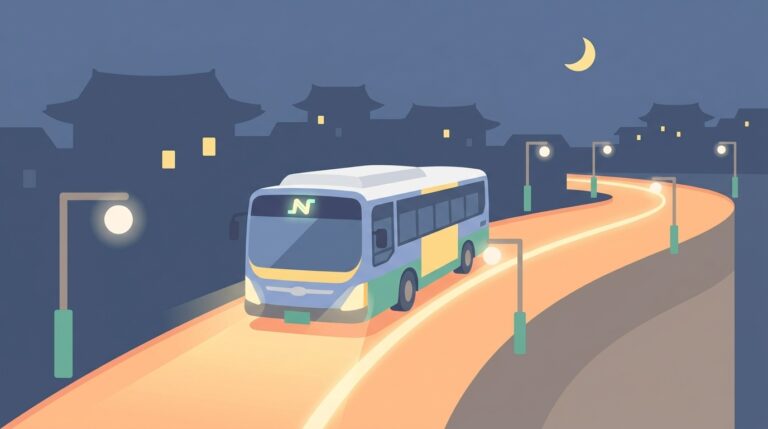
Seoul’s Owl Bus lines are distinguished by the letter ‘N’ (e.g., N13, N26, N37, N62), standing for Night. Initiated in 2013 using big data analysis of late-night telecom calls and taxi hailing patterns, this network mirrors Korea’s hyper-efficient civic infrastructure. It is a symbol of Seoul’s dedication to night safety, ensuring that hospitality workers and late-night commuters have a reliable, affordable lifeline.
Phase 5: 실전 롤플레이 시나리오 (Real-World Roleplay Scenario)
Setting: 2:15 AM at the bustling Gangnam Station Bus Transfer Center. Cold wind blowing. You and a tired local commuter, Min-woo (민우), are waiting under the digital transit board.
- 민우 (Min-woo): 🥱 (하품을 크게 하며 버스 전광판을 본다) “아… N13번 배차 간격 35분이네. 택시 잡기도 하늘의 별 따기인데 큰일 났네요.”
(A… En-sip-sam-beon bae-cha gan-gyeok sam-sip-o-bun-i-ne. Taek-si jap-gi-do ha-neul-ui byeol tta-gi-in-de keun-il nat-ne-yo.)
“Ah… The N13 interval is 35 minutes. Getting a taxi is practically impossible right now too, we’re in trouble.” - Learner: 📱 (지도를 함께 확인하며) “진짜네요. 혹시 N37번 타고 근처에서 환승하는 건 어때요?”
(Jin-jja-ne-yo. Hok-si En-sam-sip-chil-beon ta-go geun-cheo-e-seo hwan-seung-ha-neun geon eo-ttae-yo?)
“You’re right. By any chance, how about taking the N37 and transferring nearby?” - 민우 (Min-woo): 🤔 (놀란 표정으로) “오, N37번은 5분 뒤에 도착이네요! 근데 심야에도 환승 할인이 적용되던가요?”
(O, En-sam-sip-chil-beon-eun o-bun dwi-e do-chak-i-ne-yo! Geun-de sim-ya-e-do hwan-seung hal-in-i jeok-yong-doe-deon-ga-yo?)
“Oh, the N37 arrives in 5 minutes! But does the transfer discount apply during midnight hours too?” - Learner: 💡 (자신 있게 미소 지으며) “네, 45분 이내에 환승 태그하면 심야 버스끼리도 환승 할인돼요.”
(Ne, sa-sip-o-bun i-nae-e hwan-seung tae-geu-ha-myeon sim-ya beo-seu-kki-ri-do hwan-seung hal-in-dwae-yo.)
“Yes, as long as you tap within 45 minutes, transfer discounts apply between Owl buses too.” - 민우 (Min-woo): 👏 (감탄하며 카드를 꺼낸다) “한국 대중교통 시스템을 저보다 훨씬 잘 아시네요! 대박이다.”
(Han-guk dae-jung-gyo-tong si-seu-tem-eul jeo-bo-da hwol-ssin jal a-si-ne-yo! Dae-bak-i-da.)
“You know the Korean public transit system way better than I do! That’s awesome.” - Learner: 🚌 (다가오는 버스를 가리키며) “저기 오네요! 뒷문으로 하차할 때 꼭 카드 찍는 거 잊지 마세요.”
(Jeo-gi o-ne-yo! Dwin-mun-eu-ro ha-cha-hal ttae kkok ka-deu jjik-neun geo it-ji ma-se-yo.)
“Here it comes! Don’t forget to tap your card at the rear door when getting off.” - 민우 (Min-woo): 😊 (고개를 끄덕이며 버스에 오른다) “네, 덕분에 택시비 굳었네요. 같이 타시죠!”
(Ne, deok-bun-e taek-si-bi gu-deot-ne-yo. Ga-chi ta-si-jyo!)
“Yes, thanks to you I saved taxi money. Let’s get on together!” - Learner: 🤝 (가볍게 목례하며) “네, 조심히 들어가세요!”
(Ne, jo-sim-hi deul-eo-ga-se-yo!)
“Yes, get home safely!”
🔀 인터랙티브 분기점 (Interactive Branching)
What do you do when the incoming Owl Bus is packed to the brim with passengers?
* Option A: Wave both hands aggressively at the driver and shout, “태워주세요!” (Take me!)
* Feedback (Bad): 🚫 Dangerous and considered disruptive. Drivers cannot stop outside designated zones or over passenger capacity limits.
* Option B: Check the app for the next bus run and politely ask the driver upon opening: “기사님, 탑승 가능한가요?” (Driver, is boarding possible?)
* Feedback (Best): ✅ C1 Master Move! Demonstrates composure, situational awareness, and respect for bus capacity rules.
* Option C: Force your way through the closing rear door while tapping your card.
* Feedback (Risk): ⚠️ Major safety hazard that risks injury and will prompt stern reprimands from the driver.
Phase 6: 10초 감정 섀도잉 드릴 (Emotional Shadowing Drill)
Practice reading these lines aloud, matching the rhythm and emotional pauses indicated by /.
[😴 피곤하지만 다급하게](Tired yet urgent)
“기사님! / 이번 정류장에서 / N62번으로 / 바로 환승할 수 있나요?”[🙏 정중하고 조심스럽게](Polite and cautious)
“죄송하지만 / 신촌 오거리 가실 분 / 미리 벨 좀 / 눌러주시겠어요?”[😌 안도하며 뿌듯하게](Relieved and proud)
“다행이다 / 막차 놓쳐서 막막했는데 / 올빼미 버스 덕분에 / 편하게 가네.”
Phase 7: K-Culture 미니 사전 (Mini Dictionary)
- 올빼미 버스 (Ol-ppae-mi Beo-seu): Seoul’s late-night transit service operating from 23:30 to 06:00, with route numbers starting with ‘N’.
- 막차 (Mak-cha): The final vehicle/service (train, subway, or bus) of the scheduled operating day. (Antonym: 첫차 – first vehicle).
- 배차 간격 (Bae-cha Gan-gyeok): The interval between consecutive vehicle dispatches on a specific route.
- 심야 할증 (Sim-ya Hal-jeung): Late-night pricing markup applied to taxis and specialized night transit lines during early morning hours.
Phase 8: 여행자를 위한 생존 키트 (Traveler’s Survival Kit)
Top 3 Survival Phrases
- “이거 강남역 방향 맞나요?” [I-geo Gang-nam-yeok bang-hyang man-na-yo?]
- Pro Tip: Night routes often loop in complex circles; verifying the directional terminus (방향) prevents heading in the opposite direction.
- “하차 태그 안 찍혔는데 다시 찍어도 될까요?” [Ha-cha tae-geu an jji-kyeot-neun-de da-si jji-geo-do doel-kka-yo?]
- Pro Tip: Essential when the reader beeps an error; failing to tag out causes a maximum fare penalty on your next trip.
- “충전 잔액이 부족한데 현금 결제 되나요?” [Chung-jeon jan-ae-gi bu-jok-han-de hyeon-geum gyeol-je doe-na-yo?]
- Pro Tip: Keep in mind that Seoul is increasingly transitioning toward 100% “Cashless Buses” (현금 없는 버스), so ensure your transit card or mobile pay has sufficient funds.
Editor’s Travel Note
For real-time late-night bus tracking, skip standard global maps. Use the 네이버 지도 앱 다운로드 or 카카오맵 실시간 버스 길찾기 for down-to-the-second GPS locations of N-buses. Note that late-night transfer grace windows expand from 30 minutes to 45 minutes between 21:00 and 07:00!
Phase 9: “한 발 더 깊이” (Cultural Essay)
Korea’s public transit network operates as a living reflection of Jeong (정) and collective social contract (공동체 의식). The Owl Bus emerged not as a luxury, but as an egalitarian service to protect night workers, part-time youth, and commuters from exorbitant night taxi fees. Riding an N-bus at 3:00 AM reveals a fascinating cross-section of Seoul: exhausted students resting their heads on backpacks, office workers in suits quietly listening to podcasts, and drivers navigating with steady precision. It is a shared, respectful space where the city quietly breathes before dawn.
💬 Your Turn: Have you ever experienced missing transit in a foreign city? How does Korea’s dedicated Owl Bus system compare to late-night transportation in your hometown? Share your thoughts below!
Phase 10: FAQ & 오해 방지 (FAQ & Common Mistakes)
Q: Can I use the Climate Card (기후동행카드) on the Owl Bus?
A: Yes! As long as the Owl Bus route runs within Seoul’s administrative zones (routes managed by the Seoul Metropolitan Government), the unlimited Climate Card is fully accepted without extra midnight surcharges.
Q: Do regular daytime bus lines just change into N-buses at night?
A: No. N-buses have specialized, consolidated route pathways designed to cover high-demand arterial corridors connecting major hubs like Hongdae, Gangnam, Dongdaemun, and Jongno. Always check the designated ‘N’ route map.
Q: Why did the card reader charge me extra when I didn’t tap off last night?
A: If you forget to tap off (하차 태그), the system assumes you traveled to the furthest point on the route and charges maximum distance penalties on your subsequent trip. Always tap out!
🚨 흔한 실수 (Common Mistakes) Notice Board
- Mistake: Waiting at regular daytime-only bus shelters.
- Correct Action: Check for the illuminated ‘N’ symbol or night-route timetable attached to the bus shelter column.
- Mistake: Expecting 5-minute daytime dispatch frequencies.
- Correct Action: Owl Buses run at wider 25 to 40-minute intervals. Track arrival times in advance using Korean map apps.
- Mistake: Bringing open cups of hot coffee or uncovered food on board.
- Correct Action: Drivers are legally mandated to deny boarding to passengers carrying unsealed beverages or takeaway food containers.
Phase 11: 액션 미션 & 참여 유도 (Action Missions)
- 🥉 Bronze Mission (Solo Shadowing): Record yourself reading the 3 Emotional Shadowing Drill lines in Phase 6 with proper intonation and pauses.
- 🥈 Silver Mission (Map Practice): Open your Korean map app, search route N26 or N13, and write down its main transfer stations in Korean in the comments.
- 🥇 Gold Mission (Real-life Execution): Next time you are in Seoul after midnight, take an Owl Bus instead of a taxi and successfully greet the driver with a natural “안녕하세요!” upon boarding.
🎮 K-Culture Mission: Spot an Owl Bus (N-bus) or a character rushing for a makcha in a contemporary K-Drama, and post the title and episode in the comments!
Phase 12: 인터랙티브 퀴즈 챌린지 (Interactive Quiz Challenge)
Test your mastery before you catch your next night ride!
- Situational Judgment: It is 2:30 AM and you need to transfer from the N15 to the N26. How many minutes do you have to maintain the transfer discount window?
- A) 15 minutes
- B) 30 minutes
- C) 45 minutes
- D) 60 minutes
- Fill-in-the-Blank:
“지하철 ( )가 끊겨서 올빼미 버스를 타야 해요.”- A) 첫차
- B) 막차
- C) 급행
- D) 좌석
- True / False Culture Check:
Taking unsealed takeout cups of iced coffee onto Seoul late-night buses is allowed if you hold them carefully. (T/F)
🔍 Click to view Answers & Explanations
- Answer: C) 45 minutes
- Explanation: During late-night hours (21:00 to 07:00), the transit transfer grace period extends from 30 minutes to 45 minutes.
- Answer: B) 막차 (Mak-cha)
- Explanation: 막차 means the last scheduled train/bus of the night.
- Answer: False
- Explanation: Seoul bus regulations strictly prohibit open takeout food and drink containers to ensure passenger safety and clean vehicles.
- Explanation: Seoul bus regulations strictly prohibit open takeout food and drink containers to ensure passenger safety and clean vehicles.







