

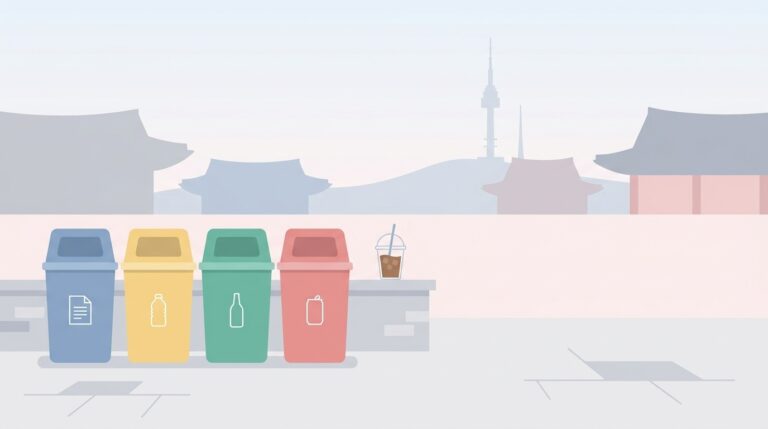
Why Are There No Public Trash Cans in Seoul? How to Handle Street Trash Like a Pro
Phase 1: 공감 (The Mystery of the Missing Trash Cans)
안녕하세요! It’s your Daily Hangul editor and cultural navigator! Picture this: You’re happily strolling through the vibrant, neon-lit streets of Hongdae. In one hand, you have a piping-hot cup of spicy tteokbokki; in the other, a refreshing iced americano (or Ah-Ah, as we say in Korea). You finish your snack, look around to toss the empty cup away, and suddenly freeze. You walk 10 meters, 50 meters, a whole block… but there is not a single public trash can in sight.
You start sweating. Can you leave it on an electric utility box? On top of a vending machine? Next to a pile of tidy trash bags on the sidewalk? If you’ve watched K-dramas, you might have seen ajummas glaring at people caught littering, and trust me, that look is 100% real in Seoul! Many international travelers and intermediate Korean learners tell us that handling street trash and navigating Korea’s strict anti-littering culture is one of their biggest culture shocks.
Don’t worry! By the end of this guide, you will master essential B1-level expressions to politely ask where to toss your trash, understand Korea’s pay-as-you-throw system, and blend in seamlessly with mindful locals.
Phase 2: 핵심 표현 3선 심층 분석 (Top 3 Essential Expressions)
1. 쓰레기 버리면 안 돼요. (Sseuregi beorimyeon an dwaeyo.)
- Pronunciation: sseu-reh-gi buh-ri-myeon ahn dweh-yo (Sounds like: Sue-reh-gee + bun without ‘n’ + ri + myun + ahn dway-yo)
- Meaning: Literal: “You cannot throw away trash here.” / Nuance: “Please don’t litter here / Littering is not allowed.”
- K-Culture Moment: You will hear an elderly neighbor or a store owner say this immediately if a tourist tries to ditch a coffee cup on top of an outdoor air conditioning unit.
- Editor’s Insight: The pattern
-면 안 돼요(-myeon an dwaeyo) means “prohibited/should not.” It is polite yet firm, making it the standard warning on public signs and in daily life.- Situation Spectrum: Casual: ⚠️ (쓰레기 버리지 마) | Semi-formal: ✅ (쓰레기 버리면 안 돼요) | Formal: ✅ (쓰레기를 투기하지 마십시오)
- 🤔 Think About It: In many Western countries, “No Littering” signs focus on monetary fines first. Why do Korean warnings often frame rules in terms of mutual social responsibility (
-면 안 돼요= “doing this makes things not okay”)?2. 이거 어디에 버려요? (Igeo eodie beoryeoyo?)
- Pronunciation: ee-guh uh-dee-eh buh-ryuh-yo
- Meaning: Literal: “Where do I throw this away?” / Nuance: “Where is the nearest trash bin for this?”
- K-Culture Moment: Asking the clerk at a convenience store after finishing an instant ramen cup noodles meal.
- Editor’s Insight: This is the ultimate lifesaver phrase. Instead of wandering with sticky fingers for 30 minutes, pop into a convenience store or subway booth and ask this politely while holding your cup.
- Situation Spectrum: Casual: ⚠️ (이거 어디 버려?) | Semi-formal: ✅ (이거 어디에 버려요?) | Formal: ✅ (이 쓰레기는 어디에 배출합니까?)
- 🤔 Think About It: How does asking before discarding demonstrate respect for the shopkeeper’s private disposal fee?
3. 분리수거 해 주세요. (Bunrisugeo hae juseyo.)
- Pronunciation: boon-ree-soo-guh heh joo-seh-yo
- Meaning: Literal: “Please do separate collection.” / Nuance: “Please sort and recycle your trash.”
- K-Culture Moment: Seen at fast-food restaurants (like Lotteria or Mom’s Touch) near the tray return counter, or stated by Airbnb hosts.
- Editor’s Insight:
분리수거(Bunrisugeo) is the backbone of Korean eco-etiquette. Everything from plastic cups to paper sleeves and food waste must be categorized separately.- Situation Spectrum: Casual: ⚠️ (분리수거 해 줘) | Semi-formal: ✅ (분리수거 해 주세요) | Formal: ✅ (분리수거를 부탁드립니다)
- 🤔 Think About It: Notice the word
수거(collection). Recycling in Korea is seen as a collective community task rather than just an individual choice.
Phase 3: 교과서 한국어 vs 진짜 한국어 (Textbook vs. Real-Life Korean)
Situation 1: Asking someone not to litter
- 📖 교과서 한국어 (Textbook): 길거리에 쓰레기를 투기하지 마십시오. (Gilgeorie sseuregireul tugihaji masipsio. – “Do not dump garbage on the public roadway.”)
- 🗣️ 진짜 한국어 (Real-life Native): 여기 쓰레기 버리시면 안 돼요! 가져가셔야 해요. (Yeogi sseuregi beorisimyeon an dwaeyo! Gajeogasyeoya haeyo. – “You can’t leave trash here! You should take it with you.”)
- 💡 왜 다를까? (Why the difference?):
투기(Tugi) is a legal term found on official street banners backed by municipal laws. In face-to-face spoken interactions, Koreans soften the tone using the honorific condition-시면 안 돼요while reminding you to carry it with you (가져가세요).
Situation 2: Asking a cafe or store to take your takeaway cup
- 📖 교과서 한국어 (Textbook): 이 폐기물을 처리해 주실 수 있습니까? (I pyegimureul cheorihae jusil su itseumnikka? – “Are you able to process this waste material?”)
- 🗣️ 진짜 한국어 (Real-life Native): 사장님, 다 마신 컵 이것 좀 버려주실 수 있나요? (Sajangnim, da masin keop igeot jom beoryeojusil su innayo? – “Boss, could you please help me throw away this empty cup?”)
- 💡 왜 다를까? (Why the difference?): Real Koreans address staff with affectionate titles like
사장님(owner/boss) and add the magic softener좀(jom – just/a bit) to make requests sound gentle and considerate.
Phase 4: K-Culture 딥다이브 & 비언어적 매너 (Culture Deep-Dive & Nunchi)
4-1. Nunchi (눈치) & Body Language Checklist
- The Two-Handed Handover: When handing an empty cup to a store clerk, hold it with both hands and give a slight 15-degree bow.
- The “Eye-Contact Scan”: If you cannot find a trash can, look for a subway station. Subway platforms and ticket gates almost always have designated bins for paper, plastic, and general waste.
- No Cup Abandonment: Leaving a takeout cup on top of a fire hydrant, bus stop bench, or utility pole is considered peak bad manners (민폐 – minpae). Carry a small plastic pouch in your bag to hold dry trash until you find a bin.
4-2. Why Did Public Trash Bins Disappear in Korea?
In 1995, South Korea implemented the revolutionary Volume-based Waste Fee System (종량제 – Jongnyangje). Under this law, households must buy government-approved, color-coded plastic bags to dispose of their general trash. When this law began, some residents tried dumping their household trash in public street bins to avoid paying for the official bags! In response, local district offices (Gu-cheong) removed thousands of public street bins. Today, Korea boasts one of the highest recycling rates in the world (over 60%), but it means the burden of holding onto your street garbage belongs to you!
Phase 5: 실전 롤플레이 시나리오 (Interactive Roleplay Scenario)
- Location: A bustling street near Yeonnam-dong Central Park (Gyeongui Line Forest Park).
- Characters: You (holding an empty boba cup) and Minji (a Korean university student & neighborhood local).
You: 🎭 (Looking around anxiously with an empty plastic cup)
     저기요, 혹시 이 근처에 쓰레기통 있어요?
     (Jeogiyo, hoksi i geuncheoe sseuregitong isseoyo?)
     "Excuse me, is there a trash bin around here by any chance?"

Minji: 🎭 (Shakes her head with a sympathetic smile)
       아, 이 공원에는 쓰레기통이 아예 없어요.
       (Ah, i gong-won-eneun sseuregitongi aye eopseoyo.)
       "Ah, there are no trash cans in this park at all."

You: 🎭 (Looks surprised and holds up the cup)
     정말요? 그럼 이 컵 어디에 버려요?
     (Jeongmalyo? Geureom i keop eodie beoryeoyo?)
     "Really? Then where do I throw this cup away?"

Minji: 🎭 (Points across the crosswalk toward a subway entrance)
       저기 지하철역 입구로 가시거나, 편의점에 부탁해야 돼요.
       (Jeogi jihacheol-yeok ipguro gasigeona, pyeon-uijeome butakhaeya dwaeyo.)
       "You either have to go to that subway entrance over there, or ask at a convenience store."

You: 🎭 (Hesitates)
       편의점에서 안 샀는데 버려달라고 해도 괜찮을까요?
       (Pyeon-uijeomeseo an satneunde beoryeodallago haedo gwaenchaneulkkayo?)
       "I didn't buy it from the convenience store, is it okay to ask them?"

Minji: 🎭 (Gives a practical insider tip)
       음료가 남아있으면 안 받으시니까, 다 비우고 '이것 좀 버려주세요' 해보세요!
       (Eumnyoga namaisseumyeon an badeusinikka, da biugo 'igeot jom beoryeojuseyo' haeboseyo!)
       "If there's liquid left inside they won't accept it, so empty it completely and say 'Please help me toss this'!"

You: 🎭 (Bows slightly with relief)
     아, 그렇군요! 알려주셔서 정말 감사합니다.
     (Ah, geureokgunyo! Allyeojusyeoseo jeongmal gamsahamnida.)
     "Ah, I see! Thank you so much for letting me know."

Minji: 🎭 (Waves cheerfully)
       아니에요! 좋은 하루 보내세요!
       (Anieyo! Joeun haru bonaeseyo!)
       "No problem! Have a great day!"
🔀 Your Next Move: Interactive Decision Point
You bought a fresh can of iced tea at a nearby convenience store. What do you do with your empty boba cup?
* Option A: Slip the boba cup behind a telephone pole when nobody is looking.
* Option B: Drink your new iced tea, show both empty cups politely to the clerk, and say: “사장님, 다 마신 컵인데 이것도 같이 버려주실 수 있나요?”
* Option C: Put the cup on top of the outdoor convenience store ice cream freezer.
- Option A Result [BAD ❌]: High risk of a fine up to 100,000 KRW and local scolding. Street CCTV in Seoul catches everything!
- Option B Result [BEST ⭐]: You bought something from their store, so the clerk will gladly separate and recycle both containers with a warm smile.
- Option C Result [RISK ⚠️]: The store owner will come running out shouting “여기 버리면 안 돼요!” Very embarrassing!
Phase 6: 10초 감정 섀도잉 드릴 (10-Second Shadowing Drills)
Practice reading these out loud with rhythm and native intonation! Pause at / marks.
[🥺 Desperate & Puzzled]- 저기요… / 근처에 쓰레기통 / 혹시 있나요?
- Jeogiyo… / geuncheoe sseuregitong / hoksi innayo?
[🙏 Polite & Earnest Request]- 사장님! / 다 마신 컵인데, / 이것 좀 버려주실 수 있을까요?
- Sajangnim! / da masin keobinde, / igeot jom beoryeojusil su isseulkkayo?
[🚨 Firm & Responsible Reminder]- 길거리에 / 쓰레기 버리면 안 돼요! / 가져가서 분리수거해요.
- Gilgeorie / sseuregi beorimyeon an dwaeyo! / gajeogaseo bunrisugeohaeyo.
Phase 7: K-Culture 미니 사전 (Essential Eco-Vocabulary)
- 종량제 봉투 (Jongnyangje Bongtu) | Pay-as-you-throw official trash bag
- The official, district-stamped plastic bags required for general household waste. You can purchase them at any convenience store counter by asking: “일반 종량제 봉투 10리터 한 장 주세요.”
- 분리수거 (Bunrisugeo) | Separated recycling collection
- Sorting recyclables into designated categories: Plastic (플라스틱), Cans (캔류), Glass (유리병), and Paper (종이).
- 음식물 쓰레기 (Eumsikmul Sseuregi) | Food waste
- Decomposed food waste collected in special yellow or blue bags (or RFID food bins) to be recycled into livestock feed and fertilizer.
- 무단투기 (Mudan-tugi) | Illegal littering / dumping
- The legal offense of dropping trash on roads or leaving household trash without standard bags. Fines range from 50,000 to 1,000,000 KRW.
Phase 8: 여행자를 위한 생존 키트 (Traveler’s Survival Kit)
Survival Phrases TOP 3
- 음료 남은 건 어디에 버려요? (Eumryo nameun geon eodie beoryeoyo? – Where can I dump the leftover drink?)
- Pro Tip: Always empty remaining ice or tea into a restroom sink before attempting to recycle the plastic cup.
- 종이컵 따로 버려야 하나요? (Jong-ikeop ttaro beoryeoya hanayo? – Do I need to dispose of the paper cup separately?)
- Pro Tip: In cafes and food courts, paper cups go into the paper (종이) chute, while plastic lids go to plastic (플라스틱).
- 비닐봉지 한 장 주세요. (Binil-bongji han jang juseyo. – Please give me one plastic carrier bag.)
- Pro Tip: Keep this bag in your daypack as your portable trash container for day-long sightseeing.
Editor’s Travel Note: Street Survival Tools
- Public Restrooms & Subways: When exploring popular areas like Myeongdong, Insadong, or Seongsu, public restrooms in subway stations are the most reliable spots to find multi-compartment recycling bins.
- Navigation Support: Use the Naver Map Navigation App (네이버 지도 앱 다운로드) to search for nearby subway stations (지하철역) or public convenience facilities if you need to dispose of clean recycling.
Phase 9: “한 발 더 깊이” (Cultural Insights: Community Mindfulness)
Why do Koreans accept the slight inconvenience of carrying their trash across town? In Korean culture, public spaces are viewed as an extension of shared community living. Leaving trash behind disrupts the shared harmony (정 – Jeong and civic duty) and creates unfair labor for neighborhood elders. By keeping your trash with you until you find an appropriate station bin or your hotel room, you are demonstrating deep respect for the everyday rhythm of Korean society.
💬 Your Turn: How does your home city manage public littering? Would a missing-bin system like Seoul’s work in your hometown? Leave your thoughts in the comments below!
Phase 10: FAQ & 오해 방지 (Structured FAQ Schema)
Q: Can I throw away my street trash in a trash bin in front of a real estate agency or shop?
A: Generally, no. Many bins placed in front of private buildings belong to commercial tenants who pay monthly municipal disposal fees for those private bins. Always ask permission first or look for public subway station bins.
Q: What should I do if a cafe refuses to take my empty takeout cup from another brand?
A: Cafes are not legally obligated to process trash from competitor shops. If they politely decline, simply wipe the cup dry, place it inside your bag, and dispose of it in the recycling bins inside a nearby subway station.
Q: Are there really CCTVs monitoring street littering in Seoul?
A: Yes! Many alleyways and corners feature solar-powered “Mudan Tugi Prevention CCTVs” equipped with automated voice warning systems that speak out loud when someone approaches with suspicious garbage.
🚨 흔한 실수 (Common Mistakes) 경고판
- Mistake: Leaving unfinished takeout beverages on the sidewalk ledge.
- Correct Action: Empty the liquid into a public restroom sink or drink it up completely before discarding the cup.
- Mistake: Throwing wet tissues and paper cups into the general plastic recycling bin.
- Correct Action: Wet wipes and greasy food-stained paper go into the general waste (일반 쓰레기) bin.
- Mistake: Tossing wooden chopsticks and plastic straws into the plastic bin.
- Correct Action: Straws and wooden chopsticks are categorized as general waste (일반 쓰레기) because they are non-recyclable items.
Phase 11: 액션 미션 & 참여 유도 (3-Step Action Missions)
- 🥉 Bronze Mission (Solo Speaking): Practice saying “이거 어디에 버려요?” five times in front of the mirror with a polite smile.
- 🥈 Silver Mission (Social Challenge): Share an Instagram Story of your eco-friendly travel day in Korea with the hashtag
#CleanSeouland caption your favorite takeaway beverage in Korean! - 🥇 Gold Mission (Real-Life Mastery): The next time you visit a Korean convenience store or cafe, politely ask the clerk to help you dispose of a clean cup using “사장님, 이것 좀 버려주실 수 있나요?”.
Phase 12: 인터랙티브 퀴즈 챌린지 (Interactive Quiz Challenge)
Q1. You just finished a cup of iced americano in Myeongdong. Where is the most reliable and socially accepted place to find a sorting bin?
A) On top of an outdoor electricity transformer box
B) Inside a nearby subway station concourse
C) Beside a random pile of yellow trash bags in an alley
👉 Click to reveal Answer & Explanation
Correct Answer: B
Subway stations consistently feature organized sorting bins for paper, plastic, and general trash. Leaving trash on electric boxes or residential garbage piles is considered illegal dumping (무단투기).
Q2. Fill in the blank with the natural Korean grammar pattern:
“길거리에 쓰레기를 ( ) 안 돼요!” (You must not litter on the street!)
A) 버리면
B) 마시면
C) 찾으면
👉 Click to reveal Answer & Explanation
Correct Answer: A (버리면)
버리다 (to throw away / to litter) combines with -면 안 돼요 to form 버리면 안 돼요 (“You must not throw away / litter”).
Q3. True or False: Used wooden chopsticks and single-use plastic straws should be recycled in the “Plastic (플라스틱)” bin in Korea.
👉 Click to reveal Answer & Explanation
Correct Answer: False
Wooden chopsticks and tiny plastic straws are not recyclable and must be placed into the General Waste (일반 쓰레기) bin.







