

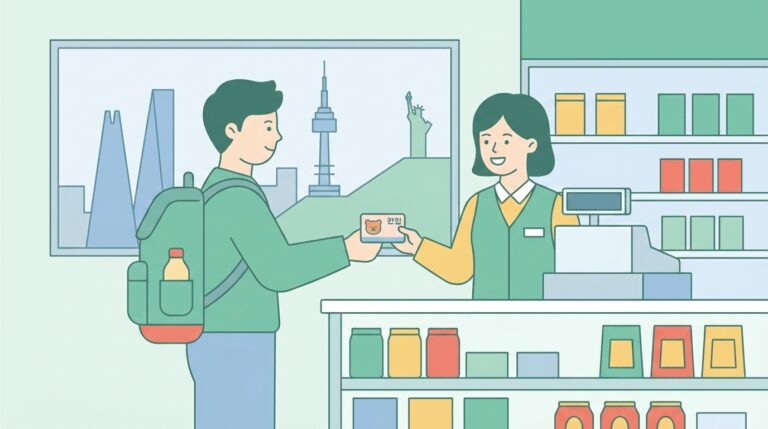
How to Top Up Your Korean Transit Card Like a True Local
Phase 1: Empathy & Story Immersion
안녕하세요! Welcome to Daily Hangul! I’m your local culture navigator and best friend in Seoul.
Picture this: You just stepped out of a vibrant Hongdae cafe after listening to your favorite K-Indie tracks. It’s rush hour, and you head down into the bustling subway station to catch the Line 2 green train. You walk confidently up to the turnstile, tap your beloved cute Kakao Friends T-money card, and suddenly… BEEP-BEEP-BEEP! The red light flashes with a harsh voice: “잔액이 부족합니다” (Insufficient balance). Behind you, five busy commuters suddenly stop in their tracks. You freeze in sheer panic, your heart racing as you wonder: Where do I go? What do I say? Can I recharge this at the convenience store right next to me?
Take a deep breath! We have all been there. Recharging a transit card (교통카드 충전) is literally the first real-world spoken test every traveler and Korean learner faces. The good news? You only need a few friendly phrases to top up your card at any subway kiosk or corner convenience store (CU, GS25, 7-Eleven) in under ten seconds. Based on real feedback from hundreds of our A2 learners, this guide will turn that awkward turnstile freeze into effortless local swagger.
Phase 2: Top 3 Core Expressions Deep-Dive
1. 교통카드 충전해 주세요 (Gyotong-kadeu chungjeon-hae juseyo)
- Pronunciation: [Gyo-tong-ka-deu choong-jeon-hae joo-seh-yo] (Think: “Gyotong” like ‘go-tongue’ + “Chungjeon” like ‘choong-jeon’ + “Hae-juseyo”)
- Meaning: Direct: “Please recharge transit card.” / Nuance: “Could you please top up my transit card?”
- K-Culture Moment: You walk into a cozy convenience store seen in Extraordinary Attorney Woo, place your card on the POS counter, and hand over a 10,000 KRW bill with this polite phrase.
- Editor’s Insight: “충전” (chungjeon) literally means ‘charge/replenish’. You can use it for your phone battery, electric vehicles, and coffee prepaid cards too!
- Situation Spectrum: Casual 🚫 | Semi-formal (Polite -요) ✅ | Formal (-십시오) ⚠️
- 🤔 Think About It: In English, we say “Top up” or “Put money on.” In Korean, using the Sino-Korean root “충전” (recharge) connects your card to electrical or energetic replenishment. Isn’t that neat?
2. 만 원 충전해 주세요 (Man won chungjeon-hae juseyo)
- Pronunciation: [Mahn-won choong-jeon-hae joo-seh-yo] (Sounds like ‘Mahn’ rhymes with ‘yawn’, followed by Korean currency ‘Won’)
- Meaning: Direct: “Please recharge 10,000 won.” / Nuance: “I’d like to put 10,000 won on this card, please.”
- K-Culture Moment: That classic scene in a K-drama where a high school student slams down a crisp bill at a GS25 counter before running to catch the bus with their crush.
- Editor’s Insight: Always specify the amount right before 충전해 주세요. (e.g., 오천 원 = 5,000 KRW, 이만 원 = 20,000 KRW).
- Situation Spectrum: Casual 🚫 | Semi-formal ✅ | Formal ⚠️
- 🤔 Think About It: Korean currency counts in units of 10,000 (만 / Man), unlike English which groups by thousands. How does this shift your mental math when traveling?
3. 현금으로 할게요 (Hyeongeum-euro halgeyo)
- Pronunciation: [Hyun-geum-eu-ro hal-geh-yo] (Sound tip: ‘Hyun’ as in actor Hyun Bin + ‘geum’ like chewing gum)
- Meaning: Direct: “I will do it by cash.” / Nuance: “I will pay with cash.”
- K-Culture Moment: The cashier taps the screen waiting for payment. Because subway cards in Korea generally MUST be recharged with cash at stores and ticket machines, this phrase seals the transaction smoothly.
- Editor’s Insight: -으로/로 할게요 is a magical A2 pattern meaning “I will go with [option].” You can use it to choose coffee sizes, payment methods, or menu items.
- Situation Spectrum: Casual 🚫 | Semi-formal ✅ | Formal ✅
- 🤔 Think About It: Why does Korea—one of the world’s most cashless societies—still mandate cash for anonymous transit card reloads? It preserves user privacy and avoids high credit processing fees for micropayments!
Phase 3: Textbook Korean vs. Real-life Korean
Situation 1: Asking the convenience store clerk to top up your card
- 📖 Textbook Korean: “교통카드를 충전하고 싶습니다. 도와주시겠습니까?” (I desire to recharge my transportation card. Will you assist me?)
- 🗣️ Real-life Korean: “교통카드 만 원만 충전해 주세요.” (Just 10,000 won on the transit card, please.)
- 💡 Why is it different? Textbook Korean sounds overly rigid like a 19th-century diplomat. Real Koreans add the soft particle “-만” (just/only) to sound naturally polite and concise in busy retail settings.
Situation 2: Asking if credit cards work for transit reloads
- 📖 Textbook Korean: “신용카드로 충전 결제가 가능합니까?” (Is recharge payment feasible via credit card?)
- 🗣️ Real-life Korean: “카드 충전은 현금만 돼요?” (For card top-up, is it cash only?)
- 💡 Why is it different? Daily conversational Korean drops heavy Sino-noun structures in favor of the everyday verb 돼요? (Does it work? / Is it okay?).
Phase 4: K-Culture Deep Dive & Non-Verbal Manners
4-1. Nunchi (눈치) & The Two-Handed Hand-off
When handing your T-money card and cash to the convenience store clerk, never flick or toss it onto the counter. In Korean etiquette, use both hands (or touch your left hand gently to your right forearm/wrist) as you hand over the cash and card. Maintain gentle eye contact with a slight nod (목례). If the cashier is busy scanning another item, observe the Nunchi rhythm: place your card directly on the glowing rectangular sensor pad next to the card reader before they even ask!
4-2. K-Travel & Transit Card Aesthetics
In Korea, your transit card is an ultimate fashion statement. K-pop fans collect limited-edition artist T-money cards (like BTS or NewJeans editions sold at convenience stores), while cafe hoppers love custom photo cards printed at Hongdae station kiosks. Knowing how to top up these keepsakes connects you instantly to local youth culture.
Phase 5: Real-Life Roleplay Scenario
Setting: A brightly lit GS25 near Gangnam Station Exit 11 on a rainy evening.
Characters:
* Min-jun (민준): The swift, friendly part-time clerk wearing an orange GS25 vest.
* You (학습자): An excited traveler holding a LINE Friends Brown T-money card and cash.
Dialogue:
1. You: 🎭 (Stepping up to counter with a soft smile) 안녕하세요! 교통카드 충전해 주세요.
(Annyeonghaseyo! Gyotong-kadeu chungjeon-hae juseyo.)
“Hello! Please top up my transit card.”
- Min-jun: 🎭 (Points at the card scanner) 네, 카드 올려주세요. 얼마 충전해 드릴까요?
(Ne, kadeu ollyeo-juseyo. Eolma chungjeon-hae deurilkkayo?)
“Yes, please place the card on the pad. How much would you like to recharge?” -
You: 🎭 (Placing card on pad and showing two 10,000 won bills) 이만 원 충전해 주세요.
(I-man won chungjeon-hae juseyo.)
“Please recharge 20,000 won.” -
Min-jun: 🎭 (Presses POS screen buttons) 네, 현금 이만 원 받았습니다. 잠시만요.
(Ne, hyeongeum i-man won bad-atseumnida. Jamsimanyo.)
“Got it, 20,000 won in cash received. Just a moment.” -
Min-jun: 🎭 (Beep sounds from the register) 충전 완료되셨습니다! 영수증 필요하세요?
(Chungjeon wanryo-doesyeotseumnida! Yeongsujeung piryohaseyo?)
“Top-up is complete! Do you need a receipt?” -
You: 🎭 (Shakes head lightly with a hand wave) 아니요, 괜찮아요.
(Aniyo, gwaenchanayo.)
“No, that’s okay.” -
Min-jun: 🎭 (Hands back card with a polite nod) 네, 감사합니다. 좋은 하루 되세요!
(Ne, gamsahamnida. Joeun haru doeseyo!)
“Yes, thank you. Have a great day!” -
You: 🎭 (Takes card with both hands and bows slightly) 감사합니다! 수고하세요!
(Gamsahamnida! Sugohaseyo!)
“Thank you! Keep up the good work!”
🔀 Interactive Choice Point
What if the clerk says: “손님, 카드는 현금 충전만 가능해요.” (Customer, card recharge is only possible with cash) after you offer a Visa card?
* Choice A: Hand over a 10,000 KRW bill and say: “아, 몰랐어요! 여기 현금 만 원이요.”
👉 [Best]: Super natural, solves the problem instantly with polite etiquette.
* Choice B: Insist loudly in English: “Credit card please! Global card!”
👉 [Bad]: Creates unnecessary stress; Korean POS systems are hard-locked to block credit card transit reloads.
* Choice C: Run away leaving your T-money card on the counter.
👉 [Risk]: You lose your cute card deposit and your transport home!
Phase 6: 10-Second Emotion Shadowing Drill
Practice the rhythm and rising/falling melody. Match the emotional cues!
[😊 Polite & Friendly]
교통카드 / 충전해 주세요!
(Gyo-tong-ka-deu / chung-jeon-hae / ju-se-yo!)-
[💡 Clear & Confident]
만 원 / 현금으로 / 할게요!
(Man won / hyun-geum-eu-ro / hal-ge-yo!) -
[👋 Casual & Courteous Departure]
감사합니다, / 수고하세요!
(Gam-sa-ham-ni-da, / su-go-ha-se-yo!)
Phase 7: K-Culture Mini Dictionary
- 티머니 (T-money) | Noun | The gold standard reloadable public transportation smart card used across subways, city buses, and taxis nationwide.
- 잔액 (Janaek) | Noun | Remaining balance. When the turnstile beeps, look for “잔액: 1,250원” on the screen.
- 충전기 (Chungjeon-gi) | Noun | Multi-language automated ticketing & top-up machine located inside every subway station.
- 환승 (Hwanseung) | Noun | Transfer discount system. If you tap within 30 minutes between subways and buses, the base fare is free!
Phase 8: Traveler’s Survival Kit
Survival Expressions TOP 3
- 얼마 남았어요? (Eolma nam-asseoyo?)
Meaning: How much balance is left on this?
Pro Tip: Hand your card to the clerk if you’re unsure if you need to top up. - 영수증 버려주세요. (Yeongsujeung beoryeo-juseyo.)
Meaning: Please throw away the receipt for me. - 티머니 카드 있어요? (T-money kadeu isseoyo?)
Meaning: Do you sell T-money cards here?
Editor’s Travel Note
- Essential App Setup: Download the [Naver Map Navigation App] (네이버지도) and set the language to English. Unlike Google Maps, it provides real-time transit arrival down to the second.
- Cash is King for Transit: Always keep at least 20,000 KRW in paper banknotes in your wallet exclusively for your transit card. Credit cards generally cannot reload standard plastic T-money cards at kiosks or stores.
Phase 9: A Step Deeper (Reflection)
In Korea, saying “수고하세요” (Keep working hard / Thank you for your effort) when leaving a convenience store or taxi demonstrates deep communal warmth. It acknowledges the service worker’s daily labor as an essential pillar of the community. Unlike in individualistic service cultures where transactions are strictly robotic, this tiny four-syllable greeting weaves you into the empathetic fabric of Korean society.
💬 Your Turn: In your home country, how do you usually greet or thank transit and convenience store workers? Share your experience in the comments below!
Phase 10: FAQ & Common Mistakes
Q: Can I recharge my T-money transit card using an international credit card (Visa/Mastercard)?
A: Unfortunately, no. Korean regulations and payment gateway setups require cash (KRW) for standard physical T-money card top-ups at convenience stores and subway kiosks. Special tourist cards (like WOWPASS or NAMANE) allow card-based app top-ups, but basic T-money requires physical banknotes.
Q: What is the minimum and maximum amount I can top up at one time?
A: You can top up in increments of 1,000 KRW up to 90,000 KRW per transaction at convenience stores, with a maximum stored balance limit of 500,000 KRW.
Q: Can I use my T-money balance to buy snacks at convenience stores?
A: Yes! T-money functions just like cash at almost all major convenience stores (GS25, CU, 7-Eleven, Emart24), Paris Baguette bakeries, and in all metered taxis.
🚨 Common Mistakes Alert Board
- ❌ Mistake 1: Tapping your whole wallet/backpack on the subway turnstile reader.
Correct Action: Take the card out! Multiple RFID cards cause an immediate “Please tap one card only” error (한 장의 카드만 대주세요). - ❌ Mistake 2: Forgetting to tap out when getting off the bus.
Correct Action: Always tap your card when exiting, otherwise you will lose your transfer discount (환승할인) and get charged a penalty fare on your next ride. - ❌ Mistake 3: Saying “안녕” (Informal hello) to adult store clerks.
Correct Action: Always use polite honorifics: 안녕하세요 (Annyeonghaseyo) and 감사합니다 (Gamsahamnida).
Phase 11: Action Missions
- 🥉 Bronze Mission (Solo Practice): Stand in front of your mirror, hold an old gift card, and recite “교통카드 만 원 충전해 주세요!” 3 times smoothly without looking at notes.
- 🥈 Silver Mission (Social Share): Comment below with your favorite Korean transit station name and write your payment preference using -으로 할게요 (e.g., 현금으로 할게요).
- 🥇 Gold Mission (Real Life): Visit any Korean convenience store or subway kiosk and complete a real top-up entirely in Korean!
🎮 K-Culture Mission: Next time you watch a modern K-Drama (like My Liberation Notes or Business Proposal), spot the turnstile tap sounds and listen for the distinct chime sound “삑” (Bbik)!
Phase 12: Interactive Quiz Challenge
Q1. Fill in the blank:
교통카드 __________ 충전해 주세요. (Please recharge 10,000 won on my transit card.)
① 백 원 (Baek won)
② 천 원 (Cheon won)
③ 만 원 (Man won)
④ 십만 원 (Sim-man won)
Q2. True or False:
You can freely use foreign credit cards to top up standard T-money cards at any local subway machine in Seoul. (True / False)
Q3. Situation Response:
The clerk hands you your recharged card. What is the most natural, polite farewell expression?
🔍 Click here to reveal Answers & Explanations!
- Q1 Answer: ③ 만 원 (Man won)
Explanation: 10,000 won is “만 원”. (100 = 백, 1,000 = 천, 100,000 = 십만). - Q2 Answer: False
Explanation: Subway vending and top-up machines in Korea only accept cash (Korean Won coins and bills) for T-money. - Q3 Answer: “감사합니다, 수고하세요!” (Thank you, have a good rest of your shift!)







