

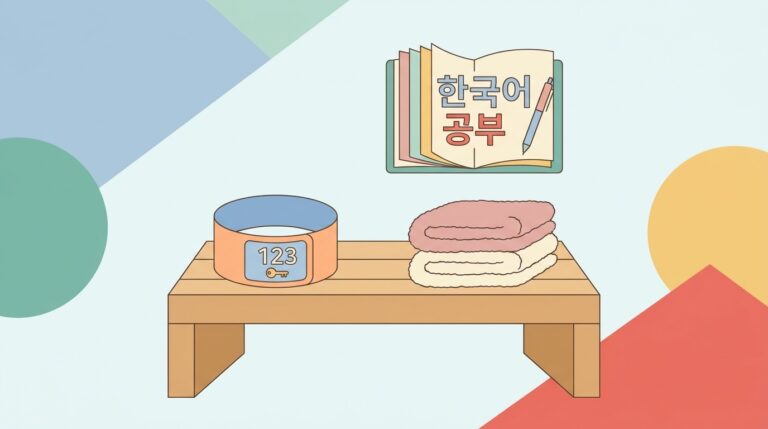
Phase 1: Empathy (Story-Driven Opening)
안녕하세요! Welcome to Daily Hangul! I’m your local culture navigator and Korean buddy.
Picture this: You just walked into a famous Korean jjimjilbang (찜질방, Korean bathhouse/sauna) in Seoul after a long flight. You paid at the front counter, received your comfy brown sauna outfit, and were handed a small, colorful wristband key with a number like ‘204’. Excited to soak in warm herbal baths and eat boiled eggs with sweet sikhye rice punch, you walk into the vast locker room. But suddenly, you stand frozen. Where is locker 204? How do you swipe this electronic key? Or worse: you tap the sensor, nothing clicks, and the person next to you is glancing over while you tug hopelessly on the locker door handle.
Don’t worry! This is the single most common moment of panic for beginners visiting a Korean spa for the first time. In Korea, your locker key is not just a metal key; it is your wallet, your shoe locker access, and your identity tag inside the facility. By mastering just a few ultra-simple A1-level Korean phrases, you will breeze through the locker room like a local regular, avoiding awkward misunderstandings and saving your spa day.
Phase 2: Top 3 Core Expressions Deep Dive
1. 열쇠 어디 있어요? (Yeol-soe eo-di i-sseo-yo?)
- Pronunciation: [yeol-soe eo-di i-sseo-yo] (Sounds like: ‘Yull-seh uh-dee ee-ssuh-yo?’)
- Meaning: “Where is the key?” / “Where is my locker?”
- K-Culture Moment: Think of K-dramas where a character drops their locker wristband in the hot tub or looks confused searching for their locker aisle in a massive multi-story spa.
- Editor’s Insight: While yeolsoe means ‘key’, Koreans also use this phrase when asking staff to help find the locker number matching their key tag.
- Situation Spectrum: Casual ⚠️ | Semi-formal ✅ | Formal ✅
- 🤔 Think About It: In English, we often ask “Where is locker 204?”, but in Korean, asking about the ‘key location’ or showing the key directly gets instant, warm guidance from the locker auntie (Imo).
2. 안 열려요. (An yeol-lyeo-yo.)
- Pronunciation: [an yeol-lyeo-yo] (Sounds like: ‘Ahn yull-lyuh-yo’)
- Meaning: “It won’t open.” / “It doesn’t open.”
- K-Culture Moment: In Korean variety shows like Running Man, members struggle with electronic locker sensors during spa games and yell this exact phrase.
- Editor’s Insight: Simple, direct, and universally understood. Adding ‘안’ (not) before ‘열려요’ (opens) creates the easiest emergency phrase in any Korean facility.
- Situation Spectrum: Casual ⚠️ | Semi-formal ✅ | Formal ✅
- 🤔 Think About It: Korean values quick problem-solving verbs. Instead of explaining “My key is malfunctioning on this lock”, simply stating “It doesn’t open” prompts staff to fix it immediately.
3. 도와주세요. (Do-wa-ju-se-yo.)
- Pronunciation: [do-wa-ju-se-yo] (Sounds like: ‘Doh-wah-joo-seh-yo’)
- Meaning: “Please help me.”
- K-Culture Moment: That classic scene where a lost tourist holds up their locker wristband with a helpless, cute smile to the bathhouse manager.
- Editor’s Insight: Pair this with a polite bow and show your wristband key. It softens any interaction instantly.
- Situation Spectrum: Casual 🚫 | Semi-formal ✅ | Formal ✅
- 🤔 Think About It: ‘주세요’ (ju-se-yo, please give/do for me) is the magical politeness wand across all Korean daily interactions.
Phase 3: Textbook Korean vs. Real Native Korean
Situation 1: Asking staff to open a stuck locker
- 📖 Textbook Korean: 제 사물함 문을 열어 주실 수 있습니까? (Je sa-mul-ham mun-eul yeol-eo ju-sil su it-seum-ni-kka? – “Could you please be able to open my locker door?”)
- 🗣️ Real Native Korean: 저기요, 이거 안 열려요. (Jeo-gi-yo, i-geo an yeol-lyeo-yo. – “Excuse me, this won’t open.”)
- 💡 Why the difference? Bathhouse locker rooms are busy and humid. Overly formal grammatical conjugations sound stiff and take too long; short, direct phrases with Jeo-gi-yo (Excuse me) work best.
Situation 2: Asking which locker matches your key number
- 📖 Textbook Korean: 몇 번 사물함을 사용해야 합니까? (Myeot beon sa-mul-ham-eul sa-yong-hae-ya hap-ni-kka? – “Which locker number should I utilize?”)
- 🗣️ Real Native Korean: 몇 번이에요? (Myeot beon-i-e-yo? – “Which number is it?”)
- 💡 Why the difference? In daily spoken Korean, context replaces repeated nouns. Pointing to your key while asking ‘몇 번이에요?’ is natural and friendly.
Phase 4: K-Culture Deep Dive & Non-Verbal Etiquette
4-1. Nunchi (눈치) & Gestures in the Locker Room
- Keep the Key on Your Wrist/Ankle: Never leave your key band on a bench or vanity table. Koreans immediately slip it onto their wrist or ankle. Losing a jjimjilbang key incurs a replacement fee (usually 10,000 to 20,000 KRW).
- Two-Hand Showing: When showing your key number to the counter staff or locker attendant (Imo-nim), hold your wrist out slightly or point with two hands to show polite respect.
- Shoe Locker First: In 99% of Korean bathhouses, your key unlocks the shoe locker at the entrance first, and that same key (with the exact same number) unlocks your clothes locker inside.
4-2. Cultural Code: The Electronic Wristband Wallet
In modern Korean jjimjilbangs, your locker key has a built-in RFID chip. You tap this key to buy iced sikhye, roast eggs, or enter massage chairs. You settle the total bill at the front desk upon leaving. Guard it like your credit card!
Phase 5: Real-Life Roleplay Scenario
Setting: The locker area of ‘Sinchon Healing Spa’. You are holding wristband key #105, but you cannot find aisle 100, and the digital sensor is beeping.
Characters: You (Traveler) & Bathhouse Attendant / Imo-nim (Locker Staff).
- Turn 1 (You): 저기요! 도와주세요. (Jeo-gi-yo! Do-wa-ju-se-yo.) 🎭 [Holding up wrist key with a slight bow]
- Turn 2 (Attendant): 네! 무슨 일이에요? (Ne! Mu-seun il-i-e-yo? – “Yes! What’s the matter?”) 🎭 [Smiling warmly with a towel in hand]
- Turn 3 (You): 열쇠 105번… 어디 있어요? (Yeol-soe baek-o-beon… eo-di i-sseo-yo?) 🎭 [Pointing to the number engraved on your key band]
- Turn 4 (Attendant): 아, 105번은 저쪽 안쪽이에요! (A, baek-o-beon-eun jeo-jjok an-jjok-i-e-yo! – “Ah, 105 is inside that way!”) 🎭 [Pointing toward the right aisle]
- Turn 5 (You): 아, 감사합니다! 그런데 문이 안 열려요. (A, gam-sa-ham-ni-da! Geu-reon-de mun-i an yeol-lyeo-yo.) 🎭 [Tapping sensor gently, showing red light]
- Turn 6 (Attendant): 열쇠를 센서에 꾹 대세요. (Yeol-soe-reul sen-seo-e kkuk dae-se-yo. – “Press the key firmly against the sensor.”) 🎭 [Demonstrating the tap motion]
- Turn 7 (Attendant): 찰칵! 열렸죠? (Chal-kak! Yeol-lyeot-jyo? – “Click! It opened, right?”) 🎭 [Smiling encouragingly]
- Turn 8 (You): 와! 열렸어요! 정말 감사합니다. (Wa! Yeol-lyeoss-eo-yo! Jeong-mal gam-sa-ham-ni-da.) 🎭 [Giving a big relieved smile and bow]
🔀 Interactive Choice Point
What do you do if your key falls into a crack and you can’t reach it?
* Option A: Shout “Help!” in English loudly across the nude bath area.
* Option B: Approach the desk, show empty hands, and say politely: “저기요, 열쇠 잃어버렸어요. 도와주세요.” (Jeo-gi-yo, yeol-soe il-eo-beo-ryeoss-eo-yo. Do-wa-ju-se-yo. – Excuse me, I lost my key. Please help me.)
* Option C: Try to force open an adjacent empty locker to put your clothes in.
- Feedback:
- Option A (Bad): Causes panic and breaks quiet bathhouse etiquette.
- Option B (Best!): Calm, super polite, and immediately prompts staff to grab the master emergency key.
- Option C (Risk): Triggers the security alarm and creates severe misunderstanding.
Phase 6: 10-Second Emotional Shadowing Drill
Practice these lines with rhythm, pausing at / and feeling the emotion:
[🙋 Politely asking for help]
저기요, / 도와주세요! (Jeo-gi-yo, / do-wa-ju-se-yo!)-
[🤔 Puzzled and looking around]
105번 / 어디 있어요? (Baek-o-beon / eo-di i-sseo-yo?) -
[🥺 Frustrated but gentle]
문이 / 안 열려요. (Mun-i / an yeol-lyeo-yo.) -
[😄 Delighted and relieved]
우와, / 열렸어요! / 감사합니다! (U-wa, / yeol-lyeoss-eo-yo! / gam-sa-ham-ni-da!)
Phase 7: K-Culture Mini Dictionary
- 열쇠 (Yeol-soe): Key (including physical keys, electronic chip bands, and digital locker tags).
- 사물함 / 라커 (Sa-mul-ham / Ra-keo): Locker or storage box.
- 신발장 (Sin-bal-jang): Shoe locker (the first locker you must unlock before entering the changing room).
- 이모님 (I-mo-nim): Bathhouse locker attendant auntie (a polite, affectionate honorific used for friendly middle-aged female staff).
Phase 8: Traveler’s Survival Kit
TOP 3 Emergency Phrases
- 신발장 어디예요? (Sin-bal-jang eo-di-ye-yo?) – “Where is the shoe locker?”
- Pro Tip: Use this right after buying your ticket at the front gate.
- 키(Key) 안 돼요. (Ki an dwae-yo.) – “The key doesn’t work.”
- Pro Tip: Short, foolproof phrase when electronic RFID tags fail.
- 영수증 주세요. (Yeong-su-jeung ju-se-yo.) – “Please give me the receipt.”
- Pro Tip: Sometimes your locker number is printed on the paper receipt rather than the key tag itself!
Editor’s Travel Note
When heading to famous 24-hour saunas in Seoul (like in Dongdaemun or Hongdae), make sure to install Naver Map App Download to search for nearby 찜질방 (Jjimjilbang). Always check if the venue accepts foreign credit cards for key settlement before changing clothes!
Phase 9: Step Deeper into Korean Culture
In Korean culture, the bathhouse locker room is a unique social leveler. Regardless of job or status, everyone wears the same uniform cotton clothes and carries the identical wristband key. The locker attendant (Imo-nim) acts like an unofficial guardian of this shared sanctuary. Calling her respectfully and showing basic linguistic effort reflects Korea’s communal Jeong (정, deep interpersonal connection).
💬 Your Turn: Have you ever visited a Korean spa, or do you plan to try one on your next Seoul trip? Which snack are you eating first: sweet sikhye or smoked eggs? Leave a comment below!
Phase 10: FAQ & Common Mistakes (FAQ Schema)
Q: What should I do if my locker number matches someone else’s locker?
A: In Korea, shoe lockers and clothes lockers share the exact same number. Make sure you unlocked your shoe locker first at the entrance; if someone else’s clothes are inside your wardrobe locker, tell the front desk: “번호가 같아요” (Beon-ho-ga gat-a-yo – The numbers are identical).
Q: Where do I wear the locker key band while soaking in hot tubs?
A: You can safely wear it around your wrist or ankle. They are 100% waterproof and heat-resistant silicone bands.
Q: Can I pay for food inside the sauna with cash or my phone?
A: Most modern jjimjilbangs do not allow cash inside the wet/sauna areas. You scan your locker key wristband for all purchases and pay the combined total at the checkout counter when returning your key.
🚨 Common Mistakes Alert Board
- Mistake: Trying to use physical currency to buy eggs at the snack bar.
- Correct Action: Tap your wrist locker key on the reader.
- Mistake: Forgetting your shoe locker number before entering the bath area.
- Correct Action: Take a mental picture or note the number on your wristband key.
- Mistake: Forcing a stiff locker handle without touching the key sensor.
- Correct Action: Align the round chip directly with the sensor circle until you hear the electronic chime.
Phase 11: Action Mission & Community Challenge
- 🥉 Bronze Mission: Say “문이 안 열려요” (Mun-i an yeol-lyeo-yo) 5 times out loud in front of your mirror with hand gestures.
- 🥈 Silver Mission: Share this guide on Instagram or X with the hashtag
#DailyHangulSpaand tag a friend you want to visit a Korean sauna with! - 🥇 Gold Mission: Next time you visit Korea, order a sikhye drink at a spa using only your wrist key and say “감사합니다” to the counter staff!
- 🎮 K-Culture Mission: Watch an episode of a K-drama featuring a sauna scene (like Crash Landing on You or The Legend of the Blue Sea) and spot the wristband keys on the characters’ arms!
Phase 12: Interactive Quiz Challenge
1. Situation Quiz: You tap your locker key, but the door stays locked. What is the most natural A1 phrase to tell the attendant?
– A) 안녕! (An-nyeong!)
– B) 저기요, 문이 안 열려요. (Jeo-gi-yo, mun-i an yeol-lyeo-yo.)
– C) 사물함 싫어요. (Sa-mul-ham sil-eo-yo.)
2. Fill-in-the-Blank: “Where is locker 105?” -> “105번 _______ 있어요?”
– A) 뭐 (mwo)
– B) 어디 (eo-di)
– C) 언제 (eon-je)
3. True or False: In Korean jjimjilbangs, you should leave your key band inside your locker when going into the steam room.
– True / False
👉 Click here to reveal Answers & Explanations!
- Answer: B. “저기요, 문이 안 열려요” is polite, natural, and accurately describes the issue.
- Answer: B (어디). 어디 있어요? translates directly to “Where is it?”.
- Answer: False. Always keep your key band securely around your wrist or ankle to prevent locker theft or losing access to your belongings!







