

Phase 1: 공감 (Empathy & K-Culture Scene)
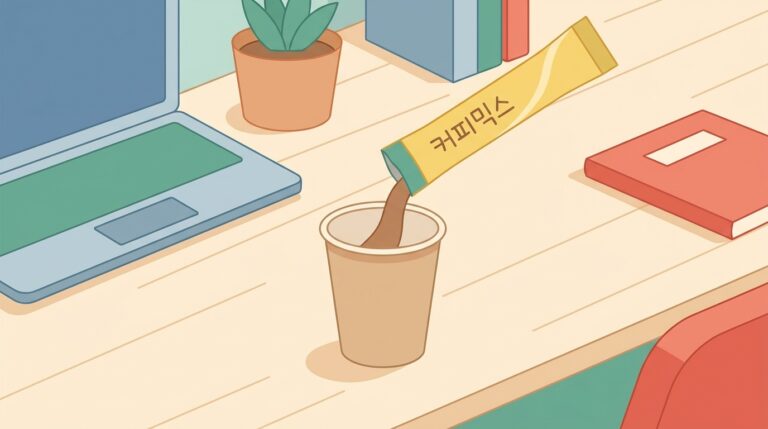
안녕하세요! 매일한글 에디터입니다. Have you ever watched a K-Drama like Misaeng (Incomplete Life) or Vincenzo and noticed that whenever characters hit a wall at work or need a heart-to-heart, they head straight to a tiny office pantry, tear open a bright yellow slim packet, and stir it into a tiny paper cup using the wrapper itself as a spoon?
Welcome to the beating heart of Korean caffeine addiction: 믹스 커피 (Mix Coffee). While Seoul boasts more artisanal cafés per block than almost anywhere on earth, the humble instant coffee stick remains the undisputed champion of workplace stamina and post-meal comfort. Many intermediate Korean learners struggle because standard textbooks only teach formal café ordering, leaving you totally lost when a senior colleague asks, “당 떨어졌지? 커피 한잔 타줄까?” By mastering these cultural nuances and natural intermediate phrases today, you will unlock authentic office banter and understand the sweet ritual that powers modern Korea!
Phase 2: 핵심 표현 3선 심층 분석 (Top 3 Key Expressions)
1. 믹스 커피 한잔 타 드릴까요? (Mik-seu keo-pi han-jan ta deu-ril-kka-yo?)
- Pronunciation: [Meek-seu kuhl-pee han-jan tah deu-reel-kkah-yoh] (Sounds like “mix coffee han-jan tah” followed by a soft questioning lilt).
- Meaning: Literal: Shall I mix/brew a cup of mix coffee for you? | Nuance: “Would you like a warm cup of instant coffee? Let me make one for you to show care and respect.”
- K-Culture Moment: The iconic junior employee offering to make coffee for an exhausted manager during overtime in K-Dramas.
- Editor’s Insight: In Korean, coffee isn’t just “poured” (따르다) or “made” (만들다); when preparing instant mix or powder, we use the verb 타다 (ta-da), which specifically means dissolving a substance in liquid.
- Situation Spectrum: Casual ⚠️ | Semi-formal ✅ | Formal ✅
- 🤔 Think About It: Offering to prepare food or drink for someone is a foundational gesture of hospitality (정, Jeong) in Korean hierarchy. How does your culture express respect through small hospitality acts?
2. 당 떨어질 때 됐잖아 (Dang tteol-eo-jil ttae dwaet-jan-a)
- Pronunciation: [Dahng tteol-uh-jeel ttae dwaet-jan-ah] (Tense tt sounds like the hard t in stop).
- Meaning: Literal: It’s that time when your blood sugar drops. | Nuance: “We’re both crashing from low energy right now—it’s high time for a sweet pick-me-up!”
- K-Culture Moment: Used around 3:30 PM across Korean offices when team members start sighing and stretching in their cubicles.
- Editor’s Insight: 당 (Dang) means sugar/glucose. Saying “my sugar is dropping” is the ultimate Korean idiom for afternoon mental fatigue.
- Situation Spectrum: Casual ✅ | Semi-formal ⚠️ | Formal 🚫
- 🤔 Think About It: Why do Koreans link productivity drops specifically to sugar/glucose levels rather than just saying “I am tired”?
3. 달달한 거 땡기네 (Dal-dal-han geo ttaeng-gi-ne)
- Pronunciation: [Dahl-dahl-han guh ttaeng-gee-neh] (The double consonant tt in ttaeng sounds crisp and punchy).
- Meaning: Literal: Sweet thing pulls at me. | Nuance: “I’m intensely craving something sweet right now!”
- K-Culture Moment: Stepping out of a spicy K-BBQ restaurant with friends and eyeing the free mix coffee dispenser machine by the entrance.
- Editor’s Insight: 땡기다 (ttaeng-gi-da) is colloquial slang for having a strong, instinctive craving for a specific taste or food.
- Situation Spectrum: Casual ✅ | Semi-formal ⚠️ | Formal 🚫
- 🤔 Think About It: How does colloquial language in your country convey bodily cravings compared to polite grammatical forms?
Phase 3: 교과서 한국어 vs 진짜 한국어 (Textbook vs. Real Korean)
- Situation 1: Craving a sweet coffee boost in the afternoon
- 📖 교과서 한국어: 지금 피곤해서 단 음료를 마시고 싶어요. (I am tired now, so I want to drink a sweet beverage.)
- 🗣️ 진짜 한국어: 당 떨어졌는데 달달한 믹스 한잔 때릴까요? (My sugar crashed; should we hit a sweet mix coffee?)
- 💡 왜 다를까? Intermediate native speakers naturally use colorful slang like “때리다” (literally ‘to hit’, metaphorically ‘to consume quickly’) and “당 떨어지다” to build camaraderie.
- Situation 2: Offering to make a coffee for a colleague
- 📖 교과서 한국어: 제가 당신을 위해 커피를 만들겠습니다. (I will make coffee for you.)
- 🗣️ 진짜 한국어: 제가 노란색 맥심 하나 타 올게요! (Let me go whip up a yellow Maxim stick for you!)
- 💡 왜 다를까? Koreans rarely say “당신” in office contexts and refer directly to the iconic yellow brand stick (맥심, Maxim Mocha Gold) as a universal shorthand for instant coffee.
Phase 4: K-Culture 딥다이브 & 비언어적 매너 (Deep Dive & Non-Verbal Manners)
4-1. 눈치(Nunchi) & Gestures
- The Two-Hand Handover: When handing a steaming paper cup of mix coffee to a senior or elder, always support your right forearm or wrist with your left hand, or hold the cup with both hands while slightly bowing your head.
- The Wrapper-Stir Technique: Watch closely in any Korean breakroom (탕비실). You will see locals stir the hot water using the folded empty coffee mix packet instead of looking for a spoon! While some debate the plastic safety, it is the quintessential Korean symbol of Ppalli-Ppalli (hurry-hurry) efficiency.
- Sugar Pinch Trick: The bottom end of a Maxim stick contains pure sugar. If someone wants their coffee less sweet, Korean office veterans will pinch the bottom 1 cm of the stick before pouring.
4-2. Cultural Code Analysis: The Free Post-Meal Coffee Ritual
In Korea, caffeine addiction intersects with dining hospitality. At traditional restaurants (K-BBQ, Gamjatang, Sundae-guk), there is almost always a coin-sized vending machine by the exit dispensing miniature cups of sweet mix coffee for free (무료). Grabbing a tiny paper cup on your way out cleanses the palate from garlic and gochujang and marks the official end of a shared meal.
Phase 5: 실전 롤플레이 시나리오 (Roleplay Scenario)
- Setting: 3:45 PM at a digital marketing agency in Gangnam. Sunlight is fading, keyboards are clacking, and Team Leader Park (박 팀장님) sighs heavily while rubbing his eyes.
-
Turn 1 (Team Leader Park): 하아… 오늘 보고서 검토할 게 왜 이렇게 많지? 🎭 (기지개를 켜며 관자놀이를 누른다)
- Haa… o-neul bo-go-seo geom-to-hal ge wae i-reo-ke man-ji?
- “Sigh… why are there so many reports to review today?”
- Turn 2 (You): 팀장님, 오후 내내 집중하셔서 피곤하시죠? 🎭 (걱정스러운 표정으로 다가가며)
- Tim-jang-nim, o-hu nae-nae jip-jung-ha-syeo-seo pi-gon-ha-si-jyo?
- “Team Leader, you’ve been concentrating all afternoon, you must be exhausted, right?”
- Turn 3 (Team Leader Park): 응, 슬슬 당 떨어질 때 됐네. 눈이 다 침침해. 🎭 (쓴웃음을 짓는다)
- Eung, seul-seul dang tteol-eo-jil ttae dwaet-ne. Nun-i da chim-chim-hae.
- “Yeah, it’s about that time my sugar levels crash. My eyesight is getting blurry.”
- Turn 4 (You): 탕비실 가서 달달한 믹스 커피 한잔 타 드릴까요? 🎭 (밝은 미소로 제안한다)
- Tang-bi-sil ga-seo dal-dal-han mik-seu keo-pi han-jan ta deu-ril-kka-yo?
- “Shall I go to the breakroom and mix a sweet coffee for you?”
- Turn 5 (Team Leader Park): 오, 그래주면 완전 고맙지! 노란색 맥심으로 부탁해. 🎭 (기대 어린 표정으로 고개를 끄덕인다)
- O, geu-rae-ju-myeon wan-jeon go-map-ji! No-ran-saek maek-sim-eu-ro bu-tak-hae.
- “Oh, I’d be so grateful if you did! Yellow Maxim, please.”
- Turn 6 (You): 네! 설탕 조절해 드릴까요, 아니면 오리지널로 타 드릴까요? 🎭 (스틱을 집어 들며)
- Ne! Seol-tang jo-jeol-hae deu-ril-kka-yo, a-ni-myeon o-ri-ji-neol-ro ta deu-ril-kka-yo?
- “Sure! Would you like me to adjust the sugar, or make it original style?”
- Turn 7 (Team Leader Park): 오늘은 스트레스 받으니까 그냥 달달하게 오리지널로 가자! 🎭 (호탕하게 웃는다)
- O-neul-eun seu-teu-re-seu bad-eu-ni-kka geu-nyang dal-dal-ha-ge o-ri-ji-neol-ro ga-ja!
- “I’m stressed today, so let’s just go with the sweet original!”
- Turn 8 (You): 알겠습니다! 당 충전 제대로 되게 맛있게 타 오겠습니다! 🎭 (양손으로 컵을 챙겨 탕비실로 향한다)
- Al-get-seum-ni-da! Dang chung-jeon je-dae-ro doe-ge mas-it-ge ta o-get-seum-ni-da!
- “Got it! I will make it deliciously so your sugar fully recharges!”
🔀 인터랙티브 분기점 (Interactive Choice)
Now that you made the coffee, how do you hand it to Team Leader Park?
- Option A: Put the cup on his desk with one hand while checking your smartphone with the other, saying: “여기요. 드세요.”
- 👉 Feedback [Bad 🚫]: Lacks courtesy! Even in casual Korean offices, handing hot drinks one-handed while distracted damages rapport.
- Option B: Hand the cup using both hands, gently placing a paper coaster underneath, saying: “팀장님, 따뜻할 때 드시고 힘내세요!”
- 👉 Feedback [Best ✨]: Perfect 100/100! Shows high Nunchi, professional etiquette, and genuine care.
- Option C: Say: “커피믹스에 건강에 안 좋은 프리마가 많으니까 조금만 드세요.”
- 👉 Feedback [Risk ⚠️]: Factually true about creamer, but unsolicited health advice when someone is stressed kills the comforting mood.
Phase 6: 10초 감정 섀도잉 드릴 (10-Second Emotion Shadowing Drill)
Practice reading these lines aloud with natural pauses (/) and authentic emotional intonation!
- [😩 지치고 피곤한 목소리로]
- 아… 오늘 진짜 / 당 떨어져서 / 일에 집중이 안 되네…
- Ah… o-neul jin-jja / dang tteol-eo-jyeo-seo / il-e jip-jung-i an doe-ne…
- [✨ 다정하고 싹싹한 톤으로]
- 팀장님! / 제가 달달한 노란색 믹스 / 한잔 타 올게요!
- Tim-jang-nim! / Je-ga dal-dal-han no-ran-saek mik-seu / han-jan ta ol-ge-yo!
- [😋 한 모금 마시고 온몸에 에너지가 돌듯]
- 캬~ 역시 당 충전에는 / 믹스 커피가 최고예요!
- Kya~ yeok-si dang chung-jeon-e-neun / mik-seu keo-pi-ga choe-go-ye-yo!
Phase 7: K-Culture 미니 사전 (Mini Dictionary)
- 당 충전 (Dang Chung-jeon) | Sugar Recharge / Sugar Rush
- Used whenever eating chocolate, dessert, or sweet mix coffee to regain energy during intense study or work.
- 탕비실 (Tang-bi-sil) | Office Pantry / Tea Room
- The sacred communal office space where instant coffee sticks, tea bags, snacks, and water purifiers live.
- 커피믹스 (Keo-pi Mik-seu) | Instant Coffee 3-in-1 Stick
- The iconic freeze-dried coffee + sugar + non-dairy creamer stick invented in Korea in 1976.
- 아아 (A-A) | Iced Americano
- The summer rival of mix coffee; the national default beverage that Koreans drink even in freezing winter (얼죽아).
Phase 8: 여행자를 위한 생존 키트 (Traveler’s Survival Kit)
Top 3 Survival Expressions
- “믹스 커피 어디에 있어요?” (Mik-seu keo-pi eo-di-e iss-eo-yo?)
- Pro Tip: Use this at supermarkets (E-Mart, Homeplus) when looking for the massive 100-stick variety packs to take home as souvenirs.
- “이거 무료 커피 맞나요?” (I-geo mu-ryo keo-pi man-na-yo?)
- Pro Tip: Ask the restaurant staff near the exit door to double-check if the coinless coffee vending machine is free for diners.
- “얼음 넣어서 시원하게 탈 수 있나요?” (Eol-eum neo-eo-seo si-won-ha-ge tal su inn-na-yo?)
- Pro Tip: At guesthouses, ask this to make the famous Korean “Iced Mix Coffee” (dissolve 2 sticks in 50ml hot water, add ice cubes).
Editor’s Travel Note
When traveling across Korea, you won’t always find specialty cafés in rural areas, but every convenience store (CU, GS25, 7-Eleven) sells individual paper cups pre-filled with coffee mix powder for under 1,000 KRW! Check locations quickly by downloading the Naver Map app on your smartphone. Keep a couple of 100 KRW coins in your wallet just in case an older eatery’s coffee machine requires a coin deposit!
Phase 9: “한 발 더 깊이” (Cultural Essay & Reflection)
In Western individualistic coffee culture, ordering coffee is an assertion of personal identity: “Oat milk, sugar-free vanilla, extra shot.” In Korean workplaces, however, the yellow mix coffee stick represents collective empathy and synchronization. Boiling the kettle for the whole team and carrying three paper cups across the office floor is an unspoken social glue that says, “I see your labor, and we are enduring this deadline together.”
💬 Your Turn: Does your workplace or culture have a specific shared snack or beverage ritual that bonds coworkers together during stressful hours? Share your thoughts below in the comments!
Phase 10: FAQ & 흔한 실수 (FAQ & Common Mistakes)
Q: Is mix coffee considered low-class or outdated in modern Korea?
A: Not at all! While trendy youth frequent espresso bars, almost every Korean—from corporate executives to university students—still enjoys mix coffee for quick nostalgia, camping trips, and post-BBQ digestion.
Q: How do I order mix coffee at a trendy café?
A: Most modern espresso cafés do not sell standard instant mix sticks. However, look on retro café menus for “다방 커피” (Dabang Coffee), which is the artisanal, rich café version of sweet Korean mix coffee!
Q: Why do Koreans use the empty wrapper to stir the coffee?
A: It originated as a clever life-hack in busy workplaces to avoid washing spoons. While health organizations note the printed film shouldn’t sit in boiling water long-term, quick 2-second stirs remain a nationwide habit.
🚨 흔한 실수 (Common Mistakes Warning)
| Mistake | Why It’s Awkward | Correct Action |
|---|---|---|
| Saying “커피를 요리하다” | 요리하다 is for cooking dishes, not beverages. | Use “커피를 타다” (for instant mix) or “커피를 내리다” (for brewed/drip). |
| Pouring a full 300ml mug of water | Korean mix sticks are formulated for tiny 100ml paper cups. Adding too much water makes it bland. | Fill only about 1/2 to 2/3 of a standard small paper cup! |
| Refusing an elder’s coffee offer bluntly | Saying “싫어요” (I dislike it) can come across as cold. | Politely say: “감사하지만 오늘은 이미 커피를 많이 마셨습니다” (Thank you, but I’ve had too much coffee today). |
Phase 11: 액션 미션 & 참여 유도 (Action Missions)
- 🥉 Bronze Mission (Self Practice): Say “당 떨어질 때 믹스 커피 한잔 타 마셔요!” out loud 3 times in front of the mirror with an energetic tone.
- 🥈 Silver Mission (Social Sharing): Snap a photo of your coffee cup today, post it with the hashtag
#DailyHanguland#당충전, and caption it with your energy level in Korean! - 🥇 Gold Mission (Real Life / Immersion): Next time you visit a Korean mart or restaurant, look for the yellow Maxim box or exit dispenser and order or make a cup using the phrase “믹스 커피 한잔 탈게요!”
- 🎮 K-Culture Hunt: In the next K-Drama you watch, pause when characters enter the office breakroom (탕비실) and spot the iconic yellow box!
Phase 12: 인터랙티브 퀴즈 챌린지 (Interactive Quiz)
1. Situation Quiz: Your Korean coworker is yawning heavily at 3:30 PM. What is the most natural intermediate phrase to show empathy and offer a coffee stick?
* A) 커피를 지금 요리해 드릴까요?
* B) 당 떨어지셨죠? 믹스 커피 한잔 타 드릴까요?
* C) 물을 많이 마시면 피로가 풀립니다.
🔍 Check Answer & Explanation
Correct Answer: B
Explanation: “당 떨어지다” perfectly identifies afternoon fatigue, and “타 드리다” is the correct honorific verb for preparing instant coffee for someone.
2. Fill-in-the-blank Quiz:
“달콤한 음료가 너무 먹고 싶어요! 지금 완전 달달한 거 ( )!”
* (Hint: Intermediate slang for strong bodily craving, beginning with 땡-)
🔍 Check Answer & Explanation
Correct Answer: 땡기네요 (or 땡겨요 / 땡기네)
Explanation: 땡기다 expresses craving something sweet, salty, or spicy intuitively.
3. True or False Culture Quiz:
Korean coffee mix sticks should be mixed with a full 12-ounce large mug of boiling water for standard taste. (True / False)
🔍 Check Answer & Explanation
Correct Answer: False
Explanation: Korean mix coffee is designed for compact paper cups (~90–100ml of hot water). Filling a large mug will dilute the rich, sweet ratio!







