

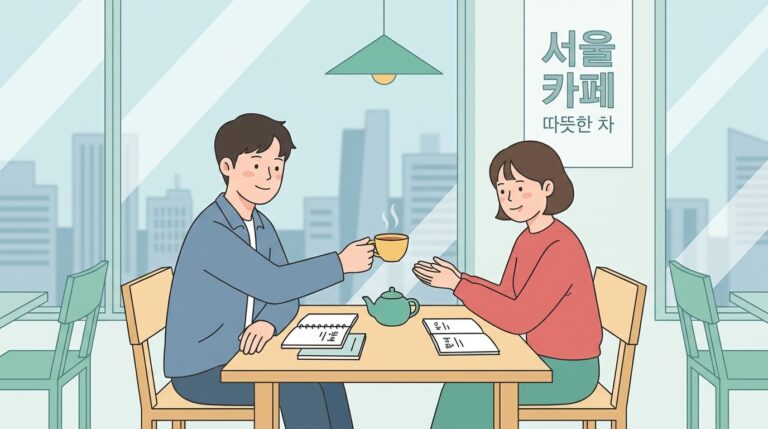
How to Say “Don’t Mention It” and Ease Gift Pressure in Korean
Phase 1: Empathy (Story-Driven Opening)
안녕하세요! 매일한글 에디터입니다. (Hello! This is your Daily Hangul Editor!)
Have you ever watched a K-drama where a character gives someone a warm cup of coffee or a beautifully wrapped gift, and the recipient immediately panics, bowing repeatedly and stammering that they cannot possibly accept such a generous favor? In Korea, receiving something—whether it is a tiny snack, a meal, or a favor—often triggers an instant cultural reflex: the feeling of budam (부담, a sense of burden or polite pressure to return the favor).
Many intermediate Korean learners know how to say “감사합니다” (Thank you) or “천만에요” (You’re welcome), but when you treat your Korean coworker to lunch or hand a souvenir to a friend, saying “You’re welcome” can sometimes sound distant or unnatural. What you really need is the magic phrase to melt away their polite worry: “It’s really nothing, so please don’t feel burdened!” Today’s guide will teach you the art of easing gratitude and giving gifts with effortless warmth.
Phase 2: Top 3 Core Expressions Deep-Dive
1. 별거 아니에요 (Byeol-geo a-ni-e-yo)
- Pronunciation: [Byeol-geo a-ni-e-yo] (Sounds like Byul-guh ah-nee-eh-yo)
- Meaning: Literal: “It is not a big thing.” | Nuance: “It’s really nothing! / Don’t worry about it!”
- K-Culture Moment: Handing a colleague an energy drink during overtime with a casual smile.
- Editor’s Insight: This is the most versatile phrase to downplay your effort so the other person does not feel obligated to return the favor immediately.
- Situation Spectrum: Casual ✅ | Semi-formal ✅ | Formal ⚠️
- 🤔 Think About It: Why do Koreans downplay their generosity by calling gifts “nothing” rather than highlighting the effort?
2. 부담 갖지 마세요 (Bu-dam gat-ji ma-se-yo)
- Pronunciation: [Bu-dam gat-ji ma-se-yo] (Sounds like Boo-dahm gaht-jee mah-seh-yo)
- Meaning: Literal: “Do not hold a burden.” | Nuance: “Please don’t feel pressured / No strings attached.”
- K-Culture Moment: Giving your tutor or boss a small holiday gift box while reassuring them it’s purely a kind gesture.
- Editor’s Insight: Budam (부담) is a central concept in Korean social etiquette. Saying this gives the recipient psychological permission to enjoy the gift guilt-free.
- Situation Spectrum: Casual ⚠️ (use 부담 갖지 마) | Semi-formal ✅ | Formal ✅
- 🤔 Think About It: In your culture, do people openly tell others not to feel indebted, or is it implied silently?
3. 마음 쓰지 마세요 (Ma-eum sseu-ji ma-se-yo)
- Pronunciation: [Ma-eum sseu-ji ma-se-yo] (Sounds like Mah-eum sseu-jee mah-seh-yo)
- Meaning: Literal: “Do not spend your heart/mind.” | Nuance: “Don’t trouble yourself / Don’t worry your heart about it.”
- K-Culture Moment: When a friend keeps apologizing for having to cancel plans or when someone feels bad about you helping them carry heavy boxes.
- Editor’s Insight: Softer and more emotional than just saying “괜찮아요” (It’s okay), showing deep empathy for their comfort.
- Situation Spectrum: Casual ⚠️ (use 마음 쓰지 마) | Semi-formal ✅ | Formal ✅
- 🤔 Think About It: How does phrasing emotional relief as “saving heart energy” reflect Korean interpersonal empathy?
Phase 3: Textbook Korean vs. Real Korean
Situation 1: Responding when a friend thanks you profusely for treating them to coffee
- 📖 Textbook Korean: 천만에요. 제가 대접하고 싶었습니다. (Cheon-man-e-yo. Je-ga dae-jeop-ha-go sip-eot-seum-ni-da. – “You are welcome. I wanted to treat you.”)
- 🗣️ Real Korean: 에이, 별것도 아닌데요 뭘! 편하게 마셔요~ (E-i, byeol-geot-do a-nin-de-yo mwol! Pyeon-ha-ge ma-syeo-yo~ – “Ayy, it’s nothing at all! Just enjoy it comfortably~”)
- 💡 Why it differs: “천만에요” sounds like something out of an 80s movie script. Native speakers use warm interjections like “에이” (Ayy) and “별것도 아닌데요 뭘” to make the gesture feel effortless.
Situation 2: Handing a small souvenir to a team member
- 📖 Textbook Korean: 이것은 당신을 위한 선물입니다. 받아주십시오. (I-geos-eun dang-sin-eul wi-han seon-mul-im-ni-da. Bad-a-ju-sip-si-o. – “This is a gift for you. Please receive it.”)
- 🗣️ Real Korean: 오다가 생각나서 샀어요. 부담 갖지 말고 받아요! (O-da-ga saeng-gak-na-seo sat-eo-yo. Bu-dam gat-ji mal-go bad-a-yo! – “I just thought of you on my way and grabbed it. Please take it without any pressure!”)
- 💡 Why it differs: Korean politeness values modesty. Pretending you picked it up casually prevents the gift from feeling heavy or demanding reciprocation.
Phase 4: K-Culture Deep-Dive & Non-Verbal Manners
4-1. Nunchi & Gestures
When saying “별거 아니에요, 부담 갖지 마세요”, your body language does half the talking:
* Hand Wave: Lightly wave one hand side-to-side at chest level with an open palm while slightly tilting your head. This universally signals modesty and softens the interaction.
* Two-Handed Delivery: Even if it is a casual snack, hand it over with both hands (or your right hand supported by your left at the forearm) before waving your hand to say “no pressure.”
4-2. Cultural Code: The Art of “Jeong” (정) and Deflecting Debt
In Korea’s collectivist relationship structure, receiving favors without repaying them triggers mianham (미안함, an apologetic gratitude). By reassuring the other person with “부담 갖지 마세요”, you are actively preserving harmony and preventing social anxiety.
Phase 5: Real Roleplay Scenario
Setting: A cozy office breakroom in Gangnam on a rainy Friday afternoon. Min-jun (민준), your senior teammate, looks exhausted from a long meeting.
- Turn 1 (You): 🎭 [Hands a warm honey-citron tea]
민준 님, 따뜻한 유자차 한잔 드세요.
(Min-jun nim, tta-tteut-han yu-ja-cha han-jan deu-se-yo.)
“Min-jun, please have a cup of warm citron tea.” - Turn 2 (Min-jun): 🎭 [Surprised, eyes wide, bowing slightly]
어머, 이걸 왜… 저 때문에 사 오신 거예요? 너무 죄송하고 감사해요.
(Eo-meo, i-geol wae… jeo ttae-mun-e sa o-sin geo-ye-yo? Neo-mu joe-song-ha-go gam-sa-hae-yo.)
“Oh my, why this… Did you buy this because of me? I feel so sorry and thankful.” - Turn 3 (You): 🎭 [Smiling warmly, lightly shaking head]
아니에요! 제 거 사는 김에 하나 더 산 거예요. 별거 아니에요.
(A-ni-e-yo! Je geo sa-neun gim-e ha-na deo san geo-ye-yo. Byeol-geo a-ni-e-yo.)
“Not at all! I just grabbed an extra one while getting mine. It’s really nothing.” - Turn 4 (Min-jun): 🎭 [Still hesitant, holding tea with two hands]
그래도 매번 이렇게 챙겨주셔서 마음이 좀 쓰이네요. 다음엔 제가 살게요!
(Geu-rae-do mae-beon i-reoh-ge chaeng-gyeo-ju-syeo-seo ma-eum-i jom sseu-i-ne-yo. Da-eum-en je-ga sal-ge-yo!)
“Still, you take care of me so often that I feel a bit indebted. Next time, it’s on me!” - Turn 5 (You): 🎭 [Reassuring voice, waving hand]
진짜 부담 갖지 마세요. 그냥 편하게 드셨으면 좋겠어요.
(Jin-jja bu-dam gat-ji ma-se-yo. Geu-nyang pyeon-ha-ge deu-syeot-seu-myeon joh-get-eo-yo.)
“Really, please don’t feel any pressure. I just hope you enjoy it comfortably.” - Turn 6 (Min-jun): 🎭 [Sighing with relief, smiling]
그럼 감사히 잘 마실게요. 덕분에 힘이 나네요!
(Geu-reom gam-sa-hi jal ma-sil-ge-yo. Deok-bun-e him-i na-ne-yo!)
“Then I will enjoy it gratefully. Thanks to you, I feel energized!” - Turn 7 (You): 🎭 [Nodding encouragingly]
네, 오늘 업무 파이팅 하세요!
(Ne, o-neul eom-mu pa-i-ting ha-se-yo!)
“Yes, fighting with your work today!” - Turn 8 (Min-jun): 🎭 [Taking a warm sip]
네, 좋은 주말 보내세요!
(Ne, joh-eun ju-mal bo-nae-se-yo!)
“Yes, have a great weekend!”
🔀 Interactive Choice Point
If Min-jun says, “다음엔 제가 꼭 밥 살게요!” (I will definitely buy you a meal next time!), how should you reply?
* Choice A: “네, 꼭 비싼 거 사주세요!” (Yes, definitely buy me something expensive!)
* 👉 Feedback [Risk]: Sounds too demanding unless you are extremely close best friends.
* Choice B: “에이, 됐어요. 안 사주셔도 돼요.” (Ayy, forget it. You don’t have to buy anything.)
* 👉 Feedback [Bad]: A bit too blunt and dismissive of his kind intention.
* Choice C: “하하, 말씀만으로도 감사해요. 나중에 편할 때 커피나 한잔해요!” (Haha, just your words are enough. Let’s grab a coffee whenever you’re free!)
* 👉 Feedback [Best]: Polite, reduces burden, and opens up future casual interaction perfectly!
Phase 6: 10-Second Emotion Shadowing Drill
Practice these with natural speech rhythm and emotion pauses (/ indicates a short breath pause):
[😊 Cheerful & Modest]
에이, / 별것도 아닌데요 뭘! / 맛있게 드세요!
(E-i, / byeol-geot-do a-nin-de-yo mwol! / Mas-it-ge deu-se-yo!)-
[🤗 Warm & Comforting]
정말 작은 성의니까 / 부담 갖지 말고 / 편하게 받으세요.
(Jeong-mal jag-eun seong-ui-ni-kka / bu-dam gat-ji mal-go / pyeon-ha-ge bad-eu-se-yo.) -
[🥺 Reassuring & Caring]
너무 마음 쓰지 마세요. / 제가 좋아서 한 일이에요.
(Neo-mu ma-eum sseu-ji ma-se-yo. / Je-ga joh-a-seo han il-i-e-yo.)
Phase 7: K-Culture Mini Dictionary
- 부담 (Bu-dam) | Burden / Psychological Pressure
- Usage: Used whenever someone feels social obligation or anxiety about reciprocation.
- 성의 (Seong-ui) | Sincerity / Small token of appreciation
- Usage: Often combined with “작은 성의” (a small token of sincerity) to politely minimize a gift’s monetary weight.
- 보답 (Bo-dap) | Repayment / Reciprocation
- Usage: Used formally to express returning kindness or good deeds to someone.
- 약소하다 (Yak-so-ha-da) | Small / Modest / Humble
- Usage: A humble adjective used before handing gifts in formal settings: “약소하지만 받아주세요” (It’s modest, but please accept it).
Phase 8: Traveler’s Survival Kit
Survival TOP 3 Phrases
- 별거 아니에요! (Byeol-geo a-ni-e-yo!)
- Pro Tip: Use this when a guesthouse host or shop owner thanks you for a small tip or souvenir.
- 마음만 받을게요. (Ma-eum-man bad-eul-ge-yo.)
- Pro Tip: Use this when you politely decline a gift or extra food without hurting feelings (“I’ll gratefully receive your warm thoughts”).
- 편하게 쓰세요. (Pyeon-ha-ge sseu-se-yo.)
- Pro Tip: Great when lending an umbrella or power bank to a local friend.
Editor’s Travel Note
When traveling in Korea, if you want to thank your Airbnb host or local guide with a small gift, grab a box of local bakery treats or use KakaoTalk Gift. Use the [Naver Map app for Korean navigation] to locate popular local bakeries near your stay.
Phase 9: Think Deeper
In Korean society, reciprocity is deeply tied to mutual respect. When you give a gift, acknowledging the recipient’s potential psychological discomfort shows high emotional intelligence. Saying “부담 갖지 마세요” bridges generosity and humility, reassuring the other person that relationships in Korea are about shared goodwill, not transactional balances.
💬 Your Turn: Have you ever received a gift or favor that made you feel pressured to immediately repay it? How would you ease someone’s mind in your language?
Phase 10: FAQ & Common Mistakes
Q: Can I use “천만에요” when my Korean boss thanks me?
A: It is grammatically correct but sounds very stiff and outdated. Instead, say “별말씀을요, 당연히 해야 할 일인데요” (Don’t mention it, it’s what I should do) or simply “도움이 되었다니 기쁩니다” (I am glad it helped).
Q: Is “부담 갖지 마세요” rude to use with older people?
A: Not at all! The honorific form “-세요” makes it polite and considerate. It shows you respect their comfort.
Q: What is the difference between “마음 쓰지 마세요” and “걱정하지 마세요”?
A: “걱정하지 마세요” means “Don’t worry (about a problem),” while “마음 쓰지 마세요” specifically means “Don’t feel emotionally burdened or indebted.”
🚨 Common Mistakes Alert
- ❌ Mistake 1: Saying “신경 꺼요” (Mind your own business) when trying to say “Don’t worry about it.”
- 👉 Correct Action: Say “신경 쓰지 마세요” (Please don’t worry yourself).
- ❌ Mistake 2: Using “별거 아니야” with your manager or elders.
- 👉 Correct Action: Add the polite ending: “별거 아니에요.”
- ❌ Mistake 3: Insisting forcefully when someone declines food: “꼭 다 드셔야 해요!”
- 👉 Correct Action: Give them room: “남기셔도 되니 편하게 맛만 보세요~” (It’s okay to leave some, just taste comfortably!).
Phase 11: Action Mission
- 🥉 Bronze Mission: Record your voice saying “별거 아니에요, 부담 갖지 마세요!” in the shadowing tone.
- 🥈 Silver Mission: Write a comment below sharing a situation where you’d use this phrase in a K-drama scenario.
- 🥇 Gold Mission: Hand a snack to a coworker or friend and say “오다 주웠어요, 부담 갖지 말고 드세요!”
- 🎮 K-Culture Mission: Watch the latest episode of your favorite slice-of-life K-drama and spot when a character uses the word “부담”!
Phase 12: Interactive Quiz Challenge
Question 1: Which phrase is best when handing a colleague a coffee without making them feel obligated to buy next time?
* A) 비싼 거니까 아껴 마셔요.
* B) 별거 아니니까 부담 갖지 마세요.
* C) 천만에요, 받아주십시오.
Question 2 (Fill-in-the-blank):
“너무 [ ] 쓰지 마세요. 제가 좋아서 한 거예요.”
Question 3 (True/False):
Saying “천만에요” is the most natural, everyday way modern Koreans say “You’re welcome” to friends.
🔍 Click here to reveal Answers & Explanations!
- Answer: B (It downplays the gift modestly and eliminates social burden.)
- Answer: 마음 (마음 쓰지 마세요 = Don’t worry your heart / Don’t feel troubled.)
- Answer: False (천만에요 is rarely used in daily conversation; Koreans prefer “아니에요”, “별거 아니에요”, or “괜찮아요”).







