

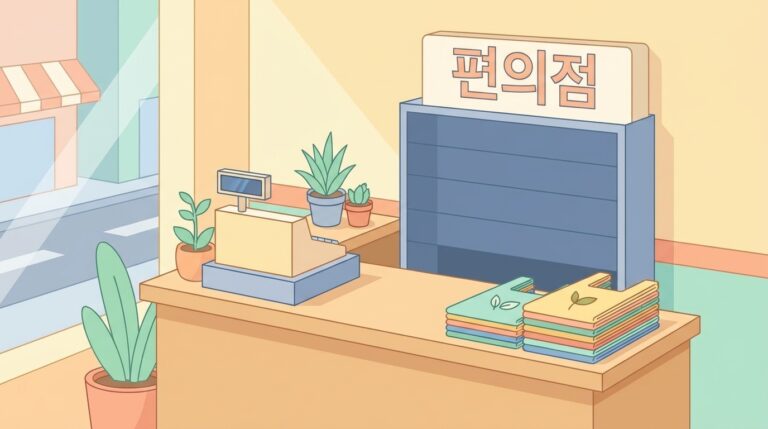
Master Korean Waste Disposal: How to Buy and Use Trash Bags Like a Local
Phase 1: Empathy (Story-Driven Opening)
안녕하세요! 매일한글 에디터입니다. (Hello! This is your Daily Hangul Editor!)
Picture this: You’ve just arrived in Seoul. You unpacked your bags, ordered some delicious K-drama style fried chicken, and settled into your cozy studio apartment (원룸). Everything feels like a dream until the next morning when you face the mountain of empty boxes, sauce cups, and chicken bones. You grab a regular plastic grocery bag, throw it all in, and head down to the street—only to be stopped by an elderly neighbor gasping in horror: “어머, 종량제 봉투 써야지!” (Oh my, you must use a standard trash bag!)
Welcome to Korea’s strict, eco-conscious world of waste management! If you throw trash away in standard plastic bags, you could face hefty fines of up to 100,000 KRW (approx. $80 USD). Every foreigner living in Korea stumbles across this exact hurdle. But don’t worry! This guide is crafted from real classroom feedback and local experience so you can walk into any convenience store and get the exact trash bag you need without breaking a sweat.
Phase 2: Key Expressions Deep Dive
1. 종량제 봉투 10리터짜리 주세요.
- Pronunciation: Jong-ryang-je bong-tu sip-li-teo-jja-ri ju-se-yo. (Sounds like: Jong-ryang-jay bong-too ship-lee-ter-jah-ree joo-say-yo)
- Meaning: Literal: “Please give me a 10-liter volume-rate bag.” / Real Nuance: “Can I get a 10-liter general waste bag, please?”
- K-Culture Moment: Seen frequently in slice-of-life K-Dramas like My Liberation Notes where characters pick up household essentials after a long commute.
- Editor’s Insight: 종량제 (volume-rate) means you pay for the bag which includes waste treatment tax. Always specify the size (e.g., 5L, 10L, 20L). For a single household, 10L (십 리터) is the golden standard!
- Situation Spectrum: Casual: ⚠️ | Semi-formal: ✅ | Formal: ✅
- 🤔 Think About It: In many countries, waste management is billed via monthly municipal taxes. In Korea, you pay per bag. How does this system change individual daily consumption habits?
2. 음식물 쓰레기 봉투는 어디에 있어요?
- Pronunciation: Eum-sik-mul sseu-re-gi bong-tu-neun eo-di-e iss-eo-yo? (Sounds like: Oom-sheek-mool ssoo-ray-gee bong-too-noon uh-dee-ay eet-saw-yo?)
- Meaning: Literal: “Where are the food waste bags?” / Real Nuance: “Where can I find the food waste bags?”
- K-Culture Moment: Characters preparing for a housewarming party (집들이) double-checking food disposal supplies at the neighborhood mart.
- Editor’s Insight: Food waste (음식물 쓰레기) requires distinct yellow or pink bags depending on your district. Never mix leftover food with general trash!
- Situation Spectrum: Casual: ⚠️ | Semi-formal: ✅ | Formal: ✅
- 🤔 Think About It: What counts as ‘food waste’ in Korea is strictly defined by whether livestock (animals) can eat it. Bones and eggshells belong in general trash!
3. 일반 쓰레기예요, 재활용이에요?
- Pronunciation: Il-ban sseu-re-gi-ye-yo, jae-hwal-yong-i-e-yo? (Sounds like: Eel-bahn ssoo-ray-gee-yay-yo, jay-hwahl-yong-ee-ay-yo?)
- Meaning: Literal: “Is it regular trash, or is it recycling?” / Real Nuance: “Does this go into general trash or recycling?”
- K-Culture Moment: Coworkers tidying up after office delivery meals, discussing where plastic containers go.
- Editor’s Insight: If plastic or paper is stained with red food sauce (like Tteokbokki sauce) and cannot be cleaned, it becomes 일반 쓰레기 (general waste), not recycling!
- Situation Spectrum: Casual: ✅ | Semi-formal: ✅ | Formal: ✅
- 🤔 Think About It: Why do Koreans view thorough waste separation not just as a rule, but as basic civic duty (눈치 and manners)?
Phase 3: Textbook Korean vs. Real Korean
Situation 1: Buying a trash bag at the convenience store
- 📖 교과서 한국어 (Textbook): “종량제 봉투를 사고 싶습니다.” (I wish to buy a volume-rate waste bag.)
- 🗣️ 진짜 한국어 (Real-life): “종량제 봉투 10리터 한 장만 주세요!” (Just one 10-liter trash bag, please!)
- 💡 Why is it different? Native speakers quickly state the size and quantity right away rather than speaking in overly formal declarations.
Situation 2: Asking if a shopping bag can be used as a trash bag
- 📖 교과서 한국어 (Textbook): “이 비닐봉지에 쓰레기를 버려도 됩니까?” (May I discard trash in this plastic bag?)
- 🗣️ 진짜 한국어 (Real-life): “이거 재사용 봉투예요?” (Is this a reusable waste bag?)
- 💡 Why is it different? Marts offer 재사용 봉투 (reusable grocery bags that double as general trash bags). Asking directly if it’s a 재사용 봉투 saves time at checkout.
Phase 4: K-Culture Deep Dive & Non-Verbal Manners
4-1. Nunchi & Gestures
- District Matching (구 확인): Trash bags are district-specific (e.g., Mapo-gu, Gangnam-gu). If you buy a bag in Hongdae (Mapo-gu), you cannot discard it in Gangnam. Cashiers will often ask your district if you look new.
- Two-Hand Politeness: When handing your payment card to the convenience store clerk while requesting the bag, always use both hands or hold your right wrist with your left hand.
4-2. Cultural Code: The Art of Bunnrisugeo (분리수거)
In Korea, separating recyclables is practically an Olympic sport! Plastic bottles must have labels stripped off, caps removed, and be crushed flat. Failure to do so might get your building caretaker (경비 아저씨) giving you a lecture. Embracing this is the ultimate sign that you have adapted to local life.
Phase 5: Real-Life Roleplay Scenario
Setting: A brightly lit GS25 convenience store in Sinchon at 9 PM.
Characters:
* Alex (알렉스): International student living in a one-room.
* Clerk (알바생): Friendly university student working part-time.
- 알렉스: 안녕하세요! 혹시 종량제 봉투 있어요?
(An-nyeong-ha-se-yo! Hok-si jong-ryang-je bong-tu iss-eo-yo?)
“Hello! Do you happen to have general trash bags?”
🎭 Hands a bottle of water on the counter. -
알바생: 네, 있어요. 몇 리터 드릴까요?
(Ne, iss-eo-yo. Myeot li-teo deu-ril-kka-yo?)
“Yes, we do. How many liters would you like?”
🎭 Points to the bag shelf behind the counter. -
알렉스: 혼자 사는데, 몇 리터가 좋아요?
(Hon-ja sa-neun-de, myeot li-teo-ga jo-a-yo?)
“I live alone, which size is good?”
🎭 Asks with a friendly smile. -
알바생: 보통 10(십)리터 제일 많이 써요.
(Bo-tong sip-li-teo je-il ma-ni sseo-yo.)
“Usually 10 liters is the most popular.”
🎭 Pulls out a sample 10L white bag. -
알렉스: 그럼 10리터로 열 장 주세요.
(Geu-reom sip-li-teo-ro yeol jang ju-se-yo.)
“Then please give me ten 10-liter bags.”
🎭 Nods in agreement. -
알바생: 서대문구 봉투 맞으시죠? 묶음으로 드릴게요.
(Seo-dae-mun-gu bong-tu maj-eu-si-jyo? Mukk-eum-eu-ro deu-ril-ge-yo.)
“You need Seodaemun-gu bags, right? I’ll give you a 10-pack bundle.”
🎭 Scans the barcode. -
알렉스: 네, 맞아요! 음식물 봉투도 있어요?
(Ne, maj-a-yo! Eum-sik-mul bong-tu-do iss-eo-yo?)
“Yes, that’s right! Do you also have food waste bags?”
🎭 Tilts head attentively. -
알바생: 네, 노란색 음식물 봉투 2리터 같이 드릴까요?
(Ne, no-ran-saek eum-sik-mul bong-tu i-li-teo gat-i deu-ril-kka-yo?)
“Yes, shall I add a 2-liter yellow food waste bag bundle too?”
🎭 Bags items neatly.
🔀 Interactive Choice Point
You realize you only have a credit card and want to buy just one single bag. How do you respond?
- Choice A: “10리터 한 장만 카드 결제 돼요?” (Can I pay for just one 10L bag with card?)
- Choice B: “봉투 공짜로 주세요.” (Give me the bag for free.)
- Choice C: “그냥 검은 비닐봉지에 버릴게요.” (I’ll just throw trash in a black plastic bag.)
Feedback:
* Choice A [BEST]: Perfect! Convenience stores allow card payments even for single bags (around 250~300 KRW).
* Choice B [BAD]: Trash bags are regulated government commodities; giving them free is illegal for the clerk!
* Choice C [RISK]: Big penalty risk! Landlords or CCTV monitoring will catch unauthorized bags and fine you.
Phase 6: 10-Second Emotional Shadowing Drill
Read these aloud, pausing at the slashes (/) and channeling the tagged emotion:
[😊 Polished & Confident]
종량제 봉투 / 10리터짜리 / 한 장 주세요!
(Jong-ryang-je bong-tu / sip-li-teo-jja-ri / han jang ju-se-yo!)-
[🤔 Curious & Inquiring]
치킨 뼈는 / 일반 쓰레기예요 / 음식물 쓰레기예요?
(Chi-kin ppyeo-neun / il-ban sseu-re-gi-ye-yo / eum-sik-mul sseu-re-gi-ye-yo?) -
[🙏 Polite & Grateful]
재사용 봉투로 / 담아 주세요! / 감사합니다.
(Jae-sa-yong bong-tu-ro / dam-a ju-se-yo! / Gam-sa-ham-ni-da.)
Phase 7: K-Culture Mini Dictionary
- 종량제 봉투 (Jong-ryang-je Bong-tu) | Standard Volume-Rate Waste Bag | Used for non-recyclable household general trash. Colors vary slightly by district (usually white or light blue).
- 음식물 쓰레기 (Eum-sik-mul Sseu-re-gi) | Food Waste | Organic food waste processed into animal feed or compost. Typically placed in distinct yellow/pink bags or smart RFID bins.
- 분리수거 (Bun-ri-su-geo) | Waste Sorting / Recycling | The practice of separating glass, cans, paper, vinyl, and plastic into designated bins.
- 대형 폐기물 스티커 (Dae-hyeong Pye-gi-mul Seu-ti-keo) | Bulky Waste Disposal Sticker | Adhesive permit bought at community offices or convenience stores to throw away furniture/mattresses.
Phase 8: Survival Kit for Travelers & Expats
TOP 3 Survival Phrases
- “봉투 필요하세요?” (Bong-tu pil-yo-ha-se-yo?) → “Do you need a plastic bag?” (Answer: “네, 재사용 봉투로 주세요!” – Yes, reusable bag please!)
- “쓰레기 어디에 버려요?” (Sseu-re-gi eo-di-e beor-yeo-yo?) → “Where do I throw this trash away?”
- “이거 분리수거 돼요?” (I-geo bun-ri-su-geo dwae-yo?) → “Is this recyclable?”
Editor’s Travel Note
- If you need to find the nearest convenience store or community center to purchase bags, open the Naver Map App Download to search for nearby 편의점 (convenience stores).
- When shopping at supermarkets like E-Mart or Lotte Mart, never buy a regular disposable bag. Ask for 재사용 종량제 봉투 (reusable trash bag) so you can use it for trash disposal at your Airbnb or hotel later!
Phase 9: Think Deeper
Korea’s strict waste segregation reflects the traditional value of Jeong (정) and collective civic responsibility. Because Korea is a densely populated country with limited landfill space, community cleanliness is upheld through active cooperation. Throwing out trash properly isn’t just following municipal law—it is an unspoken sign of respect toward your neighborhood cleaning crew and neighbors.
💬 Your Turn: How does waste sorting work in your home country? Share your funniest or most surprising waste sorting culture shock in the comments below!
Phase 10: FAQ & Common Mistakes
Q: Can I use a Gangnam-gu trash bag if I move to Mapo-gu?
A: Technically no. Each district (구) has its own waste processing contracts. However, if you move, you can visit your new local Community Service Center (주민센터) and get sticker seals (전입자 인증 스티커) to attach to your old bags!
Q: Where do chicken bones, banana peels, and eggshells go?
A: Banana peels are soft and edible for livestock, so they go into Food Waste (음식물). Hard chicken bones, clam shells, onion skins, and eggshells belong in General Waste (일반 쓰레기).
Q: What should I do with cardboard delivery boxes?
A: Remove all shipping tape, personal address labels, and barcode stickers before flattening and placing the box into the paper recycling area.
🚨 Common Mistakes Alert Board
- Mistake: Throwing food waste inside regular black shopping bags.
Correct Action: Always purchase official yellow/orange food waste bags (음식물 쓰레기 봉투). - Mistake: Leaving trash bags on the street at random daytime hours.
Correct Action: Most residential areas designate trash drop-off between 7 PM and midnight on specific weekdays. - Mistake: Putting unwashed red delivery containers into plastic recycling.
Correct Action: Rinse containers clean. If stained, dispose of them in the standard volume-rate bag.
Phase 11: Action Missions
- 🥉 Bronze Mission (Self Practice): Say “종량제 봉투 10리터 한 장 주세요” 3 times smoothly in front of a mirror.
- 🥈 Silver Mission (Social / Community): Take a photo of your properly sorted recyclables or your local district bag and share your learning progress.
- 🥇 Gold Mission (Real Life): Walk into a convenience store in Korea, successfully buy a single trash bag in Korean, and pay with your card!
- 🎮 K-Culture Mission: Next time you watch a modern K-Drama, look for scenes where characters are separating trash at their front door or rooftop!
Phase 12: Interactive Quiz Challenge
Q1. You live in a studio apartment and want to buy trash bags at a convenience store. What should you say?
a) 종량제 봉투 공짜로 주세요.
b) 종량제 봉투 10리터짜리 주세요.
c) 검은 비닐봉투 많이 주세요.
Q2. Fill in the blank:
“치킨 뼈와 달걀 껍데기는 __________ 쓰레기 봉투에 버려야 해요.” (일반 / 음식물)
Q3. True or False:
You can use a trash bag bought in Busan when living in Seoul without any special sticker. (True / False)
🔍 Click here to reveal Answers & Explanations!
- Answer: b) 종량제 봉투 10리터짜리 주세요. (10L is ideal for one-person households and politely requests the legal bag).
- Answer: 일반 (General) (Hard items that livestock cannot consume must go into general waste).
- Answer: False (Trash bags are municipal and strictly valid only within their issued district or city).







