

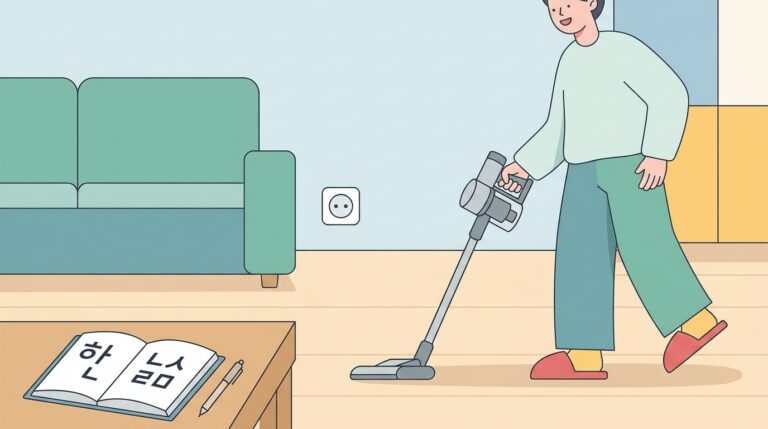
Phase 1: Empathy (Real-Life K-Story Opening)
안녕하세요! 매일한글 에디터입니다. (Hello! I’m your Daily Hangul editor.)
Picture this: You are staying at an Airbnb in Mapo-gu, Seoul, or sharing a cozy flat with a Korean roommate. The sun is shining, and you notice dust on the wooden floor after a weekend of takeout K-fried chicken. You spot a sleek stick vacuum cleaner in the corner. You want to say, “I’ll vacuum!” or ask your host where to plug it in, but your brain freezes. Do you say “clean machine use”? Why does everyone on Korean reality shows say they are spinning something?
In Korean, we don’t just “clean”; we say 청소기를 돌리다 (cheong-so-gi dol-li-da)—literally “to spin the vacuum!” If you don’t know this natural verb pairing, even simple household tasks can feel overwhelming. Many beginner learners struggle because dictionary translations like 사용하다 (to use) sound unnaturally stiff for everyday chores. This guide is built directly from real questions sent by our A1 beginner community. By the end of this 5-minute read, you will master essential appliance phrases, understand apartment noise manners (층간소음), and speak like a true local roommate!
Phase 2: Top 3 Essential Expressions
1. 청소기 돌려요 (Cheong-so-gi dol-lyeo-yo)
- Pronunciation: cheong-so-gi dol-lyeo-yo (Sounds like: Chung-so-gee dohl-lyuh-yo)
- Meaning: Direct: “I spin the vacuum.” / Real Nuance: “I am vacuuming.” or “I will run the vacuum.”
- K-Culture Moment: You often hear this in K-dramas right when weekend chores begin or in I Live Alone (나 혼자 산다) before guests visit.
- Editor’s Insight: In Korean, appliances with motors or revolving drums (vacuum cleaners, washing machines, microwaves) always take the magical verb 돌리다 (to spin/turn).
- Situation Spectrum: Casual: ✅ | Semi-formal: ✅ | Formal: ⚠️ (청소기를 돌립니다 is better in formal contexts)
- 🤔 Think About It: In English, you “vacuum” or “run the vacuum.” Why do you think Korean uses the kinetic word “spin” for motor appliances?
2. 코드 꽂아 주세요 (Ko-deu kko-ja ju-se-yo)
- Pronunciation: ko-deu kko-ja ju-se-yo (Sounds like: Koh-deu kko-jah joo-say-yo with a crisp, popping ‘kk’ sound)
- Meaning: Direct: “Please stick the cord in.” / Real Nuance: “Please plug this in.”
- K-Culture Moment: Seen when someone is helping a friend clean under the sofa and needs help reaching a hidden wall outlet.
- Editor’s Insight: The verb 꽂다 (to insert/plug in) is essential in modern Korean homes where wireless and wired chargers coexist.
- Situation Spectrum: Casual: ✅ | Semi-formal: ✅ | Formal: ✅
- 🤔 Think About It: Notice how polite requests end in ~아/어 주세요 (~a/eo ju-se-yo). It instantly softens any household request into a friendly collaboration.
3. 먼지 비워 주세요 (Meon-ji bi-wo ju-se-yo)
- Pronunciation: meon-ji bi-wo ju-se-yo (Sounds like: Mun-jee bee-woh joo-say-yo)
- Meaning: Direct: “Please empty the dust.” / Real Nuance: “Please empty the vacuum’s dustbin.”
- K-Culture Moment: When cleaning together in variety shows, one person vacuums while the other empties the filter bin into the trash bag.
- Editor’s Insight: 먼지 (meon-ji) means dust, and 비우다 (bi-u-da) means to make empty. It’s a lifesaver phrase when sharing a space!
- Situation Spectrum: Casual: ✅ | Semi-formal: ✅ | Formal: ✅
- 🤔 Think About It: Keeping shared living areas spotless is a big part of Korean shared-housing etiquette (배려).
Phase 3: Textbook Korean vs. Real Korean
Situation 1: Saying you will vacuum the living room
- 📖 Textbook Korean: 진공청소기를 사용하겠습니다. (Jin-gong-cheong-so-gi-reul sa-yong-ha-get-seum-ni-da. – “I shall utilize the vacuum cleaner.”)
- 🗣️ Real Korean: 제가 청소기 돌릴게요! (Je-ga cheong-so-gi dol-lil-ge-yo! – “I’ll run the vacuum!”)
- 💡 Why is it different? Nobody says 진공청소기 (vacuum cleaner) in daily life; we simply shorten it to 청소기. Furthermore, native speakers prefer the natural verb 돌리다 over the stiff, business-like 사용하다 (to use).
Situation 2: Asking where the power outlet is
- 📖 Textbook Korean: 전기 콘센트가 어디에 위치합니까? (Jeon-gi kon-sen-teu-ga eo-di-e wi-chi-ham-ni-kka? – “Where is the electrical outlet situated?”)
- 🗣️ Real Korean: 콘센트 어디 있어요? (Kon-sen-teu eo-di it-seo-yo? – “Where’s the outlet?”)
- 💡 Why is it different? Real Korean values quick, natural rhythm. Short questions with 어디 있어요? are polite and directly to the point.
Phase 4: K-Culture Deep Dive & Non-Verbal Manners
4-1. Nunchi & Sound Etiquette (층간소음 – Inter-floor Noise)
In Korea, over 60% of the population lives in high-density apartments or villas (multi-unit buildings). Floors transmit vibrations easily!
* The Golden Time: Always vacuum between 10:00 AM and 7:00 PM. Running a vacuum early in the morning or past 9:00 PM is considered a major breach of neighborly 눈치 (Nunchi).
* Body Language: If your roommate is studying or watching TV, make gentle eye contact, lightly point to the vacuum, and ask with a soft questioning tilt of the head: “지금 돌려도 돼요?” (May I run it now?).
4-2. The Robot Vacuum Craze in K-Media
If you watch shows like Home Alone or modern K-dramas, you will constantly spot sleek 로봇청소기 (robot vacuum cleaners) roaming the floor. Koreans affectionately treat these robot vacuums almost like pets, often giving them nicknames (like 이모님 meaning ‘Auntie helper’) because they take care of tedious chores automatically!
Phase 5: Real-Life Roleplay Scenario
Setting: You are sharing an apartment with your Korean friend, Minji (민지), on a Sunday afternoon.
- 민지: 주말인데 거실 청소 같이 할까? (Ju-ma-rin-de geo-sil cheong-so ga-chi hal-kka?)
🎭 Stretches and points at the living room floor.
“It’s the weekend, shall we clean the living room together?” -
You: 좋아요! 제가 청소기 돌릴게요. (Jo-a-yo! Je-ga cheong-so-gi dol-lil-ge-yo.)
🎭 Smiles enthusiastically and grabs the vacuum handle.
“Sounds great! I’ll run the vacuum.” -
민지: 고마워! 그런데 콘센트가 소파 뒤에 있어. (Go-ma-wo! Geu-reon-de kon-sen-teu-ga so-pa dwi-e it-seo.)
🎭 Taps the side of the sofa.
“Thanks! But the power outlet is behind the sofa.” -
You: 아, 코드 꽂아 주세요! (A, ko-deu kko-ja ju-se-yo!)
🎭 Hands the plug gently toward Minji.
“Ah, please plug in the cord for me!” -
민지: 응, 꽂았어! 먼지통 꽉 찼는지 확인해 봐. (Eung, kko-jat-eo! Meon-ji-tong kkwak chan-neun-ji hwa-gin-hae bwa.)
🎭 Plugs it in with a click and checks the dust canister.
“Done! Check if the dustbin is full.” -
You: 먼지 비워야 해요? (Meon-ji bi-wo-ya hae-yo?)
🎭 Inspects the clear canister carefully.
“Do I need to empty the dust?” -
민지: 응, 쓰레기통에 털어 넣으면 돼. (Eung, sseu-re-gi-tong-e teol-eo neo-eu-myeon dwae.)
🎭 Points to the regular trash can.
“Yeah, just shake it out into the trash can.” -
You: 네, 비우고 바로 돌릴게요! (Ne, bi-u-go ba-ro dol-lil-ge-yo!)
🎭 Nods with confidence.
“Got it, I’ll empty it and vacuum right away!”
🔀 Interactive Choice Point
Minji tells you that it is already 9:30 PM, but you still want to clean the floor. What do you do?
- Option A: Turn on the heavy stick vacuum immediately and say “청소기 지금 돌려요!”
- ❌ Bad Choice: Running a loud vacuum after 9 PM causes severe apartment vibration noise (층간소음) and may lead to complaints from downstairs neighbors!
- Option B: Ask politely, “지금 청소기 돌려도 괜찮아요?” (Is it okay to run the vacuum now?)
- ⚠️ Risk Choice: Polite, but Minji will likely suggest postponing it until morning or using a silent wet-wipe mop instead.
- Option C: Say, “밤이니까 내일 아침에 돌릴게요!” (It’s nighttime, so I’ll vacuum tomorrow morning!)
- 🏆 Best Choice: Demonstrates top-tier Nunchi and consideration for shared apartment life!
Phase 6: 10-Second Emotion Shadowing Drill
Practice these lines out loud! The slashes (/) represent natural pauses.
[😊 Cheerful & Ready to Help]
제가 / 청소기 / 돌릴게요!
(Je-ga / cheong-so-gi / dol-lil-ge-yo!)
→ “I will / run the vacuum!”-
[🤝 Helpful & Friendly]
코드 / 여기에 / 꽂아 주세요!
(Ko-deu / yeo-gi-e / kko-ja ju-se-yo!)
→ “Please / plug the cord / right here!” -
[👀 Careful & Considerate]
먼지통 / 먼저 / 비울게요!
(Meon-ji-tong / meon-jeo / bi-ul-ge-yo!)
→ “I will empty / the dust canister / first!”
Phase 7: K-Culture Mini Dictionary
- 청소기 (Cheong-so-gi) | Noun: Vacuum cleaner
Usage: The universal term for standard vacuum cleaners in Korean homes. - 콘센트 (Kon-sen-teu) | Noun: Electrical wall outlet / socket
Usage: Borrowed originally from ‘concentric plug’, this is the standard everyday word in Korea for any wall power socket. - 로봇청소기 (Ro-bot-cheong-so-gi) | Noun: Robot vacuum cleaner
Usage: Essential household appliance in modern Korean apartments, frequently discussed on home-shopping channels. - 분리수거 (Bun-ri-su-geo) | Noun: Waste sorting / recycling separation
Usage: The strict system of separating plastics, vinyl, cans, and regular trash in Korean residential areas.
Phase 8: Survival Kit for Travelers & Residents
Top 3 Survival Phrases
- 청소기 어디 있어요? (Cheong-so-gi eo-di it-seo-yo?) – “Where is the vacuum cleaner?”
Pro Tip: Use this when staying in an Airbnb or guesthouse and you need to clean up a small spill. - 어떻게 켜요? (Eo-tteo-ke kyeo-yo?) – “How do I turn this on?”
Pro Tip: Great for high-tech digital appliances with touch buttons. - 충전해 둘게요. (Chung-jeon-hae dul-ge-yo.) – “I will leave it on the charger.”
Pro Tip: Perfect etiquette when finished using a cordless vacuum.
Editor’s Travel Note
When staying in Korea, download the Naver Map official application to easily find nearby household goods stores like Daiso (다이소) where you can buy replacement cleaning sheets (정전기 청소포) if you prefer quiet cleaning late at night.
Phase 9: A Step Deeper (Cultural Thought)
Why does the Korean language use the verb 돌리다 (to spin) for so many household appliances? From washing machines (세탁기 돌리다) and microwave ovens (전자레인지 돌리다) to vacuum cleaners (청소기 돌리다), Korean verb usage reflects the internal dynamic movement of machines. Rather than passively “using” an object, the speaker describes setting a cycle into motion.
💬 Your Turn: In your native language, what active verb do you use for appliances? Does your culture have strict unspoken rules about when you can make noise at home? Share your thoughts in the comments below!
Phase 10: FAQ & Common Mistakes
Q: Can I use ‘청소하다’ instead of ‘청소기 돌리다’?
A: Yes! 청소하다 means the broad action of “cleaning” in general (wiping, organizing, sweeping). However, when you specifically mean running the vacuum cleaner, native speakers almost exclusively say 청소기 돌리다.
Q: How do I say ‘cordless vacuum’ in Korean?
A: You say 무선 청소기 (Mu-seon cheong-so-gi). 무선 (mu-seon) means wireless/cordless, while 유선 (yu-seon) means corded.
Q: What should I say if the vacuum loses suction power?
A: You can say, “흡입력이 약해요” (Heub-im-nyeog-i yak-hae-yo – The suction power is weak) or simply check the dustbin by saying “먼지통 비워야겠어요” (I need to empty the dustbin).
🚨 Common Mistakes Warning Board
- Mistake: Saying “청소기를 켜요” (Cheong-so-gi-reul kyeo-yo) for the entire cleaning process.
Correct Action: 켜다 only means flipping the power switch on. To say you are doing the chore of vacuuming, say 청소기 돌려요. - Mistake: Asking for a “plug socket” in English.
Correct Action: Use the Korean-English word 콘센트 (kon-sen-teu) so locals understand instantly. - Mistake: Vacuuming late at night after 10 PM.
Correct Action: Respect 층간소음 manners; use a quiet sticky roller (돌돌이 – dol-dol-i) if you must clean at night.
Phase 11: Action Missions
- 🥉 Bronze Level (Solo Drill): Look at an electrical outlet in your room and say aloud: “코드 꽂아 주세요!” 3 times.
- 🥈 Silver Level (Social Sharing): Post a short video or text in our Daily Hangul study group using the phrase: “오늘 청소기 돌렸어요!” (I vacuumed today!).
- 🥇 Gold Level (Real Life): If you live in Korea or share an apartment with a Korean speaker, offer to clean this weekend by asking: “제가 거실 청소기 돌릴까요?” (Shall I vacuum the living room?).
- 🎮 K-Culture Discovery Mission: Watch an episode of a Korean reality variety show (like I Live Alone) and listen for when a cast member mentions 돌리다 for laundry or vacuuming!
Phase 12: Interactive Quiz Challenge
Question 1: Situational Judgment
You want to tell your host that you will run the vacuum cleaner in the bedroom. What is the most natural sentence?
A) 제가 방에서 청소기 만들게요.
B) 제가 방 청소기 돌릴게요.
C) 제가 방 전기 사용해요.
Question 2: Fill in the Blank
벽에 있는 _________에 청소기 코드를 꽂으세요. (Plug the vacuum cord into the ________ on the wall.)
Question 3: True or False (Culture)
In Korean apartment culture, it is completely normal and acceptable to run a heavy vacuum cleaner at 11:30 PM. (True / False)
👉 Click here to reveal the answers and explanations!
Answers & Explanations:
1. Answer: B (제가 방 청소기 돌릴게요) — 돌리다 is the natural verb pairing for operating a vacuum cleaner.
2. Answer: 콘센트 (kon-sen-teu / power outlet) — Remember that wall outlets are called 콘센트 in everyday Korean.
3. Answer: False — Due to apartment floor vibration (층간소음), noisy appliances like vacuum cleaners should be used during daytime or early evening hours (before 8–9 PM).






