

Phase 1: Empathy & Connection
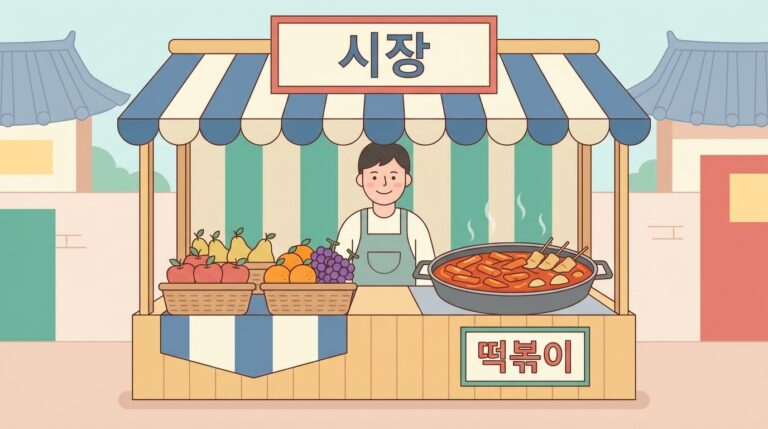
안녕하세요! 매일한글 에디터입니다. Have you ever stepped into a vibrant Korean traditional market like Gwangjang Market or Mangwon Market, surrounded by the sizzling sound of hotteok and towering stacks of fresh fruits, only to freeze when a friendly merchant looks your way? You want to ask how much something costs or ask for a little discount, but textbook phrases like “이것은 얼마입니까?” suddenly feel stiff and unnatural. Many of our learners tell us they felt intimidated by the lively, bustling energy and ended up just pointing silently. But here is the secret: Korean market merchants (상인) are among the warmest, most generous people you will ever meet once you use just a couple of natural, friendly phrases. Mastering market banter will unlock warm smiles, generous bonus treats (덤), and an authentic K-culture experience you can never get in a supermarket. Let’s dive in together!
Phase 2: 3 Essential Market Phrases
1. 이거 얼마예요? (Igeo eolmayeyo?)
- Pronunciation: ee-guh eol-mah-ye-yo (Sounds like “E-go” + “all-my-yeah-yo”)
- Meaning: Literal: “How much is this?” / Nuance: A bright, friendly, and natural way to ask the price of any item you point to.
- K-Culture Moment: Seen in street food vlogs and K-dramas whenever a character browses street carts in Hongdae or traditional markets.
- Editor’s Insight: Skip the textbook formal “얼마입니까?” in markets. “이거 얼마예요?” strikes the perfect balance of polite friendliness.
- Situation Spectrum: Casual (✅ with close friends: 이거 얼마야?), Semi-formal (✅ 이거 얼마예요?), Formal (⚠️ standard polite, perfect for markets).
- 🤔 Think About It: Why does Korean rely on polite sentence endings like
-요(-yo) even when chatting casually with friendly market vendors?
2. 조금만 깎아주세요 (Jogeumman kkak-a-juseyo)
- Pronunciation: joh-geum-mahn kkah-kkah-joo-seh-yo (Think of “car-car” with a sharp snap: kkah-kkah)
- Meaning: Literal: “Please trim/cut a little bit.” / Nuance: “Could you give me a little discount, please?”
- K-Culture Moment: A classic scene in K-variety shows like Running Man or 2 Days & 1 Night where members playfully plead for market food discounts.
- Editor’s Insight: Always say this with a soft smile and a cute, playful tone. In Korea, bargaining is less about saving pennies and more about sharing warm social interaction (jeong).
- Situation Spectrum: Casual (⚠️ only if very close), Semi-formal (✅ standard friendly), Formal (🚫 too playful for upscale department stores).
- 🤔 Think About It: In your home culture, is bargaining considered rude or normal? How does tone change how bargaining is perceived?
3. 서비스/덤 많이 주세요 (Service / Deom mani juseyo)
- Pronunciation: suh-bee-seu / deom mah-nee joo-seh-yo
- Meaning: Literal: “Give me lots of freebies/extras!” / Nuance: “Please toss in a little extra something!”
- K-Culture Moment: Often heard at traditional tteokbokki stalls when students ask for extra fish cake broth or an extra fried dumpling.
- Editor’s Insight: Deom (덤) is the traditional Korean concept of giving an extra scoop for free. Service (서비스) is modern Konglish for complimentary items.
- Situation Spectrum: Casual (✅), Semi-formal (✅), Formal (🚫 not used in fine dining or retail stores).
- 🤔 Think About It: How does receiving an unexpected free treat build community connection between a buyer and a seller?
Phase 3: Textbook Korean vs. Real Korean
Situation 1: Asking for the total price
- 📖 교과서 한국어: 전부 다 합쳐서 얼마입니까? (How much is it all added together?)
- 🗣️ 진짜 한국어: 사장님, 다 해서 얼마예요? (Boss, how much for everything?)
- 💡 왜 다를까? Real Koreans address shopkeepers as “사장님” (Sajangnim – Boss/Owner) to show respect while keeping the mood warm and casual.
Situation 2: Asking for a discount or bonus
- 📖 교과서 한국어: 가격을 할인해 주실 수 있습니까? (Can you give me a price discount?)
- 🗣️ 진짜 한국어: 이모, 조금만 깎아주세요~ (Auntie, cut a little off please~)
- 💡 왜 다를까? In market stalls, friendly kinship titles like “이모” (Imo – Auntie) build instant rapport and make discounts much more likely!
Phase 4: K-Culture Deep Dive & Non-Verbal Etiquette
4-1. Nunchi & Market Body Language
- Two-Handed Cash/Card Exchange: When handing over cash or your card, hold it with both hands or support your right wrist with your left hand. It shows instant respect and delights elder vendors.
- Eye Contact & the Soft Nod: Don’t stare intently. Give a gentle nod (mokrye) when approaching a stall to signal you are browsing politely.
- The Bright “사장님” Call: If the market is noisy, raise your hand slightly to chest height and say “사장님!” with a rising, bright tone.
4-2. Cultural Code: The Spirit of “Jeong” (정) & “Deom” (덤)
Korean markets run on Jeong (warm affection and emotional bond). Unlike fixed-price convenience stores, market stalls celebrate human connection. When you buy strawberries or mandu and speak even three words of Korean with a cheerful smile, vendors often toss in an extra handful (Deom). Appreciating this gesture with a bow and “감사합니다!” completes the cultural exchange.
Phase 5: Real-World Roleplay Scenario
Setting: Mangwon Traditional Market on a sunny Saturday afternoon. You are standing in front of a bustling fruit and snack stall run by a cheerful vendor named Mrs. Park.
- Turn 1 (You): 🎭 Smiling and pointing at a box of juicy strawberries
안녕하세요! 사장님, 이 딸기 얼마예요? (Annyeonghaseyo! Sajangnim, i ttalgi eolmayeyo? – Hello! Boss, how much are these strawberries?) - Turn 2 (Vendor): 🎭 Waving warmly with plastic gloves on
어, 어서 와요! 한 상자에 8,000원이에요. 오늘 아침에 들어와서 아주 달아요! (Eo, eoseo wayo! Han sangja-e pal-cheon-won-ie-yo. Oneul achim-e deureowaseo aju darayo! – Oh, welcome! It’s 8,000 won per box. Freshly arrived this morning, super sweet!) - Turn 3 (You): 🎭 Nodding approvingly
우와, 진짜 맛있어 보여요. 두 상자 주세요! (Uwa, jinjja mas-isseo boyeoyo. Du sangja juseyo! – Wow, they look really delicious. Please give me two boxes!) - Turn 4 (Vendor): 🎭 Packing two boxes into a plastic bag
두 상자면 만 6천 원이에요~ 학생, 한국말 참 잘하네! (Du sangjamyeon man yuk-cheon-won-ie-yo~ Haksaeng, hangukmal cham jalhane! – Two boxes make 16,000 won~ You speak Korean so well!) - Turn 5 (You): 🎭 Smiling playfully with slight cute aegyo
감사합니다! 이모, 조금만 깎아주세요~ (Gamsahamnida! Imo, jogeumman kkak-a-juseyo~ – Thank you! Auntie, could you give me a little discount~?) - Turn 6 (Vendor): 🎭 Laughing heartily and tossing in an extra small pack of cherry tomatoes
아이고 귀여워라! 천 원 깎아서 만 5천 원만 줘요. 토마토도 덤으로 줄게! (Aigo gwiyeowora! Cheon-won kkak-aseo man o-cheon-won-man jwoyo. Tomato-do deom-euro julge! – Oh how cute! I’ll take off 1,000 won, just give me 15,000 won. I’ll throw in tomatoes as a bonus too!) - Turn 7 (You): 🎭 Handing over cash with both hands and bowing lightly
우와, 감동이에요! 여기 15,000원 있어요. 많이 파세요! (Uwa, gamdong-ie-yo! Yeogi man o-cheon-won isseoyo. Mani paseyo! – Wow, I’m touched! Here is 15,000 won. Wishing you great sales!) - Turn 8 (Vendor): 🎭 Handing the bag with two hands and a bright beam
고마워요, 또 와요! (Gomawoyo, tto wayo! – Thank you, come again!)
🔀 Interactive Choice Point: How will you ask for a better deal?
- Option A: “돈 없어요. 반값으로 해줘요.” (I have no money. Make it half price.)
- 👉 Feedback [Bad]: Demanding 50% off without politeness sounds aggressive and disrespectful.
- Option B: “이모, 두 개 살 테니까 조금만 깎아주세요~” (Auntie, I’m buying two, so could you give a little discount please~?)
- 👉 Feedback [Best]: Polite, affectionate, and offers value by purchasing multiple items. Vendors love this!
- Option C: “비싸요. 다른 가게 갈게요.” (It’s expensive. I’m going to another shop.)
- 👉 Feedback [Risk]: Abrupt and cold. It breaks the friendly atmosphere instantly.
Phase 6: 10-Second Emotion Shadowing Drill
Practice reading these out loud with rhythm pauses (/) and matching facial emotions!
[😊 Bright & Friendly]사장님, / 이거 / 얼마예요? (Sajangnim, / igeo / eolmayeyo?)[🥺 Playful & Pleading]이모, / 조금만 / 깎아주세요~ (Imo, / jogeumman / kkak-a-juseyo~)[😍 Delighted & Grateful]우와, / 덤 감사해요! / 많이 파세요! (Uwa, / deom gamsahaeyo! / Mani paseyo!)
Phase 7: K-Culture Mini Dictionary
- 사장님 (Sajangnim) | Literal: Company President / Market usage: Boss, Shopkeeper. The universal respectful title for independent business owners in Korea.
- 이모 (Imo) | Literal: Maternal Aunt / Market usage: Friendly title for female stall owners. Creates instant warmth when ordering food or buying groceries.
- 덤 (Deom) | Free extra items / bonus goods. A staple of traditional market culture symbolizing community warmth.
- 현금영수증 (Hyeongeum-yeongsujeung) | Cash receipt. Helpful keyword when paying with cash at market stalls.
Phase 8: Traveler’s Survival Kit
Top 3 Survival Phrases
- 이거 포장해 주세요. (Igeo pojang-hae juseyo.) | Please wrap/pack this to go. (Pro Tip: Great for street food like tteokbokki or jeon!)
- 카드 돼요? (Kadeu dwaeyo?) | Do you take cards? (Pro Tip: Most stalls accept cards, but carrying cash is appreciated for small snacks under 5,000 won.)
- 많이 파세요! (Mani paseyo!) | Literal: Sell a lot! Nuance: Have a prosperous day! (Pro Tip: Say this as your parting farewell instead of just goodbye!)
Editor’s Travel Note
- Essential Navigation: Check open stall hours and reviews using the Naver Map navigation app guide.
- Cash Preparation: While modern markets accept credit cards, keeping 1,000 and 5,000 won banknotes in your pocket ensures fast transactions at busy food stalls.
Phase 9: Think Deeper
In many Western cultures, commerce is purely transactional—a fixed price for a fixed product. But in Korean traditional markets, communication is relational. Calling a vendor “이모” or wishing them “많이 파세요” recognizes their hard work and builds an instant bridge of human solidarity (Jeong). When you speak Korean at a market, you aren’t just buying food; you are participating in a living cultural tradition.
💬 Your Turn: Have you ever experienced a market where bargaining felt like a friendly dance rather than an argument? Share your market stories in the comments below!
Phase 10: FAQ & Common Mistakes
Q: Is it rude to ask for a discount in Korea?
A: Not in traditional markets if done playfully! However, never attempt to bargain in department stores, supermarkets, or branded convenience stores where prices are strictly computerized.
Q: Can I call any female vendor “이모” (Imo)?
A: Yes, middle-aged or elder female vendors at street food stalls and markets love the friendly nuance. If unsure, “사장님” (Sajangnim) is always a 100% safe and respectful option.
Q: What should I say when leaving a stall after buying something?
A: Say “감사합니다, 많이 파세요!” (Thank you, sell a lot!). It brings a huge smile to every vendor’s face.
🚨 Common Mistakes Alert Board
- ❌ Mistake: Calling market vendors “아줌마” (Ajumma) loudly. 👉 Correction: “아줌마” can sound slightly blunt today. Always use “사장님” or “이모”.
- ❌ Mistake: Handing money with one hand while looking away. 👉 Correction: Use both hands with eye contact and a gentle nod.
- ❌ Mistake: Demanding huge discounts like 50% off. 👉 Correction: Ask for small rounding cuts (e.g., 1,000 won off) or ask for extra snacks (덤).
Phase 11: Action Missions
- 🥉 Bronze Mission (Solo Practice): Stand in front of a mirror and practice saying “사장님, 이거 얼마예요?” 5 times with a bright smile.
- 🥈 Silver Mission (Social Share): Comment below writing what you would order at a Korean market using “[Food name] 주세요!” (e.g., 떡볶이 주세요!).
- 🥇 Gold Mission (Real Life): Visit a local Korean mart or traditional market, buy an item, and greet the cashier with “많이 파세요!” when leaving.
- 🎮 K-Culture Mission: Watch an episode of a Korean variety show (like Amazing Saturday or Street Food Fighter) and spot how many times people say “사장님”!
Phase 12: Interactive Quiz Challenge
Q1. You want to ask the price of a delicious bindaetteok stall. What is the most natural A2 phrase?
* A) 이거 얼마입니까?
* B) 사장님, 이거 얼마예요?
* C) 돈 얼마 줘?
🔍 Click to reveal Answer & Explanation
Correct Answer: B) 사장님, 이거 얼마예요?
Explanation: Calling the vendor “사장님” followed by the polite “-요” ending is the standard, natural way to ask prices in Korean markets.
Q2. Fill in the blank:
“이모, 조금만 _________! (Please give me a little discount!)”
* A) 도와주세요
* B) 깎아주세요
* C) 기다려주세요
🔍 Click to reveal Answer & Explanation
Correct Answer: B) 깎아주세요
Explanation: “깎다” means to cut or trim, used idiomatically for lowering prices.
Q3. True or False:
“It is considered polite to say ‘많이 파세요’ to market vendors when leaving after a purchase.”
* A) True
* B) False
🔍 Click to reveal Answer & Explanation
Correct Answer: A) True
Explanation: Wishing vendors good business (“많이 파세요”) is a warm Korean greeting showing consideration and politeness.







