Phase 1: Empathy (Story-driven Opening)
안녕하세요! Welcome back to Daily Hangul! I’m your Korean culture navigator. Have you recently noticed your favorite K-pop idols or Korean friends posting sleek, professional photos showing off ripped abs and glowing skin on Instagram? You might see tags like #바디프로필 (#BodyProfile) everywhere! In Korea, taking a “Body Profile” (바디프로필) photo has become a massive rite of passage for young adults. It is not just about losing weight; it is a months-long journey of extreme discipline, strict meal prep, and grueling workouts to capture your peak physical form before you age.
However, preparing for a Body Profile photo shoot in Korea comes with intense social and linguistic challenges. How do you tell your workout buddy that you are currently on a strict diet without sounding distant? How do you cheer someone on who is starving themselves before photo day? In this guide, based on real feedback from language learners living in Seoul, you will master authentic Korean expressions used during intense fitness journeys. Learning these phrases will help you blend right into gym culture, comment naturally on your friends’ transformation posts, and understand modern Korean body culture like a local!
Phase 2: Deep Dive into 3 Core Key Expressions
1. 식단 조절하고 있어요 (Sik-dan jo-jeol-ha-go is-seo-yo)
- Pronunciation: [Sik-dan jo-jeol-ha-go-iss-eo-yo] (Sounds like “Seek-dahn jo-juhl-hah-go ee-seh-yo”)
- Meaning: Literal: “I am adjusting my menu plan.” / Nuance: “I am currently controlling my diet / eating strictly for fitness goals.”
- K-Culture Moment: You are invited to an evening Chimaek (chicken and beer) party after work. You point politely at your chicken breast salad container and say this phrase to explain why you cannot eat fried chicken.
- Editor’s Insight: Koreans rarely use the direct word “다이어트” (diet) when referring to professional fitness prepping. Using “식단” (dietary regimen) shows you are taking your meal prep seriously.
- Situation Spectrum: Casual ✅ | Semi-formal ✅ | Formal ⚠️
- 🤔 Think About It: Why do you think Korean fitness culture distinguishes between simple weight loss (“다이어트”) and structured nutritional control (“식단”)?
2. 눈바디 찍었어요 (Nun-ba-di jji-geoss-eo-yo)
- Pronunciation: [Noon-ba-di jjee-geoss-eo-yo] (Sounds like “Noon-bah-dee jee-geoss-eh-yo”)
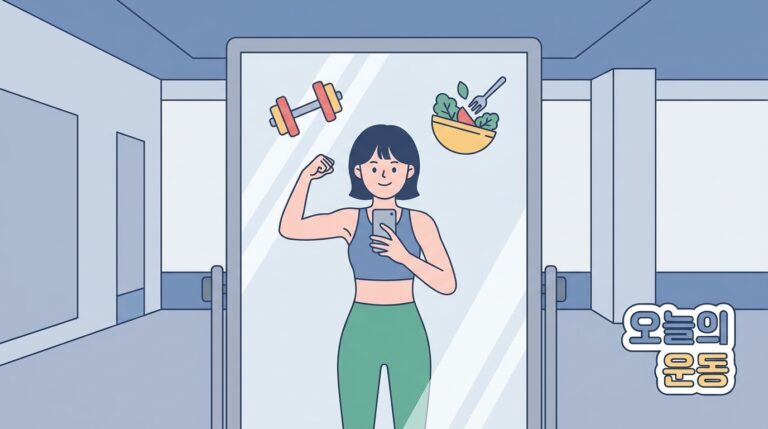
- Meaning: Literal: “I took an eye-body photo.” / Nuance: “I took a progress selfie in the mirror to check my physique visually.”
- K-Culture Moment: Early in the morning before gym class, your friend snaps a mirror mirror selfie showcasing their waistline. They send it to the group chat saying, “오늘 눈바디!” (Today’s eye-body!).
- Editor’s Insight: “눈바디” combines “눈” (eye) and “body”. In Korea, the scale weight is considered less important than how your body actually looks in the mirror.
- Situation Spectrum: Casual ✅ | Semi-formal ⚠️ | Formal 🚫
- 🤔 Think About It: How does visual tracking (Eye-Body) change your psychological connection to personal health compared to standing on a digital scale?
3. 유린기 대신 닭가슴살 먹어요 (Yu-rin-gi dae-sin dak-ga-seum-sal meog-eo-yo)
- Pronunciation: [Dak-ga-seum-sal meog-eo-yo] (Sounds like “Dahk-gah-seum-sahl muhg-eh-yo”)
- Meaning: Literal: “I eat chicken breast instead of fried dishes.” / Nuance: “I am sticking strictly to lean protein like chicken breast.”
- K-Culture Moment: Browsing through convenience stores like GS25 or CU, you will find entire fridges dedicated solely to flavored chicken breast sausages and steaks.
- Editor’s Insight: 닭가슴살 (chicken breast) is the ultimate symbol of Body Profile culture in Korea. Saying you eat it daily signals supreme dedication!
- Situation Spectrum: Casual ✅ | Semi-formal ✅ | Formal ✅
- 🤔 Think About It: How has convenience store food culture evolved in your country to support high-protein fitness trends?
Phase 3: Textbook Korean vs. Real Korean
Situation 1: Explaining why you are declining food at a social gathering
- 📖 Textbook Korean: 저는 지금 체중 감량을 하고 있어서 음식을 먹을 수 없습니다. (I am losing body weight right now, so I cannot eat food.)
- 🗣️ Real Korean: 저 지금 식단 중이라서 이것만 먹어야 돼요! (I am on a diet regimen right now, so I have to stick to this!)
- 💡 Why the difference? Modern Koreans prefer using shortened phrases like “식단 중” (in the middle of meal management) rather than formal medical terms like “체중 감량”.
Situation 2: Complimenting someone’s physique transformation on social media
- 📖 Textbook Korean: 당신의 몸매가 매우 멋지고 건강해 보입니다. (Your body line looks very cool and healthy.)
- 🗣️ Real Korean: 와, 핏 진짜 대박이다! 바디프로필 완전 성공이네요! (Wow, your fit/physique is insane! Your Body Profile is a total success!)
- 💡 Why the difference? Younger generations blend loan words like “핏” (fit) and slang like “대박” (amazing) to give natural, enthusiastically friendly feedback.
Phase 4: K-Culture Deep Dive & Non-verbal Etiquette
4-1. Nunchi & Physical Gestures
When discussing diet or body profile photos in Korea, social awareness (Nunchi) is crucial. If someone offers you food and you decline because of your diet:
* Gesture: Lightly wave your open hand horizontally in front of your chest while making an apologetic smile.
* Eye Contact: Avoid sharp eye contact when refusing drinks or food; keep your posture relaxed and lean slightly forward to show respect.
* Manner Tip: Never preach about your diet or judge what others are eating while on your fitness journey. Simply state your commitment quietly.
4-2. Cultural Code Analysis: The Body Profile Phenomenon
Why are young Koreans obsessed with taking Body Profile photos? In a competitive society where young people face huge life milestones (job hunting, housing), personal fitness represents a controllable space where hard work directly yields visual results. Studios specialize in lighting, concepts, and tan-sprays specifically for these photo shoots, turning self-care into a celebrated art form shared on social media.
Phase 5: Interactive Roleplay Scenario
Setting: A trendy gym studio in Gangnam, Seoul. You run into your Korean personal trainer, Min-ho (민호), two weeks before your scheduled Body Profile photo shoot.
Dialogue (8 Turns)
- 민호 (Trainer): 회원님! 요즘 바디프로필 준비 잘 되어 가고 있어요? (How is your Body Profile prep going these days?)
- You: 네! 요즘 식단 엄격하게 조절하고 있어요. (Yes! I am strictly controlling my diet regimen these days.)
- 민호 (Trainer): 🎭 Checks your muscle condition with an approving nod 아주 좋아요! 눈바디도 매일 찍고 계시죠? (Very good! You’re taking eye-body photos every day too, right?)
- You: 그럼요! 매일 아침마다 눈바디 찍어서 확인해요. (Of course! I take an eye-body photo every morning to check.)
- 민호 (Trainer): 대단해요! 그런데 오늘 얼굴이 немного 피곤해 보이네요. (Impressive! But you look a bit tired today.)
- You: 🎭 Laughs sheepishly while touching your cheek 닭가슴살만 먹었더니 힘이 조금 없어요. (Because I only ate chicken breast, I have a little less energy.)
- 민호 (Trainer): 🎭 Gives a reassuring high-five 조금만 더 힘내세요! 촬영 날 인생샷 나올 거예요! (Hang in there a bit more! On shoot day, you’ll get the shot of your life!)
- You: 감사합니다! 끝까지 최선을 다할게요! (Thank you! I’ll do my best until the end!)
🔀 Interactive Choice Point
Min-ho suddenly offers you a small piece of dark chocolate before your heavy deadlift set. What do you do?
- Option A: “감사합니다! 지금 식단 중이지만 운동 위해서 먹을게요!” (Thank you! I am dieting, but I’ll eat it for the workout!)
- Option B: “싫어요! 다이어트 망치기 싫어요!” (No! I don’t want to ruin my diet!)
- Option C: “선생님, 이거 카카오 99% 맞죠?” (Trainer, this is 99% cacao, right?)
Feedback:
* Option A (Best): Perfect balance! Showing flexibility while acknowledging your effort builds great rapport with your trainer.
* Option B (Bad): Too blunt! Refusing with excessive aggressiveness sounds overly emotional.
* Option C (Risk): Humorous and witty! Shows you are hyper-focused on micro-macros, though slightly obsessive.
Phase 6: 10-Second Emotion Shadowing Drill
[😊 Proudly and confidently]
저 / 요즘 / 식단 조절 / 정말 열심히 하고 있어요!
(Jeo / yo-jeum / sik-dan jo-jeol / jeong-mal yeol-sim-hi ha-go is-seo-yo!)-
[🥺 Exhausted yet determined]
닭가슴살만 먹어서 / 힘은 없지만 / 끝까지 할 거예요!
(Dak-ga-seum-sal-man meog-eo-seo / him-eun eob-si-man / kkeut-kka-ji hal ggeo-yeo-yo!) -
[🎉 Enthusiastically cheering]
오늘 눈바디 / 진짜 대박이다! / 촬영 때 인생샷 나오겠어!
(O-neul nun-ba-di / jin-jja dae-bag-i-da! / Chwal-yeong ttae in-saeng-sat na-o-gess-eo!)
Phase 7: K-Culture Mini Dictionary
- 인생샷 (In-saeng-sat) | Life Shot / Once-in-a-lifetime photo | Refers to the absolute best photograph of yourself taken in your entire life.
- 눈바디 (Nun-ba-di) | Visual Body Check | Tracking body shape changes using selfies and mirrors instead of body weight scales.
- 치팅데이 (Chi-ting-de-i) | Cheat Day | A scheduled day where people on strict diet regimens eat whatever food they craved.
- 득근 (Deuk-geun) | Muscle Gain | Slang combining “득” (gain) and “근” (muscle), commonly used to wish someone good gains at the gym.
Phase 8: Traveler’s Survival Kit
Top 3 Survival Expressions
- 노설탕 음료 있어요? (No-seol-tang eum-ryo is-seo-yo?) – Do you have sugar-free drinks?
- 드레싱은 따로 주세요. (Deu-re-sing-eun tta-ro ju-se-yo.) – Please put the dressing on the side.
- 탄수화물 적게 넣어주세요. (Tan-su-hwa-mul jeok-ge neo-eo-ju-se-yo.) – Please put fewer carbs in my dish.
Editor’s Travel Note
When staying in Seoul while keeping fit, use the Naver Map App Download to search for nearby salad cafes (“샐러드 카페”) or specialty gym facilities. You can easily order high-protein salads or low-calorie poke bowls delivered directly to your accommodation via delivery apps.
Phase 9: A Step Deeper (Thought Essay)
In modern South Korea, the trend of taking a Body Profile photo goes far deeper than visual vanity. In a high-density, fast-paced society where young adults face high societal expectations, taking complete ownership over one’s daily diet and routine serves as a meaningful form of self-actualization. Through months of disciplined habit building, young Koreans feel a profound sense of self-mastery.
💬 Your Turn: Have you ever committed to a intense physical goal like a marathon or a photo shoot? How does fitness culture in your home country compare to Korea’s “Body Profile” trend? Share your thoughts in the comments below!
Phase 10: FAQ & Common Mistakes
Q: Can I use the word “다이어트” instead of “식단” when talking to Koreans?
A: Yes, absolutely! “다이어트” is widely understood. However, saying “식단 조절” specifically emphasizes structured, healthy meal management rather than just eating less.
Q: Is taking Body Profile photos only for young fitness influencers?
A: Not at all! Today, office workers, college students, and even middle-aged parents take Body Profile photos to commemorate turning 30, 40, or graduating from school.
Q: What should I say when a Korean friend posts their Body Profile photo online?
A: You can comment: “완전 고생 많았어요! 인생샷이네요!” (You worked so hard! This is truly a photo of your life!)
🚨 Common Mistakes
- Mistake: Saying “몸이 뚱뚱해서 다이어트해요” (I’m fat so I’m dieting).
- Correct Action: Use positive phrasing like “건강을 위해서 식단 하고 있어요” (I am managing my diet for my health).
- Mistake: Calling gym trainers “선생” without the honorific title.
- Correct Action: Always address fitness instructors as “선생님” (Seon-saeng-nim).
- Mistake: Assuming cheat days mean eating non-stop all day long.
- Correct Action: In Korean fitness contexts, “치팅” usually means having just one satisfying meal after intense workouts.
Phase 11: Action Mission & Engagement
Action Mission (3 Steps)
- 🥉 Bronze: Record yourself saying “식단 조절하고 있어요” 3 times out loud with natural pronunciation.
- 🥈 Silver: Snap your own meal or gym outfit today and post it on Instagram with the caption: “오늘도 열심히 식단 중! #DailyHangul”.
- 🥇 Gold: Use one of our survival expressions to request salad dressing on the side at a Korean restaurant or cafe!
🎮 K-Culture Mission
Watch a Korean health/vlog YouTube video or drama scene showing a gym workout. Listen closely and spot if you hear the words “식단”, “득근”, or “인생샷”!
Phase 12: Interactive Quiz Challenge
1. What does the Korean slang term “눈바디” (Nun-ba-di) mean?
a) Checking weight on a digital scale
b) Checking body line changes visually in the mirror
c) Getting an eye checkup at an optometry clinic
👉 Click to see the Answer & Explanation
Answer: b)
“눈바디” combines “눈” (eye) and “body”, referring to visual progress tracking using mirrors or photos!
2. True or False: In Korea, asking for salad dressing on the side (“드레싱 따로 주세요”) is considered rude.
👉 Click to see the Answer & Explanation
Answer: False!
It is a very common request at restaurants and salad shops in Korea.