

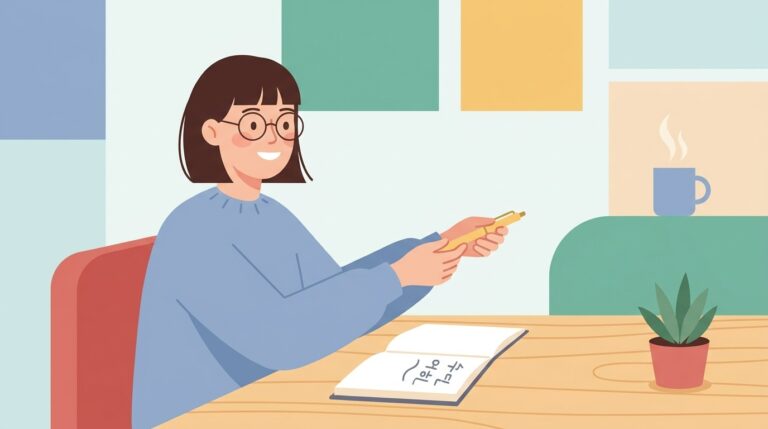
Borrowing a Pen in Korea Made Simple: Learn Polite Favors and Refusals
Phase 1: 공감 (Empathy & Warm Welcome)
안녕하세요! I’m your Daily Hangul editor. Imagine this: You are sitting at a cozy, sunlight-filled cafe in Seongsu-dong, filling out a lovely travel postcard to send back home. Suddenly, you realize you forgot your black pen! You look over at the friendly Korean student sitting at the next table, who has a neat pencil case filled with colorful pens. You want to ask, “Can I borrow a pen?” but your mind goes blank. Will you sound rude? Should you use formal grammar?
Don’t panic! Borrowing a pen is actually the ultimate low-stakes way to practice real-life Korean. In Korean culture, asking for small favors—like borrowing stationery or asking for directions—is completely normal as long as you use soft, polite phrasing. In fact, real-life learners tell us that mastering small favors gives them a huge boost in confidence when speaking to locals. By the end of this guide, you will master 3 easy core expressions, learn the magic buffer word ‘혹시’ (hoksi), and navigate small favors like a true local!
Phase 2: 핵심 표현 3선 심층 분석 (Top 3 Core Expressions)
1. 펜 좀 빌릴 수 있을까요? (Pen jom billil su isseul-kka-yo?)
- Pronunciation: Pen jom bil-ril soo ee-seul-kka-yo? (Flows softly like “pen-chom-bil-lil-soo”)
- Meaning: “Could I borrow a pen, please?” (Literal: Can I borrow a pen a little bit?)
- K-Culture Moment: A university student whispering politely to their neighbor at a quiet library in Seoul during midterms.
- Editor’s Insight: Adding ‘좀’ (jom)—which literally means ‘a little’—softens the entire request, making you sound humble and polite rather than demanding.
- Situation Spectrum: Casual (🚫) / Semi-formal (✅) / Formal (✅)
- 🤔 Think About It: Why do Koreans add ‘a little’ (좀) even when borrowing a whole item? How does softening requests show respect in your own culture?
2. 혹시 펜 있으세요? (Hoksi pen isseuseyo?)
- Pronunciation: Hok-si pen ee-sseu-se-yo? (Pronounced like “Hok-shee pen ee-sue-se-yo”)
- Meaning: “Do you happen to have a pen?”
- K-Culture Moment: Asking an office colleague or a boutique clerk before signing a document.
- Editor’s Insight: ‘혹시’ (hoksi) means “by any chance.” Starting a question with ‘혹시’ gives the other person an easy way out if they don’t have one, demonstrating great ‘Nunchi’ (눈치)!
- Situation Spectrum: Casual (⚠️) / Semi-formal (✅) / Formal (✅)
- 🤔 Think About It: In English, we say “By any chance…”. How does using buffer words lower social awkwardness?
3. 잠시만 쓸게요! (Jamsiman sseulgeyo!)
- Pronunciation: Jam-si-man sseul-ge-yo! (Pronounced like “Jahm-shee-mahn sseul-gae-yo”)
- Meaning: “I’ll just use it for a second!”
- K-Culture Moment: Quick check-in at a hotel reception desk or filling out an arrival card at Incheon Airport.
- Editor’s Insight: ‘잠시만’ means “for a short moment.” It reassures the owner that you won’t take their pen away or keep it long!
- Situation Spectrum: Casual (✅) / Semi-formal (✅) / Formal (⚠️)
- 🤔 Think About It: Reassuring people about time makes them feel safe to help. Do you have similar quick phrases in your language?
Phase 3: 교과서 한국어 vs 진짜 한국어 (Textbook vs. Real Korean)
Situation 1: Asking to borrow a pen
* 📖 교과서 한국어: “펜을 대여해 주시겠습니까?” (Pen-eul daeyeo-hae ju-si-get-seum-ni-kka? – Would you lend me a pen?)
* 🗣️ 진짜 한국어: “혹시 펜 좀 빌릴 수 있을까요?” (Hoksi pen jom billil su isseul-kka-yo?)
* 💡 왜 다를까?: Textbook expressions sound like a official legal contract! Native speakers soft-launch requests using ‘혹시’ (by any chance) and ‘좀’ (a bit) to create a warm atmosphere.
Situation 2: Refusing when you don’t have a pen
* 📖 교과서 한국어: “아니요, 펜이 없습니다.” (Aniyo, pen-i eop-seum-ni-da. – No, I do not have a pen.)
* 🗣️ 진짜 한국어: “죄송해요, 저도 펜이 없어서요…” (Joesong-haeyo, jeodo pen-i eop-seo-seo-yo…)
* 💡 왜 다를까?: Direct refusals feel cold in Korea. Ending a sentence trailing off with ‘-해서요…’ (because…) softly implies regret without feeling harsh.
Phase 4: K-Culture 딥다이브 & 비언어적 매너 (Culture & Body Language)
4-1. Nunchi & Gestures
When asking for or receiving a pen, body language speaks louder than words!
* Two-Hand Rule: Always receive and return the pen using two hands (or place your left hand gently under your right elbow).
* Head Nod: Offer a slight 15-degree head bow while saying “감사합니다” (Gamsahamnida).
* Eye Contact: Soft eye contact followed by looking down at the item shows modesty and respect.
4-2. K-Culture Code: Jeong (정) in Daily Life
In K-Dramas and daily life, sharing small items like stationery, umbrellas, or cough drops is a key way Koreans express ‘정’ (Jeong)—the warm emotional bond between people. Don’t be afraid to ask; most Koreans are delighted to help visitors!
Phase 5: 실전 롤플레이 시나리오 (Real-Life Roleplay)
Setting: A trendy cafe in Hongdae. You are sitting next to Minjun (민준), a university student studying with a laptop.
- You: 저기요, 혹시 펜 좀 있으세요? (Jeogiyo, hoksi pen jom isseuseyo?)
“Excuse me, do you happen to have a pen?”
🎭 Action: Point gently to your notebook with a friendly smile. - Minjun: 아, 펜이요? 잠시만요… (A, pen-iyo? Jamsimanyo…)
“Ah, a pen? Just a second…”
🎭 Action: Searches inside his pencil case. - Minjun: 여기 있어요! (Yeogi isseoyo!)
“Here you go!”
🎭 Action: Hands you a black gel pen with both hands. - You: 와, 정말 감사합니다! 잠시만 쓸게요. (Wa, jeongmal gamsahamnida! Jamsiman sseulgeyo.)
“Wow, thank you so much! I’ll just use it briefly.”
🎭 Action: Nod gently while accepting the pen with both hands. - Minjun: 천만에요. 편하게 쓰세요! (Cheonmaneyo. Pyeonhage sseuseyo!)
“You’re welcome. Take your time!”
🎭 Action: Smiles and goes back to typing. - You: (After writing) 다 썼습니다! 여기 있습니다. (Da sseotseumnida! Yeogi isseumnida.)
“I’m all done! Here it is.”
🎭 Action: Extend both hands to return the pen neatly. - Minjun: 네, 도움이 되었다니 다행이에요! (Ne, doumi doeotdani dahaeng-ieyo!)
“Great, glad it helped!”
🎭 Action: Accepts the pen warmly. - You: 감사합니다. 좋은 하루 보내세요! (Gamsahamnida. Joeun haru bonaeseyo!)
“Thank you. Have a great day!”
🎭 Action: Give a polite final head bow.
🔀 Interactive Branch: What if Minjun doesn’t have a pen?
* Option A: “아, 없어요? 알겠어요.” (Ah, eop-seoyo? Al-get-seoyo.)
* Option B: “아, 괜찮습니다! 감사합니다.” (Ah, gwenchanhseumnida! Gamsahamnida.)
* Option C: “왜 펜이 없으세요?” (Wae pen-i eop-seuseyo?)
Feedback:
* Option A [Risk]: Sounds a bit disappointed or curt.
* Option B [Best]: Perfect! You politely acknowledge their effort with a warm smile.
* Option C [Bad]: Very rude! Never ask why someone doesn’t carry a pen.
Phase 6: 10초 감정 섀도잉 드릴 (10-Sec Shadowing Drill)
Practice saying these lines with natural pauses (/) and emotional tone!
[🥺 Polite & Soft]혹시 / 펜 좀 / 빌릴 수 있을까요? (Hoksi / pen jom / billil su isseul-kka-yo?)[😊 Relieved & Grateful]와, / 정말 / 감사합니다! (Wa, / jeongmal / gamsahamnida!)[😔 Apologetic Refusal]죄송해요, / 저도 / 펜이 없어서요… (Joesong-haeyo, / jeodo / pen-i eop-seo-seo-yo…)
Phase 7: K-Culture 미니 사전 (Mini Dictionary)
- 혹시 (Hoksi) | By any chance | The ultimate buffer word to start any polite favor or request.
- 정 (Jeong) | Warm emotional connection | The unseen social glue in Korea built through sharing small favors.
- 눈치 (Nunchi) | Social tact/intuition | Reading the room before asking for help.
- 빌리다 (Billida) | To borrow / to lend | The key action verb used for borrowing items like pens or umbrellas.
Phase 8: 여행자를 위한 생존 키트 (Traveler’s Survival Kit)
Top 3 Survival Phrases
- 펜 좀 빌려주세요! (Pen jom bilryeo-juseyo!) – Please lend me a pen! (Pro Tip: Use at quick reception desks).
- 다 썼어요! (Da sseot-seoyo!) – I finished using it! (Pro Tip: Say this with a warm smile when returning items).
- 죄송하지만… (Joesong-hajiman…) – I’m sorry, but… (Pro Tip: Great gentle opener before asking favors).
Editor’s Travel Note
When navigating cafes or post offices in Seoul, having navigation ready is key! You can easily look up nearby locations using the Naver Map app for local navigation. Keep a small pen in your tote bag, but if you forget, don’t worry—just use your new polite Korean skills!
Phase 9: “한 발 더 깊이” (Reflection)
In Korean society, asking for a small favor isn’t seen as an annoyance—it is an opportunity to connect and share ‘Jeong’ (정). However, the secret lies in how you ask. By opening with ‘혹시’ (by any chance) and handing items over with both hands, you communicate deep respect for the other person’s space and time.
💬 Your Turn: Have you ever asked a local for a favor while traveling in Korea? How did it go? Share your experience in the comments below!
Phase 10: FAQ & 오해 방지 (FAQ & Common Mistakes)
Q: Can I just say “펜 주세요” (Pen juseyo) to borrow a pen?
A: “펜 주세요” literally means “Give me a pen.” It sounds like you are ordering or buying a pen from a shop! Always use “빌릴 수 있을까요?” (Can I borrow?) instead.
Q: What if someone refuses my request? How should I answer?
A: Smile warmly and say “아, 괜찮습니다! 감사합니다.” (Ah, it’s okay! Thank you.) to keep the interaction friendly.
Q: Do I need to use formal language with people my age?
A: Yes! When speaking to strangers of any age, always stick to polite informal (-요) or formal (-습니다) endings.
🚨 Common Mistakes TOP 3
- Mistake: Saying “펜 줘” (Pen jwo – Give pen) ➔ Correct Action: Use “펜 좀 빌릴 수 있을까요?”
- Mistake: Handing back the pen with one hand ➔ Correct Action: Use both hands with a gentle head nod.
- Mistake: Saying a blunt “없어요” when refusing ➔ Correct Action: Soften it with “죄송해요, 없어서요…”
Phase 11: 액션 미션 & 참여 유도 (Action Missions)
- 🥉 Bronze: Practice saying “혹시 펜 좀 빌릴 수 있을까요?” out loud 3 times in front of a mirror.
- 🥈 Silver: Leave a comment below making up a sample request sentence using the word ‘혹시’!
- 🥇 Gold: Next time you visit a Korean restaurant or cafe, ask for an extra napkin or pen using proper two-handed etiquette!
🎮 K-Culture Mission: Watch a K-drama study scene this week and count how many times characters say ‘혹시’ before asking a question!
Phase 12: 인터랙티브 퀴즈 챌린지 (Quiz Challenge)
Q1. What is the magic buffer word used before asking a favor in Korean?
A) 진짜 (Jinjja)
B) 혹시 (Hoksi)
C) 아마 (Ama)
Click to view Answer & Explanation
Answer: B) 혹시 (Hoksi) – It means “by any chance” and instantly softens any request!
Q2. True or False: When returning a borrowed pen to a stranger, it is fine to slide it across the table with one hand.
Click to view Answer & Explanation
Answer: False! Always return borrowed items with both hands and a small head bow to show respect.







