

Phase 1: Empathy (Storytelling Opening)
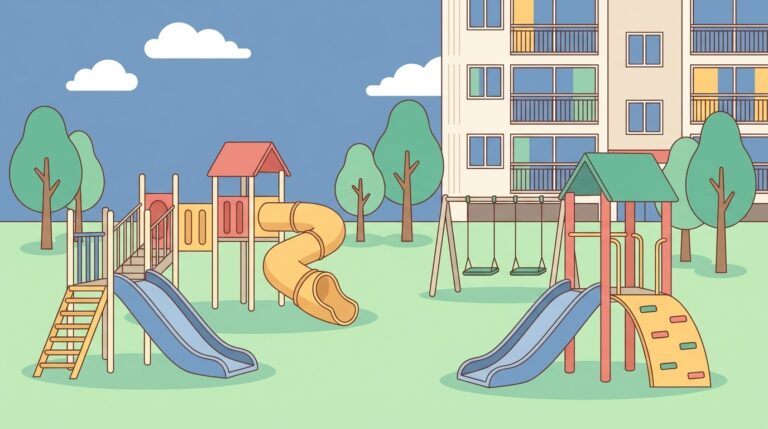
안녕하세요! I’m your Daily Hangul editor, your personal 10-year Korean culture navigator! Have you ever walked through a modern Korean apartment complex (아파트 단지) in Seoul? Tall buildings, manicured gardens, and right at the heart of it all—a vibrant, colorful playground (놀이터).
Picture this: You are sitting on a park bench, enjoying the cool breeze. A local kid runs up to you with a bright smile, holds out a bouncy ball, and looks at you expectantly. You want to say hi and invite them to play, but your mind goes blank! Is 안녕하세요 too formal for a six-year-old? How do you say “Let’s play!” without sounding like a Korean grammar textbook?
Don’t worry! Based on real feedback from hundreds of beginner learners living or traveling in Korea, this guide gives you the exact, bite-sized expressions you need. Master these simple words, and you’ll instantly feel like a welcoming neighbor in any Korean community!
Phase 2: Top 3 Core Expressions Deep Dive
1. 안녕! (An-nyeong!)
- Pronunciation: [An-nyeong] (Sounds like saying “Ah-young!” with a soft ‘n’)
- Meaning: Literal: “Peace!” | Actual: “Hi!” or “Bye!”
- K-Culture Moment: In almost every family K-Drama, kids wave their hands cheerfully and shout “안녕!” when running into playmates at the apartment courtyard.
- Editor’s Insight: This is the ultimate informal greeting. Use it with children, close friends, or younger people. Don’t use it with grandmas resting on the playground bench!
- Situation Spectrum: Casual ✅ | Semi-formal ⚠️ | Formal 🚫
- 🤔 Think About It: In English, “Hi” works for almost anyone. Why do you think Korean keeps a strict line between casual “안녕” and polite “안녕하세요” even in daily friendly settings?
2. 같이 놀자! (Ga-chi nol-ja!)
- Pronunciation: [Gah-chee nol-jah] (Sounds like “Gotcha nol-jah!”)
- Meaning: Literal: “Together let’s play!” | Actual: “Let me play with you!” / “Let’s play together!”
- K-Culture Moment: A child sitting alone on the swing set is approached by another child holding a jump rope saying, “같이 놀자!”
- Editor’s Insight: The ending ~자 (-ja) means “let’s”. It is friendly and energetic. It’s the magic key to making fast playground friends.
- Situation Spectrum: Casual ✅ | Semi-formal 🚫 | Formal 🚫
- 🤔 Think About It: How easy is it in your country to make a new friend just by walking up and saying one phrase?
3. 재미있다! (Jae-mi-it-da!)
- Pronunciation: [Jae-mi-eet-dah] (Sounds like “Gemmy eat dah!”)
- Meaning: Literal: “Fun exists!” | Actual: “This is fun!”
- K-Culture Moment: Sliding down a big yellow slide at full speed and laughing out loud with friends.
- Editor’s Insight: In spoken casual speech, kids and young adults usually drop the last sound and say “재미있어!” (Jae-mi-is-seo!).
- Situation Spectrum: Casual ✅ | Semi-formal ✅ | Formal ⚠️
- 🤔 Think About It: Notice how Korean describes feelings like fun (재미) as something that “exists” (있다) rather than an adjective you “are”?
Phase 3: Textbook Korean vs. Real Korean
Situation 1: Greeting a child at the slide
- 📖 Textbook Korean: 안녕하세요? 만난서 반갑습니다. (An-nyeong-ha-se-yo? Man-na-seo ban-gap-sum-ni-da.)
- 🗣️ Real Korean: 안녕! 반가워! (An-nyeong! Ban-ga-wo!)
- 💡 Why is it different? Speaking textbook formal Korean to a child in a playground sounds like a news anchor giving an official speech! Casual, warm speech bridges the distance instantly.
Situation 2: Asking to join a playground game
- 📖 Textbook Korean: 저와 함께 놀으시겠습니까? (Jeo-wa ham-kke nol-eu-si-get-seum-ni-ka?)
- 🗣️ Real Korean: 나도 같이 놀자! (Na-do ga-chi nol-ja!)
- 💡 Why is it different? Playground culture thrives on quick, simple enthusiasm. Short phrases keep the energy high and natural!
Phase 4: K-Culture Deep Dive & Non-Verbal Manners
4-1. Nunchi (눈치) & Playground Gestures
- The Two-Hand Wave: When greeting kids, a light two-handed wave or a quick palm wave at chest height creates an approachable vibe.
- Bowing to Elders: If an elderly resident (할머니 or 할아버지) is watching the kids from a bench, make eye contact and bow your head slightly (~15 degrees) with a polite “안녕하세요!”. This shows great 눈치 (situational awareness) and earns you immediate neighborhood affection.
4-2. Culture Code: The Korean Apartment Playground (놀이터)
In modern Korea, apartment complexes are gated micro-cities. The 놀이터 isn’t just for swings; it’s the social heart of community life. After 3:00 PM, after-school academy (학원) buses drop off kids, and parents gather on nearby benches to share local news and snacks. Understanding this space gives you a heartwarming peek into daily Korean family life!
Phase 5: Real-Life Roleplay Scenario
Setting: A sunny afternoon at the Mapo Apartment Playground. You are sitting near the swings. A friendly 7-year-old child named Min-jun (민준) walks up holding a sandbox toy.
- Turn 1 (Min-jun): 🎭 (Waves cheerfully with a big grin)
안녕! 혼자 있어? (An-nyeong! Hon-ja is-seo?) / Hi! Are you alone? - Turn 2 (You): 🎭 (Smiling warmly)
응, 안녕! (Eung, an-nyeong!) / Yeah, hi! - Turn 3 (Min-jun): 🎭 (Points to the swing set)
그네 탈래? (Geu-ne tal-lae?) / Want to ride the swing? - Turn 4 (You): 🎭 (Nodding eagerly)
좋아! 재미있겠다! (Jo-a! Jae-mi-it-get-da!) / Great! That sounds fun! - Turn 5 (Min-jun): 🎭 (Runs toward the slide next)
이것도 같이 놀자! (I-geot-do ga-chi nol-ja!) / Let’s play this together too! - Turn 6 (You): 🎭 (Following along enthusiastically)
그래, 같이 하자! (Geu-rae, ga-chi ha-ja!) / Sure, let’s do it together! - Turn 7 (Min-jun): 🎭 (Mother calls him from afar; he waves goodbye)
나 이제 갈게, 안녕! (Na i-je gal-ge, an-nyeong!) / I’m going now, bye! - Turn 8 (You): 🎭 (Waving back with both hands)
잘 가! 안녕! (Jal ga! An-nyeong!) / Bye! Take care!
🔀 Interactive Choice Point
Min-jun asks: “그네 탈래?” (Want to ride the swing?) What do you respond?
- Choice A: “안녕하십니까? 제 이름은 톰입니다.” (An-nyeong-ha-sim-ni-ka? Je i-reum-eun Tom-im-ni-da.)
- Choice B: “좋아! 같이 놀자!” (Jo-a! Ga-chi nol-ja!)
- Choice C: (Say nothing and bow 90 degrees strictly)
Feedback:
* Choice A (Risk): Too stiff! Min-jun might think you are a school principal or strict inspector!
* Choice B (Best!): Perfect! Energetic, natural, and friendly for an A1 level speaker!
* Choice C (Bad): Awkward! Children will be confused if you formal-bow without speaking.
Phase 6: 10-Second Emotion Shadowing Drill
Practice reading these out loud with the exact feeling in brackets! Use the / marks to pause briefly.
[😊 Cheerful & Welcoming]안녕! / 만나서 / 반가워! (An-nyeong! / Man-na-seo / ban-ga-wo!)[🎉 Super Excited]와! / 정말 / 재미있다! (Wa! / Jeong-mal / jae-mi-it-da!)[🤝 Friendly & Inviting]나랑 / 같이 / 놀자! (Na-rang / ga-chi / nol-ja!)
Phase 7: K-Culture Mini Dictionary
- 놀이터 (Nol-i-teo) | Playground | The outdoor play area inside Korean residential complexes.
- 아파트 (A-pa-teu) | Apartment | The primary residential housing style in modern South Korea.
- 그네 (Geu-ne) | Swing | A playground staple loved by Korean children of all ages.
- 미끄럼틀 (Mi-kkeu-reom-teul) | Slide | Literally translates to “slippery frame”.
Phase 8: Traveler’s Survival Kit
TOP 3 Survival Phrases
- 화장실 어디예요? (Hwa-jang-sil eo-di-ye-yo?) – Where is the restroom?
- Pro Tip: Apartment playgrounds usually don’t have public toilets; ask for the nearest community center bathroom.
- 조심해요! (Jo-sim-hae-yo!) – Be careful!
- Pro Tip: Use this if a child is running near a moving swing.
- 안녕! (An-nyeong!) – Bye! / Hi!
- Pro Tip: The easiest phrase to leave a warm impression when leaving.
Editor’s Travel Note
When visiting friends in Korea, navigating sprawling apartment complexes can be tricky! Download the Naver Map App Download before your trip. It pinpoints specific apartment building numbers (동) and playground zones with extreme precision!
Phase 9: One Step Deeper (Reflective Essay)
In many modern cities, urban apartments feel isolated and quiet. However, in Korea, the apartment complex playground acts as a social glue. It reflects the traditional Korean values of 정 (Jeong – warm affection and connection) and collective community care. Even as a foreigner, taking a moment to exchange friendly words at the local playground lets you experience authentic modern Korean warmth.
💬 Your Turn: Have you ever visited or seen a Korean apartment playground in a K-drama? What impressed you the most? Share your thoughts in the comments below!
Phase 10: FAQ & Common Mistakes
Q: Can I use “안녕” (An-nyeong) to elderly people in the playground?
A: No! “안녕” is casual speech (반말). Speaking casual speech to adults or elders is considered rude. Always say “안녕하세요?” (An-nyeong-ha-se-yo?) with a polite bow.
Q: What is the difference between 재미있어요 and 재미있다?
A: “재미있어요” (Jae-mi-is-seo-yo) is polite speech used when talking to others gently. “재미있다!” (Jae-mi-it-da!) is a simple exclamation like “This is fun!”
Q: Do I need to use complex honorifics with young kids?
A: Not at all! Kids feel much more comfortable when you speak friendly, simple casual Korean like “안녕!” and “같이 놀자!”.
🚨 Common Mistakes TOP 3
- Mistake: Bowing 90 degrees to a 5-year-old.
- Correct Action: Just wave your hand lightly and smile warmly!
- Mistake: Saying “당신” (Dang-sin) for “You”.
- Correct Action: Omit “you” completely! Just say “같이 놀자!” instead of “당신 같이 놀자”.
- Mistake: Pronouncing “같이” as “Gat-i”.
- Correct Action: It sounds like “Gah-chee”! Remember the ‘t’ transforms into a ‘ch’ sound.
Phase 11: Action Mission & Engagement
Action Mission 3-Steps
- 🥉 Bronze Mission: Practice saying “같이 놀자!” (Ga-chi nol-ja!) out loud 3 times in front of your mirror.
- 🥈 Silver Mission: Record your voice saying Phase 6 shadowing sentences and share it on Instagram tagging
@DailyHangul! - 🥇 Gold Mission: Spot an apartment playground in a Korean drama and spot if the kids say “안녕!” or “같이 놀자!”.
🎮 K-Culture Mission: Watch an episode of a slice-of-life K-drama (like Reply 1988 or Hospital Playlist) and count how many times neighbors greet each other around their residential building!
Phase 12: Interactive Quiz Challenge
Q1. Situation Judgment
You want to invite a friendly kid at the playground to ride the slide with you. Which phrase is best?
A) 식사하셨습니까?
B) 같이 놀자!
C) 죄송합니다.
🔍 Click to reveal Answer & Explanation
Correct Answer: B) 같이 놀자! (Ga-chi nol-ja!)
Explanation: “같이 놀자!” means “Let’s play together!”. Option A means “Have you eaten?” (too formal) and Option C means “I am sorry.”
Q2. Fill in the Blank
Complete the phrase for “This is fun!”:
“정말 _______!” (Jae-mi-it-da!)
🔍 Click to reveal Answer & Explanation
Correct Answer: 재미있다
Explanation: 재미있다 (Jae-mi-it-da) expresses excitement and fun!
Q3. True / False Culture Quiz
True or False: You should say “안녕!” to an elderly neighbor resting on the playground bench.
🔍 Click to reveal Answer & Explanation
Correct Answer: False!
Explanation: You should always use polite language like “안녕하세요?” (An-nyeong-ha-se-yo?) with elders to show respect.







