

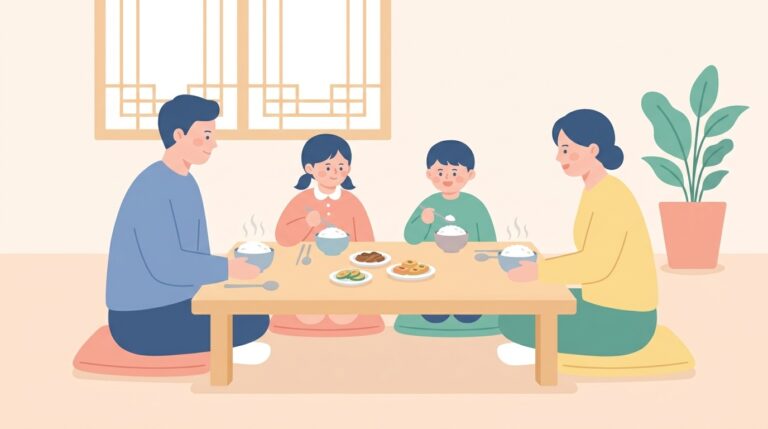
How Many People Are in Your Family? Talk About Your Family in Korean Like a Native
안녕하세요! (Annyeonghaseyo!) I’m your Daily Hangul editor and your 10-year Korean culture navigator! Have you ever been watching a warm Korean drama like Reply 1988 or hanging out with Korean friends at a cozy samgyeopsal restaurant, when someone suddenly asks: “가족이 몇 명이에요?” (How many people are in your family?)
Suddenly, your mind goes blank! Should you use hana, dul, set or il, i, sam? What counting word goes after the number? And wait—why did your Korean friend say jeohui (our) instead of nae (my) family?
If you’ve felt a moment of panic trying to count your family members in Korean, don’t worry at all. You are definitely not alone! Stating family count is one of the very first hurdles for A2 learners because Korean uses special native number forms combined with honorific counting units. Based on years of feedback from real learners, today I’ll give you the ultimate shortcut to talking about your family naturally, politely, and with total confidence. Let’s dive in together!
Phase 2: Core Expressions Deep Dive
1. 저희 가족은 네 명이에요. (Jeo-hui ga-jok-eun ne myeong-i-e-yo.)
- Pronunciation: Joh-hee gah-johk-eun neh myuhng-ee-eh-yoh (Think of “ne” like the first syllable of “net”, and “myeong” like the word “young” starting with an ‘M’).
- Meaning: Direct: “Our family is four people.” | Nuance: “There are four of us in my family.”
- K-Culture Moment: Seen frequently on Korean variety shows when guests introduce their family background during a cozy interview segment.
- Editor’s Insight: Notice the word 저희 (jeohui) instead of 우리 (uri). While both mean “our”, jeohui lowers yourself politely in front of the listener, making your Korean sound instantly polite and humble!
- Situation Spectrum: Casual (⚠️) | Semi-formal (✅) | Formal (✅)
- 🤔 Think About It: Why do Koreans prefer saying “our family” (jeohui/uri gajok) rather than “my family” (nae gajok)? What does this reveal about Korean community values?
2. 모두 몇 명이에요? (Mo-du myeot myeong-i-e-yo?)
- Pronunciation: Moh-doo myuht myuhng-ee-eh-yoh (Pronounce “myeot” with a quick, soft stop at the bottom).
- Meaning: Direct: “In total how many people is it?” | Nuance: “How many people are there in total?”
- K-Culture Moment: Asking family size before making dinner reservations or booking travel tickets for a family reunion trip.
- Editor’s Insight: 몇 (myeot) is the magical question word for “how many”. When paired with 명 (myeong)—the counting unit for people—it forms the core pattern for asking about headcount.
- Situation Spectrum: Casual (⚠️) | Semi-formal (✅) | Formal (✅)
- 🤔 Think About It: How does asking about someone’s family count in Korea signal personal interest and friendliness rather than intrusiveness?
3. 부모님하고 저, 이렇게 세 명이에요. (Bu-mo-nim-ha-go jeo, i-reoh-ke se myeong-i-e-yo.)
- Pronunciation: Boo-moh-neem-hah-goh juh, ee-ryuhk-keh seh myuhng-ee-eh-yoh
- Meaning: Direct: “Parents and me, like this three people.” | Nuance: “My parents and me, so three of us altogether.”
- K-Culture Moment: Sharing a meal at a K-BBQ place when explaining who you live with back home.
- Editor’s Insight: Adding 이렇게 (ireohke – like this / altogether) accompanied by a small hand gesture makes you sound amazingly natural, just like a local native speaker!
- Situation Spectrum: Casual (✅) | Semi-formal (✅) | Formal (⚠️)
- 🤔 Think About It: Notice how “부모님” (bumonim) uses the honorific suffix “-님” (-nim). How does respecting your parents through grammar shape daily speech?
Phase 3: Textbook Korean vs. Real Korean
Situation 1: Stating your family headcount
- 📖 Textbook Korean: 제 가족은 4명입니다. (Je gajogeun sa-myeong-im-ni-da.)
- 🗣️ Real Korean: 저희 가족은 네 명이에요! (Jeohui gajogeun ne myeong-i-e-yo!)
- 💡 Why is it different? Textbooks often mix Sino-Korean numbers (sa) with formal endings (im-ni-da), which sounds like a formal news anchor! Real Korean speakers use Native Korean numbers (ne) and the friendly, warm -e-yo ending.
Situation 2: Asking a senior/older person about their family
- 📖 Textbook Korean: 가족이 몇 명입니까? (Gajogi myeot myeong-im-ni-ka?)
- 🗣️ Real Korean: 식구가 어떻게 되세요? (Sikguga eotteohke doese-yo?)
- 💡 Why is it different? In real life, asking an adult using 식구 (sikgu) and 어떻게 되세요? (eotteohke doese-yo?) is much more respectful and elegant than directly asking “How many people?”.
Phase 4: K-Culture Deep Dive & Non-Verbal Manners
4-1. Nunchi & Gestures
When stating your family count, lower your head slightly in a soft polite nod as you say 저희 (jeohui). When counting on your fingers in Korea, start with an open hand and fold your fingers inward starting with your thumb (1 = thumb folded, 2 = index finger folded, etc.), or simply raise fingers clearly! Combining finger counting with 이렇게 (ireohke) adds immediate charm.
4-2. Cultural Code: 식구 (Sikgu) – The Eating Family
The Korean word for family members often used in daily conversation is 식구 (食口 – Sikgu), which literally translates to “eating mouths”. In Korean culture, family isn’t just about sharing bloodlines—it’s about sharing warm cooked rice (bap) around the same table. This is why in K-Dramas, family reconciliation almost always happens over a steaming bowl of homemade soup!
Phase 5: Real-Life Roleplay Scenario
Setting: A warm, aesthetic cafe in Hongdae, Seoul. You are having coffee with your Korean friend, Min-ji.
- Turn 1 (Min-ji): [😊 Smiling warmly] OO 씨, 한국 생활은 어때요? 가족들 많이 보고 싶죠?
(OO-ssi, hanguk saenghwareun eottaeyo? Gajokdeul mani bogo sipjyo?)
“How is life in Korea? You must miss your family a lot!” -
Turn 2 (You): [😌 Nodding gently] 네, 조금 보고 싶어요.
(Ne, jogeum bogo sipeoyo.)
“Yes, I miss them a little.” -
Turn 3 (Min-ji): [☕ Leaning in with curiosity] 가족이 모두 몇 명이에요?
(Gajogi modu myeot myeong-i-e-yo?)
“How many people are there in your family altogether?” -
Turn 4 (You): [✋ Raising 4 fingers with a smile] 저희 가족은 네 명이에요.
(Jeohui gajogeun ne myeong-i-e-yo.)
“There are four people in my family.” -
Turn 5 (Min-ji): [😃 Interested] 아, 네 명이요? 형제나 자매가 있어요?
(A, ne myeong-i-yo? Hyeongjena jamaega isseoyo?)
“Ah, four people? Do you have brothers or sisters?” -
Turn 6 (You): [😊 Pointing gently] 부모님하고 남동생, 이렇게 네 명이에요.
(Bumonim-hago namdongsaeng, ireohke ne myeong-i-e-yo.)
“Parents, younger brother, and me—four of us like this.” -
Turn 7 (Min-ji): [👍 Clapping hands] 와, 남동생이 있군요! 사이가 좋아요?
(Wa, namdongsaengi itgunyo! Saiga joayo?)
“Wow, you have a younger brother! Do you get along well?” -
Turn 8 (You): [😄 Laughing happily] 네! 아주 사이가 좋아요.
(Ne! A-ju saiga joayo.)
“Yes! We get along really well.”
🔀 Interactive Choice Point
Min-ji asks: “가족이 몇 명이에요?” How do you answer if you have 3 family members?
- Option A: “내 가족은 3 사람입니다.” (Nae gajogeun sam sarami-m-ni-da.)
- Option B: “저희 가족은 세 명이에요.” (Jeohui gajogeun se myeong-i-e-yo.)
- Option C: “세 개 있어요.” (Se gae isseoyo.)
— Feedback —
* Option A (Risk ⚠️): Nae (my) and sam sarami-m-ni-da sounds unnatural and overly robotic!
* Option B (Best ✅): Perfect! Using jeohui, Native Korean counter se, and honorific people unit myeong with -e-yo is 100% natural native standard!
* Option C (Bad 🚫): Gae (개) is used for objects (like apples or items), not people! Calling your family items will shock your friend!
Phase 6: 10-Second Emotional Shadowing Drill
Practice saying these out loud with rhythm and feeling!
- [😊 Happy & Proud] 저희 가족은 / 네 명이에요!
(Jeohui gajogeun / ne myeong-i-e-yo!) -
[🤔 Thoughtful & Gentle] 부모님이랑 저, / 이렇게 / 세 명이에요.
(Bumonim-irang jeo, / ireohke / se myeong-i-e-yo.) -
[✨ Warm & Polite] 식구가 / 모두 / 어떻게 되세요?
(Sikguga / modu / eotteohke doese-yo?)
Phase 7: K-Culture Mini Dictionary
- 식구 (Sikgu / 食口): Family members sharing meals together. Used in warm, homey contexts.
- 외아들 / 외딸 (Oeadeul / Oetdal): An only son / an only daughter. (e.g., “저는 외딸이에요” = I’m an only daughter).
- 몇 명 (Myeot myeong): “How many people”. Essential question combo for both family topics and restaurant seats!
- 저희 (Jeohui): The polite form of “our/we”. Standard for showing respect to your listener.
Phase 8: Traveler’s Survival Kit
Survival Expressions TOP 3
- [At Restaurants] 두 명이에요. (Du myeong-i-e-yo.) = “Table for two, please.”
- [At Ticket Booths] 모두 세 명이에요. (Modu se myeong-i-e-yo.) = “Three people in total.”
- [Polite Inquiry] 몇 분이세요? (Myeot bun-i-se-yo?) = “How many guests in your party?” (What waiters ask you!).
Editor’s Travel Note
When traveling in Korea with family, finding family-friendly places is super easy! Download the Naver Map App to search for rest stops and restaurants equipped with baby chairs or group seating.
Phase 9: One Step Deeper
In English, we instinctively say “my family”, “my house”, or “my school”. But in Korea, you will almost always hear “우리 가족” (our family) or “우리 집” (our house). This reflects the deep-rooted Korean cultural mindset of Jeong (정) and collective togetherness. Even single children say “our mom” (uri eomma)! Language isn’t just words—it’s a window into how a culture belongs together.
💬 Your Turn: How many people are in your family? Leave a comment below in Korean using “저희 가족은 [Number] 명이에요!” and I’ll personally check your Korean!
Phase 10: FAQ & Common Mistakes
Q: Should I use Native Korean numbers or Sino-Korean numbers for family count?
A: Always use Native Korean numbers! (1=한/하나, 2=두/둘, 3=세/셋, 4=네/넷, 5=다섯). Remember that 1, 2, 3, 4 drop their final consonant sound when attached to the counter 명 (han myeong, du myeong, se myeong, ne myeong).
Q: What is the difference between 명 (myeong) and 분 (bun)?
A: 명 (myeong) is the standard counter for people. 분 (bun) is the honorific version used when showing extra respect to elders or customers (e.g., 손님 두 분 = two guests).
Q: Can I say “우리 가족은 4개이에요”?
A: No! 개 (gae) is strictly for objects. Using gae for human family members is a major cultural mistake. Always stick to 명 (myeong) or 분 (bun)!
— 🚨 Common Mistakes TOP 3 —
1. ❌ Sa myeong (Sino number) ➡️ ✅ Ne myeong (Native number modification)
2. ❌ Nae gajok (In casual focus) ➡️ ✅ Jeohui gajok (Polite focus to strangers/friends)
3. ❌ Using gae (개) counter ➡️ ✅ Myeong (명) counter
Phase 11: Action Mission
- 🥉 Bronze: Say “저희 가족은 [X]명이에요” 3 times out loud in front of a mirror!
- 🥈 Silver: Write your family count sentence in the comments section below.
- 🥇 Gold: Next time you order at a Korean restaurant or talk to a Korean language partner, state your party/family headcount using native counters!
🎮 K-Culture Mission: Watch a K-Drama scene featuring a family dinner. Listen closely for whether they use 식구 (sikgu) or 가족 (gajok)!
Phase 12: Interactive Quiz Challenge
Test your knowledge!
- (Multiple Choice) Choose the correct sentence for “There are 4 people in our family”:
a) 저희 가족은 네 개이에요.
b) 저희 가족은 네 명이에요.
c) 내 가족은 사 명입니다. -
(Fill in the blank) 부모님이랑 저, 이렇게 [ ____ ] 명이에요. (Hint: 3 people)
-
(True/False) In Korea, calling family members “식구” (Sikgu) literally means “people who eat together”. (T/F)
👉 Click to reveal Quiz Answers & Explanations!
- Answer: b) 저희 가족은 네 명이에요. (Correct native number modification ‘네’ + counter ‘명’).
- Answer: 세 (se) (3 = 세 명).
- Answer: True! (식구 consists of 食 = eat, 口 = mouth!).







