

Phase 1: Empathy (Story-Driven Opening)
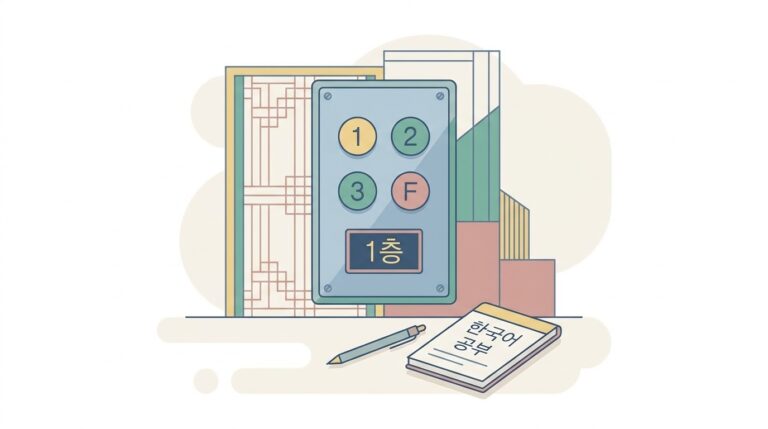
안녕하세요! I’m your Daily Hangul editor, your 10-year resident Korean culture navigator. Have you ever stepped into a sleek elevator inside a high-rise building in Gangnam, looked at the floor panel to press the 4th floor, and felt completely puzzled when you only saw 1, 2, 3, and… F?
You’re not alone! Almost every learner traveling or living in Korea experiences this exact ‘elevator moment.’ Is ‘F’ a secret floor? Is room 404 missing in hospitals? In Korea, the number 4 carries a deep-seated superstition known as tetraphobia. This isn’t just an old fable—it directly impacts real-estate pricing, building architecture, hospital floor planning, and everyday conversation.
Understanding why Koreans avoid the number 4 will not only save you from awkward elevator blunders, but it will also elevate your intermediate Korean (B2 level) by unlocking nuanced vocabulary rooted in Hanja (Sino-Korean characters). Based on feedback from hundreds of our intermediate learners, mastering these cultural expressions bridges the gap between sounding like a textbook software and sounding like a genuine native friend. Let’s dive into the fascinating psychology behind Korean numbers!
Phase 2: Deep Dive into 3 Key Expressions
1. 숫자 4는 죽을 사(死) 자랑 발음이 같아요
- Pronunciation: Sut-ja sa-neun ju-geul sa-ja-rang ba-reum-i ga-ta-yo (Sounds like: suit-jah sah-neun joog-eul sah-jah-rang bah-reum-ee gah-tah-yo)
- Meaning: “The number 4 has the same pronunciation as the Chinese character for death (死).”
- K-Culture Moment: You are explaining to a fellow foreigner why a hospital building jumps from the 3rd floor directly to the 5th floor or uses ‘F’.
- Editor’s Insight: At the B2 level, notice the construct
[Hanja character] 자(字)랑 발음이 같다. In Sino-Korean, four is 사 (四) and death is 사 (死). Because they are homophones, people instinctively associate the number with bad luck.- Situation Spectrum: Casual ✅ / Semi-formal ✅ / Formal ✅
- 🤔 Think About It: Does your native language have homophones that created widespread national superstitions (like the number 13 in Western culture or 14 in China)?
2. 4층 대신 F층이라고 써 있어요
- Pronunciation: Sa-cheung dae-shin F-cheung-i-ra-go sseo isseoyo
- Meaning: “Instead of the 4th floor, it’s written as ‘F’.”
- K-Culture Moment: Riding an elevator in a commercial building or apartment complex and guiding your friend toward the ‘F’ button.
- Editor’s Insight: ‘F’ stands for ‘Four’ or ‘Fourth’. Using ‘F’ is a modern compromise that respects traditional superstition while maintaining English-friendly architectural labeling.
- Situation Spectrum: Casual ✅ / Semi-formal ✅ / Formal ✅
- 🤔 Think About It: Why do you think modern Korean architecture chose the English letter ‘F’ rather than skipping the number entirely?
3. 굳이 불길하게 느낄 필요는 없어요
- Pronunciation: Gud-i bul-gil-ha-ge neu-kkil pyeol-yo-neun eop-seo-yo
- Meaning: “There’s no need to feel particularly ominous about it.”
- K-Culture Moment: Reassuring a coworker who got assigned to desk number 4 or room 404.
- Editor’s Insight: The word
불길하다(to be ominous/unlucky) is an advanced B2 descriptor. Paired with굳이(unnecessarily/persistently), this phrase shows emotional empathy and native level reassurance.- Situation Spectrum: Casual ✅ / Semi-formal ✅ / Formal ⚠️
- 🤔 Think About It: How do modern younger generations in your country balance old superstitious beliefs with modern rational logic?
Phase 3: Textbook Korean vs Real Native Korean
Situation 1: Explaining why someone avoids room number 4
- 📖 Textbook Korean: 4번 방은 죽음을 의미해서 불길합니다. (Room 4 is ominous because it signifies death.)
- 🗣️ Real Native Korean: 4번 방은 아무래도 좀 찜찜해서 피하게 돼요. (People tend to avoid room 4 because it just feels a bit uneasy.)
- 💡 Why the difference?: Natives rarely state flatly that 4 means death in casual settings; instead, they express psychological discomfort using
찜찜하다(feeling uncomfortable/uneasy).
Situation 2: Expressing your stance on superstitions
- 📖 Textbook Korean: 저는 미신을 믿지 않는 사람입니다. (I am a person who does not believe in superstitions.)
- 🗣️ Real Native Korean: 저는 미신 딱히 안 신경 써요. / 굳이 안 따져요. (I don’t really bother about superstitions / I don’t particularly adhere to them.)
- 💡 Why the difference?: B2 natural speech relies on adverbs like
딱히(not particularly) and verbs like신경 쓰다or따지다rather than formal declarations.
Phase 4: K-Culture Deep Dive & Non-Verbal Manners
4-1. Nunchi (눈치) & Gestures in Korean Elevators
When pressing elevator buttons in Korea with older colleagues or in formal settings, never make a big fuss about ‘F’ vs ‘4’. If someone asks you to press the 4th floor, simply press ‘F’ smoothly without over-explaining unless asked. Writing someone’s name in red ink (빨간색 이름 쓰기) is another related tabu associated with death—avoid doing this on greeting cards or sign-in lists!
4-2. Cultural Code Analysis
In K-Dramas and K-Travel contexts, pay attention to building layouts:
* Hospitals & Medical Centers: Almost universally skip floor 4 or use ‘F’ to ease patient anxiety.
* Apartment Buildings: Older apartments sometimes omit 4th floor unit numbers (e.g., jump from 302 to 501) or adjust prices slightly.
* K-Pop Fan Culture: Event seatings or lucky draw tickets labeled 4 are sometimes jokingly referred to as 피해야 할 숫자 (number to avoid), though young fans often treat it as a lighthearted joke.
Phase 5: Real-Life Roleplay Scenario
Setting: Alex (B2 Learner) is checking into a modern boutique hotel in Seoul with Minjun (Hotel Concierge).
- Minjun: 손님, 예약하신 방은 F층 4호입니다.
(Son-nim, ye-yak-ha-shin bang-eun F-cheung sa-ho-im-ni-da.)
“Sir, your reserved room is Room 4 on floor F.”
🎭 Hands keycard politely with two hands -
Alex: F층이요? 혹시 4층을 말씀하시는 건가요?
(F-cheung-i-yo? Hok-shi sa-cheung-eul mal-sseum-ha-shi-neun geon-ga-yo?)
“Floor F? Do you happen to mean the 4th floor?”
🎭 Tilt head slightly with a curious smile -
Minjun: 네, 맞습니다! 한국에서는 숫자 4 발음이 ‘죽을 사(死)’ 자와 같아서 F로 표기해요.
(Ne, mat-seum-ni-da! Han-guk-e-seo-neun sut-ja sa ba-reum-i ‘ju-geul sa’-ja-wa ga-ta-seo F-ro pyo-gi-hae-yo.)
“Yes, that’s correct! In Korea, the number 4 sounds like ‘death’, so we write it as F.”
🎭 Nods warmly and gestures toward the elevator -
Alex: 아, 사음 현상 때문이군요! 4층 대신 F를 쓰는 게 신기해요.
(A, sa-eum hyeon-sang ttae-mun-i-gun-yo! Sa-cheung dae-shin F-reul sseu-neun ge shin-gi-hae-yo.)
“Ah, because of the homophone superstition! It’s interesting to use F instead of floor 4.”
🎭 Smiles knowingly -
Minjun: 맞아요. 요즘 젊은 사람들은 딱히 안 신경 쓰지만, 여전히 건물에서는 F로 많이 써요.
(Ma-ja-yo. Yo-jeum jeolm-eun sa-ram-deul-eun ttak-hi an shin-gyeong sseu-ji-man, yeo-jeon-hi geon-mul-e-seo-neun F-ro man-i sseo-yo.)
“Exactly. Young people don’t care much these days, but buildings still use F commonly.” -
Alex: 그렇군요. 굳이 불길하게 느낄 필요는 없겠죠?
(Geu-reot-gun-yo. Gud-i bul-gil-ha-ge neu-kkil pyeol-yo-neun eop-get-jjo?)
“I see. There’s no need to feel ominous about it, right?” -
Minjun: 그럼요! 편하게 쉬시다 가시면 됩니다.
(Geu-reom-yo! Pyeon-ha-ge swi-shi-da ga-shi-myeon doem-ni-da.)
“Of course! Just relax and enjoy your stay.” -
Alex: 친절하게 설명해 주셔서 감사합니다!
(Chin-jeol-ha-ge seol-myeong-hae ju-seo-seo gam-sa-ham-ni-da!)
“Thank you for explaining it so kindly!”
🔀 Interactive Branching Point
When entering the elevator with an older Korean acquaintance, which button do you press for floor 4?
* Option A: Press the button labeled ‘F’ silently without commentary. (Best Choice)
* Option B: Loudly state: “여기 4층 대신 F라고 쓰여 있네요!” (Look, it says F instead of 4!) (Risk)
* Option C: Ask the acquaintance: “혹시 불길한데 계단으로 가실래요?” (Since it’s ominous, shall we take the stairs?) (Bad Choice)
Feedback: Option A demonstrates refined Nunchi (cultural tact). Option B brings unnecessary focus to an awkward superstition, and Option C overreacts to a minor societal custom.
Phase 6: 10-Second Emotion Shadowing Drill
Practice these lines out loud with exact rhythm and emotional inflection:
[😊 Curiosity & Light Realization]
아 / 4층 대신 / F층이라고 / 쓰는 거였군요!
(A / sa-cheung dae-shin / F-cheung-i-ra-go / sseu-neun geo-yeot-gun-yo!)-
[😅 Relieved & Reassuring Tone]
굳이 / 불길하게 / 느낄 필요는 / 전혀 없어요~
(Gud-i / bul-gil-ha-ge / neu-kkil pyeol-yo-neun / jeon-hyeo eop-seo-yo~) -
[🤔 Thoughtful B2 Tone]
숫자 4가 / ‘죽을 사’ 자랑 / 발음이 같아서 / 그렇군요.
(Sut-ja sa-ga / ‘ju-geul sa’-ja-rang / ba-reum-i ga-ta-seo / geu-reot-gun-yo.)
Phase 7: K-Culture Mini Dictionary
- 사음 현상 (Sa-eum Hyeon-sang) | Tetraphobia / Homophonic Avoidance of 4
- Usage: Academic or cultural term explaining why Sino-Korean 사 (4) and 사 (death) create linguistic avoidance.
- 찜찜하다 (Jjim-jjim-ha-da) | To feel uneasy / bothered / uncomfortable
- Usage: Used when something triggers a minor superstition or discomfort (e.g., “오늘 꿈자리가 좀 찜찜해요”).
- F층 (F-cheung) | Floor F (4th floor)
- Usage: Standard term printed on Korean elevators instead of the number 4.
- 길일 (Gil-il) | A lucky day / Auspicious date
- Usage: The opposite of unlucky numbers—choosing a good day for weddings, moving houses, or opening businesses.
Phase 8: Traveler’s Survival Kit
Top 3 Elevator & Superstition Survival Phrases
- F층이 4층 맞죠? (Is floor F the 4th floor?)
- Pro Tip: Use this at hotel front desks if you are unsure.
- 몇 층 눌러 드릴까요? (Which floor can I press for you?)
- Pro Tip: Polite etiquette when standing near the elevator control panel.
- 저는 숫자 신경 안 써요. (I don’t mind numbers/superstitions.)
- Pro Tip: Great line to express open-mindedness when assigned room 4.
Editor’s Travel Note
When navigating Korean cities, download the Naver Map App to find precise floor listings for restaurants and offices. Many popular Gangnam dessert cafes on floor 4 are labeled as floor F inside elevator directories!
Phase 9: One Step Deeper (Thinking Question)
Language reflects human desire to avoid misfortune and welcome safety. In Korean culture, homophones play a double role: while the number 4 is avoided due to its sound matching ‘death’ (死), other words like ‘돼지’ (pig) are loved because pig sound matches wealth and good fortune. This balance shows how deeply Sino-Korean roots shape everyday modern behavior.
💬 Your Turn: What numbers or symbols are considered taboo in your home culture? Have you ever noticed similar floor naming rules in your country? Share your stories in the comments below!
Phase 10: FAQ & Common Mistakes
Q: Do all elevators in Korea omit the number 4?
A: No! Modern subway stations, public government offices, and newer residential apartments often keep the number 4. However, hospitals, hotels, and commercial shopping complexes almost universally use ‘F’ or skip floor 4.
Q: Is it bad luck to write someone’s room number in red ink?
A: No, room numbers in red are fine, but writing a living person’s name in red ink is traditionally avoided because red ink was historically used on death registries.
Q: How do younger Koreans view the number 4 superstition?
A: Most younger Koreans (MZ generation) view it as a harmless myth rather than a real threat, but developers continue using ‘F’ out of respect for older generations and traditional norms.
🚨 Common Mistakes Board
- ❌ Mistake: Saying “4층은 죽음입니다” (Floor 4 is death).
- ✅ Correct Action: Use B2 emotional wording: “4층은 발음 때문에 좀 피하는 편이에요” (People tend to avoid floor 4 due to pronunciation).
- ❌ Mistake: Getting confused when an elevator panel goes 1, 2, 3, 5.
- ✅ Correct Action: Understand that floor 4 was completely skipped, so 5th floor is physically the 4th level.
Phase 11: Action Mission
- Bronze Level: Find an elevator panel in a Korean drama or real life and take a mental note of ‘F’ vs ‘4’.
- Silver Level: Record yourself speaking the sentence: “4층 대신 F층이라고 써 있어요” with natural intonation.
- Gold Level: Explain the reason for ‘F층’ in Korean to a study partner using the term ‘죽을 사 자’.
🎮 K-Culture Mission: Watch a scene from a Korean medical drama set in a hospital elevator. Check if the floor buttons show 1, 2, 3, F, 5!







