

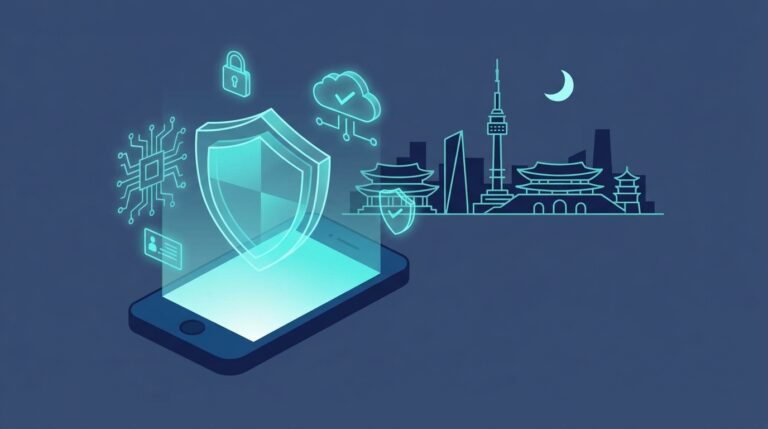
Master Advanced Korean for Cybersecurity & Personal Data Privacy (C1 Level)
Phase 1: Empathy & Context Setting
안녕하세요! 매일한글 에디터입니다.
Imagine this: You are working as a Product Manager at a fast-growing IT startup in Pangyo Techno Valley, South Korea’s Silicon Valley. Suddenly, your team lead bursts into the conference room with a grave expression, pointing to a server monitor: “팀장님, 고객 개인정보 유출 정황이 포착됐습니다!” (Team lead, we detected signs of customer personal data leakage!) If your mind goes blank or you can only think of basic beginner vocabulary like “비밀번호” (password), you might struggle to lead high-stakes tech discussions in Korea.
In South Korea’s hyper-connected digital ecosystem—where real-name mobile verification (본인인증), ultra-fast 5G, and integrated fintech platforms are part of daily life—cybersecurity and data protection are central to both corporate operations and tech thrillers like Voice or Unlocked.
Navigating C1-level Korean tech discourse requires moving beyond simple textbook grammar into nuanced terminology, formal compliance language, and vivid native workplace expressions. Based on feedback from foreign tech professionals in Korea, mastering these expressions gives you immediate credibility and professional authority in Korean business and IT environments. Let’s dive in!
Phase 2: Core Expressions Deep Dive
1. 유출되다 (Yuchul-doeda)
- Pronunciation: Yuchul-doeda (Sounds like “You-chool doe-dah”)
- Meaning: To be leaked / to be compromised (Data or confidential information).
- K-Culture Moment: Seen in corporate crisis scenes in Korean tech thrillers where sensitive customer databases get compromised by external hackers.
- Editor’s Insight: At the C1 level, distinguish ‘유출되다’ (accidental or unauthorized leak outward) from ‘유포되다’ (deliberate distribution/dissemination to the public). In official incident reports, ‘유출 사고’ (leak incident) is standard.
- Situation Spectrum: Casual ⚠️ | Semi-formal ✅ | Formal ✅
- 🤔 Think About It: Why does the Korean tech sector emphasize prompt public notification whenever ‘개인정보 유출’ occurs?
2. 보안 인증을 거치다 (Bo-an in-jeong-eul geo-chi-da)
- Pronunciation: Bo-an in-jeong-eul geo-chi-da (“Bo-ahn een-jeong-eul geo-chee-dah”)
- Meaning: To undergo / pass through security authentication.
- K-Culture Moment: Logging into Naver, Kakao Pay, or mobile banking apps when prompted for multi-factor authentication (MFA) via PASS or Kakao Certificate.
- Editor’s Insight: The verb ‘거치다’ means passing through sequential steps or gateways. Using it with ‘보안 인증’ shows a sophisticated understanding of multi-tiered security protocols.
- Situation Spectrum: Casual ⚠️ | Semi-formal ✅ | Formal ✅
- 🤔 Think About It: How does South Korea’s mandatory identity verification ecosystem impact daily app usage compared to your home country?
3. 개인정보 처리방침 (Gae-in-jeong-bo cheo-ri-bang-chim)
- Pronunciation: Gae-in-jeong-bo cheo-ri-bang-chim (“Gae-een-jeong-bo chuh-ree-bahng-cheem”)
- Meaning: Privacy Policy / Personal Data Processing Policy.
- K-Culture Moment: The mandatory fine-print popup when creating an account on Korean apps like Coupang, Baemin, or Toss.
- Editor’s Insight: Crucial for legal compliance and C1 business contexts. Pair this with ‘개인정보보호법’ (Personal Information Protection Act) during compliance discussions.
- Situation Spectrum: Casual 🚫 | Semi-formal ⚠️ | Formal ✅
- 🤔 Think About It: How do strict data privacy laws reflect Korean society’s balance between digital convenience and personal security?
Phase 3: Textbook Korean vs. Real Native Korean
Situation 1: Warning a coworker about a suspected password leak
- 📖 Textbook Korean: “비밀번호가 유출될 위험이 있으니 변경하십시오.”
- 🗣️ Real Native Korean: “비번 털린 것 같으니까 지금 바로 바꾸세요.”
- 💡 Why the difference? In casual IT office banter, Koreans shorten ‘비밀번호’ to ‘비번’ and use the vivid passive verb ‘털리다’ (slang for being looted/hacked) instead of formal passive verbs.
Situation 2: Requesting identity authentication during customer onboarding
- 📖 Textbook Korean: “본인 인증 절차를 완료해야 시스템 이용이 가능합니다.”
- 🗣️ Real Native Korean: “카카오 인증이나 PASS로 본인 확인 한 번만 찍어주세요.”
- 💡 Why the difference? Native tech users reference ubiquitous verification tools (Kakao/PASS) directly and use conversational expressions like ‘찍어주다’ (to complete/tap a step) in semi-formal workplace communication.
Phase 4: K-Culture Deep Dive & Non-Verbal Manners
4-1. Nunchi & Cybersecurity Gestures
In Korean corporate environments, showing ‘눈치’ (Nunchi – situational tact) regarding data security is vital. When typing passwords or viewing sensitive customer logs at shared desks or coffee shops, it is common courtesy to shield your screen angle or use a privacy screen filter (사생활 보호 필름). When discussing data leaks, maintaining a calm, serious posture without raising your voice in open workspaces demonstrates professional discretion.
4-2. Cultural Code: The ‘본인인증’ (Identity Verification) Ecosystem
South Korea operates one of the world’s most seamless yet strict digital identity systems. Virtually every online service requires identity verification linked to your mobile carrier and resident registration number (or Alien Registration Number for foreign residents). Understanding terms like ‘PASS 앱 인증’ or ‘2차 인증’ (Two-Factor Authentication) is not just technical jargon—it’s essential for living and working in Korea’s digital culture.
Phase 5: Real-World Roleplay Scenario
Setting: Emergency Incident Response Meeting at an IT Company in Pangyo.
Characters: Min-woo (CISO/Security Director) & Sarah (C1 International PM).
- 민우: 사라 씨, 방금 일부 사용자 계정에서 이상 로그인 시도가 감지되었습니다. (Sarah, unusual login attempts were just detected on some user accounts.)
- 🎭 Action: Looking intensely at the security dashboard.
- 사라: 혹시 개인정보가 유출된 정황도 있나요? (Are there any signs that personal data has been leaked?)
- 🎭 Action: Taking out a notebook with a focused expression.
- 민우: 아직 유출 여부는 확정되지 않았지만, 2차 인증을 거치지 않은 계정들이 위험합니다. (The leak isn’t confirmed yet, but accounts that haven’t undergone 2FA are at risk.)
- 🎭 Action: Pointing at server log charts.
- 사라: 그렇다면 해당 계정들의 접근 권한을 즉시 차단하고 비밀번호 재설정을 안내할까요? (Then should we immediately block access permissions for those accounts and issue password reset notices?)
- 🎭 Action: Nodding decisively.
- 민우: 좋은 판단입니다. 그리고 개인정보 처리방침에 따라 고객 공지문 작성을 준비해 주세요. (Good judgment. Also, please prepare a customer disclosure draft in accordance with our Privacy Policy.)
- 🎭 Action: Handing over compliance documentation.
- 사라: 네, 보안팀과 협력해서 유출 방지 대책도 함께 정리하겠습니다. (Understood. I will collaborate with the security team to summarize leak prevention measures as well.)
- 🎭 Action: Typing rapidly on laptop.
- 민우: 신속하게 대응해 주셔서 감사합니다. 피해를 최소화해 봅시다. (Thank you for reacting quickly. Let’s minimize any potential damage.)
- 🎭 Action: Giving a appreciative nod.
- 사라: 문제없습니다. 보안 가이드라인에 맞춰 처리 상황을 매시간 보고드릴게요. (No problem. I will report processing status every hour according to security guidelines.)
- 🎭 Action: Standing up to begin incident response.
🔀 Interactive Branching Point
Question: What should Sarah prioritize first when writing the technical incident report?
* Option A: “마케팅팀에 연락해 스팸 메일부터 차단하자고 한다.” (Contact marketing to block spam emails first.)
* ❌ Bad Feedback: Irrelevant to the current active breach scenario.
* Option B: “보안 인증을 강화하고 유출 범위 파악 보고서를 작성한다.” (Strengthen security auth and draft a scope analysis report.)
* ✅ Best Feedback: Excellent C1 professional execution! Addresses containment and compliance logically.
* Option C: “비밀번호를 바꿀 때까지 전체 서버를 그냥 꺼버린다.” (Shut down all company servers until passwords change.)
* ⚠️ Risk Feedback: Extreme reaction that halts business operations unnecessarily.
Phase 6: 10-Second Emotion Shadowing Drill
-
[😱 Urgent & Alert]
개인정보 유출 정황이 포착됐습니다! / 지금 바로 / 보안 조치를 취해야 합니다!
(Gae-in-jeong-bo yuchul jeong-hwang-i po-chak-dwaess-seub-ni-da! / Ji-geum ba-ro / bo-an jo-chi-reul chwi-hae-ya hab-ni-da!) -
[🧐 Professional & Decisive]
2차 인증을 거치지 않으면 / 시스템 접근 권한을 / 부여할 수 없습니다.
(I-cha in-jeong-eul geo-chi-ji ahn-heu-myeon / si-seu-tem jeog-geun gwon-han-eul / bu-yeo-hal ssu eobs-seub-ni-da.) -
[😊 Calm & Reassuring]
최신 보안 가이드라인을 준수하여 / 개인정보를 안전하게 보호하고 있습니다.
(Choe-sin bo-an ga-i-deu-ra-in-eul jun-su-ha-yeo / gae-in-jeong-bo-reul an-jeon-ha-ge bo-ho-ha-go iss-seub-ni-da.)
Phase 7: K-Culture Mini Dictionary
- 스미싱 (Smishing): SMS + Phishing. Fake text messages containing malicious link URLs mimicking delivery tracking or government agencies in Korea.
- 본인인증 (Bon-in-in-jeong): Real-name identity verification required for online services via SMS or authentication apps.
- 2차 인증 (I-cha in-jeong): Two-factor authentication (2FA/MFA) adding an extra security layer beyond simple passwords.
- 해킹 피해 (Hae-king pi-hae): Cybersecurity compromise or damages resulting from hacking incidents.
Phase 8: Traveler’s & Expat’s Survival Kit
Top 3 Tech Security Expressions:
- **
Frequently Asked Questions (FAQ)
Q: What does "유출되다 (Yuchul-doeda)" mean in Korean and how do you pronounce it?
A: In Korean, "유출되다 (Yuchul-doeda)" is pronounced [Yuchul-doeda (Sounds like "You-chool doe-dah"] and means: To be leaked / to be compromised (Data or confidential information).
Q: What does "보안 인증을 거치다 (Bo-an in-jeong-eul geo-chi-da)" mean in Korean and how do you pronounce it?
A: In Korean, "보안 인증을 거치다 (Bo-an in-jeong-eul geo-chi-da)" is pronounced [Bo-an in-jeong-eul geo-chi-da ("Bo-ahn een-jeong-eul geo-chee-dah"] and means: To undergo / pass through security authentication.
Q: What does "개인정보 처리방침 (Gae-in-jeong-bo cheo-ri-bang-chim)" mean in Korean and how do you pronounce it?
A: In Korean, "개인정보 처리방침 (Gae-in-jeong-bo cheo-ri-bang-chim)" is pronounced [Gae-in-jeong-bo cheo-ri-bang-chim ("Gae-een-jeong-bo chuh-ree-bahng-cheem"] and means: Privacy Policy / Personal Data Processing Policy.






