

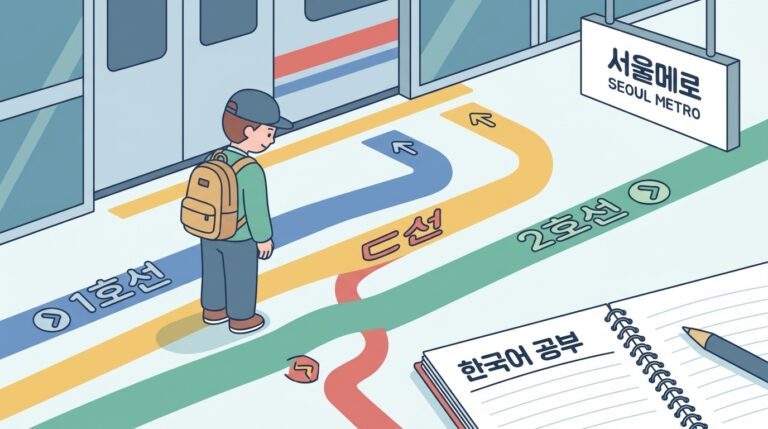
안녕하세요! This is your Daily Hangul editor. Imagine standing in the middle of Sindorim Station or Dongdaemun History & Culture Park during Seoul’s peak evening rush hour. Thousands of commuters move in a synchronized dance, colorful lines crisscross the floor, and subway announcements chime over the crowd. You look up at the complex map, realize you need to switch from Line 2 to Line 4, but the crowd is moving fast and you feel completely lost. Sound familiar? Many of our international learners share that exact moment of panic! But don’t worry—asking for transfer directions in Korean isn’t just about survival; it’s your key to navigating Korea with ultimate confidence. Based on feedback from hundreds of students who conquered Seoul’s subway system, this guide will turn that overwhelming transfer station into your personal playground. Let’s dive in!
Phase 2: Core Expressions Deep Dive
1. 어디서 환승해야 돼요? (Eodiseo hwanseung-hae-ya dwaeyo?)
- Pronunciation: [Eodiseo hwanseung-hae-ya dwaeyo?] (Sounds like: “Eo-dee-seoh hwan-soong hae-yah dwae-yo?”)
- Meaning: Where do I need to transfer? (Literal: Where must transfer occur?)
- K-Culture Moment: A panicked character in a K-drama rushing through a subway station asking a friendly commuter while holding a smartphone map.
- Editor’s Insight: While “환승” (hwanseung) is the official sino-Korean word for transfer, combining it with “-해야 돼요” makes it natural and polite for everyday interactions.
- Situation Spectrum: Casual ⚠️ | Semi-formal ✅ | Formal ✅
- 🤔 Think About It: Why do you think Korean uses specific Sino-Korean terms like ‘환승’ alongside native verb endings for polite public interactions?
2. 몇 호선으로 갈아타야 돼요? (Myeot hoseon-euro gara-taya dwaeyo?)
- Pronunciation: [Myeot hoseon-euro gara-taya dwaeyo?] (Sounds like: “Myeot ho-seon-eu-ro gah-rah-tah-yah dwae-yo?”)
- Meaning: Which line do I switch to? (Literal: To which line number should I change ride?)
- K-Culture Moment: Asking the subway station worker standing near the turnstiles when you aren’t sure if Line 3 or Line 5 goes to your destination.
- Editor’s Insight: “갈아타다” is a pure Korean verb meaning ‘to change rides’. It feels warm and conversational compared to the formal noun ‘환승’.
- Situation Spectrum: Casual ⚠️ | Semi-formal ✅ | Formal ✅
- 🤔 Think About It: How does asking for line numbers (호선) reflect Seoul’s systematically organized public transportation grid?
3. 이쪽으로 가면 [Line/Station] 나와요? (Ijjog-euro gamyeon [Line/Station] nawayo?)
- Pronunciation: [Ijjog-euro gamyeon… nawayo?] (Sounds like: “Ee-jjoh-geu-ro gah-myeon… nah-wah-yo?”)
- Meaning: If I go this way, will [Line/Station] appear?
- K-Culture Moment: Pointing toward a long underground corridor in Gangnam Station to double-check before walking 5 minutes.
- Editor’s Insight: Using the verb “나오다” (to come out/appear) is extremely natural in spoken Korean when asking if a path leads to a landmark.
- Situation Spectrum: Casual ⚠️ | Semi-formal ✅ | Formal ✅
- 🤔 Think About It: Notice how Korean direction phrasing focuses on visual confirmation (“does it appear?”) rather than abstract spatial logic.
Phase 3: Textbook Korean vs. Real Korean
Situation 1: Asking where to change lines
- 📖 Textbook Korean: 어디에서 환승을 해야 합니까? (Where must I make a transfer?)
- 🗣️ Real Korean: 어디서 갈아타면 돼요? (Where should I transfer?)
- 💡 Why different? Real spoken Korean truncates “어디에서” to “어디서” and prefers the friendly verb pattern “-면 돼요?” over stiff grammatical endings.
Situation 2: Confirming direction toward a transfer platform
- 📖 Textbook Korean: 4호선 승강장이 이 방향입니까? (Is the Line 4 platform in this direction?)
- 🗣️ Real Korean: 4호선 타려면 이쪽으로 가요? (Do I go this way to take Line 4?)
- 💡 Why different? Koreans prefer action-oriented phrasing (“타려면” – in order to ride) rather than formal noun phrases (“승강장” – platform).
Phase 4: K-Culture Deep Dive & Non-Verbal Manners
4-1. Nunchi & Gestures
When asking for directions in a fast-paced Korean subway station, eye contact combined with a soft head tilt shows immediate respect. Point with an open palm toward the hallway or sign rather than a single index finger. If someone is walking fast, say “저기요!” (Jeogiyo!) with a gentle bow to grab their attention politely without interrupting their pace.
4-2. Culture Code: The Color-Coded Subway Magic
Seoul’s subway station floors feature vibrant color-coded lines guiding you directly to transfer lines. Also, listen closely when your train approaches a transfer station—you will hear the traditional Korean orchestral melody “Pungnyu” (풍류) playing over the speaker! It’s a delightful K-travel signature indicating it’s time to gather your belongings.
Phase 5: Real Role-play Scenario
Setting: Express Bus Terminal Station (고속터미널역). You are on Line 3 trying to transfer to Line 7, but the signs look confusing.
NPC Character: Min-jun (A helpful local commuter holding a coffee).
- You: 🎭 (Politely holding up a phone map) 저기요, 죄송한데요. (Jeogiyo, joesonghandeyo. / Excuse me, I’m sorry to bother you.)
- Min-jun: 🎭 (Stopping and smiling friendly) 네! 무슨 일 있으세요? (Ne! Museun il isseuseyo? / Yes! How can I help you?)
- You: 🎭 (Pointing down the hallway) 7호선으로 갈아타려고 하는데, 어디로 가야 돼요? (Chil-hoseon-euro gara-taryeogo hande, eodiro gaya dwaeyo? / I’m trying to transfer to Line 7, where should I go?)
- Min-jun: 🎭 (Pointing toward the green floor strip) 아, 7호선이요? 저기 바닥에 초록색 선 보이시죠? (A, chil-hoseon-iyo? Jeogi badage choroksaek seon boisijyo? / Ah, Line 7? See that green line on the floor over there?)
- You: 🎭 (Looking down) 네, 초록색 선 보여요! (Ne, choroksaek seon boyeoyo! / Yes, I see the green line!)
- Min-jun: 🎭 (Gesturing forward) 그 선만 쭉 따라가시면 7호선 개찰구가 나와요. (Geu seonman jjuk ttaragasimyeon chil-hoseon gaechalguga nawayo. / Just follow that line straight, and the Line 7 gates will appear.)
- You: 🎭 (Bowing gratefully) 아, 그렇군요! 정말 감사합니다! (A, geureokgunyo! Jeongmal gamsahamnida! / Ah, I see! Thank you so much!)
- Min-jun: 🎭 (Waving hand lightly) 아니에요, 조심히 가세요! (Anieyo, josimhi gaseyo! / No problem, have a safe trip!)
🔀 Interactive Choice Point
Min-jun points to the green line, but you also see an escalator going down labeled with Line 9. What do you do?
* Option A: Say “아, 감사해요!” and sprint down the escalator without checking.
* Option B: Ask “7호선은 에스컬레이터 타고 내려가나요?” (Do I go down the escalator for Line 7?)
* Option C: Walk away silently following a crowd of people.
Feedback:
* Best Choice (Option B): Excellent! Double-checking saves you from accidentally paying twice or heading to Line 9!
* Risk (Option A): Danger! You might end up on the wrong platform and lose precious transit time.
* Bad Choice (Option C): Following random crowds in Seoul transfer hubs often leads to the wrong exit or line.
Phase 6: 10-Second Emotion Shadowing Drill
[🥺 Confused & Needing Help]저기요… / 7호선 갈아타는 데가 / 어디예요? (Jeogiyo… / chil-hoseon gara-taneun dega / eodiyeyo?)[😊 Relieved & Expressing Gratitude]아! / 이쪽으로 가면 되는군요 / 정말 감사합니다! (A! / ijjog-euro gamyeon doeneungunyo / jeongmal gamsahamnida!)
Phase 7: K-Culture Mini Dictionary
- 환승역 (Hwanseung-yeok) | Transfer Station | Subway stations connecting two or more lines (e.g., Hongdae, Gangnam).
- 호선 (Hoseon) | Line Number | Used to denote subway routes (e.g., 2호선 = Line 2).
- 개찰구 (Gaechal-gu) | Ticket Gate/Turnstile | Where you tap your transit card to enter or exit.
- 환승 할인 (Hwanseung Harin) | Transfer Discount | The system granting free/discounted transfers between subway and bus within 30 minutes.
Phase 8: Traveler’s Survival Kit
TOP 3 Survival Expressions
- 7호선 어디서 타요? (Chil-hoseon eodiseo tayo?) – Where do I catch Line 7? (Pro Tip: Short, direct, works every time!)
- 반대편에서 타야 돼요? (Bandaepyeon-eseo taya dwaeyo?) – Do I need to board on the opposite side? (Pro Tip: Great when you aren’t sure about the direction!)
- 이거 홍대 가요? (Igeo Hongdae gayo?) – Does this go to Hongdae? (Pro Tip: Ask commuters on the platform to confirm train direction.)
Editor’s Travel Note
Before navigating Seoul’s underground mazes, make sure to download the Naver Map App Download or KakaoMetro. T-Money cards work seamlessly across subways and buses, and remember to tap your card every time you transfer to enjoy the automated transfer discount!
Phase 9: One Step Deeper
Korean subway stations reflect Korea’s collective efficiency and community care. Notice how strangers gladly stop their busy commutes to walk tourists directly to their transfer gates. This kindness, rooted in Korea’s culture of “Jeong” (정), shows that transit is not just about moving between places, but connecting with people.
💬 Your Turn: Have you ever gotten lost in a foreign transit system? Share your favorite travel direction story in the comments below!
Phase 10: FAQ & Common Mistakes
Q: What should I say if I accidentally tapped my card at the wrong turnstile?
- A: Look for the “Help” button (비상벨) on the gate post. Press it, say “잘못 탔어요” (Jalmot tasseoyo – I got on by mistake), and the staff will open the gate for you.
Q: Can I use ‘갈아타다’ when switching from a subway to a bus?
- A: Yes! ‘갈아타다’ applies to any mode of transport, whether switching subway lines or transferring from train to bus.
Q: How do I know which subway car is best for a quick transfer?
- A: Look at smartphone apps like KakaoMetro or floor signs—they tell you the exact door number (e.g., Car 5-3) for the fastest transfer path.
🚨 Common Mistakes TOP 3
- Mistake: Pointing with one finger at strangers when asking directions. -> Correct Action: Use an open hand gesture with palm facing slightly up.
- Mistake: Saying “어디입니까?” loudly to busy commuters. -> Correct Action: Soften your approach with “저기요, 혹시…” (Jeogiyo, hoksi…).
- Mistake: Tapping out of turnstiles without checking transfer signs. -> Correct Action: Always look for the colorful internal transfer signs before exiting ticket gates!
Phase 11: Action Mission & Engagement
- 🥉 Bronze: Say “어디서 갈아타야 돼요?” out loud 3 times with shadowing drill intonation.
- 🥈 Silver: Practice asking for directions to Line 2 using a subway map image on social media and tag @DailyHangul.
- 🥇 Gold: Use your new expressions live on your next trip to Korea or in a conversation exchange class!
🎮 K-Culture Mission: Watch a modern K-drama episode set in Seoul and spot a scene inside a subway station! Note down if you hear the transfer music or see color-coded lines.
Phase 12: Interactive Quiz Challenge
Q1. Situation Judgment
You want to ask a friendly passerby if Line 4 is down this hallway. Which sentence is most natural?
🔍 View Answer & Explanation
Answer: “4호선 타려면 이쪽으로 가요?”
Explanation: Using “-려면” (in order to ride) + “이쪽으로 가요?” is the most natural, B1-level conversational phrasing for asking directions in real life!
Q2. Fill in the Blank
7호선으로 __________ 싶어요. 어디서 환승해요? (I want to switch to Line 7. Where do I transfer?)
* A) 갈아타고
* B) 내리고
* C) 타지 않이고
🔍 View Answer & Explanation
Answer: A) 갈아타고
Explanation: “갈아타고 싶어요” means “I want to transfer/switch rides”.
Q3. True/False Culture Quiz
True or False: Seoul subway stations have color-coded lines on the floor to help passengers find transfer lines easily.
🔍 View Answer & Explanation
Answer: True!
Explanation: Major transfer hubs in Seoul feature clear, colored floor lines guiding you directly to your desired transfer line.







