

Riding the Seoul Subway Like a Native: Navigating Personal Space and Manspreading Etiquette
Phase 1: Empathy & Storytelling
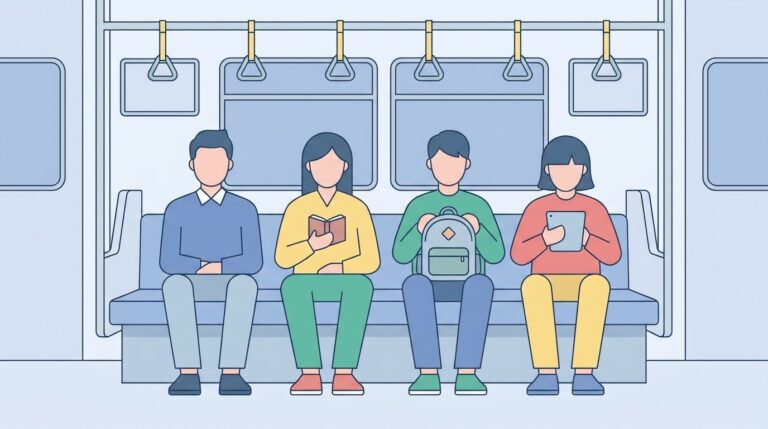
안녕하세요! I’m your Daily Hangul editor, your 10-year local culture navigator. Picture this: It’s 6:30 PM on Seoul Subway Line 2. You finally score an open seat after a long day exploring Hongdae. But just as you sit down, the person next to you spreads their legs at a 90-degree angle, pushing right into your knee space. You feel squeezed, uncomfortable, and unsure what to say. Should you speak up? Will you sound rude?
This is one of the most common micro-hurdles travelers and expats face in South Korea. In Korean online communities, this phenomenon even earned its own famous term: 쩍벌남 (jjeok-beol-nam), or ‘manspreader.’ Korean transit culture places a high value on public courtesy, and knowing how to politely assert your space—or avoid accidentally taking up someone else’s—will make your rides smooth and stress-free. Based on real learner feedback, this guide gives you the exact phrases, cultural nuance, and confidence to ride the Seoul metro like a natural local!
Phase 2: Core Expressions Deep Dive
1. 다리 좀 모아주세요
- Pronunciation: Da-ri jom mo-a-ju-se-yo (Think: Dah-ree johm moh-ah-joo-seh-yoh, sounds like ‘moah’ as in gathering things together)
- Meaning: ‘Please gather your legs a bit.’ (Literal) vs ‘Could you please narrow your stance?’ (Nuance)
- K-Culture Moment: You’ll frequently hear this on crowded subways, or see it featured in Korean comedy sketches depicting commute struggles.
- Editor’s Insight: The word ‘좀 (jom)’ is magic here! It softens the request from a direct command into a gentle nudge.
- Situation Spectrum: Casual ⚠️ | Semi-formal ✅ | Formal ✅
- 🤔 Think About It: How does your culture handle requests for personal space in public? Do people speak directly or prefer non-verbal signals?
2. 실례지만 자리 좀 좁혀주실 수 있나요?
- Pronunciation: Sil-rye-ji-man ja-ri jom job-hyeo-ju-sil su in-na-yo? (Seel-ryeh-jee-mahn jah-ree johm johp-hyoh-joo-seel soo een-nah-yoh?)
- Meaning: ‘Excuse me, but could you make a little room?’
- K-Culture Moment: Used in office commuting hours when someone’s bag or legs spill over onto the adjacent seat.
- Editor’s Insight: Starting with ‘실례지만 (excuse me, but)’ shows immediate respect and prevents the other person from feeling publicly shamed.
- Situation Spectrum: Casual ⚠️ | Semi-formal ✅ | Formal ✅
- 🤔 Think About It: In Korean, phrasing requests as potential abilities (‘can you…’) reduces social confrontation. Does your language do the same?
3. 쩍벌남
- Pronunciation: Jjeok-beol-nam (Jjyohk-beohl-nahm, with a crisp ‘Jj’ sound like ‘jet’ pronounced strongly)
- Meaning: Manspreader (Lit. Wide-spread legs man)
- K-Culture Moment: Frequently spotted in Korean online memes, webtoons, and news reports on subway etiquette campaigns.
- Editor’s Insight: This is a colloquial term (slang). While useful to know when chatting with friends, never address a stranger directly as ‘쩍벌남’!
- Situation Spectrum: Casual ✅ | Semi-formal 🚫 | Formal 🚫
- 🤔 Think About It: Why do you think slang words like this emerge in highly dense urban centers like Seoul?
Phase 3: Textbook Korean vs. Real Korean
Situation 1: Asking someone to move their legs
- 📖 Textbook: 다리를 벌리지 마십시오. (Da-ri-reul beol-li-ji ma-sip-si-o. – ‘Do not spread your legs.’)
- 🗣️ Real Korean: 다리 조금만 모아주세요~ (Da-ri jo-geum-man mo-a-ju-se-yo~ – ‘Please bring your legs in just a bit~’)
- 💡 Why the difference? Textbook commands sound like official police notices! Real Koreans use soft requests ending in ‘-주세요’ with modifying words like ‘조금만 (just a little)’ to preserve harmony.
Situation 2: Expressing that a seat feels cramped
- 📖 Textbook: 자리가 매우 좁습니다. (Ja-ri-ga mae-u job-seum-ni-da. – ‘The seat is very narrow.’)
- 🗣️ Real Korean: 조금만 붙어 앉아주실 수 있을까요? (Jo-geum-man bu-teo an-ja-ju-sil su iss-eul-kka-yo? – ‘Could we sit a bit closer together?’)
- 💡 Why the difference? Stating ‘the seat is narrow’ sounds like a complaint. Asking to ‘sit closer together’ frames it as a shared effort.
Phase 4: K-Culture Deep Dive & Non-verbal Manners
4-1. Nunchi (눈치) & Subtle Gestures
In Korea, non-verbal communication is half the language. If someone is spreading their legs:
1. The Shoulder Tuck: Shift your shoulders forward slightly and look down at the knee gap. This sends a silent ‘Nunchi’ signal.
2. The Soft Hand Motion: Gently press your own elbows inward or pat your outer thigh to signal cramped space.
3. Eye Contact: Avoid glaring directly into their eyes. Keep a neutral face while delivering ‘다리 좀 모아주세요’.
4-2. Public Transit Code: Jeong & Shared Space
Korean public transportation operates on high social trust and collective courtesy (공중도덕). In dramas like My Liberation Notes, the daily subway ride symbolizes the shared emotional weight of daily life. Occupying more than your designated seat isn’t just physical discomfort—it disrupts collective harmony (정/공공예절).
Phase 5: Real-World Roleplay Scenario
Setting: Seoul Subway Line 2 during evening rush hour. You sit next to a middle-aged commuter (Passenger) whose legs are wide open.
- Passenger: (휴대전화를 보며 다리를 벌리고 있다) Pushes against your seat area
- You: 저기요, 실례지만… (Jeo-gi-yo, sil-rye-ji-man…) 🎭 Tapping your knee lightly
- Passenger: 네? 무슨 일이시죠? (Ne? Mu-seun il-i-si-jo?) 🎭 Looking up from phone
- You: 다리 조금만 모아주실 수 있나요? (Da-ri jo-geum-man mo-a-ju-sil su in-na-yo?) 🎭 Polite smile
- Passenger: 아, 미안합니다. 제가 몰랐네요. (A, mi-an-ham-ni-da. Je-ga mol-ran-ne-yo.) 🎭 Pulls legs together immediately
- You: 감사합니다! (Gam-sa-ham-ni-da!) 🎭 Nodding head smoothly
- Passenger: 퇴근길이라 정신이 없었네요. (Toe-geun-gil-i-ra jeong-sin-i eob-seon-ne-yo.) 🎭 Smiling sheepishly
- You: 괜찮습니다! 편하게 가세요. (Gwaen-chan-seum-ni-da! Pyeon-ha-ge ga-se-yo.) 🎭 Relaxing back into seat
🔀 Interactive Choice Point
What would you say if the passenger doesn’t move right away?
* Choice A: “야! 다리 좀 좁혀!” (Ya! Dari jom job-hyeo!)
* Choice B: “죄송하지만 자리가 조금 좁아서요, 부탁드릴게요.” (Joe-song-ha-ji-man ja-ri-ga jo-geum job-a-seo-yo, bu-tak-deu-ril-ge-yo.)
* Choice C: “쩍벌남이시네요!”
Feedback:
* Choice A (Risk): Rude informal tone! Could cause an argument on the train.
* Choice B (Best): Perfect B1-level expression! Polite, soft, and effective.
* Choice C (Bad): Using slang directly to a stranger’s face will offend them!
Phase 6: 10-Second Emotion Shadowing Drill
Practice reading these out loud with the exact rhythm markers / and emotional tags:
[😊 Polite & Soft]다리 / 조금만 / 모아주세요. (Da-ri / jo-geum-man / mo-a-ju-se-yo.)[🥺 Apologetic & Gentle]실례지만 / 자리가 / 조금 좁아서요. (Sil-rye-ji-man / ja-ri-ga / jo-geum job-a-seo-yo.)[😌 Relieved & Warm]아, / 감사합니다! / 편안하게 가세요. (A, / gam-sa-ham-ni-da! / pyeon-an-ha-ge ga-se-yo.)
Phase 7: K-Culture Mini Dictionary
- 쩍벌남 (Jjeok-beol-nam): Manspreader. A compound of 쩍 (wide open) + 벌리다 (to spread) + 남 (man).
- 눈치 (Nunchi): Subtle art of reading the room, social awareness, and body language.
- 대중교통 에티켓 (Daejung-gyotong etiket): Public transit etiquette including phone manners, seat sharing, and voice volume.
- 배려석 (Baeryeoseok): Courtesy seats designated for pregnant women, elderly, or disabled passengers.
Phase 8: Traveler Survival Kit
TOP 3 Survival Expressions
- 다리 조금만 모아주세요. (Da-ri jo-geum-man mo-a-ju-se-yo.) – Please narrow your legs a bit.
- 지하철 자리가 좁아요. (Ji-ha-cheol ja-ri-ga job-a-yo.) – The subway seat is cramped.
- 잠시만 지나갈게요. (Jam-si-man ji-na-gal-ge-yo.) – Excuse me, passing through.
Editor’s Travel Note
Before riding the Seoul subway, make sure to download the Naver Map App Download and KakaoMetro app for live train layouts and transfer guides. Keep your backpack held in front during peak hours to save space!
Phase 9: One Step Deeper (Thinking Question)
In dense metropolitan areas like Seoul, physical space is at a premium. The concept of ‘공공예절’ (public decorum) isn’t just about rules; it reflects a deep-rooted cultural desire not to burden others (피해를 주지 않기). When you learn phrases that gently protect personal boundaries without causing conflict, you master both the language and the heart of Korean etiquette.
💬 Your Turn: Have you ever experienced manspreading on public transport in your home country? How did you react? Share your thoughts in the comments below!
Phase 10: FAQ & Common Mistakes
Q: Is manspreading illegal on Korean subways?
A: No, it is not illegal, but it is considered a major breach of public courtesy. Many metro stations feature posters discouraging it.
Q: Can I use the word ‘쩍벌남’ directly to someone?
A: Absolutely not! It is considered insulting slang. Always use polite requests like ‘다리 조금만 모아주세요’.
Q: What if an elderly person takes up extra space?
A: In Korean culture, respect for elders is paramount. It’s often best to gently adjust your position or quietly stand up rather than confront them directly.
🚨 Common Mistakes TOP 3
- Using ‘너’ or direct commands: Saying “다리 벌리지 마!” is hostile.
- Correct Action: Use honorific endings: “모아주세요”.
- Forgetting ‘조금만’ (just a little): Without this modifier, requests sound demanding.
- Correct Action: Always insert ‘조금만’.
- Ignoring non-verbal cues: Jumping straight to speaking without soft eye contact can surprise people.
- Correct Action: Make eye contact first, smile gently, then speak.
Phase 11: Action Mission & Engagement
- 🥉 Bronze Mission: Practice saying “다리 조금만 모아주세요” aloud 3 times in front of a mirror.
- 🥈 Silver Mission: Share this blog post on your SNS with your favorite Korean transit tip!
- 🥇 Gold Mission: Use this phrase or observe transit etiquette during your next trip to Korea or in a Korean dialogue practice session.
🎮 K-Culture Mission: Watch a K-Drama commute scene (e.g., Business Proposal or My Liberation Notes) and spot how passengers sit and react on the subway!
Phase 12: Interactive Quiz Challenge
Quiz 1: Situation Judgment
Which expression is the most polite and natural way to ask someone to close their legs on the train?
* A) 쩍벌하지 마세요!
* B) 다리 조금만 모아주실 수 있나요?
* C) 저기요, 비키세요.
Click to reveal answer
Answer: B
Explanation: Option B uses polite honorifics and the soft modifier ‘조금만’. Option A uses direct slang, and Option C is excessively blunt.
Quiz 2: Fill in the Blank
Complete the sentence: “실례지만 자리가 조금 ______ 모아주세요.”
* A) 넓으니까
* B) 좁아서요
* C) 없어서
Click to reveal answer
Answer: B
Explanation: ‘좁아서요’ means ‘because it’s narrow/cramped’, making it the logical cause for asking someone to adjust their space.
Quiz 3: True / False Culture Quiz
True or False: Calling a stranger ‘쩍벌남’ to their face is considered acceptable in daily Korean conversation.
Click to reveal answer
Answer: FALSE
Explanation: ‘쩍벌남’ is a slang/descriptive term used when talking about someone behind their back or online, never directly to a stranger.







