

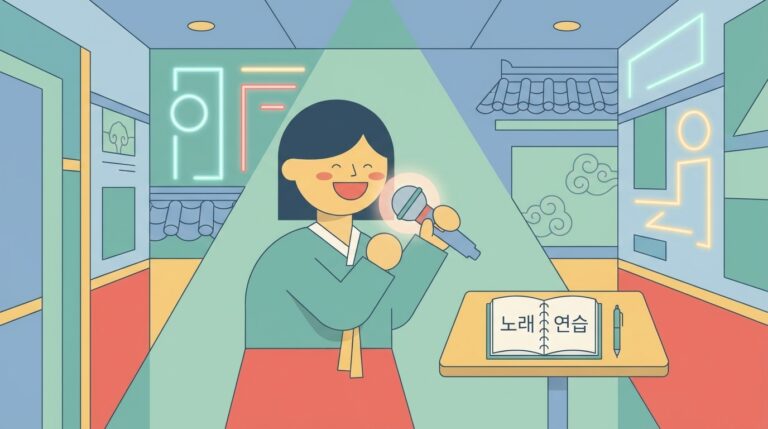
Release Your Stress at a Korean Noraebang Like a Local!
안녕하세요! 매일한글 에디터입니다. (Hello! This is your Daily Hangul Editor.)
Have you ever had one of those exhausting days in Korea where your shoulders feel heavy, your brain is overloaded with work or travel logistics, and all you want to do is hit the reset button? If you ask any local in Seoul how they shake off that suffocating pressure, nine times out of ten, they’ll point you straight to a glowing sign reading 노래방 (Noraebang).
Imagine stepping into a dimly lit, soundproofed room with colorful disco lights pulsing against the walls. You grab the vintage wireless microphone, smash the echo button, and scream your heart out to a high-pitched rock ballad or an intense K-Pop beat. By the time you step back into the cool night air, your vocal cords might be raspy, but your mind is weightless.
Screaming in a Noraebang isn’t just about singing—it’s a deeply rooted socio-cultural ritual for emotional catharsis in Korea. Today, we’re delving into intermediate (B2 level) Korean expressions, real-life nuances, and etiquette so you can confidently step into a Noraebang and let off steam like a native!
Phase 2: 3 Core Expressions for the Ultimate Noraebang Catharsis
1. 스트레스가 확 풀려요 (Seuteureseuga hwak pfullyeoyo)
- Pronunciation: [seuteureseuga hwak pfullyeoyo] (Sounds like: seuh-teu-reh-seuh-gah hwahk pool-ryeo-yo — think of ‘hwak’ like a sudden, energetic gust of wind blowing away dust).
- Meaning: Literal: “Stress unwinds completely at once.” / Nuance: “My stress is instantly blown away!”
- K-Culture Moment: After singing three intense high-note songs in a row (like IU’s Good Day or Steelheart’s She’s Gone), your friend passes you a bottle of water and asks how you feel.
- Editor’s Insight: The adverb 확 (hwak) is an expressive sound-mimicking word signifying a dramatic, sudden change. Combining it with 풀리다 (to be untied/released) emphasizes complete catharsis.
- Situation Spectrum: Casual (✅), Semi-formal (✅), Formal (⚠️)
- 🤔 Think About It: Does your culture have a specific word for instant, dramatic emotional release through sound?
2. 목이 쉬도록 불렀어요 (Mogi swidorok bulleosseoyo)
- Pronunciation: [mogi swidorok bulleosseoyo] (Sounds like: moh-gee swee-doh-rohk bool-reoh-sseo-yo — ‘swi’ feels like whispering ‘shee’).
- Meaning: Literal: “I sang until my neck/throat went hoarse.” / Nuance: “I sang my lungs out!”
- K-Culture Moment: Arriving at the office or school the next morning with a raspy voice, sipping warm tea while proudly explaining your wild night out.
- Editor’s Insight: -도록 (dorok) is a B2-level grammatical connector meaning “to the point where” or “until.” It shows how extreme your action was.
- Situation Spectrum: Casual (✅), Semi-formal (✅), Formal (🚫)
- 🤔 Think About It: Why is physical exhaustion after singing celebrated as a sign of stress relief in Korea?
3. 목청껏 떼창을 했어요 (Mokcheongkkeot ttechangeul haesseoyo)
- Pronunciation: [mokcheongkkeot ttechangeul haesseoyo] (Sounds like: mohk-cheong-kkeot tteh-chang-eul hae-sseo-yo — ‘tte’ requires tense vocal cords like ‘T-Rex’).
- Meaning: Literal: “I sang in unison at the top of my throat.” / Nuance: “We shouted a mass sing-along with everything we had!”
- K-Culture Moment: When the chorus of a classic anthem hits and every single person in the room stands up, raising their tambourines, screaming every lyric together.
- Editor’s Insight: 떼창 (ttechang) combines 떼 (crowd/group) and 창 (singing). It’s a core element of Korean concert and Noraebang culture.
- Situation Spectrum: Casual (✅), Semi-formal (⚠️), Formal (🚫)
- 🤔 Think About It: How does group singing foster solidarity in high-stress societies?
Phase 3: Textbook Korean vs. Real Native Korean
Situation 1: Expressing that you are feeling relieved of stress
- 📖 Textbook Korean: 노래를 불러서 스트레스가 해소되었습니다. (Noraereul bulleoseo seuteureseuga haesodeoeeosseumnida. – “Stress was resolved by singing.”)
- 🗣️ Real Native Korean: 지지르고 나니까 스트레스가 싹 가셨어요! (Jijireugo nanikka seuteureseuga ssak gasyeosseoyo! – “After screaming it out, my stress completely washed away!”)
- 💡 Why the difference?: Natives rarely use formal Sino-Korean words like ‘해소’ in casual conversations. Verbs like 지르다 (to scream/shout) and adverbs like 싹 (completely/cleanly) add vivid emotion.
Situation 2: Asking someone what their favorite song to sing is
- 📖 Textbook Korean: 자주 부르는 노래가 무엇입니까? (Jaju bureuneun noraega mueosimnikka? – “What is the song you sing frequently?”)
- 🗣️ Real Native Korean: 18번 곡이 뭐예요? / 최애 노래가 뭐예요? (Sipalbeon gogi mwoyeyo? / Choe-ae noraega mwoyeyo? – “What’s your go-to track #18? / What’s your absolute fav song?”)
- 💡 Why the difference?: 18번 (Sipalbeon) is a classic idiom meaning one’s favorite go-to song, while 최애 (Choe-ae) is modern trend slang used heavily among younger generations.
Phase 4: K-Culture Deep Dive & Non-Verbal Manners
4-1. Noraebang Etiquette & Nunchi (눈치)
- The Remote Control Hierarchy: Never snatch the remote control (리모컨) while someone else is selecting a song unless you are asked to enter numbers for them!
- The Tambourine Duty: If you aren’t singing, show your support by shaking the tambourine in rhythm. Standing motionless while staring at your phone is considered a major atmosphere-killer (분위기 깨기).
- Chorus Stealing: Do NOT sing along into the second microphone during someone’s solo track unless they invite a 떼창 (sing-along).
4-2. The Evolution of Coin Noraebang (코노)
In the past, Noraebang was a group activity for corporate dinners (회식). However, modern Korean youth heavily utilize Coin Noraebang (코노 – Kono). For 1,000 KRW (~$0.75 USD), you can sing 2 or 3 songs solo in a mini-booth during lunch breaks or after school to instantly vent frustration.
Phase 5: Real-Life Roleplay Scenario
- Setting: Friday night at a bustling Coin Noraebang in Hongdae. You and your Korean friend Minjun (민준) are unwinding after a tough week.
1. 민준: 오늘 회사 일 때문에 진짜 힘들었지? (🎭 Sighs heavily and sits on the leather couch)
   [Oneul hoesa il ttaemune jinjja himdeureotji?]
   "Work was really tough today, right?"

2. 독자: 응, 머리가 터질 것 같아. 오늘 목 쉴 때까지 질러보자! (🎭 Clenches fist with determination)
   [Eung, meoriga teojil geot gata. Oneul mok swil ttaekkaji jilleoboja!]
   "Yeah, my head feels like exploding. Let's scream until our voices go hoarse tonight!"

3. 민준: 좋다! 일단 네 18번 곡부터 예약해. (🎭 Hands over the large illuminated remote control)
   [Jota! Ildan ne sipalbeon gokbuteo yeyakhae.]
   "Awesome! Reserve your go-to favorite track first."

4. 독자: 고마워! 나 스트레스 확 풀리게 신나는 댄스 곡으로 할게. (🎭 Rapidly presses song digits on the remote)
   [Gomawo! Na seuteureseuga hwak pfullyeoge sinnaneun daenseu gogeuro halge.]
   "Thanks! I'll pick an exciting dance track to blow off stress instantly."

5. 민준: 좋아, 내가 템버린으로 비트 맞춰줄게! (🎭 Shakes two tambourines vigorously above his head)
   [Joa, naega taembeorineuro biteu matchwojulge!]
   "Great, I'll match the beat with tambourines!"

6. 독자: 후렴구 나오면 같이 떼창 해야 돼! (🎭 Points microphone toward Minjun while dancing)
   [Huryeomgu naomyeon gachi ttechang haeya dwae!]
   "When the chorus comes, you have to sing along with me!"

7. 민준: 당연하지! 오늘 스트레스 싹 날려버리자! (🎭 Stands up and shouts into his mic)
   [Dangyeonhaji! Oneul seuteureseu ssak nallyeobeorija!]
   "Of course! Let me blow all that stress away today!"

8. 독자: 와, 소리 지르니까 속이 다 시원하다! (🎭 Takes a deep breath with a relieved smile)
   [Wa, meori-reul jireunikka sogi da siwonhada!]
   "Wow, screaming it out makes my chest feel so refreshed!"
🔀 Interactive Branching Choice
Minjun asks: “다음 곡은 슬픈 발라드 부를까, 아니면 더 신나는 로크 곡 부를까?” (Should we sing a sad ballad next or an even wilder rock song?)
- Choice A: “더 신나게 지를 수 있는 록 노래로 가자!” (Let me scream louder with a rock song!)
- 🏆 Best: Perfect match for the energy! You both max out the volume and blow off all remaining stress.
- Choice B: “갑자기 분위기 다운되게 슬픈 노래 부르자.” (Let’s sing a sad song to cool down suddenly.)
- ⚠️ Risk: It might kill the hyped atmosphere, but good if you need to cry out your stress.
- Choice C: “이제 힘드니까 그냥 집에 갈래.” (I’m tired now, so I want to go home.)
- 🚫 Bad: Kills the mood prematurely after only one song!
Phase 6: 10-Second Emotional Shadowing Drill
Practice these lines out loud with feeling! Pay attention to the pause markers (/).
[🔥 패기 넘치게 - With high energy]
오늘 / 목이 쉬도록 / 불러볼 거예요!
(Oneul / mogi swidorok / bulleobol geoyeyo!)-
[😌 속시원한 감정 - With deep emotional relief]
소리를 지르고 나니까 / 속이 다 시원해요!
(Sorireul jireugo nanikka / sogi da siwonhaeyo!) -
[🎉 흥분된 톤 - With excitement]
다 같이 / 떼창 합시다 / 소리 질러!
(Da gachi / ttechang hipsida / meori jilleo!)
Phase 7: K-Culture Mini Dictionary
- 코노 (Kono) | Abbreviation for ‘Coin Noraebang’. Small automated karaoke booths paid per song.
- 서비스 (Seobiseu) | Free extra time added by the owner! If your timer suddenly jumps from 5 mins to 30 mins, say “감사합니다!”
- 애창곡 (Aechanggok) | A song you love to sing repeatedly.
- 우린 차트 (Melon Chart Top 100) | The default hit playlist everyone browses when undecided on song selection.
Phase 8: Traveler’s Survival Kit
TOP 3 Survival Phrases
- 서비스 좀 주세요! (Seobiseu jom juseyo!) — “Please give us some extra free minutes!”
- 음정 좀 낮춰 주세요. (Eumjeong jom natchwo juseyo.) — “Please lower the key sound pitch.”
- 마이크 커버 새로 주세요. (Maikeu keobeo saero juseyo.) — “Please give us a fresh sanitary mic cover.”
Editor’s Travel Note
When navigating night entertainment areas in Seoul, download the Naver Map Application to quickly search for high-rated Coin Noraebang (코노) nearby. Most accept local credit cards or 1,000 KRW cash bills directly at the room kiosks.
Phase 9: A Step Deeper — The Humanities Perspective
In western cultures, singing loudly in public space is often strictly controlled. However, in modern South Korea—a hyper-fast society driven by intense competition—Noraebang functions as a socially sanctioned high-pressure release valve. Expressing emotions together through 떼창 (unison singing) fosters deep emotional bonds and collective healing, turning personal fatigue into shared catharsis.
💬 Your Turn: What is your absolute go-to song when you need to scream away stress? Let us know in the comments below!
Phase 10: FAQ & Common Mistakes
Q: Can I go to a Noraebang alone in Korea without feeling awkward?
A: Absolutely! Coin Noraebang (코노) was specifically created for solo singers (혼코노). Nobody will judge you!
Q: What does ‘서비스 (Seobiseu)’ mean on the timer screen?
A: It means the generous owner added free extra time to your session! You don’t have to pay extra for it.
Q: Is it okay to scream as loud as possible?
A: Yes! Noraebangs have insulated soundproof walls meant specifically for loud shouting.
🚨 Common Mistakes TOP 3
- Mistake: Using formal dictionary verbs like 스트레스를 해소합니다 in casual chat.
- Correct Action: Use 스트레스가 확 풀려요! or 스트레스 날렸어요!
- Mistake: Entering the room with shoes off.
- Correct Action: Unless it’s an elevated ondol-style wooden floor booth, keep your shoes on!
- Mistake: Forgetting to put on the plastic sanitary cover (마이크 커버) on the microphone.
- Correct Action: Always wrap the fresh rubberized cover over the mic head before singing.
Phase 11: Action Missions
- Bronze Mission: Say “스트레스가 확 풀려요!” out loud three times while focusing on natural intonation.
- Silver Mission: Share a video or story on social media of your favorite Korean song with the hashtag
#DailyHangul_Noraebang. - Gold Mission: Visit a Coin Noraebang, request extra time using “서비스 주세요!”, and sing a song until your voice gets hoarse!
🎮 K-Culture Mission: Watch a scene from a K-Drama where characters go to a Noraebang after work and spot how they use tambourines!
Phase 12: Interactive Quiz Challenge
Quiz 1. Situation Judgment
When you want to tell your Korean friend that your stress was completely removed after singing loud rock songs, which expression is best?
– A) 스트레스가 해소되었습니다.
– B) 스트레스가 확 풀렸어요!
– C) 목이 쉬었습니다.
🔍 View Answer & Explanation
Correct Answer: B
Explanation: B is natural, energetic, and expresses instant emotional catharsis in casual conversation!
Quiz 2. Fill-in-the-Blank
“오늘 노래를 너무 많이 불러서 [ ] 쉬었어요.”
🔍 View Answer & Explanation
Correct Answer: 목이 (throat/neck)
Explanation: 목이 쉬다 means ‘throat goes hoarse’.
Quiz 3. True or False
In Korea, ‘서비스 (Seobiseu)’ at a Noraebang means you must pay extra money for food.
🔍 View Answer & Explanation
Correct Answer: False
Explanation: ‘Service’ refers to free bonus minutes added to your karaoke timer by the store manager!







