

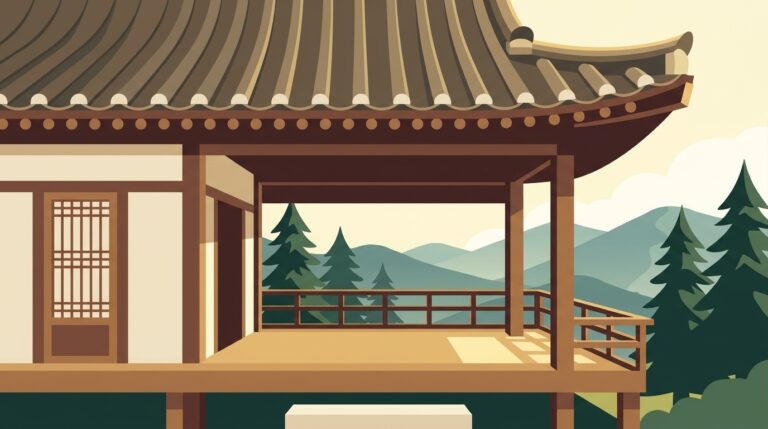
Unlocking Hanok Mechanics: Master C1-Level Expressions Through Traditional Korean Architecture
안녕하세요! 매일한글 에디터입니다. Welcome back to your favorite corner of Korean cultural learning!
Phase 1: Empathy & Storytelling
Have you ever stepped into a traditional Korean house—a 한옥 (Hanok)—during the sweltering heat of August in Bukchon Hanok Village, expecting to melt, only to be greeted by a cool, refreshing breeze flowing across the wooden floor? Or perhaps you’ve visited during the dead of winter, slipped off your shoes, and felt an inviting, deep warmth emanating right beneath your feet without seeing a single radiator?
Many advanced Korean learners tell us: “I want to talk about Korean history and traditional architecture in depth, but I lack the sophisticated, C1-level vocabulary to explain WHY Hanok is so scientifically brilliant!” You know words like 집 (house) or 따뜻하다 (warm), but to articulate structural nuances, wind dynamics, and philosophical harmony with nature, you need high-level native idioms and architectural terminology.
In this guide, based on real feedback from our advanced learners, you will master C1-level Korean expressions that bridge scientific principles with traditional aesthetics. Elevate your conversation from basic descriptions to intellectual cultural discourse!
Phase 2: Key C1 Expressions Deep Dive
1. 차경(借景)을 활용하다
- Pronunciation: [chagyeong-eul hwalyonghada] (Sounds like “cha-gyeong-eul hwal-yong-ha-da”)
- Meaning: Literal: To borrow scenery. / Nuance: To design spaces so that external natural landscapes act as natural picture frames through windows and open doors.
- K-Culture Moment: Seen in historical dramas like The Red Sleeve or K-dramas where characters sit on a wooden porch, framing the autumn leaves through a paper screen door.
- Editor’s Insight: Rather than building artificial gardens, Koreans bring surrounding mountains and trees into their rooms metaphorically. Using 차경 shows a high understanding of traditional aesthetics.
- Situation Spectrum: Casual 🚫 / Semi-formal ⚠️ / Formal ✅
- 🤔 Think About It: Does your native culture prefer building walls to block the outside, or framing external nature as internal decor?
2. 자연 친화적 구조를 갖추다
- Pronunciation: [jayeon chinhwajeok gujoreul gatchuda] (Sounds like “ja-yeon chin-hwa-jeok gu-jo-reul gat-chu-da”)
- Meaning: Literal: To possess an eco-friendly structure. / Nuance: To be constructed with naturally sourced materials that harmonize with the environment without environmental footprint.
- K-Culture Moment: Architectural documentaries featuring traditional artisans constructing timber buildings without using metal nails.
- Editor’s Insight: Combine 자연 친화적 (eco-friendly) with 갖추다 (to equip/possess) to sound articulate in formal presentations or discussions.
- Situation Spectrum: Casual 🚫 / Semi-formal ⚠️ / Formal ✅
- 🤔 Think About It: What materials in your country’s traditional housing reflect local climate conditions?
3. 대청마루와 온돌의 공존
- Pronunciation: [daecheongmaruwa ondoureui gongjon] (Sounds like “dae-cheong-ma-ru-wa on-dol-ui gong-jon”)
- Meaning: Literal: Coexistence of Daecheongmaru (wooden hall) and Ondol (underfloor heating).
- Nuance: The scientific balance of cooling systems (subtropical summer) and heating systems (subarctic winter) in one single home.
- K-Culture Moment: When travel hosts explain why Hanok is a masterpiece of seasonal adaptation.
- Editor’s Insight: 공존 (coexistence) elevates your analysis from simple facts to scientific synthesis.
- Situation Spectrum: Casual ⚠️ / Semi-formal ✅ / Formal ✅
- 🤔 Think About It: How do modern heating and cooling systems differ in philosophy from natural passive systems?
Phase 3: Textbook Korean vs. Real Native C1 Korean
Situation 1: Explaining how Hanok stays cool in summer
- 📖 Textbook Korean: 한옥은 바람이 잘 통해서 여름에 시원합니다. (Hanok is cool in summer because wind blows well.)
- 🗣️ Real C1 Native Korean: 대청마루와 뒷마당 사이의 기압 차를 이용해 자연 대류 현상을 일으키는 원리예요. (It utilizes the pressure difference between the wooden hall and backyard to induce natural convection.)
- 💡 Why the difference? C1 speakers use precise scientific terms like 기압 차 (pressure differential) and 자연 대류 (natural convection) to explain architectural intelligence.
Situation 2: Describing the window frames
- 📖 Textbook Korean: 창문을 열면 밖의 풍경이 보입니다. (When you open the window, you see the outside scenery.)
- 🗣️ Real C1 Native Korean: 창틀이 자연 풍경을 담아내는 액자 역할을 해서 차경의 미학을 완성해요. (The window frame acts as a picture frame holding natural scenery, completing the aesthetics of borrowed landscape.)
- 💡 Why the difference? Advanced speakers frame functionality in poetic and cultural terminology like 액자 역할 (frame role) and 차경의 미학 (aesthetics of borrowed scenery).
Phase 4: K-Culture Deep Dive & Mannerisms
4-1. Nunchi & Etiquette in Traditional Hanok
When entering a Hanok, never step directly on the 문턱 (threshold) of the door! Historically, the threshold represents the boundary of the home and spirits; physically, stepping on it damages the hand-fitted wooden frame. Step over it smoothly with a respectful nod.
4-2. Cultural Code: Thermal Harmony
Hanok architecture combines two opposite thermodynamic systems: 온돌 (Ondol), a conductive underfloor masonry heating system, and 대청마루 (Daecheongmaru), an elevated open wooden floor for ventilation. This dual system exists nowhere else in the world in a single residential form, reflecting the Korean mindset of 음양조화 (harmony of Yin and Yang).
Phase 5: Real-World Interactive Roleplay
Setting: You are taking a specialized guided tour at a famous Hanok conservation site in Jeonju with Master Carpenter Kim (김 목수).
- 김 목수: 어서 오세요. 한옥의 어떤 점에 관심이 있어서 찾아오셨나요?
(Welcome. What aspect of Hanok brings you here today?) - Learner (You): [🎭 With genuine curiosity] 안녕하세요, 목수님! 한옥이 계절 변화에 과학적으로 대응하는 방식이 궁금합니다.
(Hello Master! I’m curious about how Hanok scientifically responds to seasonal changes.) - 김 목수: 허허, 보는 눈이 있으시군요. 한옥의 지붕, 즉 처마의 길이가 왜 긴지 혹시 아시나요?
(Haha, you have a good eye! Do you happen to know why the eaves, or Cheoma, are so long?) - Learner (You): [🎭 Pointing gently towards the roofline] 여름의 높은 태양 빛은 차단하고, 겨울의 낮은 햇살은 깊숙이 들여보내기 위함 아닌가요?
(Is it not to block the high summer sun and allow low winter sunlight to penetrate deep inside?) - 김 목수: 정확합니다! 그뿐만 아니라 마당에 잔디를 심지 않는 이유도 과학적이지요.
(Spot on! Furthermore, the reason we don’t plant grass in the courtyard is also scientific.) - Learner (You): [🎭 Nodding intently] 맞아요, 백색 모래 마당이 열을 받으면 상승 기류가 생겨서 시원한 바람이 불어오죠.
(Right, when the white sand courtyard heats up, it creates an updraft, causing a cool breeze to blow.) - 김 목수: 대단하시네요! 외국 분이 한옥의 대류 현상까지 이렇게 깊이 이해하고 계시다니 감탄했습니다.
(Amazing! I’m thoroughly impressed that a foreigner understands Hanok’s convection principles so deeply.) - Learner (You): [🎭 Smiling warmly] 한옥은 알면 알수록 자연과 호흡하는 건축물이라는 생각이 듭니다.
(The more I learn about Hanok, the more I feel it’s a structure that breathes with nature.)
🔀 Interactive Choice Point
How would you respond if the guide asks: “한옥에서 가장 매력적인 공간은 어디라고 생각하시나요?” (Which space in Hanok do you find most charming?)
- Option A: 저는 차경을 느낄 수 있는 창가 쪽 대청마루가 가장 인상적입니다. (Best response: Uses C1 vocabulary naturally)
- Option B: 그냥 온돌방이 따뜻해서 제일 좋아요. (Bad response: Too simplistic for C1 level)
- Option C: 에어컨이 없어서 좀 불편할 것 같아요. (Risk response: Misses the cultural depth of the question)
Phase 6: 10-Second Emotion Shadowing Drill
[😊 자부심 있고 정중하게]한옥은 / 단순한 집이 아니라 / 자연과의 조화를 이룬 / 과학적 유산입니다.
(Hanok / is not merely a house / but a scientific heritage / in harmony with nature.)[🧐 깊이 감탄하며]처마의 곡선 하나에도 / 계절별 일조량을 계산한 / 지혜가 담겨 있군요.
(Even in a single curve of the eaves / lies wisdom / calculating seasonal sunlight levels.)
Phase 7: K-Culture Mini Dictionary
- 대청마루 (Daecheongmaru): Elevated central wooden floor that acts as the summer living area, facilitating natural wind flow.
- 온돌 (Ondol): Traditional underfloor stone heating mechanism utilizing smoke and heat from a kitchen fire.
- 처마 (Cheoma): Extending curved eaves of the tile roof designed specifically for solar control.
- 문턱 (Munteok): Wooden threshold at the bottom of door frames separating inner and outer spaces.
Phase 8: Traveler’s Survival Kit
Top 3 C1 Expressions for Cultural Tours
- 한옥의 구조적 특징을 설명해 주시겠어요? (Could you explain the structural features of this Hanok?)
- 이 공간에 적용된 과학적 원리가 궁금합니다. (I’m curious about the scientific principles applied to this space.)
- 한옥 체험을 통해 온돌의 온기를 직접 느껴보고 싶어요. (I want to experience the warmth of Ondol firsthand through a Hanok stay.)
Editor’s Travel Note
When booking an authentic Hanok accommodation in Bukchon or Jeonju, search using the 네이버 지도 앱 다운로드 to find certified traditional stays (한옥체험업). Always check if the Ondol system is wood-heated or modernized gas heating for a true authentic touch!
Phase 9: A Step Deeper (Humanities Essay)
Traditional Korean architecture does not seek to dominate its surrounding geography; instead, it adapts to the topography. While Western architecture historically reshaped hillsides to place symmetrical stone castles, Hanok bends its pillars slightly to fit natural unshaped stones (덤벙주초). This reveals the fundamental Korean cultural mindset: 순응 (adaptation) rather than conquest. In modern language, Hanok represents the ultimate zero-energy passive architecture.
💬 Your Turn: Does traditional architecture in your country adapt to nature or try to overcome it? Leave a comment below in Korean!
Phase 10: FAQ & Common Mistakes
Q: Is Hanok made entirely without nails?
A: Traditional Hanok uses a wood-joining technique called 고주모치 and 장부맞춤, interlocking wooden beams without metal nails, allowing the building to absorb earthquake tremors.
Q: Why is Hanok paper (한지) used on windows instead of glass?
A: Hanji is a natural porous membrane that acts as an automatic humidity regulator and natural air filter while diffusing soft sunlight.
Q: Can Hanok withstand modern cold winters?
A: Traditional paper doors could be breezy, but modern Hanoks utilize double-glazed thermal glass frames disguised inside Hanji designs.
🚨 Common Mistakes Alert
- ❌ 한옥은 나무로 만들어서 온돌을 쓰면 불이 난다. (Incorrect logic)
- ✅ 온돌은 구들장(돌판) 밑으로 연기와 열기만 지나가는 구조라 안전합니다. (Ondol routes hot smoke under thick granite stones, never exposing timber to open flame).
Phase 11: Action Missions
- Bronze Mission: Read the Phase 6 Shadowing Drill out loud 3 times focusing on pause points (
/). - Silver Mission: Share a photo of any traditional architecture on Instagram and write a caption using
#차경or#자연친화적. - Gold Mission: Book a Hanok tea house and ask the owner about the building’s history using one C1 expression from Phase 8!
Phase 12: Interactive Quiz Challenge
Q1. What is the main scientific function of the bare white sand courtyard in Hanok?
A) To make the house look larger
B) To absorb heat and create updrafts for natural convection breeze
C) To plant seasonal flowers
🔍 Click to reveal Answer & Explanation
Answer: B
Explanation: The unplanted sandy yard heats up under direct sunlight faster than the shaded wooden hall (대청마루), creating a temperature and pressure differential that draws cool air through the building.
Q2. Fill in the blank:
한옥은 외부 풍경을 마치 액자처럼 안으로 받아들이는 ( _____ )의 미학을 자랑합니다.
🔍 Click to reveal Answer & Explanation
Answer: 차경 (Borrowed scenery)
Explanation: Chagyeong (차경) refers to framing outside natural scenery as indoor art through windows and door frames.







