

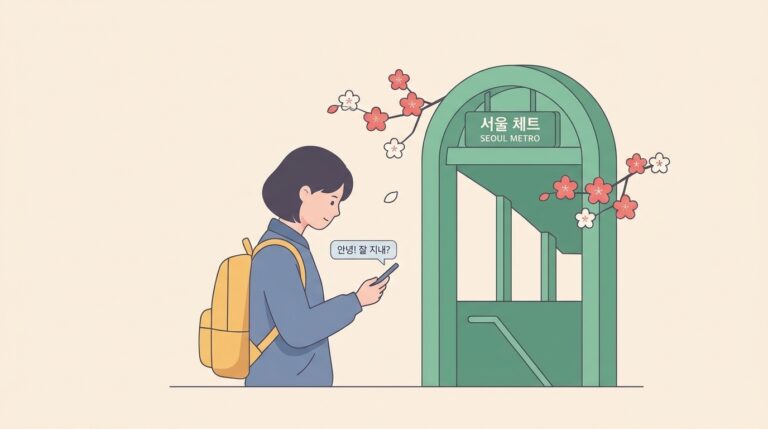
Running Late in Korea? How to Apologize and Text Like a Local!
Phase 1: Empathy (Story-Driven Opening)
Annyeonghaseyo! I’m your Daily Hangul editor, your trusted Korean culture navigator! Picture this: You arranged to meet your Korean friends at a cozy cafe in Hongdae at 3:00 PM. It is now 2:45 PM, and you are trapped inside a packed Line 2 subway train that just came to a complete stop between stations. Your heart races, sweat drips down your forehead, and your phone screen lights up with a text: “어디야? (Where are you?)”
In Korea, punctuality is deeply tied to respect, but life happens! Navigating complex subway transfers or sudden traffic jams in Seoul is a right of passage for every traveler and learner. Many beginners panic and copy-paste rigid dictionary translations like “저는 지각할 것입니다” (I will be late), which sounds like a robot reading a press release! Based on real feedback from hundreds of our A2 learners, knowing how to softly, politely, and naturally text “I’m running a little late” instantly turns a stressful moment into a warm bonding experience. Let’s master the exact phrases native Koreans use every day!
Phase 2: Core Expressions Deep Dive
1. 조금 늦을 것 같아요 (Jogeum neujeul geot gat-a-yo)
- Pronunciation: [jo-geum neu-jeul geot gah-tah-yo] (Sounds like: “Joe-geum neutral got-ah-yo”)
- Meaning: Literal: “It seems I will be a little late.” / Real Nuance: “I’m running a bit late!”
- K-Culture Moment: You see this constantly in K-Dramas when the main character gets caught in an unexpected work emergency and texts their date while running down the street.
- Editor’s Insight: Koreans love using ~것 같아요 (“it seems like”) to soften bad news. Stating “I am late” directly sounds overly blunt. Adding ~것 같아요 makes you sound considerate and humble!
- Situation Spectrum: Casual ✅ | Semi-formal ✅ | Formal ⚠️
- 🤔 Think About It: Why do you think Korean culture prefers indirect phrasing when breaking unpleasant news?
2. 차가 막혀서 조금 늦어요 (Cha-ga mak-hyeo-seo jogeum neu-jeo-yo)
- Pronunciation: [cha-ga mak-hyeo-seo jo-geum neu-jeo-yo] (Sounds like: “Cha-gah mahk-hyuh-suh joe-geum neu-juh-yo”)
- Meaning: Literal: “Because traffic is blocked, I am a little late.” / Real Nuance: “I’m caught in traffic!”
- K-Culture Moment: Seoul traffic during rush hour is legendary. Whether you are in a taxi or a bus along the Han River bridges, this is the ultimate standard excuse.
- Editor’s Insight: The cause (~해서) comes first, followed by the result. Giving a specific reason right away reassures the waiting person that you didn’t just oversleep!
- Situation Spectrum: Casual ✅ | Semi-formal ✅ | Formal ⚠️
- 🤔 Think About It: In your culture, do you state the reason for being late first, or do you apologize first?
3. 먼저 들어가 계세요 (Meon-jeo deu-reo-ga gye-se-yo)
- Pronunciation: [meon-jeo deu-reo-gah gyeh-seh-yo] (Sounds like: “Mun-juh deu-roh-gah geh-seh-yo”)
- Meaning: Literal: “Please go inside first.” / Real Nuance: “Please go ahead and wait inside!”
- K-Culture Moment: Used when meeting outside a busy restaurant, cafe, or movie theater, especially during hot summers or freezing Korean winters.
- Editor’s Insight: This sentence shows high Nunchi (tact/consideration). Asking your friend to wait indoors out of the weather shows you care about their comfort more than your embarrassment.
- Situation Spectrum: Casual ✅ | Semi-formal ✅ | Formal ✅
- 🤔 Think About It: How does asking someone to wait inside show care in a fast-paced urban culture?
Phase 3: Textbook Korean vs Real Korean
Situation 1: Letting someone know you are 10 minutes late
- 📖 Textbook Korean: 저는 10분 동안 지각할 것입니다. (Jeo-neun sip-bun dong-an ji-gak-hal geos-im-ni-da.)
- 🗣️ Real Korean: 미안해! 나 10분 정도 늦을 것 같아! (Mi-an-hae! Na sip-bun jeong-do neujeul geot gat-a!)
- 💡 Why?: “지각하다” sounds like an official school tardiness record! In real life, native speakers simply use the verb “늦다” (to be late) paired with “~정도” (about/around) to sound natural.
Situation 2: Telling a friend not to wait outside
- 📖 Textbook Korean: 밖에서 기다리지 마십시오. (Bak-ge-seo gi-da-ri-ji ma-sip-si-o.)
- 🗣️ Real Korean: 추우니까 먼저 들어가 있어! (Chu-u-ni-kka meon-jeo deu-reo-ga is-seo!)
- 💡 Why?: The imperative command “마십시오” feels cold and distance-creating. Giving a caring reason like “It’s cold, so go inside!” builds warmth.
Phase 4: K-Culture Deep Dive & Non-Verbal Etiquette
4-1. Nunchi & Gestures
When you finally arrive at your meeting spot after being late, proper non-verbal etiquette will instantly melt away any potential awkwardness:
1. The ‘Running Bow’: As soon as you spot your friend, speed up your walk into a light jog, tilt your head slightly forward, and place one hand on your chest.
2. The Two-Handed Apology: Hold your phone or belongings with both hands or bring your hands together at chest height as you say “진짜 미안해!” (I’m so sorry!).
3. Notice the Mood (Nunchi): If your friend waited in line for a trendy restaurant, immediately offer to buy them a coffee or dessert later as a gesture of gratitude!
4-2. Cultural Code Analysis: Korean Punctuality Culture
You might hear about “Korean Time” (코리안 타임) in historical contexts, but modern Korea operates at breakneck speed (Ppal-li Ppal-li culture). In Seoul’s fast-paced social scene, arriving 5–10 minutes early is standard. However, because public transit is so precise, sending a text the moment you realize you will miss a transfer is considered the peak of social courtesy.
Phase 5: Real-Life Role-Play Scenario
Setting: You are meeting your Korean friend Minji at a aesthetic cafe in Seongsu-dong. You missed your bus transfer.
- Turn 1 (Minji): 민지: 어디쯤 왔어? 나 카페 도착했어! (Eodijjeum was-seo? Na ka-pe do-chak-haes-seo!) / Where about are you? I arrived at the cafe!
- Turn 2 (You): 🎭 [Looking panicked at your bus app] 나 지금 버스를 놓쳐서 조금 늦을 것 같아! (Na ji-geum beos-eu-reul no-chyeo-seo jo-geum neujeul geot gat-a!) / I missed the bus just now, so I think I’ll be a little late!
- Turn 3 (Minji): 민지: 아 진짜? 얼마나 걸릴 것 같아? (A jin-jja? Eol-ma-na geol-ril geot gat-a?) / Oh really? How long do you think it will take?
- Turn 4 (You): 🎭 [Checking map navigation] 한 15분 정도 더 걸릴 것 같아. 너무 미안해! (Han sip-o-bun jeong-do deo geol-ril geot gat-a. Neo-mu mi-an-hae!) / I think it will take about 15 more minutes. I’m so sorry!
- Turn 5 (Minji): 민지: 괜찮아! 날씨 추운데 조심히 와. (Gwaen-chan-a! Nal-ssi chu-un-de jo-shim-hi wa.) / It’s okay! It’s cold outside, so come safely.
- Turn 6 (You): 🎭 [Feeling relieved] 고마워! 밖에서 기다리지 말고 먼저 들어가 계세요! (Go-ma-wo! Bak-ge-seo gi-da-ri-ji mal-go meon-jeo deu-reo-ga gye-se-yo!) / Thanks! Don’t wait outside, please go inside first!
- Turn 7 (Minji): 민지: 응, 나 따뜻한 아메리카노 주문하고 있을게! (Eung, na tta-tteut-han a-me-ri-ka-no ju-mun-ha-go is-seul-ge!) / Yeah, I’ll order a warm Americano while I wait!
- Turn 8 (You): 🎭 [Walking fast] 응! 내가 가서 커피값 낼게! 금방 가! (Eung! Nae-ga ga-seo keo-pi-gkap nael-ge! Geum-bang ga!) / Okay! I’ll pay for the coffee when I get there! I’ll be there soon!
🔀 Interactive Choice Point
Minji texts: “나 먼저 들어왔어! 너 음료 뭐 마실래?” (I came inside! What drink do you want?)
* Choice A: 아무거나 사줘. (Buy me anything.)
* Choice B: 나 따뜻한 라떼 부탁해! 내가 가서 돈 줄게! (Warm latte please! I’ll give you money when I arrive!)
* Choice C: 답장을 하지 않고 뛰어간다. (Ignore the message and sprint.)
- Feedback:
- Choice A (Risk): “Anything” puts the decision burden back on your friend who is already waiting for you!
- Choice B (BEST!): Clear, polite, and reassures them that you will cover the cost for their trouble.
- Choice C (BAD): Leaving a friend on ‘read’ while late causes unnecessary anxiety!
Phase 6: 10-Second Emotion Shadowing Drill
Practice saying these aloud with natural feeling!
[🥺 Regretful & Apologetic]- 진짜 / 미안해! / 차가 / 너무 / 막혀! (Jin-jja / mi-an-hae! / Cha-ga / neo-mu / mak-hyeo!)
[🏃 Hurried & Reassuring]- 지금 / 내렸어! / 금방 / 달려갈게! (Ji-geum / nae-ryeoss-eo! / Geum-bang / dal-ryeo-gal-ge!)
[☕ Caring & Considerate]- 밖에서 / 기다리지 말고 / 먼저 / 들어가 있어! (Bak-ge-seo / gi-da-ri-ji mal-go / meon-jeo / deu-reo-ga is-seo!)
Phase 7: K-Culture Mini Dictionary
- 약속 (Yaksok) | Appointment / Plan / Promise | Refers to any social plans with friends, business meetings, or dates. Saying “약속이 있다” means “I have plans.”
- 코리안 타임 (Korean Time) | Korean Time | A legacy term from past decades referring to being 15-30 mins late. Today, it is mostly used sarcastically when someone is notoriously late!
- 번개 (Beonggae) | Lightning / Spontaneous Meetup | Short for ‘번개모임’. Unplanned, last-minute hangouts arranged on the same day.
- 막차 (Makcha) | The Last Train/Bus | Crucial concept in Korean night life! Missing the makcha means taking an expensive late-night taxi home.
Phase 8: Traveler’s Survival Kit
TOP 3 Survival Phrases
- 조금 늦어요 (Jo-geum neu-jeo-yo) – I’m a bit late.
- 어디세요? (Eo-di-se-yo?) – Where are you? (Polite)
- 금방 도착해요 (Geum-bang do-chak-hae-yo) – I’ll arrive shortly.
Editor’s Travel Note
When traveling in Korea, Google Maps often lacks real-time walking or transit routing. Make sure to download Naver Map for real-time subway arrival times or check route times on KakaoMap to accurately predict your arrival time and avoid being late!
Phase 9: One Step Deeper (Reflective Essay)
In Korean society, apologizing for being late is less about the formal rules of time and more about acknowledging the other person’s sacrifice. When someone waits for you, they are giving you their most valuable non-renewable resource: time. By texting early, suggesting they go indoors, or offering to buy coffee, you show that you do not take their kindness for granted. This underlying philosophy of Baeryeo (배려 – consideration) is the heart of enduring relationships in Korea.
💬 Your Turn: How do people in your country handle running late for social meetups? Do you text right away or wait until you arrive? Tell us in the comments below!
Phase 10: FAQ & Common Mistakes
Q: What if I am going to be less than 5 minutes late? Should I still text?
A: Yes! Even for 5 minutes, sending a quick “5분 정도 늦을 것 같아!” (I’ll be about 5 mins late) shows amazing courtesy and lets them relax instead of staring at their watch.
Q: Is it rude to buy coffee to apologize for being late?
A: Not at all! In fact, buying coffee, tea, or a small dessert is the most natural, friendly way in Korean culture to say “Thanks for waiting for me!”
Q: What is the difference between “늦게 왔어” and “늦게 왔어요”?
A: “늦게 왔어” is casual speech (Panmal) for close friends of the same age or younger. “늦게 왔어요” is polite speech (Chondaetmal) for acquaintances or older people.
🚨 Common Mistakes TOP 3
- Saying “미안해” to your boss or teacher: Always use formal high-respect forms like “죄송합니다” (Joe-song-ham-ni-da) in formal settings.
- Translating “traffic was bad” as “교통이 나빴어”: Natives never say this! Always say “차가 막혀요” (Traffic is jammed).
- Not providing a time estimate: Simply saying “I’m late” leaves your friend hanging. Always attach a time frame like “10분 정도” (About 10 minutes).
Phase 11: Action Mission & Engagement
- 🥉 Bronze Level: Speak “조금 늦을 것 같아요” out loud 3 times in front of the mirror with an apologetic expression.
- 🥈 Silver Level: Write a sample text message in Korean explaining that traffic is jammed and post it in your learning notebook.
- 🥇 Gold Level: Next time you meet a Korean language partner or friend, use “먼저 들어가 계세요” when you are running a couple minutes behind!
🎮 K-Culture Mission: Watch a scene from your favorite K-drama today. Can you spot a character saying “어디야?” (Where are you?) or “금방 가!” (I’m coming soon!)?
Phase 12: Interactive Quiz Challenge
Test your knowledge before you go!
Q1. Fill in the blank: “차가 _______ 조금 늦어요.” (Because traffic is backed up, I’m late.)
Click to view answer & explanation
Answer: 막혀서 (mak-hyeo-seo)
Explanation: ‘막히다’ means to be blocked/congested. Adding ‘~어서’ gives the reason “because it is blocked.”
Q2. True or False: In Korea, it is polite to let your friend wait outside in the winter while you are late.
Click to view answer & explanation
Answer: False
Explanation: You should always suggest “먼저 들어가 있어!” (Go inside first!) so your friend stays warm.






