

Phase 1: Empathy & Storytelling
안녕하세요! 매일한글 에디터입니다. (Hello! I am the lead editor at Daily Hangul.)
Have you ever ordered something delicate online in Korea—like a glass mug, skincare bottles, or a precious K-pop album—and worried about how it would arrive? Korea’s parcel delivery system (택배, taekbae) is amazingly fast and efficient, but when it comes to fragile items, knowing what to say can save you from a heart-breaking broken package!
Many beginner learners feel nervous when communicating with delivery drivers or reading warning labels. Based on real feedback from expats living in Seoul, this guide will give you the exact words you need to protect your fragile parcels easily and confidently.
Phase 2: Key Expressions Analysis
1. 조심해 주세요 (Josimhae juseyo)
- Pronunciation: [jo-sim-hae ju-se-yo] (Sounds like jo-seem-hey joo-say-yo)
- Meaning: “Please be careful.”
- K-Culture Moment: Handing over a box filled with delicate tea sets to a courier at a local Korean convenience store.
- Editor’s Insight: This is your multi-tool phrase in Korea. You can use it for delivery items, taking taxis, or moving heavy furniture!
- Situation Spectrum: Casual ⚠️ / Semi-formal ✅ / Formal ✅
- 🤔 Think About It: Adding “주세요” (juseyo – please give/do) instantly transforms a simple verb into a warm and respectful polite request.
2. 깨지기 쉬워요 (Kkaejigi swiwoyo)
- Pronunciation: [kkae-ji-gi swi-wo-yo] (Sounds like kkay-jee-gee swee-wo-yo)
- Meaning: “It breaks easily” / “It’s fragile.”
- K-Culture Moment: Explaining to the delivery worker why your parcel needs gentle handling.
- Editor’s Insight: Simple and crystal clear. It explains the exact condition of your package without complicated grammar.
- Situation Spectrum: Casual ⚠️ / Semi-formal ✅ / Formal ✅
- 🤔 Think About It: In Korean culture, stating the reason (“it’s fragile”) before making a request (“be careful”) is considered polite and considerate.
3. 문 앞에 놓아주세요 (Mun ap-e no-a-ju-se-yo)
- Pronunciation: [mun ap-e no-a-ju-se-yo] (Sounds like moon ap-eh noh-ah-joo-say-yo)
- Meaning: “Please leave it in front of the door.”
- K-Culture Moment: Texting your courier back when you receive an automated delivery update while at work.
- Editor’s Insight: The most essential contact-free delivery phrase in modern Korean daily life.
- Situation Spectrum: Casual ⚠️ / Semi-formal ✅ / Formal ✅
- 🤔 Think About It: Korea’s high level of public trust allows packages to be safely left outside apartment doors every day!
Phase 3: Textbook Korean vs. Real Korean
Situation 1: Telling courier to handle with care
- 📖 Textbook: 이 물건은 파손 위험이 있으니 주의해 주십시오. (This item carries a risk of damage, so please exercise caution.)
- 🗣️ Real Korean: 깨지기 쉬우니까 조심해 주세요! (It’s fragile, so please be careful!)
- 💡 Why different? The textbook sentence is for formal contracts or printed caution signs. Real native speakers prefer warm, natural conversational requests!
Situation 2: Asking where the parcel was left
- 📖 Textbook: 배송 물품을 어디에 두셨습니까? (Where did you place the delivery item?)
- 🗣️ Real Korean: 택배 어디에 두셨어요? (Where did you leave the package?)
- 💡 Why different? Everyday Korean favors short, friendly words like ‘택배’ (taekbae) over formal Sino-Korean terms.
Phase 4: K-Culture Deep Dive & Non-verbal Manners
4-1. Nunchi & Gestures
When showing a fragile parcel to a courier or pointing at a warning sticker, hold the box or point using both hands. Using two hands is a core Korean etiquette rule that shows care and respect. Add a slight head bow while saying “감사합니다” (Gamsahabnida) to build instant goodwill!
4-2. Culture Code
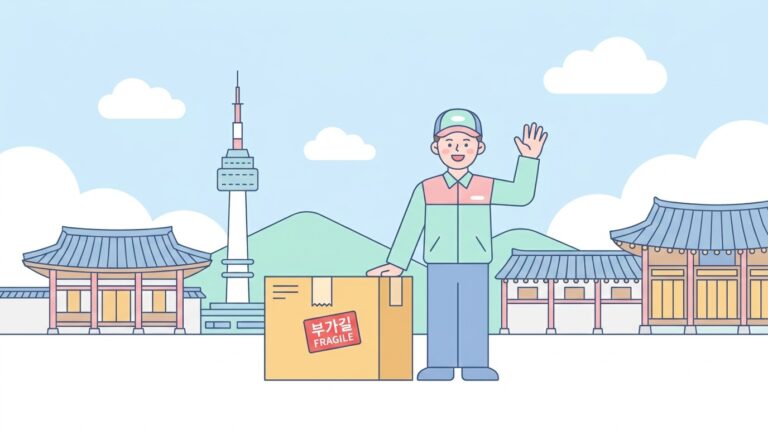
Korea relies heavily on red standard warning stickers labeled 파손주의 (Fragile / Handle with Care). Drivers often send a quick photo of your package resting outside your door as delivery confirmation—a classic Korean delivery habit!
Phase 5: Interactive Roleplay Scenario
Setting: You are receiving a fragile parcel containing a glass lamp at your apartment door.
Character: Friendly Courier Driver (택배 기사님)
- Turn 1 (Courier): 안녕하세요! 택배 배달 왔습니다! (Hello! Parcel delivery is here!)
- Turn 2 (You): 🎭 [Smiling and opening door] 아, 감사합니다! (Ah, thank you!)
- Turn 3 (Courier): 이거 무슨 상자예요? 좀 가벼운데요. (What kind of box is this? It feels light.)
- Turn 4 (You): 🎭 [Holding box with both hands] 안에 유리 램프가 있어서 깨지기 쉬워요. (There’s a glass lamp inside, so it breaks easily.)
- Turn 5 (Courier): 아, 정말요? 파손 주의 스티커 붙여야겠네요. (Oh, really? We should put a Fragile sticker on it.)
- Turn 6 (You): 네, 문 앞에 조심해서 놓아주세요! (Yes, please place it carefully in front of the door!)
- Turn 7 (Courier): 알겠습니다. 안전하게 둘게요! (Understood. I will leave it safely!)
- Turn 8 (You): 🎭 [Bowing head slightly] 정말 감사합니다! 좋은 하루 보내세요! (Thank you so much! Have a nice day!)
🔀 Interactive Choice:
What should you say if you want the courier to handle a delicate parcel gently?
* Option A: “그냥 던져 주세요!” (Please just throw it!)
* Option B: “깨지기 쉬우니까 조심해 주세요!” (It’s fragile, so please be careful!)
* Option C: “이거 버려 주세요!” (Please throw this away!)
Feedback:
* Option A (Bad): Yikes! The courier might drop your delicate item!
* Option B (Best): Perfect! Clear, friendly, and protects your item.
* Option C (Risk): Oh no! You just asked them to throw your box in the trash!
Phase 6: 10-Second Emotional Shadowing Drill
- [😊 Friendly & Polite] 깨지기 쉬우니까 / 조심해 주세요! (Kkaejigi swiwo-nika / josimhae juseyo!)
- [📦 Relieved & Grateful] 문 앞에 / 놓아주셔서 / 감사합니다! (Mun ap-e / no-a-ju-seos-eo / gamsahabnida!)
Phase 7: K-Culture Mini Dictionary
- 택배 (Taekbae) | Parcel / Express Delivery | Used every day for online shopping deliveries.
- 파손 주의 (Pason jui) | Fragile / Handle with Care | Printed on red warning labels for delicate items.
- 문 앞 (Mun ap) | Front Door | The most common drop-off location in Korean apartment buildings.
- 기사님 (Gisanim) | Driver / Technician | A polite title used to address delivery drivers and drivers in general.
Phase 8: Survival Kit for Travelers
Top 3 Expressions:
- 조심해 주세요! (Josimhae juseyo!) – Please be careful!
- 문 앞에 놓아주세요. (Mun ap-e no-a-ju-se-yo.) – Please leave it at the door.
- 파손주의 스티커 있어요? (Pason-jui seutikeo isseoyo?) – Do you have a fragile sticker?
Editor’s Travel Note:
When tracking packages in Korea, check out the Naver Maps app download or use local logistics service websites. Always make sure your exact room number (e.g., 302호) is typed clearly on your order form!
Phase 9: One Step Deeper
In Korea, delivery services operate on incredible speed and deep mutual trust. Couriers work around the clock to deliver packages safely. A simple smile, bowing with both hands, or saying “조심해 주세요” shows respect for their hard work and makes Korean society a warmer place for everyone.
💬 Your Turn: Have you ever received a parcel in Korea or used a delivery service? Share your experience in the comments below!
Phase 10: FAQ & Common Mistakes
Q: How do I request contactless delivery in Korean?
A: Simply text the driver: “문 앞에 놓아주세요” (Please leave it in front of the door).
Q: What does the red sticker saying “파손주의” mean?
A: It literally translates to “Caution: Damage”, meaning “Fragile / Handle with Care”.
Q: How should I politely address a Korean delivery driver?
A: Call them “택배 기사님” (Taekbae gisanim) or simply “기사님” (Gisanim).
🚨 Common Mistakes:
- Mistake: Saying “파손하세요” (Do damage).
- Correct Action: Say “파손 주의해 주세요” (Please handle with care regarding damage).
- Mistake: Using casual language (반말) like “조심해”.
- Correct Action: Always add polite endings: “조심해 주세요”.
- Mistake: Forgetting your room number on the shipping address.
- Correct Action: Always include your house/apartment number clearly.
Phase 11: Action Missions
- Bronze Mission: Practice saying “깨지기 쉬우니까 조심해 주세요!” out loud 3 times.
- Silver Mission: Write a comment below using the phrase “문 앞에 놓아주세요”.
- Gold Mission: Use these expressions at a Korean convenience store or post office when mailing a box!
- 🎮 K-Culture Mission: Look out for red “파손주의” stickers in your favorite K-drama scenes!
Phase 12: Interactive Quiz Challenge
Q1. Which phrase means “Please be careful” in Korean?
A) 버려 주세요
B) 조심해 주세요
C) 어서 오세요
Q2. True or False: “문 앞” means inside your house.
A) True
B) False
Click to reveal answers & explanations!
- Q1 Answer: B) 조심해 주세요 (Please be careful).
- Q2 Answer: B) False (“문 앞” means in front of the door, outside your entrance!).







