

Phase 1: Empathy & Storytelling Opening
안녕하세요! I’m your lead editor at Daily Hangul. If you have ever wandered through the quiet, scented alleys of Yeonnam-dong or Seochon in Seoul, you have likely stepped into a charming 독립서점 (indie bookstore). Unlike massive retail chains, these cozy spaces display handcrafted zines, experimental art books, and deeply personal memoirs. You might think, “I want to publish my own Korean book and sell it here!”
However, behind the dreamy aesthetic of independent publishing lies a brutal administrative battleground: 유통망 확보 (securing distribution networks). When advanced C2 learners transition from basic conversational mastery to negotiating professional contracts, pitching zines, or discussing intellectual property with Korean curators, standard textbook Korean completely falls short. You need nuanced, culturally tuned C2-level Korean that demonstrates professional respect, industry savvy, and emotional intelligence. In this guide, based on real feedback from creative expats and industry insiders in Seoul, you will learn how to navigate the indie publishing ecosystem like a seasoned professional.
Phase 2: Deep-Dive Analysis of 3 Key C2 Expressions
1. 유통망을 뚫다 (yutongmang-eul ttulda)
- Pronunciation: [yoo-tong-mang-eul ttul-da] (Sounds like ‘yoo-tong-mang’ + ‘tool-da’)
- Meaning: Literally “to pierce through a distribution network.” Figuratively used to describe breaking into competitive distribution channels or securing retail shelf space against high entry barriers.
- K-Culture Moment: Seen in business dramas or indie publishing vlogs when an author celebrates signing their first consignment contract with a major boutique network.
- Editor’s Insight: C2 speakers use ‘뚫다’ (to pierce) rather than simple verbs like ‘찾다’ (to find) or ‘확보하다’ (to secure) to emphasize the grit and difficulty involved in market entry.
- Situation Spectrum:
- Casual: ⚠️ (Sounds too formal/business-oriented for everyday friendly chatter)
- Semi-formal: ✅ (Perfect for author interviews or informal industry networking)
- Formal: ✅ (Used in official pitch decks or business meetings)
- 🤔 Think About It: How does your native language express the intense struggle of securing market distribution compared to the forceful visual metaphor of “piercing” a network in Korean?
2. 취향을 입히다 (chwihyang-eul iphida)
- Pronunciation: [chwi-hyang-eul ip-hi-da] (Sounds like ‘chwee-hyang’ + ‘ip-hee-da’)
- Meaning: Literally “to dress [a project] in personal taste.” Figuratively means infusing a unique aesthetic, philosophy, or personal curation into a published work or independent space.
- K-Culture Moment: Frequently used by Korean indie book curators (책방지기) on Instagram when introducing new self-published titles that feature distinctive typography and binding.
- Editor’s Insight: Combining ‘취향’ (taste/preference) with ‘입히다’ (to dress/clothe) elevates your speech from basic C1 Korean (“취향을 반영하다”) to poetic C2 native artistry.
- Situation Spectrum:
- Casual: ✅ (Used naturally when sharing creative philosophies with friends)
- Semi-formal: ✅ (Ideal for book introductions and marketing copy)
- Formal: ✅ (Appropriate for art proposals and editorial statements)
- 🤔 Think About It: Why do you think Korean creators use clothing metaphors like “dressing” to describe applying aesthetic themes to abstract knowledge?
3. 입고를 타진하다 (ipgo-reul tajinhada)
- Pronunciation: [ip-go-reul ta-jin-ha-da] (Sounds like ‘ip-go’ + ‘ta-jeen-ha-da’)
- Meaning: To formally inquire about or sound out the possibility of having your book stocked on a store’s shelves.
- K-Culture Moment: Used in professional emails sent by indie authors when attaching sample PDFs to bookstore owners.
- Editor’s Insight: ‘타진하다’ comes from medical percussion (tapping to diagnose). In C2 business contexts, it conveys a polite, non-pushy approach to checking mutual interest before sending formal contracts.
- Situation Spectrum:
- Casual: 🚫 (Too bureaucratic for friendly talk)
- Semi-formal: ✅ (Great for polite business inquiries via social media DMs)
- Formal: ✅ (Standard terminology for publishing proposals)
- 🤔 Think About It: How does indirect sounding out (‘타진’) reflect Korean workplace communication values compared to direct contract demands?
Phase 3: Textbook Korean vs. Real Native Korean
Scenario 1: Discussing Distribution Struggles
- 📖 Textbook Korean: “독립 출판물은 유통 채널을 찾기가 어렵습니다.” (It is difficult to find distribution channels for independent publications.)
- 🗣️ Real Native Korean: “독립출판은 판로를 뚫기가 그야말로 하늘의 별 따기예요.” (For indie publishing, breaking open a sales route is literally like plucking a star from the sky.)
- 💡 Why is it different? C2 native speakers replace generic passive verbs with dynamic idioms (‘하늘의 별 따기’) and industry idioms (‘판로를 뚫다’) to convey authentic emotion and professional reality.
Scenario 2: Explaining Book Curation
- 📖 Textbook Korean: “이 책은 제 개인적인 스타일을 반영하여 제작되었습니다.” (This book was produced reflecting my personal style.)
- 🗣️ Real Native Korean: “제 개인적인 취향을 결결이 입힌 소중한 결과물이에요.” (It’s a precious outcome layered deeply with my personal taste.)
- 💡 Why is it different? Using sensory words like ‘결결이’ (layer upon layer) and ‘입히다’ (to dress) turns plain descriptions into artistic storytelling.
Phase 4: K-Culture Deep Dive & Non-Verbal Manners
4-1. Nunchi & Professional Demeanor in Indie Pitching
When pitching your publication to a Korean 책방지기 (bookstore owner), aggressive hard-selling will backfire. Korean indie bookstores are curated ecosystems based on personal rapport and aesthetic alignment.
* Visual Eye Contact & Posture: Hold your pitch deck or sample book with both hands when handing it over. Maintain soft, respectful eye contact without staring intently.
* Nunchi (Tact): Observe the store environment first. If the owner is busy stocking shelves or chatting with patrons, wait quietly or leave a professional business card with a sample copy rather than demanding an immediate decision.
4-2. The Indie Bookstore Phenomenon in Korea
Indie publishing in South Korea is not just a commercial industry; it is a cultural movement driven by young creatives in districts like Seongsu-dong, Euljiro, and Mapo-gu. These spaces double as community hubs where authors host small workshops. Securing shelf space here requires demonstrating how your work enriches their specific community narrative.
Phase 5: Practical Roleplay Scenario
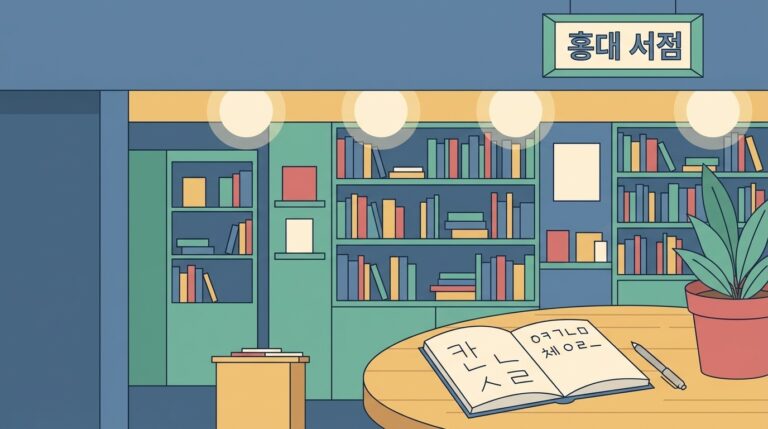
Setting: A cozy indie bookstore in Hongdae. You (An independent author) are pitching your newly printed cultural photo essay to Min-jun (The bookshop owner/curator).
Dialogue
- You: [😊 Politely approaching with sample book] 안녕하세요, 사장님! 분위기가 너무 좋아서 평소에도 자주 찾던 공간인데, 오늘 혹시 잠시 이야기 나누실 시간 괜찮으실까요?
(Annyeonghaseyo, sajangnim! Bunwigiga neomu joh-aseo pyeongso-edo jaju chatdeon gonggan-inde, oneul hoksi jamsi iyagi nanusil sigan gwaenchanheusilkayo? / Hello! I’ve been a frequent visitor because I love the atmosphere here. Do you happen to have a brief moment to chat today?) - Min-jun: [📄 Looking up warmly from desk] 아, 네! 안녕하세요. 어떤 일 때문에 그러시나요?
(A, ne! Annyeonghaseyo. Eotteon il ttaemune geureosinayo? / Ah, hello! How can I help you today?) - You: [🎭 Showing sample book with two hands] 제가 이번에 서울의 노포를 주제로 취향을 듬뿍 입힌 독립출판물을 내게 되었는데요. 사장님의 큐레이션 결에 잘 맞을 것 같아 입고를 타진해 보고 싶어서요.
(Jega ibone Seoul-ui nopo-reul juje-ro chwihyang-eul deumppuk iphin dongnipchulpanmul-eul naege doeonneundeyo. Sajangnim-ui kyure-iseon gyeor-e jal maj-eul geot gata ipgo-reul tajinhae bogo sip-eoseoyo. / I recently self-published a zine focusing on Seoul’s historic eateries, infused with personal curation. I felt it matched your bookstore’s vibe, so I wanted to politely sound out the possibility of stocking it here.) - Min-jun: [🧐 Browsing through pages] 아, 판형도 독특하고 디자인 감각이 돋보이네요. 하지만 저희 매장이 소규모라 이미 서가 공간이 꽉 차서요.
(A, panhyeong-do dokteukhago dijain gamgaki dotboineyo. Hajiman jeohui maejangi sogyumo-ra imi seoga gonggani kkwak chaseoyo. / Oh, the trim size is unique and the design stands out. However, our shop is quite small and our shelf space is currently completely full.) - You: [💡 Expressing understanding smoothly] 네, 공간적 한계가 있으시대서 충분히 이해합니다. 혹시 당장 정식 입고는 어렵더라도 위탁 판매나 소량 샘플링 비치는 가능할지 여쭤봐도 될까요?
(Ne, gongganjeok han-gaega isseusidaeseo chungbuni ihaehamnida. Hoksi dangjang jeongsik ipgo-neun eoryeopdeorado witak panmae-na soryang saempleong bichi-neun gananghalji yeojjeobwado doelkayo? / I completely understand given the spatial limitations. Even if official stocking isn’t possible right away, would you consider consignment sales or displaying a small sample copy?) - Min-jun: [😊 Nodding thoughtfully] 위탁 판매라면 소량으로 시범 운영해 볼 수 있을 것 같네요. 유통 조건이나 정산 비율은 어떻게 생각하고 계신가요?
(Witak panmaeramyeon soryang-euro sibeom unyeonghae bol su isseul geot gaetneyeo. Yutong jogeon-ina jeongsan biyureun eotteokke saenggakhago gyesingayo? / If it’s consignment, we might test run a small batch. What distribution terms and commission split do you have in mind?) - You: [📝 Presenting one-page proposal] 독립서점 표준 위탁 비율인 7:3 정도로 생각하고 있으며, 세부 계약 사항은 이 제안서에 정리해 두었습니다. 편하게 검토해 주세요!
(Dongnipseojeom pyojun witak biyurin chil-dae-sam jeongdoro saenggakhago isseumyeo, sebeu gyeyak sahang-eun i jeanseo-e jeongrihae dueosseumnida. Pyeonhage geomtohae juseyo! / I was thinking of the standard indie bookstore consignment split of 70:30, and I have detailed the terms in this proposal. Please review it at your convenience!) - Min-jun: [🤝 Smiling and taking proposal] 깔끔하게 준비해 오셨네요! 검토 후 금주 내로 연락드리겠습니다.
(Kkalkkeumhage junbihae osyeotneyeo! Geomto hu geumju nae-ro yeonrakdeurigessumnida. / You prepared this very neatly! I will review it and contact you within this week.)
🔀 Interactive Branching Choice
When Min-jun says shelf space is full (Turn 4), how should you respond?
* Option A: “아쉽네요. 그럼 다음 주에 다시 찾아와서 설득해 보겠습니다!” (Too pushy)
* Option B: “네, 공간적 한계가 있으시대서 충분히 이해합니다. 혹시 당장 정식 입고는 어렵더라도 위탁 판매나 소량 샘플링은 가능할까요?” (Best choice)
* Option C: “그럼 그냥 책 한 권 서가 구석에 놓아두고 갈게요!” (Unprofessional)
Feedback:
- Option A (Risk): Demanding to return next week ignores the owner’s operational reality and strains personal rapport.
- Option B (Best): Demonstrates high emotional intelligence (Nunchi), respects store boundaries, and offers a flexible alternative (consignment).
- Option C (Bad): Disregards shop inventory management rules and creates an uncomfortable burden.
Phase 6: 10-Second Emotion Shadowing Drill
Practice reading these C2 sentences aloud with authentic rhythm and emotional nuances using ‘/’ as pause points.
- [😊 Professional yet warm tone]
제 개인적인 취향을 / 결결이 입힌 책인데, / 서점의 큐레이션 결과 / 잘 어울릴 것 같아 / 입고를 타진하고자 합니다.
(Je gaeinjeokin chwihyangeul / gyeolgyeollei iphin chaeginde, / seojeomui kyureiseon gyeolgoa / jal eoullil geot gata / ipgoreul tajinhagoja hamnida.) -
[🤝 Confident and diplomatic tone]
독립출판물의 / 유통망을 뚫는 과정이 / 만만치 않지만, / 서로 상생할 수 있는 / 위탁 조건을 제안드립니다.
(Dongnipchulpanmului / yutongmangeul ttulneun gyoajeongi / manmanchi antjiman, / seoro sangsaenghal su inneun / witak jogeoneul jeandeurimnida.)
Phase 7: K-Culture Mini Dictionary
- 독립서점 (Dongnip-seojeom) | Indie Bookstore
- Boutique, independently owned bookstores curated around niche themes (e.g., poetry, photo zines, graphic design).
- 입고 (Ip-go) | Book Stocking / Inbound Inventory
- The official process of delivering books to retail stores for inventory listing.
- 책방지기 (Chaekbang-jigi) | Indie Bookstore Curator / Keeper
- An affectionate, culturally rich term used instead of generic words like ‘매장 매니저’ (store manager) to describe indie bookstore owners.
- 판형 (Pan-hyeong) | Trim Size & Book Format
- The physical dimensions, aspect ratio, and layout design of a printed book.
Phase 8: Expat & Traveler Survival Kit
Top 3 Professional Expressions
- 위탁 판매로 입고가 가능할까요? (witak panmaero ipgoga gananghaljjeoyo?)
- Pro Tip: Use this when asking if you can supply books on a commission basis.
- 입고 제안서를 메일로 보냈습니다. (ipgo jeanseoreul meillo bonaesseumnida.)
- Pro Tip: Essential line when following up on stock submission proposals.
- 정산 비율은 어떻게 되나요? (jeongsan biyureun eotteokke doenayo?)
- Pro Tip: Politely asking about the sales commission and revenue split.
Editor’s Travel Note
When visiting indie bookshops across Seoul to research publishing trends, navigation apps are essential. Avoid relying solely on global map applications; instead, rely on the Naver Map app download to easily find hidden alleyway shops, check real-time business hours, and locate cozy literary cafes.
Phase 9: Deep Thought (Korean Culture & Values)
In South Korean creative culture, publishing is deeply connected to the concept of ‘결’ (texture/lineage). When Korean creators pitch books or collaborate on projects, they don’t just sell functional products; they ask whether two parties share the same artistic texture. This reflects a broader societal value where business relationships are rooted in personal alignment, emotional warmth, and mutual respect rather than sterile transaction metrics.
💬 Your Turn: Have you ever created a zine or creative project in your native language? How would you describe its unique ‘결’ (texture and spirit) if you were pitching it to a boutique Korean bookshop?
Phase 10: FAQ & Common Mistakes
Q: Can I pitch my English-language book to Korean indie bookstores?
A: Yes! Many boutique bookstores in Seoul (such as those in Euljiro and Mapo) welcome English or bilingual zines, provided you articulate how your narrative connects with local patrons using polite Korean.
Q: What is the standard sales split for independent publishing consignment in Korea?
A: The industry standard split between author and bookstore for consignment (위탁) is typically 7:3 (70% to author, 30% to shop).
Q: Is it necessary to print a formal business proposal (제안서)?
A: Highly recommended! Even a clean, single-page printed proposal showcasing your book cover, summary, price, and contact info demonstrates C2-level professional credibility.
🚨 Common Mistakes TOP 3
- Mistake: Using aggressive sales techniques like “제 책은 정말 잘 팔릴 테니 무조건 많이 입고해주세요.” (My book will sell so well, so definitely stock a ton.)
- Correct Action: Maintain humility and emphasize shared aesthetic vision: “저희 책이 사장님의 큐레이션 결에 어울릴 것 같아 소량 입고를 제안해 드립니다.”
- Mistake: Forgetting to specify whether supply is consignment (위탁) or direct purchase (현매).
- Correct Action: Clarify transaction models early using concise language: “위탁 조건인지 현매 조건인지 확인 부탁드립니다.”
- Mistake: Calling indie bookshop owners generic titles like ‘저기요’ or ‘아저씨’.
- Correct Action: Always address them respectfully as ‘사장님’ or ‘책방지기님’.
Phase 11: Action Missions
- 🥉 Bronze Mission: Record yourself practicing the Phase 6 Shadowing Drill until your pauses (‘/’) sound natural.
- 🥈 Silver Mission: Write a mock 3-sentence email proposal pitching a book topic to a fictional bookstore curator.
- 🥇 Gold Mission: Visit a real Korean indie bookstore or interact with their Instagram account, posting a thoughtful C2 comment using expressions like ‘취향을 입히다’ or ‘큐레이션 결’.
🎮 K-Culture Search Mission: Look up #독립서점 on Instagram and read 3 captions written by local book curators. Identify how many times terms like ‘입고’ or ‘결’ appear!
Phase 12: Interactive Quiz Challenge
Question 1: Situation Analysis
When asking an indie bookstore owner if they can review your book submission via email, which phrase is most natural at C2 level?
* A) 책 좀 봐주세요.
* B) 입고 제안서를 보내드렸으니 편하게 검토해 주시면 감사하겠습니다.
* C) 메일 보냈으니 지금 바로 확인해 주세요.
Show Answer & Explanation
Correct Answer: B
Explanation: Option B uses refined business Korean (‘검토해 주시면 감사하겠습니다’) showing respect and professional boundaries. Option A is too blunt, and Option C is demanding.
Question 2: Fill in the Blank
“이 소설집은 작가의 독창적인 ______을/를 결결이 입혀 제작되었습니다.”
* A) 판형
* B) 취향
* C) 정산
Show Answer & Explanation
Correct Answer: B (취향 – Taste/Preference)
Explanation: ‘취향을 입히다’ (to dress in taste) is the fixed C2 metaphorical idiom learned in Phase 2.
Question 3: Culture True/False
In Korean indie publishing culture, asking for a consignment split of 7:3 (Author:Shop) is considered rude and unreasonable.
* A) True
* B) False
Show Answer & Explanation
Correct Answer: B (False)
Explanation: A 7:3 split is the standard industry practice across South Korean independent bookstores.






