

Phase 1: Empathy & Opening
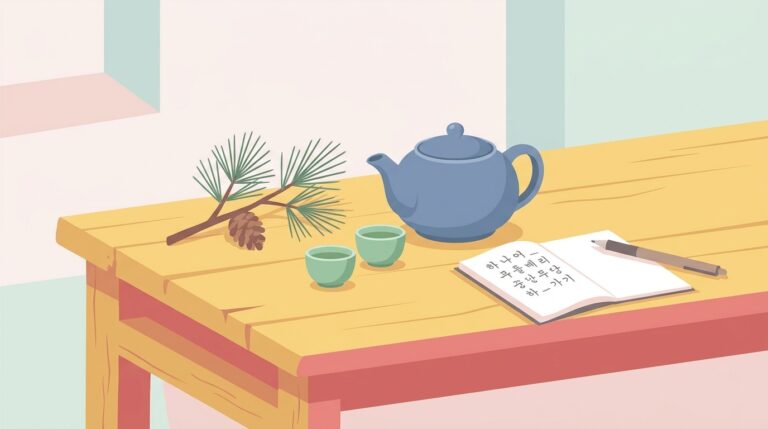
안녕하세요! 매일한글 에디터입니다. Have you ever felt overwhelmed by the fast-paced modern world and yearned for a quiet space to reset your mind? Picture this: you enter a peaceful wooden hanok tucked away in a quiet alley of Insadong, Seoul. The scent of wild green tea leaf steam fills the air, and the soft sound of warm water pouring creates an instant calm. You want to express your deep appreciation for this moment, but textbook Korean like “이 차는 맛있습니다” (This tea is delicious) feels too basic and fails to capture the subtle tranquility you feel inside.
At the C1 level, expressing emotional states requires rich, evocative vocabulary that mirrors native Korean sensibilities. Today, based on real feedback from advanced learners who visited traditional tea houses and temple stays, we will explore advanced Korean expressions related to Dado (다도, the Korean art of tea) and mindfulness. By mastering these expressions, you will be able to talk about inner peace, spiritual calm, and spatial aesthetics with confidence and elegance!
Phase 2: Deep Dive into 3 Core Expressions
1. 마음을 비우다 (Maeum-eul bi-u-da)
- Pronunciation: [Mae-um-eul bi-u-da] (Sounds like: mah-oom-eul bee-oo-dah)
- Meaning: Literally “to empty one’s heart/mind.” Nuance: Clearing away worries, greed, or mental clutters to achieve tranquility.
- K-Culture Moment: Frequently used in Korean temple stay documentaries or calming healing dramas like Little Forest when characters step away from city stress.
- Editor’s Insight: Unlike simply saying “스트레스를 풀다” (to release stress), “마음을 비우다” implies a spiritual reset—letting go of attachments rather than just coping with fatigue.
- Situation Spectrum: Casual ✅ / Semi-formal ✅ / Formal ✅
- 🤔 Think About It: Does your language view peace as “filling up with calm” or “emptying out noise”? How does the concept of “emptying” reflect Asian philosophy?
2. 찻향에 젖어들다 (Chat-hyang-e jeot-eo-deul-da)
- Pronunciation: [Chat-hyang-e jeod-eoh-deul-dah] (Sounds like: chaht-hyang-eh juhd-uh-deul-dah)
- Meaning: Literally “to become soaked in the fragrance of tea.” Nuance: Fully immersing oneself in the aroma and atmosphere of tea.
- K-Culture Moment: Used by tea masters and historical drama protagonists during intimate, introspective tea ceremonies.
- Editor’s Insight: The verb “젖어들다” (to be soaked/immersed) adds a poetic depth, describing an emotional state where sensory experience saturates your thoughts.
- Situation Spectrum: Casual ⚠️ / Semi-formal ✅ / Formal ✅
- 🤔 Think About It: How does sensory vocabulary enhance emotional expression compared to standard adjectives like “좋다”?
3. 여백의 미를 느끼다 (Yeo-baek-ui mi-reul neuk-ki-da)
- Pronunciation: [Yeo-baek-ui mi-reul neuk-ki-dah] (Sounds like: yuh-baek-wee mee-reul neuk-kee-dah)
- Meaning: Literally “to feel the beauty of empty space (margin).” Nuance: Appreciating silence, pause, and uncluttered simplicity.
- K-Culture Moment: Often mentioned when admiring traditional Korean art, architecture, or quiet meditation pauses during a tea ritual.
- Editor’s Insight: “여백의 미” is a core Korean aesthetic value. Expressing this shows you truly grasp Korean cultural philosophy beyond basic conversation.
- Situation Spectrum: Casual ⚠️ / Semi-formal ✅ / Formal ✅
- 🤔 Think About It: Is silence awkward in your culture, or is it appreciated as a meaningful space like in Korean aesthetics?
Phase 3: Textbook Korean vs Real Native Korean
Situation 1: Expressing How Relaxed Tea Makes You Feel
- 📖 Textbook Korean: 차를 마시니까 마음이 편안하고 스트레스가 풀려요.
- 🗣️ Real Native Korean: 따스한 찻향 덕분에 마음이 온전히 놓이네요.
- 💡 Why the Difference? Native speakers at an advanced level use sensory cause-and-effect (“따스한 찻향 덕분에”) and idiomatic expressions (“마음이 놓이다”) to sound natural and poetic.
Situation 2: Praising the Atmosphere of a Quiet Tea House
- 📖 Textbook Korean: 이 찻집은 조용해서 휴식하기 좋습니다.
- 🗣️ Real Native Korean: 고요함 속에 특유의 여백의 미가 느껴져서 참 좋네요.
- 💡 Why the Difference? Using abstract nouns like “고요함” (tranquility) and cultural aesthetic concepts like “여백의 미” elevates your commentary to a refined C1 level.
Phase 4: K-Culture Deep Dive & Non-Verbal Manners
4-1. Nunchi & Tea Etiquette Gestures
In traditional Korean tea culture (Dado), posture and hand placement reflect respect and inner calm:
* Two-Handed Pouring: Always support the teapot (dagwan) handle with your right hand while placing your left hand lightly on the lid or base.
* Receiving the Cup: Hold the tea cup with two hands—right hand cradling the cup, left hand supporting underneath.
* Sipping Courtesy: Turn your shoulders slightly away or gently block your mouth with your hand if drinking in front of an elder or tea master, taking three small sips to savor color, scent, and flavor.
4-2. Culture Code: Templestay & Dado
In modern Korea, young adults frequently attend Templestay (템플스테이) to escape urban burnout. Far from being strictly religious, it serves as a secular sanctuary where people practice 차담 (Chadam – tea chats with monks) to practice emotional reflection and 마음비움 (mind-clearing).
Phase 5: Real-Life Roleplay Scenario
Setting: A peaceful traditional tea room in Bukchon. You are conversing with a senior Tea Master (다도 명인).
- Tea Master: 어서 오세요. 오늘 날씨가 제법 쌀쌀한데, 어떤 차를 준비해 드릴까요?
(Welcome. It’s quite chilly today; what kind of tea may I prepare for you?) - Learner (You): 🎭 [Politely bowing] 선생님, 오늘은 마음을 정돈하고 싶어서 왔습니다. 추천해 주실 수 있나요?
(Master, I came today because I wish to settle my mind. Could you recommend something?) - Tea Master: 그렇다면 따뜻한 우전차(첫물차)가 좋겠네요. 찻잎이 아주 어린 차입니다.
(In that case, warm Ujeon tea made from early leaves would be good. The tea leaves are very young.) - Learner (You): 🎭 [Watching the tea brew with focus] 찻물 소리와 향 덕분에 벌써 마음이 비워지는 기분이 듭니다.
(Thanks to the sound of pouring tea and the scent, I already feel my mind being cleared.) - Tea Master: 허허, 차를 대하는 태도가 아주 깊으시군요. 차는 세 번 나누어 마시는 것이 좋습니다.
(Haha, your attitude toward tea is very deep. It is best to drink tea in three separate sips.) - Learner (You): 🎭 [Receiving the cup with two hands] 찻향에 젖어들며 천천히 음미해 보겠습니다.
(I will savor it slowly while becoming immersed in the scent of tea.) - Tea Master: 차 한 잔의 고요함 속에서 당신만의 여백을 찾아보세요.
(In the silence of a single cup of tea, find your own inner open space.) - Learner (You): 🎭 [Taking a slow sip] 네, 바쁜 일상에서 벗어나 참된 평화를 느끼는 시간이네요. 감사드립니다.
(Yes, stepping away from busy daily life, it is a time to feel true peace. Thank you.)
🔀 Interactive Branching Point
When the Tea Master asks how you feel after drinking the tea, how will you respond?
- Option A: “차 맛이 진짜 깔끔하고 맛있네요! 한 잔 더 주세요!”
- Option B: “따스한 찻향 덕분에 가슴속 응어리가 풀리고 마음이 온전히 놓이네요.”
- Option C: “생각보다 밋밋한데 혹시 설탕이나 꿀을 넣어도 될까요?”
Feedback:
* Option A (Bad): While enthusiastic, asking for a refill casually breaks the meditative C1 atmosphere.
* Option B (Best): Perfect! Using advanced sensory and emotional vocabulary matches the C1 nuance and shows high cultural literacy.
* Option C (Risk): Adding sugar/honey to traditional Korean green tea can be considered disrespectful to the tea master’s craftsmanship.
Phase 6: 10-Second Emotional Shadowing Drill
Practice pronouncing these sentences with accurate emotional tags and natural pauses (/).
[🧘 Calm and Reflective]
따스한 / 찻향 덕분에 / 마음이 온전히 / 놓이네요.
(Ttaseu-han / chat-hyang deok-bu-ne / mae-um-i on-jeon-hi / no-i-ne-yo.)-
[🌿 Peaceful and Poetic]
고요함 속에 / 특유의 / 여백의 미가 / 느껴집니다.
(Go-yo-ham sok-e / teu-kyu-ui / yeo-baek-ui mi-ga / neuk-kyeo-jim-ni-da.) -
[😌 Deeply Grateful]
바쁜 일상을 벗어나 / 참된 평화를 / 누리는 시간이에요.
(Ba-ppeun il-sang-eul beot-eo-na / cham-doen pyeong-hwa-reul / nu-ri-neun si-gan-i-e-yo.)
Phase 7: K-Culture Mini Dictionary
- 다관 (Dagwan) | Traditional Teapot | The small ceramic teapot specifically used in Korean tea ceremonies to steep leaves gently.
- 다담 (Chadam) | Tea Conversation | Meaningful dialogue shared over tea, often centered on mindfulness, life advice, or personal reflection.
- 차선 (Chaseon) | Bamboo Whisk | A delicate tool made of split bamboo used to mix whisked tea powder seamlessly.
- 여백 (Yeobaek) | Empty Space / Margin | An essential Korean aesthetic philosophy emphasizing the beauty found in unused space, silence, and simplicity.
Phase 8: Traveler’s Survival Kit
Survival Phrases TOP 3
- 추천해 주실 만한 전통차가 있나요?
(Chu-cheon-hae ju-sil man-han jeon-tong-cha-ga in-na-yo?)
Pro Tip: Use this at traditional tea houses when you want the owner’s best seasonal recommendation. - 차 마시는 방법을 설명해 주실 수 있나요?
(Cha ma-si-neun bang-beob-eul seol-myeong-hae ju-sil su in-na-yo?)
Pro Tip: Perfect for first-timers at Dado tea houses; staff will happily demonstrate pouring etiquette. - 마음이 아주 조용해지는 공간이네요.
(Mae-um-i a-ju jo-yong-hae-ji-neun gong-gan-i-ne-yo.)
Pro Tip: A sophisticated compliment to give tea house owners regarding their cafe’s serene ambience.
Editor’s Travel Note
When visiting Seoul, search for traditional tea houses in Bukchon or Insadong using 네이버 지도 앱 다운로드 for real-time accurate reviews and walking routes. Always check if reservations are required for formal Dado tea ceremony classes.
Phase 9: One Step Deeper (Humanities Essay)
In modern Korean culture, speed and efficiency (Palli-Palli) often dominate daily routines. However, the resurgence of traditional tea houses and temple stays highlights a deeply rooted longing for balance. The concept of Yeobaek (여백)—leaving blank space—is not considered wastefulness in Korea; rather, it is viewed as essential room for the spirit to breathe. Embracing tea culture allows Koreans to insert intentional pauses into their bustling lives.
💬 Your Turn: How do people in your country create “empty space” to recharge their minds amidst a busy lifestyle? Leave a comment below in Korean using the phrase 마음을 비우다!
Phase 10: FAQ & Common Mistakes
Q: What is the difference between 마음을 비우다 and 스트레스를 풀다?
A: While “스트레스를 풀다” refers to active relief from stress (like working out or singing), “마음을 비우다” implies a meditative mental reset by removing internal greed, anxieties, and cluttered thoughts.
Q: Is it rude to speak during a traditional tea ceremony?
A: Soft, respectful conversation (Chadam) is encouraged! However, loud talking or abrupt noises should be avoided to respect the quiet ambience.
Q: Can I use 여백의 미 outside of tea ceremonies?
A: Yes! You can use it when discussing interior design, modern minimalist architecture, traditional ink landscape paintings, or even film direction.
🚨 Common Mistakes TOP 3
- ❌ Incorrect: 차를 마셔서 마음이 비었어요. (Literal past tense sounds like your heart became empty/devoid of emotion).
- ✅ Correct Action: Use “마음이 비워지는 기분이에요” (I feel like my mind is being cleared).
- ❌ Incorrect: 찻향을 젖어요. (Grammatically wrong particle).
- ✅ Correct Action: Always use the particle ‘에’ -> “찻향에 젖어들다”.
- ❌ Incorrect: 설탕을 주세요. (Asking for sugar in traditional Korean tea places).
- ✅ Correct Action: Savor the natural grain or floral flavors of Korean tea leaf blends as served.
Phase 11: Action Mission & Engagement
Action Mission 3 Steps
- 🥉 Bronze: Record yourself practicing the Phase 6 shadowing drills with appropriate pauses.
- 🥈 Silver: Share a photo of your favorite cup of tea on Instagram and caption it in Korean using 마음을 비우는 시간.
- 🥇 Gold: Visit a local Korean tea house or temple stay and conduct a ordering conversation using C1 level phrases!
🎮 K-Culture Mission
Watch a scene from a healing Korean drama (e.g., Hospital Playlist or Little Forest) where characters share a quiet moment over drinks. Listen for how they express relief or peace! Share what expression you found in the comments.
Phase 12: Interactive Quiz Challenge
Q1. Situation Quiz
Which phrase is best suited when admiring the tranquil emptiness and uncluttered minimalist space of a traditional Korean tea room?
* A) 마음을 비우다
* B) 여백의 미를 느끼다
* C) 스트레스를 풀다
🔍 Click to reveal the Answer & Explanation
Answer: B) 여백의 미를 느끼다
Explanation: “여백의 미” specifically describes the aesthetic beauty of empty space and simple tranquility in Korean traditional philosophy.
Q2. Fill in the Blank
Complete the sentence using the correct particle and verb:
“따스한 찻향____ __________(immersed in), 마음이 평화로워집니다.”
🔍 Click to reveal the Answer & Explanation
Answer: 에 젖어들며
Explanation: The full correct expression is “찻향에 젖어들며” (becoming immersed in the tea aroma).
Q3. Culture True or False
In Korean tea etiquette, it is customary to pour teapot water holding the pot handle with both hands on the handle alone.
🔍 Click to reveal the Answer & Explanation
Answer: False
Explanation: You should hold the teapot handle with your right hand while lightly placing your left hand on the lid or base for etiquette and safety.







