

Phase 1: Empathy (Storytelling Opening)
안녕하세요! 매일한글 에디터입니다.
Imagine this: You receive a KakaoTalk message from your Korean friend Minjun at 5 PM on a Friday. “오늘 저녁에 같이 삼겹살 먹을까? (Shall we eat Samgyeopsal together tonight?)” You really want to hang out, but you have a pounding headache, or maybe you are buried under a mountain of urgent work. You open your messaging app, type “아니요, 안돼요” (No, I can’t), but freeze. Doesn’t that sound too blunt? Too cold?
In Korean culture, directly saying “No” to a plan can feel overly harsh and even damaging to the relationship. Many language learners struggle with this exact moment—how do you decline an invitation politely without sounding rude or hurting someone’s feelings? If you have ever worried about ruining the vibe when canceling plans, you are not alone! Based on feedback from hundreds of beginner Korean learners, we crafted this ultimate guide to help you decline appointments smoothly using warm, culturally polite Korean expressions. By the end of this lesson, you will master the art of soft refusal like a true local!
Phase 2: Deep Dive into 3 Core Expressions
1. 오늘은 좀 힘들 것 같아요 (O-neul-eun jom him-deul geot gat-a-yo)
- Pronunciation: [oh-neul-eun jom heem-deul geot gah-tah-yo] (Sounds like: “Oh-neul” + “Jom” + “Heem-deul”)
- Meaning: Literal: “It seems a bit difficult today.” | Real Nuance: “I don’t think I can make it today, sorry!”
- K-Culture Moment: You often see K-Drama office workers politely declining an after-work drinking gathering (회식) using this soft phrase while slightly touching their neck.
- Editor’s Insight: Instead of saying “I can’t go,” Koreans use 힘들다 (to be difficult/hard) combined with ~것 같아요 (it seems like). This softens the refusal so it sounds like a circumstance, not a personal rejection.
- Situation Spectrum: Casual ⚠️ / Semi-formal ✅ / Formal 🚫
- 🤔 Think About It: Why do you think Korean culture prefers framing a personal refusal as a “difficult situation” rather than a direct personal choice?
2. 갑자기 일이 생겼어요 (Gap-ja-gi il-i saeng-gyeoss-eo-yo)
- Pronunciation: [gahp-jah-gee eel-ee saeng-gyeosh-eo-yo] (Sounds like: “Gahp-jah-gee” + “Eel-ee saeng-gyeosh-uh-yo”)
- Meaning: Literal: “Something suddenly came up.” | Real Nuance: “Something urgent popped up, so I can’t meet.”
- K-Culture Moment: K-Pop idols often use this phrase during live streams when explaining why a planned content schedule had to be rescheduled.
- Editor’s Insight: This is the ultimate versatile excuse! It is polite, concise, and saves you from over-explaining private personal matters.
- Situation Spectrum: Casual ⚠️ / Semi-formal ✅ / Formal ✅
- 🤔 Think About It: Is it common in your country to give exact details when canceling plans, or do people prefer general excuses like this?
3. 몸이 좀 안 좋아서 다음에 봐요 (Mom-i jom an jo-a-seo da-eum-e bwa-yo)
- Pronunciation: [mohm-ee jom ahn joh-ah-seoh dah-eum-eh bwah-yo] (Sounds like: “Mohm-ee” + “An-joh-ah-seoh”)
- Meaning: Literal: “My body isn’t feeling good, so let me see you next time.” | Real Nuance: “I’m feeling under the weather, let’s raincheck!”
- K-Culture Moment: Seen frequently in slice-of-life Korean webtoons where characters prioritize rest while promising to catch up later.
- Editor’s Insight: Ending a refusal with 다음에 봐요 (See you next time) shows that you still value the relationship and genuinely want to meet later.
- Situation Spectrum: Casual ✅ / Semi-formal ✅ / Formal ⚠️
- 🤔 Think About It: Why is offering a future promise (다음에) crucial when saying no in Korean friendship etiquette?
Phase 3: Textbook Korean vs. Real Korean
Situation 1: Canceling due to work or business
* 📖 교과서 한국어: 저는 오늘 약속에 갈 수 없습니다. (Jeo-neun o-neul yak-sok-e gal su eobs-seumb-ni-da.)
* 🗣️ 진짜 한국어: 오늘 약속 못 갈 것 같아요! (O-neul yak-sok mot gal geot gat-a-yo!)
* 💡 왜 다를까? The textbook version is grammatically correct but sounds like a formal robotic announcement. Real Koreans use 못 (cannot) and ~것 같아요 (seems like) to sound warm and regretful.
Situation 2: Canceling due to illness
* 📖 교과서 한국어: 아프기 때문에 못 만납니다. (A-peu-gi ttae-mun-e mot man-nab-ni-da.)
* 🗣️ 진짜 한국어: 몸이 안 좋아서 다음에 만나야 할 것 같아요. (Mom-i an jo-a-seo da-eum-e man-na-ya hal geot gat-a-yo.)
* 💡 왜 다를까? ~기 때문에 sounds like a textbook scientific cause-and-effect report. Using ~아/어서 flows smoothly and naturally in conversational Korean.
Phase 4: K-Culture Deep Dive & Non-Verbal Manners
4-1. Nunchi (눈치) & Gestures
When delivering bad news or declining a plan in Korea, your non-verbal cues matter as much as your words!
1. The Apologetic Head Tilt: Lower your head slightly (about 15 degrees) while expressing your apology.
2. Hand on Neck / Scratching Head: A gentle hand on the back of your neck signals sheepish regret.
3. Clasping Hands: Lightly holding both hands together in front of your chest emphasizes sincerity.
4-2. Culture Code: “밥 한 번 먹자” (Let’s eat together sometime)
In Korea, promising a future meal is the universal social balm. When you cancel plans, always offer a softened future cushion: “다음에 맛있는 거 먹어요!” (Let me treat you to something delicious next time!). This shifts the vibe from rejection to anticipation.
Phase 5: Real Role-play Scenario
Scenario: You promised to meet your Korean friend Sujin at Hongdae for coffee, but you developed a sudden fever.
- Sujin: 오늘 홍대 카페 몇 시에 볼까? (O-neul Hong-dae ka-pe myeot si-e bol-kka? / What time shall we meet at the Hongdae cafe today?)
- You: 🎭 (Hesitant voice, touching forehead) 수진 씨, 정말 미안해요. (Su-jin ssi, jeong-mal mi-an-hae-yo. / Sujin, I’m really sorry.)
- Sujin: 왜 그래요? 무슨 일 있어요? (Wae geu-rae-yo? Mu-seun il iss-eo-yo? / What’s wrong? Did something happen?)
- You: 🎭 (Apologetic posture) 몸이 좀 안 좋아서 오늘은 힘들 것 같아요. (Mom-i jom an jo-a-seo o-neul-eun him-deul geot gat-a-yo. / I’m not feeling well, so I think today might be difficult.)
- Sujin: 아 정말요? 많이 아파요? (A jeong-mal-yo? Ma-ni a-pa-yo? / Oh really? Are you very sick?)
- You: 🎭 (Soft smile) 약 먹고 쉬면 괜찮아질 거예요. (Yak meok-go swi-myeon gwaen-chan-a-jil geo-yeo-yo. / I’ll be fine after taking medicine and resting.)
- Sujin: 그래요, 오늘 쉬고 다음에 봐요! (Geu-rae-yo, o-neul swi-go da-eum-e bwa-yo! / Okay, rest today and see you next time!)
- You: 🎭 (Nodding warmly) 고마워요. 다음에 꼭 맛있는 거 먹어요! (Go-ma-wo-yo. Da-eum-e kkok mas-iss-neun geo meok-eo-yo! / Thank you. Let me definitely buy you delicious food next time!)
🔀 Interactive Branch Point:
How would you respond if Sujin asks to meet tomorrow instead?
* Choice A: 안 돼요. 내일도 바빠요. (An dwae-yo. Nae-il-do ba-ppa-yo.)
* Choice B: 내일 상태 보고 다시 연락해도 될까요? (Nae-il sang-tae bo-go da-si yeon-rak-hae-do dwael-kka-yo?)
* Choice C: 무조건 돼요! 내일 만나요. (Mu-jo-geon dwae-yo! Nae-il man-na-yo.)
Feedback:
* Choice A (Risk 🚫): Extremely blunt! Saying 안 돼요 sounds harsh and rude to friends.
* Choice B (Best ✅): Perfect! It means “Can I contact you tomorrow after checking how I feel?” Soft, practical, and polite.
* Choice C (Bad ⚠️): You might still be sick tomorrow! Don’t overpromise when unwell.
Phase 6: 10-Second Emotion Shadowing Drill
[🥺 Regretful & Soft]
정말 미안해요 / 오늘은 좀 힘들 것 같아요.
(Jeong-mal mi-an-hae-yo / o-neul-eun jom him-deul geot gat-a-yo.)-
[😷 Apologetic & Sick]
몸이 안 좋아서 / 다음에 봐야 할 것 같아요.
(Mom-i an jo-a-seo / da-eum-e bwa-ya hal geot gat-a-yo.) -
[😊 Warm & Reassuring]
다음에 / 제가 맛있는 거 살게요!
(Da-eum-e / je-ga mas-iss-neun geo sal-ge-yo!)
Phase 7: K-Culture Mini Dictionary
- 약속 (Yak-sok) | Appointment / Promise | Used for social plans, meetings, or dates.
- 핑계 (Ping-gye) | Excuse | An excuse used to avoid something (e.g., 핑계 대지 마! = Don’t make excuses!).
- 다음에 (Da-eum-e) | Next time | The magic phrase in Korea to end refusals on a positive note.
- 눈치 (Nun-chi) | Social tact / Sense | The ability to gauge feelings and gauge tone in social situations.
Phase 8: Survival Kit for Travelers
Top 3 Survival Expressions
- 오늘 못 갈 것 같아요. (O-neul mot gal geot gat-a-yo.) – I don’t think I can go today.
- 일정을 변경할 수 있을까요? (Il-jeong-eul byeon-gyeong-hal su iss-eul-kka-yo?) – Can I change the schedule?
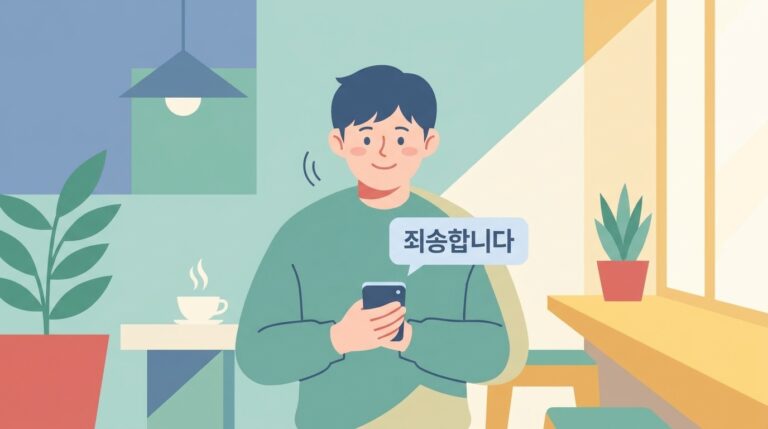
- 죄송합니다. (Joe-song-ham-ni-da.) – I am sorry. (Essential polite phrase)
Editor’s Travel Note
If you need to change table reservations or location bookings in Korea due to sudden cancellations, check out the Naver Map App Download guide to quickly find phone numbers or chat with local venues directly!
Phase 9:
Frequently Asked Questions (FAQ)
Q: What does "오늘은 좀 힘들 것 같아요 (O-neul-eun jom him-deul geot gat-a-yo)" mean in Korean and how do you pronounce it?
A: In Korean, "오늘은 좀 힘들 것 같아요 (O-neul-eun jom him-deul geot gat-a-yo)" is pronounced [oh-neul-eun jom heem-deul geot gah-tah-yo] and means: Literal: "It seems a bit difficult today." | Real Nuance: "I don't think I can make it today, sorry!"
Q: What does "갑자기 일이 생겼어요 (Gap-ja-gi il-i saeng-gyeoss-eo-yo)" mean in Korean and how do you pronounce it?
A: In Korean, "갑자기 일이 생겼어요 (Gap-ja-gi il-i saeng-gyeoss-eo-yo)" is pronounced [gahp-jah-gee eel-ee saeng-gyeosh-eo-yo] and means: Literal: "Something suddenly came up." | Real Nuance: "Something urgent popped up, so I can't meet."
Q: What does "몸이 좀 안 좋아서 다음에 봐요 (Mom-i jom an jo-a-seo da-eum-e bwa-yo)" mean in Korean and how do you pronounce it?
A: In Korean, "몸이 좀 안 좋아서 다음에 봐요 (Mom-i jom an jo-a-seo da-eum-e bwa-yo)" is pronounced [mohm-ee jom ahn joh-ah-seoh dah-eum-eh bwah-yo] and means: Literal: "My body isn't feeling good, so let me see you next time." | Real Nuance: "I'm feeling under the weather, let's raincheck!"






