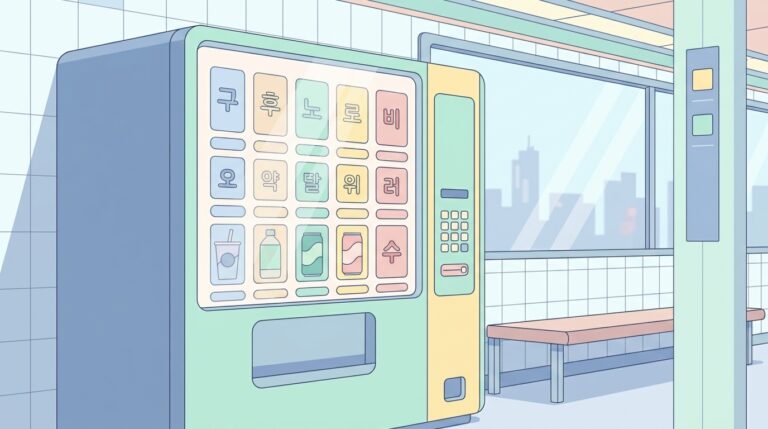
Phase 1: Empathy & K-Culture Scene
안녕하세요! 매일한글 에디터입니다. (Hello! I am your Daily Hangul editor.)
Picture this: You’ve been walking around the vibrant streets of Hongdae all afternoon. You are thirsty, and right next to a bus stop, you spot a sleek Korean vending machine packed with delicious iced tea, banana milk, and hot canned coffee. You pull out your wallet or phone card, stand in front of the machine, and suddenly… total freeze! Which button do you press? What if your coins get stuck? How do you ask someone standing nearby for help without sounding overly stiff?
Don’t panic! Missing out on a refreshing drink just because of a language barrier is a thing of the past. Vending machines in Korea are everywhere—in subway stations, university campuses, hiking trail entrances, and convenience store nooks. Knowing just two or three quick A1-level phrases will turn a potential moment of panic into a smooth, satisfying interaction. Based on real feedback from hundreds of beginner Korean learners, this guide gives you the exact phrases, pronunciation hacks, and cultural secrets you need to grab your favorite beverage with 100% confidence!
Phase 2: Top 3 Core Korean Phrases
1. 자판기가 어디에 있어요? (Japangi-ga eodie issoyo?)
- Pronunciation: Jah-pahn-gee-gah oh-dee-eh ees-ssoh-yoh? (Sounds like ‘jah-pahn-gee’ + ‘where is it?’)
- Meaning: Literal: “Where is the vending machine?” / Nuance: A natural, polite question to ask locals nearby.
- K-Culture Moment: You are exploring a cozy K-Drama style train station or park and want to grab a quick canned drink.
- Editor’s Insight: ‘자판기’ (Japangi) is short for ‘자동판매기’ (automatic vending machine). Nobody uses the long full name in daily life!
- Situation Spectrum: Casual ⚠️ | Semi-formal ✅ | Formal ✅
- 🤔 Think About It: In English, you might say “Is there a vending machine around here?” In Korean, asking direct location (“Where is…”) with a polite ending is completely natural and respectful.
2. 이거 어떻게 써요? (Igeo eottoke sseoyo?)
- Pronunciation: Ee-goh oh-ttoh-keh sseh-yoh? (‘Ee-goh’ = this, ‘eottoke’ = how)
- Meaning: Literal: “How do I use this?” / Nuance: “Could you show me how this works?”
- K-Culture Moment: Modern Korean vending machines often accept touch-card payments or mobile apps. When the screen looks confusing, you show the machine to a friendly passerby.
- Editor’s Insight: ‘어떻게’ (Eottoke) is your magic word for “how”. Pair it with any action to ask for quick assistance!
- Situation Spectrum: Casual ⚠️ | Semi-formal ✅ | Formal ✅
- 🤔 Think About It: Korean culture values helping others in public spaces. Asking politely like this usually gets you a very warm hands-on demonstration!
3. 잔돈이 안 나와요. (Jandon-i an nawayo.)
- Pronunciation: Jahn-dohn-ee ahn nah-wah-yoh. (‘Jahn-dohn’ = change, ‘an nawayo’ = doesn’t come out)
- Meaning: Literal: “The change isn’t coming out.” / Nuance: “My change is stuck / I didn’t get my change back.”
- K-Culture Moment: You put a 1,000 KRW bill into an older vending machine, buy a drink for 800 KRW, but the remaining coin doesn’t drop.
- Editor’s Insight: ‘잔돈’ (Jandon) specifically refers to small change/coins returned after payment.
- Situation Spectrum: Casual ⚠️ | Semi-formal ✅ | Formal ✅
- 🤔 Think About It: Notice how Korean often describes what is happening (the change is not coming out) rather than saying “The machine ate my money!”.
Phase 3: Textbook Korean vs Real Native Korean
Situation 1: Asking where the vending machine is
* 📖 Textbook Korean: 자판기 위치가 어디입니까? (Japangi wichiga eodiimnika?)
* 🗣️ Real Native Korean: 자판기 어디 있어요? (Japangi eodi issoyo?)
* 💡 Why the difference?: The textbook version uses formal declarative grammar (~입니까?), which sounds like a written exam or an official public announcement. Native speakers prefer the soft, comfortable ~어디 있어요? in real conversations.
Situation 2: Asking someone how to pay with a credit card
* 📖 Textbook Korean: 신용카드로 결제할 수 있습니까? (Sinyongkadeuro gyeoljehal su issnimnika?)
* 🗣️ Real Native Korean: 카드 결제돼요? (Kadeu gyeoljedaeyo?)
* 💡 Why the difference?: Locals drop long grammatical connectors to keep speech fast and snappy. 카드 결제돼요? (“Does card payment work?”) gets straight to the point effortlessly.
Phase 4: K-Culture Deep Dive & Non-Verbal Manners
4-1. Nunchi (눈치) & Key Gestures
When asking a stranger near a vending machine:
1. Two-Handed Courtesy: If you are pointing at the coin slot or handing money to someone helping you, support your right forearm slightly with your left hand. This subtle gesture displays instant politeness.
2. Gentle Head Tilt: A quick, small bow (about 15 degrees) while saying “저기요~” (Jeogiyo~ / Excuse me~) instantly creates friendly rapport.
4-2. Cultural Code: The Korean Vending Machine Vibe
In Korea, vending machines are not just for soda. You will find sweet warm canned coffee (온음료), hot roasted corn tea, and seasonal cold refreshments. Most urban machines now support contactless card payments, but older machines near hiking spots or older subway stations still love 1,000 KRW bills and 100/500 KRW coins.
Phase 5: Real-Life Roleplay Scenario
Setting: Seoul Subway Line 2 station platform. You are trying to buy cold green tea from a vending machine, but the card reader light is blinking red.
- Character (NPC): Helpful Station Staff Member (역무원 – Yeongmuwon)
- You: 저기요, 자판기 어디 있어요? (Jeogiyo, japangi eodi issoyo?)
🎭 Action: Point gently toward the platform corridor. - NPC: 바로 여기 있어요! (Baro yeogi issoyo!)
🎭 Action: Smiles and steps toward the machine. - You: 아, 감사합니다! 그런데 이거 어떻게 써요? (A, gamsahamnida! Geureonde igeo eottoke sseoyo?)
🎭 Action: Tilt head slightly and show your IC debit card. - NPC: 아, 카드는 여기에 대면 돼요. (A, kadeuneun yeogiye daemyeon ddaeyo.)
🎭 Action: Points to the contactless sensor pad. - You: 이렇게요? 음료수가 안 나와요. (Iroke-yo? Eumryosuga an nawayo.)
🎭 Action: Tap the card, but nothing drops. - NPC: 버튼을 먼저 누르고 카드를 대야 해요! (Beoteuneul meonje nureugo kadeureul daeya haeyo!)
🎭 Action: Demonstrates pressing the green tea button first. - You: 아! 버튼 먼저요? 나왔어요! (A! Beoteun meonje-yo? Nawass-eoyo!)
🎭 Action: Smiles happily as the tea can drops into the tray. - NPC: 맛있게 드세요! (Mas-itge deuseyo!)
🎭 Action: Waves hand cheerfully.
🔀 Interactive Choice Point
What do you say after receiving your drink from the helpful local?
* Choice A: 고마워! (Gomawo!)
* Choice B: 정말 감사합니다! 안녕히 계세요! (Jeongmal gamsahamnida! Annyeonghi gyeseyeo!)
* Choice C: 돈 드립니다. (Don deurimnida.)
Feedback:
* Choice A (Risk): Too casual! Using informal language with an adult or staff member sounds impolite.
* Choice B (BEST!): Perfect! Expresses deep gratitude and says good-bye respectfully.
* Choice C (Bad): “Here is money” makes no sense since you already paid the machine, not the person!
Phase 6: 10-Second Emotion Shadowing Drill
Repeat these out loud while matching the emotion markers:
[😊 Curiosity & Politeness]
저기요 / 자판기 / 어디 있어요?
(Jeogiyo / japangi / eodi issoyo?)-
[🥺 Confused & Needing Help]
이거 / 카드 / 어떻게 써요?
(Igeo / kadeu / eottoke sseoyo?) -
[🎉 Relieved & Happy]
아! / 음료수 / 나왔어요! / 감사합니다!
(A! / eumryosu / nawass-eoyo! / gamsahamnida!)
Phase 7: K-Culture Mini Dictionary
- 자판기 (Japangi) | Vending Machine
Everyday Usage: Shortened term used everywhere in daily conversation. - 잔돈 (Jandon) | Change / Small coins
Everyday Usage: Refers to leftover cash/coins after buying something. - 음료수 (Eumryosu) | Beverage / Soft drink
Everyday Usage: General word for any canned or bottled drink. - 카드 결제 (Kadeu Gyeolje) | Card Payment
Everyday Usage: Essential phrase when asking if credit/debit cards are accepted.
Phase 8: Traveler’s Survival Kit
TOP 3 Emergency Phrases
- 여기 카드 돼요? (Yeogi kadeu ddaeyo?) – Does card work here?
- 고장 났어요. (Gojang nass-eoyo.) – It’s broken.
- 도와주세요! (Dowajuseyo!) – Please help me!
Editor’s Travel Note
Before heading out, make sure to check out the Naver Map App Download to quickly locate nearby convenience stores and transit hubs where vending facilities are abundant. If a vending machine keeps rejecting your cash, check if the bill is wrinkled or check for a red light indicating “잔돈 부족” (Low Coin Reserve).
Phase 9: One Step Deeper
In Korea, vending machines are designed around public trust and high efficiency. You will rarely see damaged or vandalized machines. Because Korean culture emphasizes communal respect and convenience, taking care of public amenities is second nature. Don’t hesitate to ask anyone nearby for help—Koreans love sharing quick tips with visitors!
💬 Your Turn: What Korean beverage are you dying to try from a local vending machine? Banana milk, warm canned coffee, or barley tea? Let us know in the comments below!
Phase 10: FAQ & Common Mistakes
Q: Can I use international credit cards at Korean vending machines?
A: Most modern machines support Visa and Mastercard contactless payment, but older machines only take local T-money transportation cards or cash (1,000 KRW notes and coins).
Q: What should I do if the vending machine swallows my money?
A: Look for a phone number on the front panel of the machine. You can show the machine to a station officer or shop employee nearby and say “돈이 들어갔는데 안 나와요” (Don-i deureogangneunde an nawayo / Money went in but didn’t come out).
Q: How do I know if a drink is hot or cold?
A: Check the LED light under the beverage picture! Red (따뜻한/온) means hot, while Blue (시원한/냉) means cold.
🚨 Common Mistakes Alert!
- ❌ Mistake 1: Inserting 5,000 KRW or 10,000 KRW bills into small outdoor machines.
- ✅ Correct Action: Most older machines only accept 1,000 KRW paper bills. Keep small notes handy!
- ❌ Mistake 2: Tapping your card before pressing the drink selection button.
- ✅ Correct Action: On many Korean machines, you press the drink button first, then tap your card!
- ❌ Mistake 3: Calling vending machine cash “포인트” (Point).
- ✅ Correct Action: Use the word “잔돈” (Jandon) for coin change.
Phase 11: Action Missions & Engagement
- 🥉 Bronze Mission: Practice saying “자판기 어디 있어요?” 3 times out loud in front of a mirror.
- 🥈 Silver Mission: Find a Korean vending machine in a K-Drama or YouTube video and spot whether the drink is hot (red light) or cold (blue light)!
- 🥇 Gold Mission: Use “카드 결제 돼요?” or “이거 어떻게 써요?” at a local Korean mart or vending machine on your next trip!
🎮 K-Culture Mission: Watch a scene from your favorite Korean drama set in a convenience store or subway station. Can you hear characters saying “저기요” or asking for drinks?
Phase 12: Interactive Quiz Challenge
Test your knowledge before you go!
1. Situation Quiz: You want to buy a cold drink, but you don’t know how to operate the machine screen. What do you say?
a) 잔돈이 안 나와요.
b) 이거 어떻게 써요?
c) 자판기 어디 있어요?
👉 Click to see Answer & Explanation
Correct Answer: b) 이거 어떻게 써요? (How do I use this?)
Explanation: Use this phrase whenever you need quick guidance on operating any machine!
2. Fill-in-the-blank: Fill in the missing word for ‘Vending Machine’: [ ] 어디 있어요?
👉 Click to see Answer & Explanation
Correct Answer: 자판기 (Japangi)
Explanation: Full phrase is “자판기 어디 있어요?”
3. True or False: In Korean vending machines, RED lights indicate a cold beverage.
👉 Click to see Answer & Explanation
Correct Answer: FALSE
Explanation: Red indicates warm/hot drinks (온음료), while blue indicates cold drinks (냉음료)!