

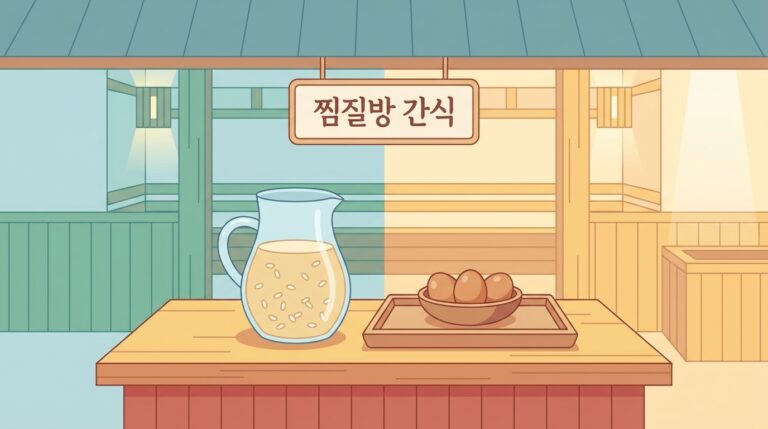
Master Jjimjilbang Snacking: How to Order Sikhye and Roasted Eggs Like a Native
안녕하세요! This is your Daily Hangul editor, your 10-year Korean culture navigator. Have you ever stepped into a Korean Jjimjilbang (찜질방), drenched in sweat after relaxing in a hot charcoal room, feeling your tummy rumble? You walk over to the snack bar (매점) where a giant cooler of ice-cold sikhye (sweet rice punch) and trays of savory roasted eggs await. But as you stand in line, doubt creeps in: Should I pay with cash or tap my electronic locker key? How do I ask for extra ice or a bundle of three eggs politely without sounding like a textbook robot? Don’t worry! Ordering Jjimjilbang treats is a cozy rite of passage in Korea. Today, we’ll master natural B2-level phrases and cultural secrets so you can order like an absolute insider.
Phase 2: Core Expressions Deep Dive
1. 식혜 하나랑 구운 계란 세 개 주세요
- Pronunciation: [Sik-hye ha-na-rang gu-un gye-ran se gae ju-se-yo] (Sounds like: Seek-hyeh ha-na-rang goo-oon gyeh-ran seh gae joo-seh-yo)
- Meaning: “One sikhye and three roasted eggs, please.”
- K-Culture Moment: You will hear this exact sentence in almost every Korean drama scene featuring a Jjimjilbang visit, like Crash Landing on You or Reply 1988.
- Editor’s Insight: Using ~랑 (rang) instead of ~하고 (hago) or ~와/과 (wa/gwa) gives your Korean an immediate, conversational touch. B2 speakers sound much more natural when connecting items casually with ~랑!
- Situation Spectrum: Casual ✅ | Semi-formal ✅ | Formal ⚠️
- 🤔 Think About It: Why do Koreans almost always eat roasted eggs in sets of 2 or 3 rather than just 1? (Hint: Sharing food is at the heart of Jjimjilbang culture!)
2. 계란은 키로 찍으면 되나요?
- Pronunciation: [Gye-ran-eun ki-ro jjig-eu-myeon doe-na-yo?]
- Meaning: “Can I tag my locker key for the eggs?”
- K-Culture Moment: Standing at the counter holding your rubber key band on your wrist while checking payment methods.
- Editor’s Insight: The verb 찍다 (jjik-da) literally means ‘to stamp’ or ‘to scan/tag’. In modern Korean Jjimjilbangs, you rarely pay cash at the snack counter; you tag your RFID key ring and pay at the front desk when leaving.
- Situation Spectrum: Casual ✅ | Semi-formal ✅ | Formal 🚫
- 🤔 Think About It: How does cashless keytag tracking reflect trust and convenience in Korean service design?
3. 얼음 많이 넣어서 시원하게 해주세요
- Pronunciation: [Eor-eum ma-ni neo-eo-seo si-won-ha-ge hae-ju-se-yo]
- Meaning: “Please put lots of ice to make it extra cold.”
- K-Culture Moment: Ordering your big plastic drink jug (often called a ‘sikhye bottle’) to bring back into the hot steam room.
- Editor’s Insight: Notice the structure ~하게 해주세요 (make it [adjective] for me). It expresses a nuanced request gently rather than demanding ‘put more ice’.
- Situation Spectrum: Casual ✅ | Semi-formal ✅ | Formal ✅
- 🤔 Think About It: What does the Korean concept of 시원하다 (si-won-ha-da) mean when applied to cold drinks versus hot bath waters?
Phase 3: Textbook Korean vs. Real Native Korean
Situation 1: Ordering drinks and snacks
- 📖 Textbook Korean: 식혜 한 잔과 구운 계란 세 개를 주십시오. (Sik-hye han jan-gwa gu-un gye-ran se gae-reul ju-sip-si-o.)
- 🗣️ Real Native Korean: 식혜 하나랑 구운 계란 세 개만 주세요. (Sik-hye ha-na-rang gu-un gye-ran se gae-man ju-se-yo.)
- 💡 Why the difference? ~만 (man) here doesn’t strictly mean “only”; native speakers use it as a polite softening particle when ordering to make the request sound lighter and modest.
Situation 2: Paying at the snack counter
- 📖 Textbook Korean: 이열쇠로 결제할 수 있습니까? (I yeol-swe-ro gyeol-je-hal su it-seum-ni-ka?)
- 🗣️ Real Native Korean: 이거 키로 찍을게요! (I-geo ki-ro jjig-eul-ge-yo!)
- 💡 Why the difference? Real Koreans refer to the locker key wristband as ‘키’ (ki) or ‘락커키’ rather than ‘열쇠’ in casual settings, and use 찍다 (to tag) instead of formal ‘결제하다’.
Phase 4: K-Culture Deep Dive & Non-Verbal Manners
4-1. Nunchi & Gestures
When stepping up to the snack counter (매점), gently raise your wrist showing the electronic keyband. The staff will tap a barcode reader against your key ring. When cracking your roasted eggs, never crack them directly on glass tables or soft couch cushions! The classic fun move is cracking them on your friend’s forehead (lightly!), but if you’re alone, tap them on the wooden tray base.
4-2. Cultural Code: The Jjimjilbang Snack Combo
Why Sikhye and Roasted Eggs (맥반석 계란)? Hot saunas induce sweating, draining your hydration and salt levels. Roasted eggs supply essential protein, while sweet malted Sikhye quickly restores sugar and stamina. Pairing these two while wearing the famous towel sheep-head (양머리) is the ultimate Korean self-care ritual.
Phase 5: Practical Roleplay Scenario
Setting: A bustling snack bar inside a famous Seoul Jjimjilbang.
Characters: You (Customer) & 매점 이모 (Snack Counter Auntie)
- Turn 1 (이모): 어서 오세요! 뭐 드려요?
(Eeo-seo o-se-yo! Mwo deu-ryeo-yo?)
🎭 Smiling warmly while wiping down the stainless counter
“Welcome! What can I get for you?” -
Turn 2 (You): 안녕하세요! 식혜 하나랑 구운 계란 세 개 주세요.
(An-nyeong-ha-se-yo! Sik-hye ha-na-rang gu-un gye-ran se gae ju-se-yo.)
🎭 Politely nodding with a friendly tone
“Hello! One sikhye and three roasted eggs, please.” -
Turn 3 (이모): 식혜에 얼음 많이 넣어 줄까요?
(Sik-hye-e eor-eum ma-ni neo-eo jul-kka-yo?)
🎭 Holding up a large transparent container bottle
“Should I add lots of ice to your sikhye?” -
Turn 4 (You): 네! 얼음 많이 넣어서 시원하게 해주세요.
(Ne! Eor-eum ma-ni neo-eo-seo si-won-ha-ge hae-ju-se-yo.)
🎭 Smiling brightly and pointing to the cup
“Yes! Please add lots of ice so it’s super cold.” -
Turn 5 (이모): 계란은 훈제랑 맥반석 중에 뭘로 줄까?
(Gye-ran-eun hun-je-rang maek-ban-seok jung-e mwol-lo jul-kka?)
🎭 Pointing to two containers of dark brown eggs
“For the eggs, do you want smoked or brown mineral-roasted?” -
Turn 6 (You): 맥반석 계란으로 주세요!
(Maek-ban-seok gye-ran-eu-ro ju-se-yo!)
🎭 Choosing eagerly
“Mineral-roasted eggs, please!” -
Turn 7 (이모): 자, 여기 있어요. 키 이쪽에 찍어 주세요.
(Ja, yeo-gi it-seo-yo. Ki i-jjok-e jjig-eo ju-se-yo.)
🎭 Handing over a tray and pointing to the scanner
“Here you go. Please tag your key right here.” -
Turn 8 (You): 네, 감사합니다! 맛있게 먹을게요.
(Ne, gam-sa-ham-ni-da! Mas-it-ge meog-eul-ge-yo.)
🎭 Tapping key band on sensor with a beep sound
“Yes, thank you! I’ll enjoy it.”
🔀 Interactive Choice Point
The Auntie asks if you want cash or key billing. How do you respond?
* Option A: “현금 없는데 카드 되나요?” (I don’t have cash, do you take card?)
* Option B: “키로 찍을게요!” (I’ll tag it with my key!)
* Option C: “나중에 나갈 때 한꺼번에 살게요.” (I’ll buy it all together when I leave.)
Feedback:
* Option A (Risk): ⚠️ Snack counters inside saunas rarely process direct credit cards; they prefer key tagging. You might confuse the staff.
* Option B (Best): ✅ Perfect! Smooth, natural, and matches standard Jjimjilbang cashless operations.
* Option C (Bad): 🚫 You cannot take food without scanning your key first. You must register the purchase on your key band immediately!
Phase 6: 10-Second Emotion Shadowing Drill
[😊 Bright & Friendly]
식혜 하나랑 / 구운 계란 세 개 / 주세요!
(Sik-hye ha-na-rang / gu-un gye-ran se gae / ju-se-yo!)-
[🧊 Refreshing & Eager]
얼음 많이 넣어서 / 진짜 시원하게 / 해주세요!
(Eor-eum ma-ni neo-eo-seo / jin-jja si-won-ha-ge / hae-ju-se-yo!) -
[🙋 Confident & Polite]
계란은 / 키로 찍으면 / 되나요?
(Gye-ran-eun / ki-ro jjig-eu-myeon / doe-na-yo?)
Phase 7: K-Culture Mini Dictionary
- 식혜 (Sikhye) | Sweet Rice Punch | A traditional fermented grain beverage served ice-cold with floating rice grains. Essential post-sauna drink.
- 구운 계란 / 맥반석 계란 (Guun Gyeran / Maekbanseok Gyeran) | Baked / Mineral Roasted Eggs | Slow-baked eggs featuring a nutty, chewy brown egg white and rich yolk.
- 락커키 / 키 (Locker Key) | Electronic Wristband Key | Acts as your room key, locker lock, and digital wallet inside modern facilities.
- 매점 (Maejeom) | Snack Counter | The central hub inside a sauna selling food, cold drinks, shampoo pouches, and scrub towels.
Phase 8: Traveler’s Survival Kit
Survival Expressions TOP 3
- 수건 더 주세요. (Su-geon deo ju-se-yo.) = Please give me extra towels. (Pro Tip: Men’s baths usually have unlimited towels; women’s baths usually give 2 upon entry).
- 식혜 크게 하나 주세요. (Sik-hye keu-ge ha-na ju-se-yo.) = Please give me one large sikhye.
- 열쇠 잃어버렸어요. (Yeol-swe il-eo-beor-eot-seo-yo.) = I lost my key. (Report immediately to front desk!).
Editor’s Travel Note
Before heading out to famous Seoul saunas like Dragon Hill or Aquafield, check facility hours using Naver Map App Navigation. Remember that food purchased at the 매점 gets billed to your locker key, which you clear at the front counter prior to leaving!
Phase 9: One Step Deeper
Korean Jjimjilbangs represent a unique communal trust system. Stepping into a shared space barefoot, wearing uniform loungewear, and relying on wrist keybands creates an atmosphere where social status disappears. Everyone shares the same floor, drinks the same sikhye, and relaxes together. Embracing this communal warmth will change how you experience Korean hospitality.
💬 Your Turn: Have you ever tried Sikhye before? What snack are you most excited to try at a Korean Jjimjilbang? Let us know in the comments below!
Phase 10: FAQ & Common Mistakes
Q: Can I pay cash at the Jjimjilbang snack bar?
A: Most modern Jjimjilbangs operate entirely on wrist key tags. You tap your key at the snack counter and pay your total bill at the front desk when exiting.
Q: How do I open roasted eggs without making a mess?
A: Tap the egg gently on your plastic tray to create small cracks all around, then peel from the wider bottom end where the air pocket sits.
Q: What is the difference between 훈제계란 and 맥반석계란?
A: 훈제 (Hun-je) is smoked eggs with a distinct smoky flavor, while 맥반석 (Maek-ban-seok) is mineral-stone roasted, yielding a extra chewy texture.
🚨 Common Mistakes TOP 3
- Mistake: Trying to hand cash directly to snack counter staff.
Correct Action: Present your wrist keyband for scanning. - Mistake: Saying “식혜 한 병 주십시오” (Too formal/stiff).
Correct Action: Say naturally: “식혜 하나 주세요.” - Mistake: Cracking eggs on marble tabletops or glass partitions.
Correct Action: Crack them on your food tray or palm.
Phase 11: Action Mission & Engagement
- Bronze: Practice saying “식혜 하나랑 구운 계란 세 개 주세요” 3 times out loud.
- Silver: Record your voice with emotional shadowing and compare it with K-drama sauna clips!
- Gold: Visit a local Korean supermarket or Jjimjilbang, order Sikhye in Korean, and tag your key like a pro!
🎮 K-Culture Mission: Watch an episode of a Korean variety show (e.g., Running Man) and spot the moment they wear the towel sheep-head (양머리) while eating eggs!
Phase 12: Interactive Quiz Challenge
1. Situation Quiz: How should you indicate payment at a Jjimjilbang snack bar?
– A) Show your credit card
– B) Say “키로 찍을게요”
– C) Leave exact cash on the counter
🔍 Click for Answer & Explanation
Correct Answer: B
Explanation: Modern Jjimjilbangs track purchases via keyband scans (“키로 찍다”).
2. Fill-in-the-Blank: “얼음 많이 넣어서 __________ 해주세요.” (Please make it cold with lots of ice.)
– A) 따뜻하게
– B) 시원하게
– C) 매콤하게
🔍 Click for Answer & Explanation
Correct Answer: B
Explanation: 시원하게 means ‘cold/refreshing’. 따뜻하게 means ‘warm’ and 매콤하게 means ‘spicy’.
3. True or False: You must pay cash immediately every time you order snacks inside the sauna area.
– A) True
– B) False
🔍 Click for Answer & Explanation
Correct Answer: B (False)
Explanation: All charges accumulate on your electronic wristband key and are settled upon final exit.







