

Master Korean Hiking Gear Advice and Trekking Etiquette Like a Local
Phase 1: Empathy & K-Culture Entry
Annyeonghaseyo! Welcome back to Daily Hangul. I’m your lead editor and cultural navigator.
Picture this: You are standing at the entrance of Bukhansan National Park on a crisp Saturday morning. Surrounding you are vibrant neon-clad Korean hikers equipped with state-of-the-art gear. You step into a local outdoor shop near the trailhead because your trail runners aren’t cutting it on Korea’s steep, granite-heavy terrain. You want to ask for mid-cut hiking boots that protect your ankles, and you need advice on properly adjusting trekking poles for a steep descent. However, textbook terms like “등산화를 사고 싶습니다” (I want to buy hiking boots) sound surprisingly stiff, and you struggle to explain nuances like load distribution or ankle support.
In South Korea, hiking isn’t just exercise; it’s a social ritual complete with post-hike feasts (dwi-puri) and meticulous gear preparation. Expressing your physical comfort and equipment needs in natural, high-level Korean elevates your confidence and earns instant respect from local outdoorsmen. Based on real feedback from advanced learners who tackled Korea’s majestic peaks, this guide gives you the precise C1-level vocabulary and natural phrasing needed to discuss outdoor gear like a seasoned trail veteran.
Phase 2: Core Expressions Deep Dive
1. 발목을 다치지 않게 두껍고 잡아주는 느낌이 필요해요.
- Pronunciation: [Bal-mok-eul da-chi-ji angst-ge du-kkeop-go jab-a-ju-neun neuk-kim-i pil-yo-hae-yo] (Sounds like: bal-mok-eul da-chi-ji an-ge doo-kkeop-go jahb-ah-joo-neun nook-keem-ee peel-yoh-hae-yo)
- Meaning: Literal: I need a thick and supportive feel so I don’t hurt my ankle. / Nuance: I’m looking for mid-to-high cut boots with firm ankle support for rugged terrain.
- K-Culture Moment: Seen in outdoor lifestyle shows where hikers visit gear shops in Dobongsan before tackling Rocky ridges.
- Editor’s Insight: The verb ‘잡아주다’ (to hold/support) is widely used in Korean gear reviews to describe supportive shoes, backpacks, or apparel.
- Situation Spectrum: Casual ⚠️ | Semi-formal ✅ | Formal ✅
- 🤔 Think About It: How does your native language describe equipment support compared to the active Korean verb ‘잡아주다’?
2. 하산할 때 체중을 분산시키려면 스틱 길이를 어떻게 맞추나요?
- Pronunciation: [Ha-san-hal ttae che-jung-eul bun-san-si-ki-ryeo-myeon seu-tik gil-i-reul eo-tteok-ge mat-chu-na-yo]
- Meaning: Literal: When descending, how do I set the pole length to distribute weight? / Nuance: What is the optimal stick adjustment to reduce joint impact going downhill?
- K-Culture Moment: Frequently heard during guided group treks on Mt. Seorak when advisors correct beginners’ posture.
- Editor’s Insight: ‘체중을 분산시키다’ (to distribute body weight) shows C1 mastery over technical physical terminology.
- Situation Spectrum: Casual ⚠️ | Semi-formal ✅ | Formal ✅
- 🤔 Think About It: Notice how technical terms like ‘하산’ (descent) replace plain words like ‘내려가기’ in sports contexts.
3. 접지력이 좋아서 암릉 구간에서도 안 미끄러지겠어요.
- Pronunciation: [Jeob-ji-ryeok-i jo-a-seo am-reung gu-gan-e-seo-do an mi-kkeu-reo-ji-gess-eo-yo]
- Meaning: Literal: The traction is good so it won’t slip even on rocky ridges. / Nuance: These soles have excellent grip for granite outcrops.
- K-Culture Moment: Popularly used in outdoor gear unboxing videos and gear blogs analyzing ridge climbs.
- Editor’s Insight: ‘접지력’ (ground grip/traction) and ‘암릉’ (rocky ridge) are essential vocabulary for Korean granite trails.
- Situation Spectrum: Casual ✅ | Semi-formal ✅ | Formal ✅
- 🤔 Think About It: Why is rock grip such a heavily emphasized selling point in Korean outdoor gear culture?
Phase 3: Textbook Korean vs. Real Korean
Scenario 1: Asking if boots fit correctly
- 📖 Textbook Korean: 이 신발이 제 발에 맞습니까? (Is this shoe right for my foot?)
- 🗣️ Real Korean: 발가락 끝이 앞쪽에 닿지 않고 뒤축이 살짝 남나요? (Does my toe stay clear of the front with a slight gap at the heel?)
- 💡 Why the difference? Experienced hikers use detailed spatial check phrases to ensure downhill comfort rather than a simple ‘fit’ question.
Scenario 2: Adjusting hiking pole locks
- 📖 Textbook Korean: 스틱을 고정하세요. (Lock the stick.)
- 🗣️ Real Korean: 내리막에서는 스틱을 길게 빼서 락을 단단히 잠궈 주셔야 해요. (On downhills, extend the poles longer and lock them securely.)
- 💡 Why the difference? Advanced speakers specify trail direction (내리막) and mechanics (락을 잠그다) for clarity and safety.
Phase 4: K-Culture Deep Dive & Non-Verbal Manners
4-1. Nunchi & Trail Etiquette
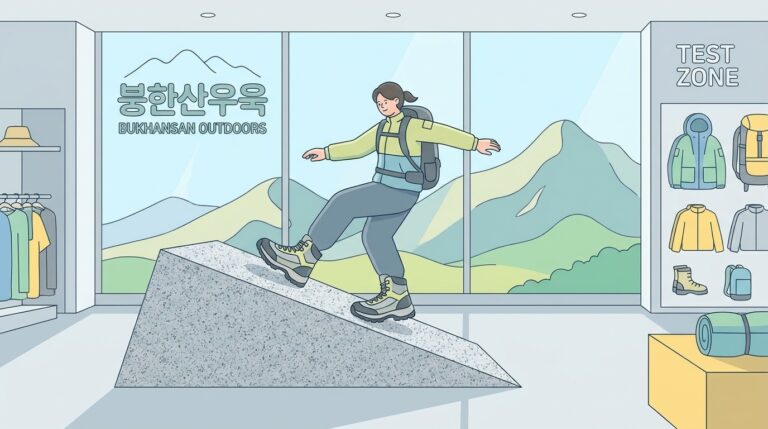
When shopping for gear or hiking in Korea, non-verbal deference is key. Always lace up sample boots while stomping lightly on an inclined slope board inside the store. When testing poles, press down firmly with your upper body weight—never strike the floor noisily near others. On trails, yield the uphill path to climbing hikers while keeping your pole tips pointed safely backward and low to avoid striking people behind you.
4-2. Cultural Code: The Outdoor Gear Phenomenon
In South Korea, hiking gear is a major fashion statement and technological preference. Due to Korea’s rocky topography (70% mountains), specialized soles like ‘Ridge-edge’ rubber are standard. Hikers often bond over discussing boot grip and carbon fiber pole lightness while sharing cucumber slices or Makgeolli at summits.
Phase 5: Real Roleplay Scenario
Setting: An outdoor gear shop near Bukhansan Trailhead. You are discussing boot fitting and pole adjustment with an experienced shop manager (NPC: Mr. Kang).
- Mr. Kang: 어서 오세요! 오늘 북한산 오르시나요? 어떤 장비 찾으세요?
(Welcome! Are you climbing Bukhansan today? What gear are you looking for?) - You: 🎭 [Pointing to mid-cut boots with a discerning eye] 안녕하세요! 암릉 산행이 많아서 접지력이 좋고 발목을 단단히 잡아주는 등산화를 보려고요.
(Hello! I’m looking for hiking boots with high traction and firm ankle support since I’ll be on rocky ridges.) - Mr. Kang: 잘 오셨습니다. 이 모델이 릿지 전용 창이라 바위에 착 붙습니다. 한번 신어 보시죠.
(You came to the right place. This model has a ridge-specific sole that sticks to rocks. Try it on.) - You: 🎭 [Lacing up and pressing toes forward] 두꺼운 양말을 쳤을 때 뒤축에 손가락 하나 정도 들어가는 유격이 있나요?
(When wearing thick socks, is there about a finger’s space at the heel?) - Mr. Kang: 네, 딱 적당하네요! 내리막에서 발가락 쏠림을 막아줍니다. 스틱도 같이 필요하신가요?
(Yes, it fits just right! It prevents toe jamming on downhills. Do you also need poles?) - You: 🎭 [Holding a carbon pole] 네, 경사도에 따라 길이를 조절하는 락 시스템이 튼튼한 걸로 추천해 주세요.
(Yes, please recommend one with a sturdy locking system for adjusting length according to slope grade.) - Mr. Kang: 이 카본 스틱이 가볍고 체중 분산에 탁월합니다. 하산할 땐 배꼽 높이보다 길게 맞추세요.
(This carbon pole is light and excellent for weight distribution. Set it higher than navel level when descending.) - You: 🎭 [Testing pole weight with a nod] 완충 작용도 좋고 아주 가볍네요. 이 조합으로 가져가겠습니다!
(The shock absorption is good and it’s very light. I’ll take this combination!)
🔀 Interactive Choice Point
When testing boots that feel slightly tight around the toes, what do you say?
* Option A: 그냥 이 사이즈로 할게요. 신다 보면 늘어나겠죠. (I’ll take this size. It’ll stretch as I wear it.)
* Option B: 내리막길에서 발가락이 쏠릴 것 같은데, 반 치수 더 큰 걸로 신어볼 수 있을까요? (My toes might jam on downhills; can I try half a size larger?)
* Option C: 이 신발 너무 작은데 다른 브랜드 큰 거 없나요? (This shoe is too small, don’t you have large ones from another brand?)
Feedback:
* Option A (Risk): Dangerous! Hiking boots rarely stretch enough to protect toes during steep drops.
* Option B (Best): Excellent C1 phraseology! Shows understanding of downhill physical mechanics (‘발가락이 쏠리다’) and precise sizing requests (‘반 치수’).
* Option C (Bad): Too blunt and ignores adjustable fitting parameters.
Phase 6: 10-Second Emotion Shadowing Drill
Practice these natural intonations with emotional emphasis:
[😊 Confident & Knowledgeable]암릉 구간에서는 / 접지력이 좋은 신발이 / 필수예요![🤔 Curious & Precise]하산할 때 / 무릎 부담을 줄이려면 / 스틱 길이를 / 얼마나 늘려야 하나요?[😌 Relieved & Satisfied]발목을 단단히 잡아주니까 / 자갈길에서도 / 전혀 안 불안하네요!
Phase 7: K-Culture Mini Dictionary
- 암릉 (Am-reung) | Rocky Ridge | Essential term for Korean hiking routes made of bare granite rock.
- 접지력 (Jeob-ji-ryeok) | Grip / Traction | High-frequency metric discussed when comparing rubber soles for mountain safety.
- 하산 (Ha-san) | Descent / Going down | Formal Sino-Korean noun used for trekking down mountain peaks.
- 뒤풀이 (Dwi-pu-ri) | After-party / Post-hike social gathering | The customary post-hike meal (e.g., Pajeon and Makgeolli) shared among hikers.
Phase 8: Traveler’s Survival Kit
Survival Top 3
- 발목을 잡아주는 미드컷 있어요? (Do you have mid-cut boots that support ankles?)
- 스틱 락이 풀리지 않게 조여 주세요. (Please tighten the pole lock so it doesn’t loosen.)
- 이 등산화 창 교체 가능한가요? (Can the sole of these hiking boots be replaced?)
Editor’s Travel Note
Before heading to Korean peaks, check route difficulty using the Naver Map Hiking and Walking Route Guide. Always buy hiking boots half a size larger (5mm) than your normal city shoes to account for foot swelling and thick wool socks.
Phase 9: A Step Deeper
Korean hiking culture reflects a unique blend of community bonding, gear passion, and respect for nature. Notice how Korean hikers switch to Sino-Korean vocabulary (입산 for entering mountains, 하산 for descending, 암릉 for rocky ridges) to show expertise and situational awareness. Demonstrating this vocabulary displays high language mastery and respect for local outdoor traditions.
💬 Your Turn: What gear feature is most important to you when trekking rugged mountains? Share your experiences in the comments below!
Phase 10: FAQ & Common Mistakes
Q: Should I buy hiking boots in my exact street shoe size in Korea?
A: No, always request half a size larger (5mm-10mm up) to prevent toe bruising during steep downhills (하산).
Q: What is the most natural way to ask if poles are made of carbon fiber?
A: Ask: “이 스틱 카본 소재라 가벼운가요?” (Is this stick carbon material, making it light?)
Q: How do I tell someone my pole collapsed while walking?
A: Say: “하산 중에 스틱 잠금장치가 풀렸어요.” (The pole locking mechanism came undone during descent.)
🚨 Common Mistakes
- ❌ 잘못된 표현: 내리막에서 발가락이 아파요. (Too basic)
- ⭕ Correct Action: 내리막에서 발가락에 체중이 쏠려 통증이 있어요. (Precise C1 terminology)
- ❌ 잘못된 표현: 스틱 길이를 크게 하세요. (Grammarly awkward)
- ⭕ Correct Action: 하산 시에는 스틱 길이를 길게 늘려주세요. (Natural situational request)
Phase 11: Action Mission
- 🥉 Bronze: Record yourself saying: “발목을 단단히 잡아주는 등산화 추천해 주세요.”
- 🥈 Silver: Write a comment describing your dream Korean mountain trek using terms like 접지력 and 암릉.
- 🥇 Gold: Visit an outdoor shop or online forum and ask about pole adjustments in Korean using Phase 2 expressions.
🎮 K-Culture Mission: Watch a clip of a Korean hiking vlog on YouTube and identify every time the creator mentions “접지력” or “하산”.
Phase 12: Interactive Quiz Challenge
Test your knowledge with these dynamic practice questions!
Question 1: Which expression best describes soles with great grip on rock faces?
Answer: 접지력이 아주 좋습니다.
Explanation: ‘접지력’ refers specifically to traction or grip on surfaces, essential for granite climbs.
Question 2: Fill in the blank: 하산할 때는 스틱 길이를 배꼽 높이보다 (_____ ) 맞추어야 무릎 부담이 적습니다.
Answer: 길게 (longer)
Explanation: When descending, longer poles allow you to plant them ahead and absorb downhill shock.
Question 3: True or False? You should buy hiking boots that fit tightly at the toes with thin socks.
Answer: False.
Explanation: You need a 5-10mm gap at the front to prevent toe injuries during downhill trekking.







