

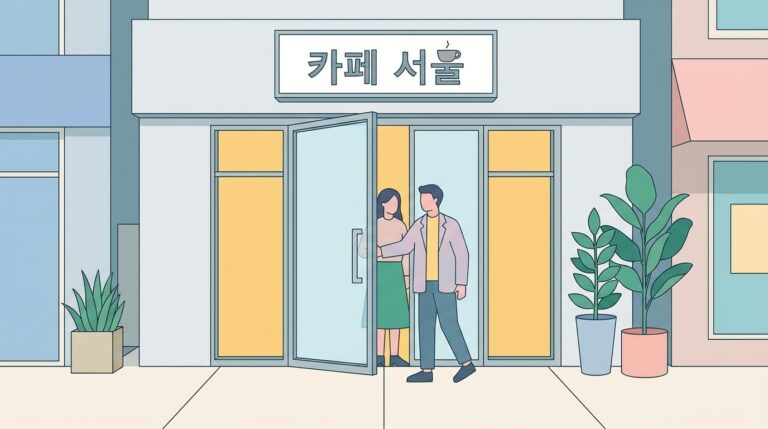
안녕하세요! 매일한글 에디터입니다. Have you ever stood in front of a heavy glass door at a trendy Seongsu-dong cafe, holding it open while looking back, only to feel a wave of confusion as people pass through without making eye contact? Or perhaps you were on a date in Hongdae and wondered whether pulling out a chair or practicing ‘Ladies First’ courtesy feels chivalrous or slightly patronizing in contemporary South Korea? As someone navigating Korean culture at an advanced C2 level, you know that etiquette here isn’t just about static rules—it’s a living, breathing dance of mutual awareness, implicit space-saving, and unspoken consideration.
Today, we are diving deep into the subtle art of door-holding etiquette, personal space dynamics, and how ‘Lady First’ concepts have transformed into gender-neutral Nunchi (눈치) and collective courtesy (Bae-ryeo, 배려) in modern Korean society. Based on years of tutoring high-level learners and analyzing real-world cultural shifts, this guide will refine your linguistic precision and social radar.
Phase 2: Core Expressions Deep Dive
1. 제가 먼저 문 잡아드릴게요
- Pronunciation: [Je-ga meon-jeo mun jab-a-deu-ril-ge-yo] (Sounds like: “Jeh-gah muhn-juh moon jahb-ah-deu-reel-geh-yo”)
- Meaning: “Let me hold the door for you first.” (Literal vs. Nuance: A proactive offer demonstrating polished hospitality without sound overly dramatic).
- K-Culture Moment: Seen frequently in K-Dramas when a protagonist discreetly holds a revolving door or heavy brass entrance at a high-end Gangnam company building.
- Editor’s Insight: This phrase elevates simple politeness into refined consideration using the honorific ending
-아/어 드릴게요(-a/eo deu-ril-ge-yo).- Situation Spectrum: Casual ⚠️ | Semi-formal ✅ | Formal ✅
- 🤔 Think About It: Does holding doors in your home culture imply a physical capability imbalance, or is it strictly a gender-neutral politeness marker?
2. 뒷사람을 배려하는 차원에서…
- Pronunciation: [Dwit-sa-ram-eul bae-ryeo-ha-neun cha-won-e-seo]
- Meaning: “In the spirit of being considerate to those behind me…”
- K-Culture Moment: Used in conversational Korean podcasts or office meetings when discussing social harmony and communal public manners.
- Editor’s Insight: At C2 level, substituting basic words like ‘생각해서’ (saeng-gak-hae-seo) with ‘차원에서’ (cha-won-e-seo, “on the dimension/level of”) showcases sophisticated abstract reasoning.
- Situation Spectrum: Casual 🚫 | Semi-formal ✅ | Formal ✅
- 🤔 Think About It: How does phrasing actions around collective awareness shift the responsibility from personal chivalry to group harmony?
3. 굳이 문을 안 잡아주셔도 돼요, 괜찮습니다
- Pronunciation: [Gu-ji mun-eul an jab-a-ju-syeo-do dwae-yo, gwaen-chan-seum-ni-da]
- Meaning: “You really don’t need to hold the door, it’s totally fine!”
- K-Culture Moment: Spoken by independent, professional characters in modern office dramas who prefer not to inconvenience others unnecessarily.
- Editor’s Insight: ‘굳이’ (gu-ji) adds the nuanced feeling of “going out of one’s way.” Using it politely prevents the other person from feeling overly indebted (Budam, 부담).
- Situation Spectrum: Casual ✅ | Semi-formal ✅ | Formal ⚠️
- 🤔 Think About It: Is declining chivalrous gestures perceived as self-reliance or polite reluctance in your society?
Phase 3: Textbook Korean vs. Real Native Korean
Scenario 1: Holding an elevator door
- 📖 Textbook: 문을 잡아주셔서 매우 감사합니다. (Mun-eul jab-a-ju-syeo-seo mae-u gam-sa-ham-ni-da.)
- 🗣️ Real Native: 아, 감사합니다! 천천히 타세요~ (A, gam-sa-ham-ni-da! Cheon-cheon-hi ta-se-yo~)
- 💡 Why the difference? Native Koreans prioritize quick, warm efficiency. Adding “천천히 타세요” (Please take your time getting on) removes the pressure off the approaching person.
Scenario 2: Politely letting someone go first at a entrance
- 📖 Textbook: 여성분이 먼저 들어가십시오. (Yeosung-bun-i meon-jeo deu-reo-ga-sip-si-o.)
- 🗣️ Real Native: 먼저 들어가세요! / 먼저 지나가세요! (Meon-jeo deu-reo-ga-se-yo! / Meon-jeo ji-na-ga-se-yo!)
- 💡 Why the difference? Traditional western “Lady First” phrasing can feel outdated or heavy in modern Korea. Gender-neutral age/situational priority (“먼저 들어가세요”) is much more natural.
Phase 4: K-Culture Deep Dive & Non-verbal Manners
4-1. Nunchi (눈치) & Non-verbal Gestures
In Korea, holding a door open for 30 seconds while staring at someone approaching from 20 meters away can actually create Budam (부담, awkward pressure), forcing them to awkwardly jog toward you. Native door etiquette revolves around ‘The Glance & Soft Catch’:
* The Hand Tap & Catch: As you walk through a door, glance back using Nunchi. If someone is within 2-3 paces behind you, catch the door edge briefly with your hand until their hand makes contact.
* Eye Contact & Nod: A subtle 15-degree head nod replaces lengthy conversations. Eye contact is soft and brief.
4-2. Cultural Code Analysis: The Evolution of Chivalry in Korea
While western chivalry historically stems from courtly etiquette, Korean politeness stems from communal harmony (Jeong, 정) and respect for hierarchy/age rather than strict gender chivalry. However, influenced by global media and K-Dramas, modern young Koreans blend chivalrous gestures (like pulling out chairs or walking on the street side of sidewalk) as acts of personal affection rather than mandatory social codes. In public spaces, gender-neutral spatial etiquette rules supreme.
Phase 5: Interactive Roleplay Scenario
Setting: A busy, sleek tech cafe in Pangyo. You are entering with your senior Korean colleague, Team Leader Kim (김 팀장님), who is carrying documents.
- Turn 1 (Kim): 아, 요새 일교차가 크네요. 문이 생각보다 단단히 잠겨 있네… (Ah, the temperature swings are big lately. This door is locked tight…)
- Turn 2 (You): 🎭 Quickly stepping forward to pull the heavy glass door open.
제가 열어 드릴게요, 팀장님. 먼저 들어가세요! (Let me open it for you, Team Leader. Go in first!) - Turn 3 (Kim): 🎭 Smiling warmly while walking through.
고마워요! 역시 센스 있으시네. 에어컨 바람 진짜 시원하다. (Thank you! As expected, you have great tact. The air conditioning feels so refreshing.) - Turn 4 (You): 🎭 Catching the door for a stranger walking right behind Team Leader Kim.
뒷사람 오니까 잠시만요… 들어가세요! (Someone is right behind, just a moment… Go ahead!) - Turn 5 (Stranger): 🎭 Nodding briskly with a light smile.
아, 감사합니다! (Ah, thank you!) - Turn 6 (Kim): 🎭 Waiting near the counter for you.
OO 씨는 배려가 몸에 배어 있네요. 요즘 이런 매너 보기 힘든데! (You really have thoughtfulness embedded in your habits. It’s rare to see such manners these days!) - Turn 7 (You): 🎭 Modestly waving a hand down low.
별말씀을요. 작은 배려가 서로를 기분 좋게 만드는 거니까요. (Don’t mention it. A little consideration makes everyone feel good.) - Turn 8 (Kim): 🎭 Laughing approvingly.
말씀도 어쩜 이렇게 고상이 하세요? 오늘 커피는 제가 살게요! (How do you speak so elegantly? Coffee is on me today!)
🔀 Interactive Choice Point
At Turn 4, if a stranger is approaching about 5 steps away, what do you do?
* Option A: Hold the door wide open, waving them over urgently while shouting “어서 오세요!” (Come in fast!)
* Option B: Catch the edge of the door lightly, giving them enough time to catch it themselves while entering smoothly. (BEST CHOICE)
* Option C: Let go immediately because you only meant to hold it for Team Leader Kim.
Feedback:
* Option A (Risk): Creates unnecessary hurry and awkward social pressure (Budam).
* Option B (Best): Demonstrates flawless C2-level Nunchi and modern Korean public etiquette.
* Option C (Bad): Might cause the heavy door to slam into the approaching person.
Phase 6: 10-Second Emotion Shadowing Drill
[😊 Polished & Welcoming]
제가 / 문 잡아드릴 테니까 / 편하게 들어가세요! (Je-ga / mun jab-a-deu-ril te-ni-kka / pyeon-ha-ge deu-reo-ga-se-yo!)[😌 Modest & Elegant]
당연한 일인 걸요. / 작은 배려일 뿐입니다. (Dang-yeon-han il-in geol-yo. / Jak-eun bae-ryeo-il ppun-im-ni-da.)[🥺 Polite Refusal]
아휴, / 굳이 안 잡아주셔도 되는데… / 감사합니다! (A-hyu, / gu-ji an jab-a-ju-syeo-do dwae-neun-de… / gam-sa-ham-ni-da!)
Phase 7: K-Culture Mini Dictionary
- 배려 (Bae-ryeo) | Consideration / Thoughtfulness
- Usage: The core pillar of Korean social etiquette. Doing small acts that prevent others from experiencing inconvenience.
- 부담 (Budam) | Burden / Awkward pressure
- Usage: Overly dramatic chivalry or politeness can make the recipient feel obligated or uncomfortable, generating Budam.
- 센스 있다 (Sense it-da) | To have great social tact / Quick-witted kindness
- Usage: Complementing someone who anticipates needs without being asked (e.g., holding elevator buttons).
- 매너남/매너녀 (Maeneonam / Maeneonyeo) | Manner man / Manner woman
- Usage: Media slang describing someone who routinely practices polite, considerate gestures.
Phase 8: Traveler’s Survival Kit
Top 3 Survival Phrases
- 먼저 들어가세요! (Meon-jeo deu-reo-ga-se-yo!) – “Go ahead in first!”
- 문 좀 잡아주시겠어요? (Mun jom jab-a-ju-si-get-eo-yo?) – “Could you hold the door for a second?”
- 감사합니다, 덕분에 사살 들어왔어요! (Gam-sa-ham-ni-da, deok-bun-e sa-sal deu-reo-wat-eo-yo!) – “Thank you, thanks to you I made it in easily!”
Editor’s Travel Note
When navigating dense subway stations or large department stores in Seoul, checking foot traffic flow via real-time navigation apps is key. Before your trip, make sure to check out our Naver Map app download and usage guide to seamlessly navigate Korean public spaces like a local!
Phase 9: One Step Deeper (Culture Insight Essay)
In Western chivalry, holding open a door often roots itself in historical gender norms and individual gallantry. In South Korea, however, public etiquette is heavily modulated by collectivist spatial awareness. Koreans value smooth social velocity. Holding a door too long forces the stranger into an awkward ‘half-jog,’ disturbing their personal flow. True C2 mastery lies in understanding that Korean manners aren’t about grand gestures; they are about maintaining subtle, frictionless harmony for everyone sharing the public space.
💬 Your Turn: Have you ever experienced a cultural clash regarding door etiquette or chivalry while traveling? Share your experience in the comments below!
Phase 10: FAQ & Common Mistakes
Q: Is ‘Ladies First’ commonly practiced among younger Korean generations?
A: While younger generations appreciate polite acts, explicit ‘Ladies First’ framing is largely replaced by gender-neutral consideration (Bae-ryeo) based on convenience, safety, and mutual respect rather than chivalric rules.
Q: Why do some Koreans walk right through a held door without saying ‘Thank you’?
A: It is rarely out of malice! In high-density urban settings like Seoul, people often show appreciation with a micro-nod or quick eye movement rather than vocalizing it, to keep public noise low.
Q: Should I hold the door for older people in Korea?
A: Absolutely! In Korea’s age-respect culture, holding doors or stepping aside for elders (Eor-eun, 어른) is always viewed as exemplary behavior.
🚨 Common Mistakes Board
- 🚫 Mistake: Shout “Lady First!” in English while holding a door open for a colleague.
- 🟢 Correct Action: Say naturally: “먼저 들어가세요” (Meon-jeo deu-reo-ga-se-yo).
- 🚫 Mistake: Standing 10 meters ahead keeping a heavy door open while staring intently.
- 🟢 Correct Action: Keep walking, catch the door behind you lightly, and pass the catch off smoothly.
Phase 11: Action Mission
- Bronze Level: Practice saying “제가 먼저 잡아드릴게요” out loud 5 times with natural emotional phrasing.
- Silver Level: Leave a comment below using the word ‘배려’ (Bae-ryeo) in an advanced C2 sentence structure.
- Gold Level: On your next trip to Korea or visit to a Korean market, catch a door for the person behind you with a gentle head nod!
🎮 K-Culture Mission: Watch a modern Korean office drama (like Work Later, Drink Now or Extraordinary Attorney Woo) and count how many times characters gently hold elevator doors or office doors for each other without making a big deal out of it!
Phase 12: Interactive Quiz Challenge
1. Fill in the blank:
“뒷사람을 _________ 차원에서 문을 잠시 잡아두었습니다.”
(a) 미워하는 (b) 배려하는 (c) 무시하는
2. True or False:
In modern Korea, holding a door open for a person who is 30 meters away is considered high-level politeness. (True / False)
🔍 Click to reveal Answers & Explanations
- Answer: (b) 배려하는 (bae-ryeo-ha-neun)
- Explanation: ‘배려하는’ means being considerate toward others.
- Answer: False
- Explanation: Holding doors from too far away creates Budam (awkward pressure) and forces the person to rush. Catching it when they are within 2-3 steps is ideal!
- Explanation: Holding doors from too far away creates Budam (awkward pressure) and forces the person to rush. Catching it when they are within 2-3 steps is ideal!







