

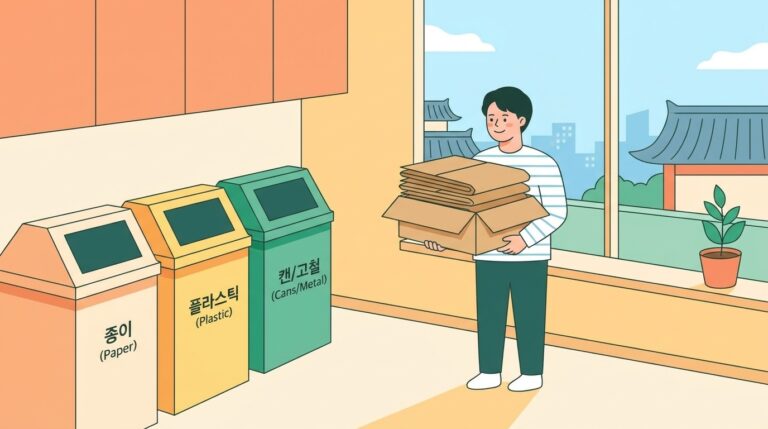
Surviving Korean Apartment Recycling Days Like a Local
안녕하세요! This is your Daily Hangul editor. Imagine this: You’ve settled into your stylish Seoul apartment. You just unpacked your boxes, cooked a nice meal, and gathered your trash. Feeling productive, you head downstairs with your bags at 10 PM on a Tuesday, only to be stopped by an anxious security guard (아저씨) waving his hands in a frantic ‘X’ shape. “오늘 분리수거 날 아니에요!” (Today is not recycling day!). Navigating Korean apartment life—especially strict waste sorting schedules—can feel intimidating. But don’t worry! Mastering this is your fast track to feeling like a true local, and your neighbors will love you for it.
Phase 2: Core Expressions Deep Dive
1. 오늘 분리수거 날이에요? (Onul bunrisugeo nal-i-e-yo?)
- Pronunciation: oh-neul boon-ree-soo-geo nal-ee-eyo? (Sounds like ‘boon-ree’ pronounced smoothly like ‘boon-ree’)
- Meaning: Direct: “Is today recycling day?” / Nuance: Asking politely to double-check trash disposal schedules.
- K-Culture Moment: In modern K-dramas, you often see characters running downstairs holding big plastic baskets filled with folded cardboard boxes on designated weeknights.
- Editor’s Insight: ‘분리’ (separation) + ‘수거’ (collection). Adding ‘날’ makes it the specific designated day.
- Situation Spectrum: Casual ⚠️ / Semi-formal ✅ / Formal ✅
- 🤔 Think About It: How does scheduled collective trash sorting reflect Korea’s high-density community living values?
2. 요일 맞춰서 버려야 돼요 (Yo-il mat-chweo-seo beo-ryeo-ya dwae-yo)
- Pronunciation: yo-eel mat-chwer-seo ber-ryeo-yah dway-yo
- Meaning: Direct: “You must throw it away according to the day of the week.”
- K-Culture Moment: Neighborly interactions in apartment corridors often revolve around reminding newcomer tenants about strict garbage day compliance.
- Editor’s Insight: ‘맞추다’ means to align or match. It emphasizes strict adherence to community regulations.
- Situation Spectrum: Casual ⚠️ / Semi-formal ✅ / Formal ✅
- 🤔 Think About It: Why do you think Korean urban spaces rely heavily on shared civic discipline?
3. 상자는 접어서 배출해 주세요 (Sang-ja-neun jeob-eo-seo bae-chul-hae ju-se-yo)
- Pronunciation: sang-jah-neun jeob-er-seo bae-chool-hae joo-say-yo
- Meaning: Direct: “Please fold the boxes before discharging them.”
- K-Culture Moment: Security guards making daily announcements over apartment loudspeakers regarding proper box disposal during high-delivery seasons.
- Editor’s Insight: ‘배출’ is the official civic term for discharging waste properly.
- Situation Spectrum: Casual 🚫 / Semi-formal ✅ / Formal ✅
- 🤔 Think About It: How does space-saving behavior benefit shared facilities in urban complexes?
Phase 3: Textbook Korean vs. Real Korean
Situation 1: Asking if plastic goes here
📖 Textbook Korean: 이것은 플라스틱 수거함입니까? (Is this the plastic collection box?)
🗣️ Real Korean: 이거 플라스틱에 넣으면 돼요? (Do I put this in plastic?)
💡 Why the difference? Real native Korean favors simple action verbs (넣다 – to put in) over passive nominal sentences in daily interactions.
Situation 2: Warning someone about the schedule
📖 Textbook Korean: 지정된 요일에만 쓰레기를 버리십시오. (Dispose of garbage only on designated days.)
🗣️ Real Korean: 분리수거 오늘 말고 목요일에 하셔야 돼요! (Recycling needs to be done on Thursday, not today!)
💡 Why the difference? Spoken Korean uses conversational softeners like ‘-하셔야 돼요’ rather than harsh imperative signage language.
Phase 4: K-Culture Deep Dive & Non-Verbal Etiquette
4-1. Nunchi & Gestures
When approaching the waste sorting area (분리수거장), notice the security guard’s body language. If they cross their arms into an ‘X’, stop immediately! When handing over folded cardboard or asking for help, bow slightly at 15 degrees and hold items with both hands as a sign of respect.
4-2. Culture Code Analysis
In Korean apartment culture, waste separation is taken very seriously due to limited land and high population density. Apartments enforce zero-tolerance policies on wrong-day disposal to maintain cleanliness and hygiene. Many residents rely on apartment management apps or physical notice boards near elevators to track their designated ‘Recycling Day’ (분리수거 요일).
Phase 5: Interactive Roleplay Scenario
Setting: Apartment recycling station at 8 PM.
Characters: You (Resident) and Mr. Park (Apartment Security Guard / 아저씨).
- You: 안녕하세요! 오늘 비닐 버리는 날 맞죠? (An-nyeong-ha-se-yo! Oh-neul bi-nil beo-ri-neun nal mat-jyo?)
🎭 Action: Smiling nervously while holding a bag of plastic wraps. - Mr. Park: 아유, 비닐은 화요일이에요! 오늘은 플라스틱이랑 종이만 돼요. (A-yu, bi-nil-eun hwa-yo-il-i-e-yo! Oh-neul-eun pleu-las-tig-i-rang jong-i-man dwae-yo.)
🎭 Action: Shaking head gently and pointing at the blue sign. - You: 아, 정말요? 제가 요일을 착각했네요. 죄송합니다! (A, jeong-mal-yo? Je-ga yo-il-eul chak-gak-haet-ne-yo. Jwe-song-ham-ni-da!)
🎭 Action: Slightly bowing shoulders in apology. - Mr. Park: 괜찮아요. 처음 오신 분들은 다 헷갈려 해요. (Gwaen-chan-a-yo. Cheo-eum o-sin bun-deul-eun da het-gal-ryeo hae-yo.)
🎭 Action: Smiling reassuringly. - You: 그럼 이건 다시 집에 가져가야겠네요? (Geu-reom i-geon da-si jib-e ga-jeo-ga-ya-get-ne-yo?)
🎭 Action: Lifting the plastic bag up. - Mr. Park: 네, 화요일 저녁에 가져오시면 됩니다. (Ne, hwa-yo-il jeo-nyeog-e ga-jeo-o-si-myeon doem-ni-da.)
🎭 Action: Tapping the Tuesday column on the chart. - You: 친절하게 알려주셔서 감사합니다, 아저씨! (Chin-jeol-ha-ge al-lyeo-ju-seo-seo gam-sa-ham-ni-da, a-jeos-si!)
🎭 Action: Bowing politely with a warm smile. - Mr. Park: 네, 조심히 들어 가세요! (Ne, jo-sim-hi deul-eo ga-se-yo!)
🎭 Action: Waving warmly.
🔀 Interactive Choice Point
What will you say if you aren’t sure where to place styrofoam?
– Option A: 아저씨, 스티로폼은 어디에 둬요? (Casual & Direct) -> BEST! Natural and clear.
– Option B: 이것을 어디에 버립니까? (Bookish & Stiff) -> BAD! Sounds like an exam question.
– Option C: 그냥 여기 두고 갈게요! (Rude & Careless) -> RISK! Might trigger a fine or complaints from neighbors.
Phase 6: 10-Second Emotion Shadowing Drill
- [🥺 Apologetic & Flustered] 아 / 제가 요일을 / 착각했어요! (A / je-ga yo-il-eul / chak-gak-haet-eo-yo!)
- [😊 Grateful & Friendly] 친절하게 / 알려주셔서 / 감사합니다! (Chin-jeol-ha-ge / al-lyeo-ju-seo-seo / gam-sa-ham-ni-da!)
- [🧐 Curious & Polite] 이거 / 플라스틱에 / 넣으면 돼요? (I-geo / pleu-las-tig-e / neo-heu-myeon dwae-yo?)
Phase 7: K-Culture Mini Dictionary
- 분리수거 (Bunrisugeo) | Waste Sorting | The practice of separating recyclable materials by category.
- 경비아저씨 (Gyeongbi-ajeossi) | Security Guard | Respectful term for the senior guards managing apartment facilities and waste areas.
- 종량제 봉투 (Jongryangje Bongtu) | Pay-per-trash Bag | Mandatory prepaid government-issued plastic bags for non-recyclable general waste.
- 대형 폐기물 (Daehyeong Paegimul) | Bulky Waste | Large household items requiring special paid sticker tags before disposal.
Phase 8: Traveler’s Survival Kit
- Survival Phrases:
- 분리수거 어디서 해요? (Where do I do recycling?)
- 종량제 봉투 어디서 사요? (Where can I buy general waste bags?)
- 이거 버려도 돼요? (Can I dispose of this?)
- Editor’s Travel Note: Make sure to check neighborhood schedules using local maps. Explore navigation via Naver Map App Download to locate nearby convenience stores selling correct municipal waste bags.
Phase 9: One Step Deeper
Recycling in Korea is not just an ecological chore; it represents a shared social etiquette. Living in high-density apartments requires mutual trust and cooperation. Following recycling days shows respect for your neighbors and the security team maintaining your community.
💬 Your Turn: What recycling rules surprised you the most when living or traveling in Korea? Share your stories in the comments below!
Phase 10: FAQ & Common Mistakes
Q: What happens if I throw out recycling on the wrong day?
A: Your waste won’t be collected, security guards may ask you to take it back, or your building management might issue a reminder notice.
Q: Can I use regular grocery plastic bags for general garbage?
A: No! You must purchase official ‘종량제 봉투’ (standard plastic trash bags) from local convenience stores or supermarkets in your specific district.
Q: Where do clean food containers go?
A: Food residue must be completely washed off before throwing containers into plastic recycling. Stained plastic goes to general waste.
🚨 Common Mistakes:
* Mistake 1: Leaving waste outside on non-designated days. (Correct Action: Keep trash inside until recycling day evening).
* Mistake 2: Throwing unwashed takeout boxes into recycling. (Correct Action: Rinse thoroughly with water first).
* Mistake 3: Mixing food waste with general waste. (Correct Action: Dispose of food waste separately in designated bins).
Phase 11: Action Missions
- Bronze Level: Practice saying “오늘 분리수거 날이에요?” 3 times out loud.
- Silver Level: Spot the waste sorting sign in your Korean apartment building or drama scene and identify 2 material words (e.g., 종이, 플라스틱).
- Gold Level: Successfully sort your waste on the correct day and thank your apartment security guard in Korean!
🎮 K-Culture Mission: Watch a Vlog or K-Drama apartment scene and spot where the recycling area is located!
Phase 12: Interactive Quiz Challenge
-
What bag should you use for general non-recyclable garbage in Korea?
Click to view Answer
You must use an official district-specific 종량제 봉투 (pay-per-trash bag) purchased from local supermarkets or convenience stores.
-
True or False: You can throw out cardboard boxes without folding them as long as it’s recycling day.
Click to view Answer
False! Boxes must be flattened and folded (상자는 접어서) to save community space.







