

Phase 1: 공감 (Storytelling Opening)
안녕하세요! 매일한글 에디터입니다. 👋
Imagine walking into a traditional Korean bathhouse (Jjimjilbang) for the very first time. You’ve changed into your spa wear, explored the lounge, and now you stand right before the entrance to the steaming hot bath area (탕). The water looks amazingly relaxing, but suddenly a wave of anxiety hits you: “How hot is this bath? What do I say if I want to sit next to someone? What if I accidentally break an unspoken rule?”
Don’t worry at all! Every foreign learner goes through this exact moment of hesitation. Soaking in the hot tub at a Korean spa is a beloved cultural ritual, and with just a few simple A2-level Korean phrases and essential etiquette tips, you will transform from a nervous beginner into a relaxed insider. Based on feedback from hundreds of our global students, this guide will give you the practical Korean words and confidence you need to dive right in!
Phase 2: 핵심 표현 3선 심층 분석
1. 물이 많이 뜨거워요? (Mul-i man-i tteu-geo-wo-yo?)
- Pronunciation: Mul-i man-i tteu-geo-wo-yo? (Sounds like “Mul-ee mahn-ee tteu-guh-woh-yoh” – ‘tteu’ sounds like the sharp ‘t’ in ‘stop’)
- Meaning: Direct: “Is the water very hot?” vs. Actual: “How hot is this bath? Is it comfortable to get into?”
- K-Culture Moment: In K-dramas, you often see characters dipping one foot in cautiously and asking fellow bathers if the water temperature is manageable.
- Editor’s Insight: Koreans love warm and hot baths! Even if someone smiles and says “It’s refreshing!” (시원해요!), the water might actually be quite hot, so asking this phrase first is super handy.
- Situation Spectrum: Casual ⚠️ / Semi-formal ✅ / Formal 🚫
- 🤔 Think About It: Why do you think Koreans use the word “시원하다” (refreshing/cool) when soaking in scalding hot water?
2. 여기 앉아도 돼요? (Yeo-gi an-ja-do dwae-yo?)
- Pronunciation: Yeo-gi an-ja-do dwae-yo? (Sounds like “Yuh-gee ahn-jah-doh dwae-yoh”)
- Meaning: Direct: “Can I sit here?” vs. Actual: “Is this spot taken / do you mind if I share this tub space with you?”
- K-Culture Moment: In a busy hot bath, asking this quick, polite question shows great manners before sliding into the water next to a local resident.
- Editor’s Insight: The pattern ‘-아/어도 돼요?’ is one of the most useful beginner grammar tools in Korean for asking permission politely in any daily situation.
- Situation Spectrum: Casual ⚠️ / Semi-formal ✅ / Formal 🚫
- 🤔 Think About It: In your hometown, do people speak to strangers in public baths, or do they keep complete silence?
3. 수건은 머리에 말아야 해요. (Su-geon-eun meor-i-e mar-a-ya hae-yo.)
- Pronunciation: Su-geon-eun meor-i-e mar-a-ya hae-yo. (Sounds like “Soo-guhn-eun muh-ree-eh mah-rah-yah hae-yoh”)
- Meaning: Direct: “You must wrap the towel on your head.” vs. Actual: “Keep your towel out of the water by rolling it on your head like sheep horns!”
- K-Culture Moment: The iconic “Yangmori” (lamb head towel cap) seen in almost every Korean drama set inside a Jjimjilbang!
- Editor’s Insight: Putting towels directly into bathwater is considered unhygienic in Korea. Rolling it onto your head keeps your hair up and towel clean!
- Situation Spectrum: Casual ⚠️ / Semi-formal ✅ / Formal 🚫
- 🤔 Think About It: How does keeping shared bath water clean reflect Korea’s collective harmony culture?
Phase 3: 교과서 한국어 vs 진짜 한국어
Situation 1: Asking if the water temperature is okay
- 📖 교과서 한국어: 이 탕의 온도가 몇 도입니까? (What is the temperature of this bath?)
- 🗣️ 진짜 한국어: 물 많이 뜨거워요? (Is the water super hot?)
- 💡 왜 다를까?: Nobody asks for exact numeric temperatures in a relaxing bath! A simple question about heat is much more natural and conversational.
Situation 2: Expressing satisfaction in the bath
- 📖 교과서 한국어: 목욕물이 아주 상쾌합니다. (The bath water is very refreshing.)
- 🗣️ 진짜 한국어: 와, 진짜 시원하다! (Wow, this feels so refreshing!)
- 💡 왜 다를까?: Koreans naturally express deep relief and muscle relaxation using “시원하다” (si-won-ha-da) even when soaking in hot water!
Phase 4: K-Culture 딥다이브 & 비언어적 매너
4-1. 눈치(Nunchi) & Gestures
Before stepping into any bath (탕), always wash your body thoroughly at the shower station first—entering unwashed is a major taboo! When approaching a shared hot tub, make subtle eye contact, give a gentle slight head nod (15-degree bow), and enter slowly without splashing water on others.
4-2. 문화 코드 분석
The Jjimjilbang experience combines relaxation with community bonding. After soaking in the hot tub, bathers wear comfortable spa wear in the main common lounge to sip icy Sikhye (sweet rice beverage) and eat roasted eggs together!
Phase 5: 실전 롤플레이 시나리오
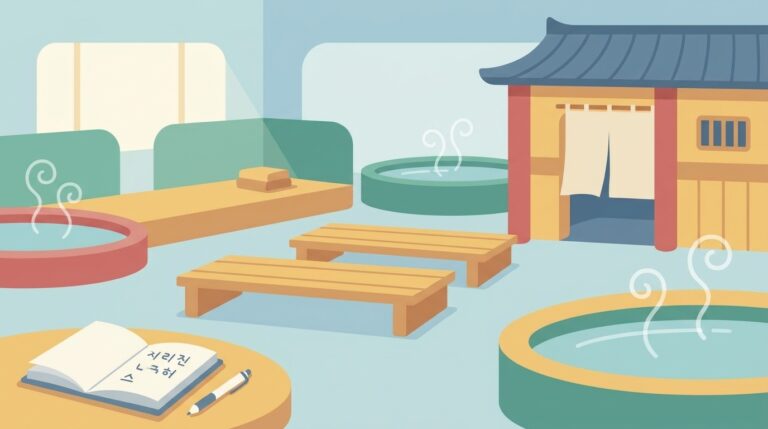
Setting: A serene hot bath inside a traditional Seoul Jjimjilbang. Steam fills the air around green marble tubs. You approach an friendly Ahjumma (middle-aged local regular) resting peacefully in the herbal hot bath.
Characters: You (A2 Korean Learner) & Bath Master Ahjumma (Friendly local regular)
- You: 안녕하세요! (An-nyeong-ha-se-yo!) 🎭 [Smiling politely, holding your towel]
- Ahjumma: 어서 와요! 들어와요~ (Eo-seo wa-yo! Deul-eo-wa-yo~) 🎭 [Waving warmly in the steaming bath]
- You: 여기 앉아도 돼요? (Yeo-gi an-ja-do dwae-yo?) 🎭 [Pointing gently to an open bench spot under water]
- Ahjumma: 그럼요, 앉으세요! (Geu-reom-yo, an-jeu-se-yo!) 🎭 [Patting the submerged bench surface]
- You: 감사합니다. 물이 많이 뜨거워요? (Gam-sa-ham-ni-da. Mul-i man-i tteu-geo-wo-yo?) 🎭 [Testing the water carefully with one foot]
- Ahjumma: 아니에요, 딱 좋아요. 어때요? (A-ni-e-yo, ttak jo-a-yo. Eot-tae-yo?) 🎭 [Smiling reassuringly]
- You: 와, 진짜 시원해요! (Wa, jin-jja si-won-hae-yo!) 🎭 [Sinking in and relaxing your shoulders]
- Ahjumma: 하하, 한국 사람 다 됐네! (Ha-ha, han-guk sa-ram da dwaen-ne!) 🎭 [Laughing happily]
🔀 인터랙티브 분기점
Question: What should you do before stepping into the tub?
* Option A: Jump straight into the tub to warm up immediately.
* Option B: Wash your body thoroughly at the shower stall first, then enter slowly.
* Option C: Dip your towel into the tub water to clean it.
Feedback:
* Option A (Bad): ❌ Jumping in without showering off breaks basic bath hygiene and startles other bathers!
* Option B (Best): ✅ Perfect! Washing off first shows great respect and follows local bath etiquette effortlessly.
* Option C (Risk): ⚠️ Never submerge your towel in the bathwater! Keep it on your head or bench edge.
Phase 6: 10초 감정 섀도잉 드릴
- [😊 Friendly & Polite] 안녕하세요! / 여기 / 앉아도 돼요? (An-nyeong-ha-se-yo! / Yeo-gi / an-ja-do dwae-yo?)
- [🤔 Curious & Cautious] 물이 / 많이 / 뜨거워요? (Mul-i / man-i / tteu-geo-wo-yo?)
- [😍 Relaxed & Delighted] 와, / 진짜 / 시원해요! (Wa, / jin-jja / si-won-hae-yo!)
Phase 7: K-Culture 미니 사전
- 온탕 (On-tang) | Warm Bath | The standard hot relaxation tub in a Korean spa.
- 냉탕 (Naeng-tang) | Cold Plunge Pool | The refreshing cold bath used after soaking in hot tubs.
- 세신사 (Se-sin-sa) | Exfoliation Specialist | Professional bathhouse scrubbers who provide famous deep body scrubs.
- 식혜 (Sikhye) | Sweet Rice Drink | Traditional chilled sweet rice beverage, the ultimate post-bath treat.
Phase 8: 여행자를 위한 생존 키트
Survival Expressions TOP 3:
- 수건 더 주세요. (Su-geon deo ju-se-yo.) – Please give me more towels. | Pro Tip: Ask at the front desk or counter.
- 열쇠 잃어버렸어요. (Yeol-soe il-eo-beor-eoy-eo-yo.) – I lost my key. | Pro Tip: Always wear your key wristband on your wrist or ankle.
- 식혜 하나 주세요. (Sikhye ha-na ju-se-yo.) – One Sikhye, please. | Pro Tip: Scan your electronic key band at the snack counter!
Editor’s Travel Note:
Before heading out, check exact location hours using Naver Map App Download and book late-night rides conveniently through Kakao T Taxi Services!
Phase 9: “한 발 더 깊이” (생각 질문)
Korean Jjimjilbang culture is built on shared relaxation and communal trust. Stripping away heavy street clothes and social status creates a unique environment where everyone sits equal under warm steam. Using polite phrases like “여기 앉아도 돼요?” bridges the distance between strangers and turns a simple bath into a warm cultural memory.
💬 Your Turn: Have you ever visited a public bathhouse in Korea or your hometown? What surprised you the most? Share your thoughts in the comments below!
Phase 10: FAQ & 오해 방지
Q: Do I need to be completely naked in the gender-segregated bath areas?
A: Yes! In the segregated bath areas (탕), swimsuits and clothing are not permitted to keep the bathwater clean. In the unisex central lounge and sauna areas, everyone wears provided t-shirts and shorts.
Q: Can I submerge my head or hair in the tub?
A: No, long hair should be tied up or wrapped in a towel to prevent hair from touching the bathwater.
Q: What if the bath water feels too hot for me?
A: You can say “조금 뜨거워요” (It’s a bit hot) and move to a milder warm bath (온탕) rather than a high-temperature tub (열탕).
🚨 흔한 실수 (Common Mistakes) TOP 3:
- Entering the bath without showering first -> Correct Action: Always take a quick shower at the wash station first.
- Putting your towel into bathwater -> Correct Action: Fold it onto your head (Yangmori cap style) or leave it on the tiled bench.
- Splashing water or swimming -> Correct Action: Move gently and enjoy quiet, peaceful relaxation.
Phase 11: 액션 미션 & 참여 유도
Action Mission 3단계:
- 🥉 Bronze: Practice saying “여기 앉아도 돼요?” 3 times out loud today!
- 🥈 Silver: Share a picture of your favorite spa refreshment on SNS with hashtag #DailyHangulSpa.
- 🥇 Gold: Visit a local Korean spa and order an icy Sikhye in Korean!
🎮 K-Culture Mission: Watch a scene from K-dramas like Reply 1988 or Legend of the Blue Sea set in a Jjimjilbang and spot the iconic sheep-head towel hats!
Phase 12: 인터랙티브 퀴즈 챌린지
Q1. What does “시원하다” mean when a Korean enters a steaming hot bath?
Click for Answer & Explanation
Answer: It means “refreshing” or “relieving”! While it literally translates to cool, Koreans use it to describe the relaxing sensation of heat opening up tired muscles.
Q2. Fill in the blank: “여기 ______ 돼요?” (Can I sit here?)
Click for Answer & Explanation
Answer: 앉아도 (an-ja-do). The full phrase is “여기 앉아도 돼요?”
Q3. True or False: Swimsuits should be worn inside the gender-segregated hot tubs.
Click for Answer & Explanation
Answer: False! Swimsuits are not allowed inside the bath tubs to maintain clean water hygiene.






