

Phase 1: Empathy & K-Culture Opening
안녕하세요! Hello! I’m your Daily Hangul editor and your 10-year local culture navigator!
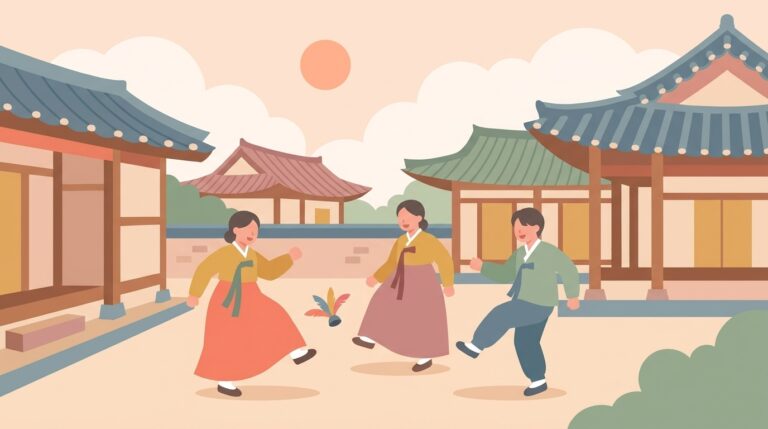
Have you ever watched Korean variety shows like Running Man or 2 Days 1 Night and seen the cast laughing, jumping, and trying desperately to kick a colorful, tassel-like object with their feet? That classic game is called 제기차기 (Jegichagi)!
Maybe you tried it yourself at a Hanok village in Seoul or during a cultural festival, only to watch the Jegi fly off in a crazy direction after just one kick. “Why is this so hard?” you might have thought while everyone laughed! Don’t worry at all—almost every beginner drops it immediately on their first try. Jegichagi looks effortless on screen, but it takes balance, rhythm, and a cheerful spirit.
In this lesson, you won’t just learn how to play this iconic traditional game; you’ll also unlock essential A2 Korean expressions used during games, understand the friendly social culture behind it, and learn how to cheer like a true native speaker. Let’s jump right in!
Phase 2: Key Expressions Analysis
1. 몇 개 찼어요? (Myeot gae chass-eo-yo?)
- Pronunciation: [Myeot gae chass-eo-yo?] (Sounds like Myeot-gae-chah-ssuh-yo?)
- Meaning: Literal: “How many did you kick?” | Nuance: “What was your score?”
- K-Culture Moment: Asked immediately after someone finishes their attempt in variety show challenges.
- Editor’s Insight: Use this anytime you play repetitive casual games with friends (like jumping rope or keep-ups).
- Situation Spectrum: Casual ✅ / Semi-formal ✅ / Formal ⚠️
- 🤔 Think About It: Why do casual Korean games focus so much on friendly score counting?
2. 한 번만 더 해요! (Han beon-man deo hae-yo!)
- Pronunciation: [Han beon-man deo hae-yo!] (Sounds like Han-buhn-mahn-duh-hae-yo!)
- Meaning: Literal: “Let’s do it just one more time!” | Nuance: “Give me one more chance!”
- K-Culture Moment: Screamed in dramatic, cute desperation when someone fails on their very first kick.
- Editor’s Insight: Adding ~만 (man) adds the cute charm of “just this once, please!”
- Situation Spectrum: Casual ✅ / Semi-formal ✅ / Formal 🚫
- 🤔 Think About It: How does playful pleading strengthen social bonding in Korean game culture?
3. 아깝다! (A-kkap-da!)
- Pronunciation: [Ah-kkap-da!] (Sounds like Ah-kkahp-dah!)
- Meaning: Literal: “What a waste!” | Nuance: “So close!” or “Almost!”
- K-Culture Moment: Shouted in unison by teammates when the Jegi hits the ground right before breaking a record.
- Editor’s Insight: Expresses instant empathy when someone barely misses a goal.
- Situation Spectrum: Casual ✅ / Semi-formal ⚠️ / Formal 🚫
- 🤔 Think About It: Why is shared disappointment considered a key part of teamwork in Korea?
Phase 3: Textbook Korean vs. Real Korean
Situation 1: Asking for another attempt
* 📖 Textbook Korean: 다시 시도하겠습니다. (Dasi sido-hagesseumnida. – I will attempt again.)
* 🗣️ Real Korean: 한 번만 더 할게요! (Han beon-man deo hal-ge-yo! – I’ll do it one more time!)
* 💡 Why the difference?: Textbook Korean uses heavy formal structures. In fun games, real Koreans use warm intention endings like ~ㄹ게요.
Situation 2: Asking someone’s score
* 📖 Textbook Korean: 몇 개를 차셨습니까? (Myeot gae-reul cha-syeoss-seumnida? – How many did you kick?)
* 🗣️ Real Korean: 몇 개 찼어요? (Myeot gae chass-eo-yo? – How many did you get?)
* 💡 Why the difference?: Object markers like -를 are naturally dropped in casual spoken conversation for quick flow.
Phase 4: K-Culture Deep Dive & Mannerisms
4-1. Nunchi & Body Language
When playing Jegichagi, bend your knees slightly and extend your arms for balance. Kicking with the inside of your foot (known as the 안차기 stance) shows locals you know the authentic method! If you fail quickly, laugh it off with a light bow—good sportsmanship and laughter are key to 눈치 (Nunchi) in social games.
4-2. Culture Code Analysis
Historically played during Lunar New Year (설날), Jegichagi symbolizes health and agility for the coming year. Today, it remains a beloved icebreaker in schools, TV variety shows, and workshops because it requires zero expensive equipment—just a Jegi, energy, and friends!
Phase 5: Interactive Roleplay Scenario
Setting: You are visiting Namsangol Hanok Village with your Korean friend, Minjun. You spot a traditional game experience corner.
Dialogue:
1. Minjun: 어! 여기에 제기차기 있다! 해볼래? (Eo! Yeo-gi-e je-gi-cha-gi it-da! Hae-bol-lae? – Oh! There’s Jegichagi here! Want to try?)
2. You: 좋아요! 그런데 어떻게 해요? (Jo-ha-yo! Geu-ron-de eo-tteoh-ge hae-yo? – Great! But how do you do it?)
3. Minjun: 발 안쪽으로 제기를 차면 돼요. 내가 먼저 해볼게! (Bal an-jjok-eu-ro je-gi-reul cha-myeon dwae-yo. Nae-ga meon-jeo hae-bol-ge! – You kick it with the inside of your foot. I’ll try first!)
4. Minjun: (Kicks 3 times, drops it) 아! 세 개밖에 못 찼어! (Ah! Se gae-bak-e mot chass-eo! – Ah! I only got three!)
5. You: 🎭 (Smiling sympathetically) 아깝다! 이제 제 차례예요? (A-kkap-da! I-je je cha-rye-yeo-yo? – So close! Is it my turn now?)
6. Minjun: 응! 할 수 있어! 파이팅! (Eung! Hal su is-seo! Pa-i-ting! – Yeah! You can do it! Fighting!)
7. You: (Kicks once, drops it immediately) 어머, 한 개 찼어요! (Eo-meo, han gae chass-eo-yo! – Oh dear, I got one!)
8. Minjun: 괜찮아! 첫 번째는 원래 어려워! (Gwaen-chanha! Cheot beon-jjae-neun won-rae eo-ryeo-wo! – It’s okay! The first try is always hard!)
🔀 Interactive Choice Point:
How do you respond to Minjun now?
* Option A: 한 번만 더 해요! (Han beon-man deo hae-yo! – Let me try just one more time!)
* Option B: 저는 그만할래요. (Jeo-neun geu-man-hal-lae-yo. – I want to stop.)
* Option C: 이거 너무 재미없어요. (I-geo neo-mu jae-mi-eobs-eo-yo. – This is super boring.)
Feedback:
* Option A [BEST]: Perfect! Showing playful enthusiasm keeps the game energizing and fun.
* Option B [RISK]: Polite, but it cuts the fun social bonding short.
* Option C [BAD]: Yikes! Too blunt and ruins the cheerful mood.
Phase 6: Emotion Shadowing Drill
[😊 Excited & Cheerful]제기차기 / 같이 / 해요! (Je-gi-cha-gi / gat-i / hae-yo!)[🥺 Playful & Pleading]한 번만 / 더 / 할게요! (Han beon-man / deo / hal-ge-yo!)[😮 Empathetic Regret]아! / 진짜 / 아깝다! (Ah! / jin-jja / a-kkap-da!)
Phase 7: K-Culture Mini Dictionary
- 제기 (Jegi) | A Korean shuttlecock-like object made of paper/vinyl wrapped around coins.
- 안차기 (An-cha-gi) | The inside-foot kicking technique, the most common beginner style.
- 내기 (Nae-gi) | A friendly wager/bet (often for buying coffee or snacks after the game).
- 순서 (Sun-seo) | Turn or playing order (e.g., 순서 정해요 – Let’s decide the order).
Phase 8: Traveler’s Survival Kit
Top 3 Survival Expressions
- 이거 어떻게해요? (I-geo eo-tteoh-ge hae-yo? – How do I do this?)
- 제 차례예요? (Je cha-rye-yeo-yo? – Is it my turn?)
- 한 번 더! (Han beon deo! – One more time!)
Editor’s Travel Note
Looking for places to experience traditional Korean games in Seoul? Head over to Namsangol Hanok Village or Bukchon Hanok Village. Check the Naver Map App Download Guide to easily navigate public transport routes to traditional culture zones across Seoul!
Phase 9: A Deeper Reflection
In Korean culture, traditional games like Jegichagi are less about winning and more about shared laughter. The game naturally creates moments of lighthearted failure, giving players permission to laugh at themselves and cheer for others. This spirit of togetherness (정 – Jeong) turns simple street games into lifelong memories.
💬 Your Turn: What traditional game in your country brings people together with instant laughter? Share your stories in the comments below!
Phase 10: FAQ & Common Mistakes
Q: Is Jegichagi only played by kids?
A: Not at all! K-pop idols, variety stars, and adults love playing it at company retreats and holiday festivals.
Q: What is a decent score for beginners?
A: Getting 3 to 5 consecutive kicks on your first day is considered a huge success!
Q: Can I kick using both feet?
A: Yes! Advanced players alternate feet in a style called 양발차기 (Yangbal-chagi).
🚨 Common Mistakes Alert
- Error: Saying “다시 해요!” too sternly. -> Correct Action: Add “한 번만” with a light smile to sound friendly.
- Error: Kicking with toes. -> Correct Action: Turn your ankle inward (안차기) for better control.
- Error: Using stiff formal speech in casual games. -> Correct Action: Stick to polite ~요 forms.
Phase 11: Action Missions
- 🥉 Bronze Mission: Practice saying “한 번만 더 해요!” out loud 3 times.
- 🥈 Silver Mission: Record yourself attempting a kick and saying “아깝다!” on video.
- 🥇 Gold Mission: Challenge a Korean friend to a friendly 3-kick Jegichagi match!
- 🎮 K-Culture Mission: Spot a Jegichagi scene in your favorite K-variety show (Running Man, Going Seventeen, etc.)!
Phase 12: Interactive Quiz Challenge
-
Situation Quiz: Your friend barely missed their 5th kick. What do you shout?
Click to view Answer
아깝다! (A-kkap-da! – So close!)
-
Fill-in-the-blank: “한 번__ 더 해요!” (Fill in the missing particle for “just”).
Click to view Answer
만 (~man)
-
True / False: Jegichagi is only allowed in professional sports stadiums.
Click to view Answer
False! It is played casually in parks, Hanok villages, and schoolyards everywhere.







