

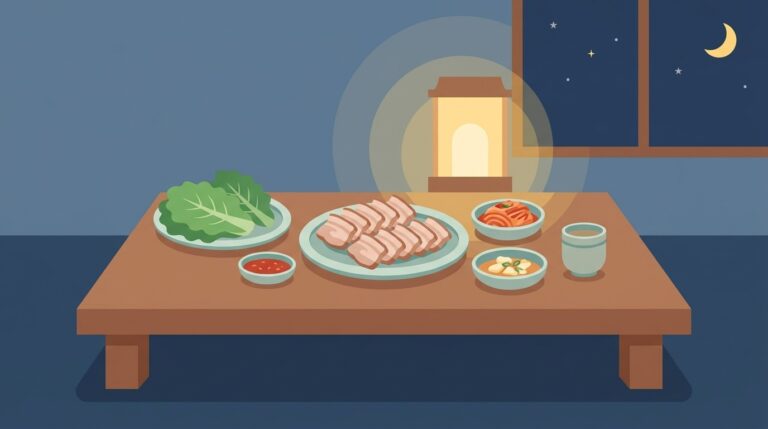
안녕하세요! 매일한글 에디터입니다. Have you ever stayed up late in Korea, watching your favorite K-Drama, only to hear your stomach rumble at 11 PM? In Korea, late-night eating isn’t just a bad habit—it’s a beloved cultural tradition called 야식 (Yasik)! And among all late-night snacks, 보쌈 (Bossam – tender boiled pork wraps) reigns supreme. Imagine steam rising from freshly sliced savory pork, wrapped in crisp cabbage with spicy radish salad. But when you step into a crowded local restaurant or try to order over the phone, anxiety hits: What size do I order? How do I politely ask for more dipping sauce? Don’t worry! Based on real feedback from hundreds of beginner learners, this friendly step-by-step guide will make you feel confident enough to order Bossam like a true local tonight.
Phase 2: Deep Dive into 3 Core Expressions
1. 보쌈 소 자 하나 주세요
- Pronunciation: [Bo-ssam so-ja ha-na ju-se-yo] (Sounds like: “Bo-sam” + “saw-jah” + “ha-na” + “ju-say-yo”)
- Meaning: “One small order of Bossam, please.” (Literal: Bossam small size one give please)
- K-Culture Moment: Seen in nighttime street scenes in Korean dramas where friends gather after work for late-night food.
- Editor’s Insight: Sizes in Korean restaurants usually follow 소 (So – Small), 중 (Jung – Medium), and 대 (Dae – Large). For 1-2 people, “소 자” is perfect!
- Situation Spectrum: Casual ✅ | Semi-formal ✅ | Formal ⚠️
- 🤔 Think About It: How does your country categorize food portion sizes compared to Small/Medium/Large in Korea?
2. 쌈장 좀 더 주세요
- Pronunciation: [Ssam-jang jom deo ju-se-yo] (Sounds like: “Ssam-jahng” + “chom” + “duh” + “ju-say-yo”)
- Meaning: “Please give me a little more Ssamjang sauce.” (Literal: Ssamjang sauce a little more give please)
- K-Culture Moment: Asking the friendly restaurant owner (Imo) for extra side dishes during a meal.
- Editor’s Insight: Using 좀 (jom – a little) softens your request, making you sound polite and natural rather than demanding!
- Situation Spectrum: Casual ✅ | Semi-formal ✅ | Formal ✅
- 🤔 Think About It: Why do you think Korean culture values free refills on side dishes (Banchan)?
3. 야식으로 딱이에요
- Pronunciation: [Ya-sig-eu-ro ttag-i-e-yo] (Sounds like: “Yah-seeg-eu-ro” + “ttahg-ee-eh-yo”)
- Meaning: “It’s perfect for a late-night snack!”
- K-Culture Moment: Exclaimed when late-night food arrives during a party or late night study session.
- Editor’s Insight: The word 딱 (ttag) means “perfectly” or “exactly right.” It adds vivid enthusiasm to your feeling.
- Situation Spectrum: Casual ✅ | Semi-formal ✅ | Formal ⚠️
- 🤔 Think About It: What food in your home culture holds the title of the ultimate late-night comfort meal?
Phase 3: Textbook Korean vs. Real Korean
Situation 1: Ordering a small portion of Bossam
* 📖 Textbook: 보쌈 소 자를 주문하고 싶습니다. (Bo-ssam so-ja-reul ju-mun-ha-go sip-seub-ni-da.)
* 🗣️ Real Korean: 보쌈 소 자 하나요! (Bo-ssam so-ja ha-na-yo!)
* 💡 Why is it different? Real-life Korean cuts out unnecessary verbs in casual dining. Simply stating the item + size + hano-yo is polite and clear.
Situation 2: Asking for more lettuce wraps
* 📖 Textbook: 상추를 더 제공해 주시겠습니까? (Sang-chu-reul deo jeo-gong-hae ju-si-get-seub-ni-da-kka?)
* 🗣️ Real Korean: 상추 조금만 더 주실 수 있나요? (Sang-chu jo-geum-man deo ju-sil su in-na-yo?)
* 💡 Why is it different? Textbook phrasing sounds like an official document! Using jo-geum-man (just a little) makes your request cozy and humble.
Phase 4: K-Culture Deep Dive & Non-verbal Manners
4-1. Nunchi & Gestures
When eating Bossam at a restaurant, hand gestures matter! Use two hands when receiving extra side dishes from the restaurant staff to show respect. When building your Bossam wrap (Ssam), place a leaf of lettuce or napa cabbage on your hand, add pork, Ssamjang, and radish, then fold it into a single bite-sized package. Trying to eat it in two bites might spill the juices!
4-2. Culture Code: Ya-sik & Jeong
Late-night food in Korea represents 정 (Jeong – deep connection and warmth). Sharing Bossam late at night brings people together after a hard day. Delivery culture in Korea operates 24/7, making late-night eats an essential part of contemporary urban living.
Phase 5: Real-Life Roleplay Scenario
Setting: A cozy late-night Bossam restaurant in Seoul. You are speaking with the warm restaurant owner (이모 – Imo).
- Imo: 어서 오세요! 몇 분이세요? (Welcome! How many people?)
- You: 안녕하세요! 한 명이에요. (Hello! Just one person.)
- Imo: 편한 데 앉으세요. 뭐 드시겠어요? (Sit anywhere comfortable. What would you like to eat?)
- You: 🎭 (pointing politely at the menu) 보쌈 소 자 하나 주세요! (One small Bossam, please!)
- Imo: 네! 음료수도 필요하세요? (Sure! Would you like a drink too?)
- You: 🎭 (nodding warmly) 아니요, 괜찮아요. 물 주시면 돼요. (No, I’m okay. Just water is fine.)
- Imo: 🎭 (bringing food) 맛있게 드세요! (Enjoy your meal!)
- You: 🎭 (with happy anticipation) 감사해요! 야식으로 딱이에요. (Thank you! It’s perfect for a late-night snack.)
🔀 Interactive Branching Point
How will you ask for extra garlic and sauce during the meal?
* Option A: “이모! 마늘이랑 쌈장 좀 더 주세요!” (Auntie! A little more garlic and ssamjang please!)
* Option B: “여기요, 마늘 주십시오.” (Hey here, give me garlic.)
* Option C: (Stay quiet and eat without extra sauce.)
Feedback:
* Option A (Best): Friendly, natural, and polite! Using “이모” (Imo) builds instant rapport.
* Option B (Risk): Too direct and blunt. Sounds demands and mechanical.
* Option C (Bad): You miss out on tasty toppings and a great practice opportunity!
Phase 6: 10-Second Emotional Shadowing Drill
[😊 Excitement]보쌈 / 소 자 / 하나 주세요! (Bo-ssam / so-ja / ha-na ju-se-yo!)[🥺 Polite Request]쌈장 / 조금만 / 더 주실 수 있나요? (Ssam-jang / jo-geum-man / deo ju-sil su in-na-yo?)[😋 High Energy]와, / 야식으로 / 딱이에요! (Wa, / ya-sig-eu-ro / ttag-i-e-yo!)
Phase 7: K-Culture Mini Dictionary
- 야식 (Yasik): Late-night snack/meal eaten after dinner hours.
- 보쌈 (Bossam): Boiled pork sliced thin and wrapped with leafy vegetables.
- 쌈장 (Ssamjang): A savory dipping sauce made of soybean paste, chili paste, and sesame oil.
- 무말랭이 (Mumallaengi): Seasoned dried radish dish with a chewy texture, essential with Bossam.
Phase 8: Traveler’s Survival Kit
TOP 3 Survival Phrases
- 여기 주문할게요! (Yeo-gi ju-mun-hal-ge-yo!) – “I’d like to order here!”
- 물은 셀프인가요? (Mu-reun sel-peu-in-ga-yo?) – “Is water self-service?”
- 계산해 주세요. (Gye-san-hae ju-se-yo.) – “Please calculate the bill / Check, please.”
Editor’s Travel Note
When navigating Korean food spots late at night, download the Naver Map App Download for real-time operating hours. Most delivery places accept local cards or cash upon arrival!
Phase 9: One Step Deeper
Food culture in Korea is deeply tied to community. Eating Bossam isn’t just about filling your belly late at night; it’s about unwind, sharing stories, and connecting over comfort food. Notice how Korean restaurant titles often feel familial (like calling staff Imo or Emoni). Language reflects this warmth.
💬 Your Turn: What is your ultimate favorite late-night comfort food? Let us know in the comments below!
Phase 10: FAQ & Common Mistakes
Q: Can I order Bossam as a solo diner?
A: Yes! Look for restaurants that offer 1인 보쌈 (1-Person Bossam) options on their menu.
Q: Is Bossam spicy?
A: The boiled pork itself is not spicy at all! Only the kimchi radish side dishes or dipping sauces can be spicy.
Q: Do I need to pay extra for extra cabbage or side dishes?
A: At most traditional restaurants, side dish refills (Banchan) are complimentary!
🚨 Common Mistakes TOP 3
- Mistake: Calling male/young servers “이모” (Imo – Auntie).
- Correct Action: Use “저기요” (Jeo-gi-yo – Excuse me) instead.
- Mistake: Trying to cut pork slices with chopsticks.
- Correct Action: Pork slices are served pre-cut! Simply pick them up.
- Mistake: Saying “고맙다” (Gomaap-da) to staff.
- Correct Action: Use formal politeness: “감사합니다” (Gam-sa-ham-ni-da).
Phase 11: Action Mission & Engagement
- 🥉 Bronze Mission: Practice saying “보쌈 소 자 하나 주세요” out loud 3 times.
- 🥈 Silver Mission: Post a photo of your favorite late-night snack on Instagram and tag @DailyHangul!
- 🥇 Gold Mission: Order Bossam in Korean at a local Korean restaurant or through a Korean app.
🎮 K-Culture Mission: Watch a Korean mukbang video on YouTube and spot 2 times the creator says “야식” (Yasik) or “맛있어요” (Masisseoyo)!
Phase 12: Interactive Quiz Challenge
1. Fill in the blank: “보쌈 _____ 자 하나 주세요” (I want a SMALL Bossam).
* A) 대 (Dae)
* B) 소 (So)
* C) 중 (Jung)
2. True or False: In Korea, side dish refills at traditional Bossam places usually cost extra money.
Click to reveal answers!
Answers:
1. B) 소 (So) – ‘소’ means small size!
2. False – Side dishes (Banchan) refills are generally free in Korea!







